Uncategorized

Beauty and Justice

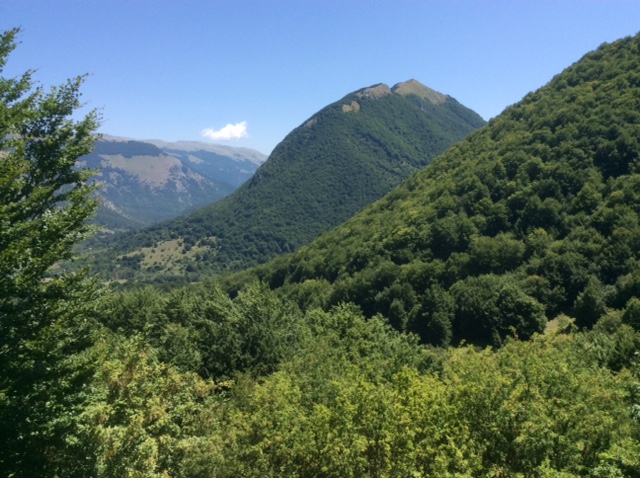
IMG_7053
Mountains in Abruzzo National Park

 “Man is hungry for beauty. There is a void.”—Oscar Wilde

In the streets of my Delhi neighborhood, workers are building new apartments. Women carry sand on their heads. Bricks are stacked on the walkway. Yesterday the populous celebrated Republic Day, and I was reading Pamela Timms’ book, Korma Kheer & Kismet, the chapter titled “Independence Day in Sadar Bazar” where she describes the civic protests of 2011 where social activist, Kisan Baburao “Anna” Hazare, began a hunger strike in protest of government corruption. Concerned with the amount of interest Hazare stirred up in the populace, prime minister of the time, Manmohan Singh responded, ‘”Corruption manifests itself in many forms. Funds meant for schemes for the welfare of the common man end up in the pocket of government officials. In some other instances, government discretion is used to favor a selected few. There are also cases where government contracts are wrongfully awarded to the wrong people. We cannot let such activities continue unchecked.”’ Hazare’s hunger strike began the day after the prime minister made the statement, reports Timms, and goes on to describe some of the corruptions in the system—food vendors paying as much as a quarter of their salaries to the police to be able to stay open, and rickshaw drivers paying as much as 20% of their salaries to police to prevent their tires from being slashed, families having to pay bribe money to secure a place for their child at school. (p. 55) (You can read an overview of large-scale corruption in India here if you wish.)

It’s no surprise that corruption is present not only in India. It is a worldwide problem in both businesses, see a list here of top business corruption cases, and governments. Take a look at the thematic map from Transparency International here, to see a visual representation of corruption levels in countries across the world. Justice doesn’t prevail. In many cases, it’s simply the way the world functions where people live, and the everyday person, if he or she wants to function in society, doesn’t have a lot of choice about it.

With corruption and misuse of power so widespread, an enormous percentage of people in the world are pawns to those who hold the power. How do people manage? How do people—any of us and all of us—caught in such systems go on living with good conscience? I remember listening to Garth Lenz describing on his TED Talk about the effects of mining for oil in Canada’s tar sands had on the native people of the area. Parents in that area are caught in the dilemma of needing to feed their children, yet the toxins in the river are causing cancers at the rate of 10 times what it is in other parts of Canada. Because it’s very costly to fly in all the food a person needs in order eat, the aboriginal people are forced to eat the food “..as a parent, I just can’t imagine what that does to your soul. And that’s what we’re doing,” says Lenz. (transcript available here.) Certainly there were people during the time of Spain’s inquisition, in Nazi Germany and in Pol Pot’s Cambodia who didn’t agree with the government’s position but felt compelled to go along with the crowd mentality for fear of their own lives and those of their children’s. Certainly, there are people today in our own institutions who disagree with the use of power and yet are afraid of speaking out for fear of losing their jobs and the livelihood for their families. Not everyone can just move on or move out to a new situation, new job, new country, new life, and even if that were possible, where might one live or work where corruption was not part of the way of life? We have to learn to live in a fallen world.

I’m reminded of Maria Mazziotti Gillan’s poem, “I Open a Box,” in her book, Ancestor’s Song, where she describes her Italian immigrant mother’s doctor coming to her New Jersey tenement to assist her in the delivery of her baby. He arrives late, and Gillan’s mother has already given birth, cut the umbilical cord, and washed her child. When the doctor finally arrives, he doesn’t even enter the room. Instead, he distances himself from the situation.

“He washed his hands, wiped
them on one of the rough linen towels
I brought from Italy, stood in the doorway.
“You’ll be okay,” he said, and left.
“Oh, well,” my mother said, “I think
he was afraid of catching it.”
“Catching what?” I asked.
“Poverty,” she said.

IMG_7119
New Delhi neighborhood street.

Poverty is often perceived by wealthier countries as something out there over there, not mine not related to one’s own life. Like the doctor at the door, people want to distance themselves from the poor, not realizing their lives are connected. We may want to stand at the door like the doctor of this poem observing a world we don’t want to be a part of. We may think we can wash our hands, bid others well and walk away, and disconnect ourselves from what we don’t want and live in a different neighborhood. But our lives are intertwined. One example: A few years back, students in my speech class debated whether the lithium beneath Bolivia’s salt flats should be mined. The area is of tremendous beauty yet the area holds more than half the world’s lithium. Lithium is a lightweight metal used in powering our high tech products—iPhones, iPods, and other handheld devices. Now, as the world searches for alternative energy and looks towards ways to store electricity in batteries in order to meet more of our needs, including the use of batteries for electric vehicles, the need for lithium grows in greater and greater demand.

Dan McDougal, in his article on Mail Online “In search of Lithium: The battle for the third element” quotes a lithium-ion battery producer, Mary Ann Wright of Johnson Controls-Saft, ‘Since a vehicle battery requires 100 times as much lithium carbonate as its laptop equivalent, the green-car revolution could make lithium one of the planet’s most strategic commodities.’“ There’s not enough lithium to power the world’s 900 million vehicles, however, McDougal observes. Bolivia has significantly large amounts of the needed lithium to produce the batteries for the growing electric car industry, an industry that most people perceive as a green technology. Mc Dougal reports that according to “William Tahil, research director with technology consultancy Meridian International Research, ‘to make just 60 million plug-in hybrid vehicles a year containing a small lithium-ion battery would require 420,000 tons of lithium carbonate – or six times the current global production annually.” To continue, McDougal goes on to report that “The US Geological Survey claims at least 5.4 million tons of lithium could be extracted in Salar De Uyuni, while another report puts it as high as nine million tons.”’ Bolivia is a very poor country. Child workers are exploited, but children work to help their families. While mining the mineral would bring needed jobs and money into the country, a problem is that mining the mineral requires an abundance of water, and water is a rare commodity in Bolivia’s high desert. Bolivia has experienced exploitation by outsiders before in the tin and silver mining industries. An overuse of water could significantly affect the country and its people in numerous ways—making it difficult to have enough water for daily use, as well as for farming. Additionally, mining pollutes water with toxins as well. McDougal asks his readers “Is the world’s need for a green solution to transport worth the destruction of this unique environment and way of life that it lives on?”

Transportation is necessary. Our society is structured in such a way that few of us can walk to work. We need some way of getting to work. We want to do that in the least harmful way to the environment and others. As a result, in the desire to move away from our dependence on oil, many people are looking toward buying an electric car. These same people may be unaware that in doing so they are connected to moral dilemmas of another sort. We are all part of the greater web of being.

IMG_6990
Walls and grass in Vicalvi, Italy sunset.

Parker Palmer, in his book, The Courage to Teach, which I’m currently reading, talks about the biologist Barbara McClintock, who was given the Nobel Prize in 1983 for her work that changed our understanding of genetics. Prior to her work, people thought of genes as separate things, not in connection to the environment they were a part of. Palmer explains that McClintock’s interviewer who wrote her biography, Fox Keller, “wanted to know, ‘What enabled McClintock to see further and deeper into the mysteries of genetics than her colleagues?’ McClintock’s answer, Keller tells us, is simple: “Over and over again she tells us one must have the time to look, the patience to ‘hear what the material has to say to you,’ the openness to ‘let it come to you.’ Above all, one must have ‘a feeling for the organism.’” We co-create our world. We can’t stand at the door. The burden of the cost of anything is born by all eventually. As Palmer goes on to say, “Modern knowledge has allowed us to manipulate the world but not to control its fate (to say nothing of our own), a fact that becomes more clear each day as the ecosystem dies and our human systems fail.” (p. 57) Perhaps, then one important way of living inside of corrupt systems and move ourselves and society toward greater wholeness is to do what we can with those around us to build and restore relationships constructively. Some things or many things may not be in our power. But some things will. We can learn to listen closely to the interrelationships of people and things so we gain a greater connection to life. With this understanding, we can better comprehend what actions will create harmony both with others and with nature.
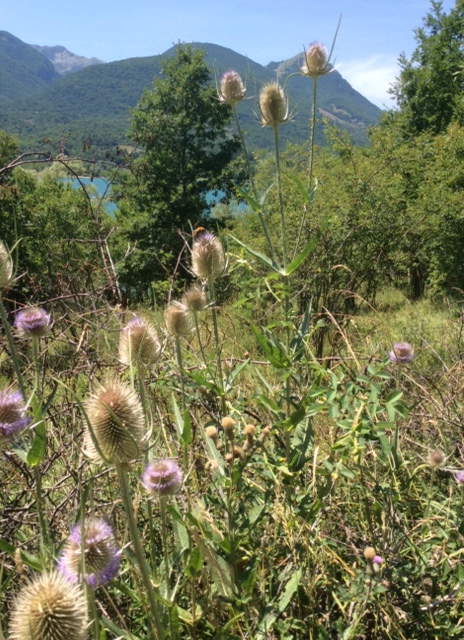
IMG_7054
Abruzzo National Park, Italy.

Dostoyevsky said, “Beauty can save the world.” While it may not appear to be a solution to growing environmental and social concerns, the idea deserves a closer look. What connection does beauty have in showing us a way through our dilemmas of how to live in unjust social systems? The New York Times “Books” section, published in 1987 includes an excerpt from Richard Ellman’s essay “Oscar Wilde.” Ellman relates the story of Oscar Wilde coming to New York City in 1882. “Beauty is nearer to most of us than we are aware,” Wilde explained talking to reporters. One of the reporters wanted to know if a nearby grain elevator was beautiful. Earlier in the conversation, Wilde had said, ‘I am here to diffuse beauty, and I have no objection to saying that.” As reporters continued probing, Wilde explained further his ideas about beauty. ”’It’s a wide field which has no limit, and all definitions are unsatisfactory. Some people might search and not find anything. But the search, if carried on according to right laws, would constitute estheticism. They would find happiness in striving, even in despair of ever finding what they sought. The renaissance of beauty is not to be hoped for without strife internal and external.” ”Where then is this movement to end?” ”There is no end to it; it will go on forever, just as it had no beginning. I have used the word renaissance to show that it is no new thing with me. It has always existed. As time goes on the men and the forms of expression may change, but the principle will remain. Man is hungry for beauty. . . . There is a void; nature will fill it. The ridicule which esthetes have been subjected to is the only way of blind unhappy souls who cannot find the way to beauty.”’ Creating a world of beauty is creating the ideal world. Creating a heaven, so to speak. To do so will take great effort. But people are hungry for it, as Wilde says. We are hungry for beauty, and that hunger connects to the desire for a world without corruption. Without corruption, beauty has a better chance of thriving.

Elaine Scarry, author of On Beauty and Being Just, speaks on her Harvard Thinks Big, “Beauty as a Call to Justice” about how experiences of beauty help to move humans toward justice. When we experience the beautiful, we are pulled out of our everyday way of interacting with our surroundings. We stand still. We are transfixed, she explains. In those moments, beauty pours into us an awareness of the “surfeit of aliveness.” It takes us out of ourselves, and connects us with a larger reality. Scarry makes the case that this experience of beauty helps lead us to love what we see and to want to care for it and have a relationship with it.

IMG_7048
Wildflowers, Vicalvi, Italy.

I don’t know if its true as Keats said in his “Ode to a Grecian Urn” that “Beauty is truth, truth beauty,–that is all/Ye know on earth, and all ye need to know,” but I do believe we need to have a much deeper knowing of beauty than we currently hold. There is a relationship between our loss of beauty in many of our urban environments, a loss resulting from our pragmatic values that relegates beauty to the bottom realms, and efficiency to the higher realms of priority. When I speak of beauty, I’m not talking about beauty in the decorative or commercial sense. I’m speaking of the beauty such as nature gives us in a star strewn sky or a valley sweeping down in green fields from stoney mountain peaks. I’m speaking of the beauty Scarry described above—that stops us short, that overwhelms, and then lifts us out of ourselves. Is our culture’s pragmatic love of efficiency causing us to structure society in such a way that it’s actually challenging to make deep connections with others? We have connection to people on Facebook, but does the minimalistic communication that exists there nurture deep conversation and relationship? I doubt it. Could it also be true that our lack of seeing ourselves as connected to the beauty of the Bolivian salt flats and the lives of Bolivian miners as we pursue our technological development (and other similar realities) is part of the reason corruption continues to thrive? Do people act in ugly ways because they live in a world where connection to the natural world is broken? In glimpses of beauty, we can see the world we want to belong to, a world of balance and wholeness, and are drawn to it. If we gave beauty a place of respect and honor in our cultures, possibly we would treat the world with more respect. If we developed more of a relationship with those around us and with the natural world, wouldn’t we understand our connection to the world and realize more fully the effects of our choices? Is our collective loss of beauty causing us to lose our souls?

IMG_6955
At the castle ruins, Vicalvi, Italy.

I never used to understand the Jesus prayer—the ancient prayer that says, “Have mercy on me.” I felt it seemed too focused on the negative and I already struggle to move beyond my failures. But as I see myself more and more intertwined with the existence of all that is, I see the value of this prayer. What the world is or isn’t, isn’t all up to me, but I’m also a part of all that is. How do we live in a corrupt world and yet continue to grow toward wholeness? The problems are all much bigger than me but mercy is extended. “For the Beauty of the Earth” is an old song that carries with it the idea of giving praise for the world around us and to the skies. Perhaps the ongoing practice of noticing and valuing beauty in the world, as the words of this song illustrate, acts to create a greater awareness of our interconnectivity. It’s worth trying.

One of the especially valuable aspects of creative work—of art and literature, of writing—is the way it nurtures the inner life. The artist must look very carefully at whatever she or he is drawing in order to see it and how it functions in relationship to itself and to the world it inhabits. In writing, an author must delve inside the subject with imagination in order to understand the subject and the interrelationship of the subject to oneself and the world. To write or to do art is to cultivate beauty. It is a way to reconnect to the world, is a way of making whole again as telling our story is a way of making us whole again. The flourishing of this kind of empathetic understanding that comes through our interaction with literature and the arts is important to not only the continuance of the world, but the continuance of a world that is good to live in.

Wherever we are, we can work with others to create greater wholeness. If we are going to change at all, it will be a step-by-step movement toward wholeness. In the mean time, we can pray as we walk, “have mercy,” and, by grace, we will continue on.
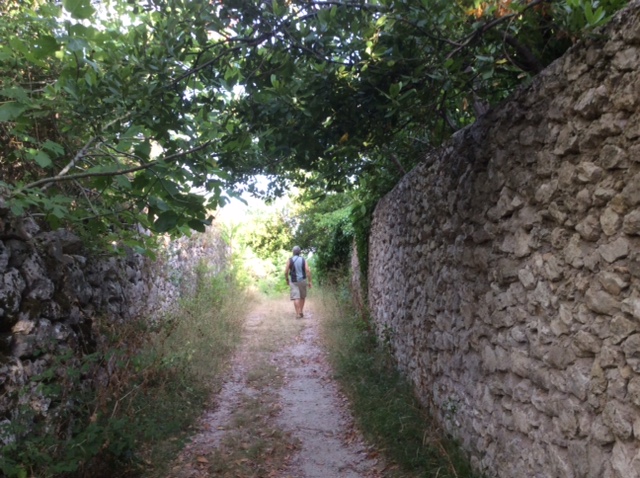
IMG_6975
At Vicalvi castle, above the Comino Valley, Italy
Uncategorized

Living In the Borderlands, Nicholas Samaras’s Poetry, Hands of the Saddlemaker

Most days we move through a world of familiar routines, often with unsurprising outcomes. The past few days I spent time with friends who own a house in Peschio, a tiny village situated above Alvito, Italy, a small community located on the edge of the Comino Valley a couple of hours below Rome in the state of Lazio. In Peschio, traditions still hold sway in people’s everyday lives. Bells ring on the hour, people have close connections with their neighbors and still live where they were born. Neighbors share gifts of food such as handmade pasta. In the evening, people gather for conversation at the local ice cream parlor or sit with friends on benches in the street. The town adorns the roads with ribbons for a celebration of the Madonna, carrying an icon of her through the streets. Here, communities aren’t driven by competition or pressed down with the weight of tasks to complete in a limited period of time. Life here is simple. Houses are not fancy, neither are their clothes. It’s true that the area struggles economically and that the population is aging, yet at the same time people have time to chat on the street or gather for an impromptu dinner on the neighborhood piazza. Human connection remains central to life.

I feel a connection to those living in a world where tradition is still a vital part of people’s understanding and way of being, but this way of being can’t be mine. I wasn’t raised with traditions that go back to the old world. I have lived in too many worlds with too many other lives, but there is a beauty there. Unlike the world in Alvito, the world most of us live in is filled not with space for human connection, but instead with human competition and the drive to get ahead, make a name, or gain power in some area, even if a narrow one. Minutes count, and finding time to sit outside and enjoy the evening air or to chat with a friend can be challenging. In such a world it is difficult to find satisfaction or wholeness. It’s challenging to find the time to reflect on life, hard to assume an attitude of receptivity instead of needing to act or be in charge, though receptivity is a central attitude that enables us to learn respect for our limitations and to value our interdependence with others, qualities that in turn engender connectivity with others and help us experience life as meaningful.

Occasionally, however, amidst the clatter and squeeze of everyday life that pushes us along from one event to the next, the extraordinary, like a giant fish rising from the sea’s depths or storm wind shaking a tree to its roots, occurs, and we are given a window into our lives that touches us at our roots and helps us see what we are. Having recently read Nicholas Samaras’s book, Hands of the Saddlemaker, I feel I have experienced the extraordinary. Echoes from the poems’ imagery and language move through my mind, rising at unexpected moments, floating up from the subconscious where the poems have been at work. The poems probe the  struggle to live purposefully with meaning when traditional values and ways of being no longer hold the world together.

Though we have access to unprecedented volumes of knowledge in our day, to live meaningfully and purposefully, all of us must negotiate between enormous areas of ongoing, continuous and rapid social, economic and technological fluctuation and change. It is no easy task to assimilate ourselves into these various worlds and learn how to integrate them into our lives in a way that allows us to develop wholeness. Each of us must explore how to direct ourselves through the current of these changes. Existentialist theologian Paul Tillich said, “Faith consists in being vitally concerned with that ultimate reality to which I give the symbolical name of God. Whoever reflects earnestly on the meaning of life is on the verge of an act of faith,” and Samaras’s poetry is an exploration of meaning making while swimming in the sea of the postmodern era. The intensely vivid quality of Samaras’s descriptions, language and poetic narratives in Hands of the Saddlemaker pulled me below the surface of words into an interior current flowing between places of exile and belonging, faith, and loss, love and death.

From the opening poem, “Lost,” describing the ease with which a person can lose his or her way, to the final piece, “Decade,” depicting the transformative moment where pain and brokenness from a relationship are let go, the poems in this volume traverse the territory between the traditions, beliefs and practices that both bind and open us. The book’s ending poem, “Decade” returns to a place of confrontation with grief and loss that allows one to come to finally release from its hold and come to a place of stasis where healing might begin. Philosopher Soren Kierkegaard said, “The greatest hazard of all, losing one’s self, can occur very quietly in the world, as if it were nothing at all. No other loss can occur so quietly; any other loss – an arm, a leg, five dollars, a wife, etc. – is sure to be noticed.” The ground we stand in our era is constantly shifting and most of us don’t have lives that thread us back to origins, place or carefully followed tradition. The poems explore the territory between and beyond borders, tradition and predefined boundaries, stretching into broader realms of experience and emotion where transformation is forged and meaning created amidst brokenness. This is a book of poems that speaks to our time and worthy of careful and repeated readings.

 One of the poems in the volume, “Easter in the Cancer Ward” describes the process of coloring and decorating eggs for Easter, while confronting the certainty of death and contemplating the significance of belief in life after death ends. One of the children in the ward with cancer directly states “I’m dying.” Another unexpectedly later asks the poem’s narrator if he believes in Christ and living forever, prompting him to search within in himself for an honest answer. Easter, as we know, is about life after death, but the poem places us in the moment where death lives inside of life and helps us see how the two are connected. The poem ends where the children put the narrator’s hands into the red dye, staining them red, the color of resurrection. The poem’s last line, “and we are laughing,” is especially poignant. Here is an image of life in death, death in life, and the hard territory one walks between the two. The child has led the speaker to touch that place, a world of pain and wonder inseparable from each other.

In his poem about crossing borders, “Passport,” Samaras writes, “In counties of the temporary, we are forever/ accumulating, possessing, leaving behind./ In the end, our hands will finally be empty.” This is an absolutely powerful piece about impermanence. In some sense, we are always standing at a border, the border between today and tomorrow, youth and age, innocence and experience. The border is a place of transformation–leaving a country, possessions, or a life. We exchange one way of being for another, one life for another. “I cannot help but be a citizen of transience,” writes Samaras, “always looking for the land beyond language.” Forever life is changing and we are leaving behind what we were, “our pale winter/ breaths losing the shape of our bodies.” There is death, but there is also the possibility of entering “the land beyond language,” a place where presence moves beyond the clothes we carry or the language our tongues wear, or any particular belonging, and we are “fresh and farthingless[ly]” ourselves.

Earlier this summer while walking in downtown Santa Cruz, California, I walked past a street preacher standing on his soap box calling out to passers by telling them they were sinners and to come to Jesus. While it’s true that we are all incomplete and need renewal daily, the word sin, is hardly in anyone’s vocabulary these days. I found the soapbox preacher’s tone disturbing. It didn’t compel me to examine my life. Instead, I wanted to push him away. I don’t like anyone yelling at me.

IMG_6829
WW2 monument in Alvito, Italy

Religion today is bound up in politics, is full of lines drawn on many sides defining right from wrong. What may have once been clear divisions of morality has been manipulated by motivations of profit, of revenge and the love of control, often confusing our understanding of what is really being said so that it’s difficult to know and act on the truth, even as we understand it. While some people are certain they know what is right (as I suspect the street preacher did because of his tone) in this world–the correct beliefs and actions, or at least want to convince us that they do, Samaras’a poetry presents a different vision of belief in the Divine. “In the Shell of a City Cathedral” two men enter an abandoned NY city cathedral that is condemned and scheduled to be torn down, paralleling what is in fact a reality in Christianity today, where the church is being blotted out in its geographical place of origin (see William Dalrymple’s From the Holy Mountain) and where the church has lost respect in the general population as a result of misconduct by priests, attitudes of bigotry, injustice, and through other acts contrary to the teaching of Christ who called people to love their neighbor. Even though the church in Samaras’s “In the Shell of a City Cathedral” is boarded up, abandoned, and set for destruction, though the homeless are lined up and sleeping outside it, the two men intuitively recognize there something inside the vestiges of its structure that nevertheless still offers refuge. “There is nothing worse than a safe life,” writes Samaras, and the faith demonstrated in this poem is not one of safety. The world inside the cathedral is broken. Wires and tubes twist across the floor, the staircase is dilapidated, and the roof opens to the sky and moon. What was once sacred is strewn together with the profane. The two men find it disturbing that “such a building, such a solidity can fall to man’s priorities.” The church’s broken state reflects our human inability to discern what is holy or pure. Svetozar, one of the two men, steps on a nail that pierces his foot. Similar to this unexpected wounding in a place once sacred but now desecrated, innocents across the world have been harmed in the darkness of wars that have changed lives forever, and in particular since the World Wars. Like the homeless sleeping outside the church walls, we are all in some sense homeless now, without belief and holding a general societal disregard or nonchalance regarding injustices. Ignore the nail that has pierced the foot, however, and we die.

Why enter the cathedral? Why call on faith in a time when to believe in God is to many an absurdity? “We climb to resist/ ourselves in a complacent country,” writes Samaras. “To enter this cathedral/ this edifice was necessary.” Faith isn’t arrogance or a person calling from a soapbox on a city street. It is the climb in a church of uncertain structure to

…a level footing, an icon

and a dusty mirror.
All through palpable darkness, the ginger

feeling for where the foot should go next,
the leaning the weight into it.

Here is humility. Here is a spirituality that connects to the suffering of humanity in the dark places of difficulty and pain. Here is where Samaras brings us to at the end of the poem, “wind filters throughout clothes. For a moment, I thought/ I heard the connected lives of others.” The speaker is holding the memory of one’s own hands wrapped around the broken bannister’s weight. The Christian ritual of communion and bread breaking represents Jesus’s self broken, like the bread, and the shared selfless giving with the community of humanity. Yes the church is broken, like all human institutions. But there is also the church that is still what a church is meant to be–God living through people on earth; Mother Theresa, Desmond Tutu, Dietrich Bonhoeffer, Teresa of Avila, Oscar Romero, Parker Palmer, and the myriad of every day people who do the work in the world and in themselves that creates wholeness. Faith is more than a set of beliefs. As Kierkegaard says, “It is so hard to believe because it is so hard to obey.”  The poem shows us those who take the risk and enter in can learn spiritual truths that remain beneath and inside the brokenness and with it, we can find strength to change our lives.

Perhaps I feel drawn to the poems in Hands of the Saddlemaker because inside the poems I hear a voice that tells me there are no easy answers. Several of the poems in the book deal with the hard work of reconciliation. We are all living in some form of exile and we must work out our own salvation. Having lived in other countries outside my own for 25 years, I feel an affinity for the voices of those living outside the boundaries of what might have once been home. I am from the borderlands. My parents moved to California from South Dakota and I was the first in my family to be born there. SanDiego County bordering Mexico was my childhood home. For me, everywhere and nowhere is home. I’m reminded of the old gospel song, “This World is Not My Home” (and here is a bluegrass version.) Though I live in one world, I am of another world too.

Woven through this volume of poems is the sense that the writing is born from a distinct, even painful awareness of the incompleteness of one’s own life, and the willingness to confront it honestly in order to cut through to the marrow of bone where the soul is laid bare and offered up on an altar like a prayer. I think of the Rembrandt painting I saw this summer in the Hermitage in St. Petersburg, Russia, of Abraham offering up Isaac and the angel holding back Abraham’s hand. The story and painting is a metaphor for what powerful art and writing is. It functions as a sacred offering. In the act of making and reading poetry and art we can be saved, so to speak, through the power of art and words to restore.

It was 3:00 am at the border as I reentered India last night, serendipitously, just like the line in Samaras’s poem, “Passport” where he says “It is always three am at the border.” I had my bag with my yearly supply of vitamins, my clothes, my journal. Men pushed a long line of luggage carts, some leaned against a wall, listless with the weight of waiting. My shoes are old and wearing through the bottoms, but again I begin. Beyond the airport doors waited the city’s broken walls, the millions who sleep on the street. Tired, without sleep, aware of the world I left behind, the world I was about to step into, I left the airport’s bright lights and glossy tiles and rode out into India. There are so many brave people living on India’s streets, each day not knowing where or how their food will come, how they will meet with illness or loss. Continuously, I am reminded here of the need to step beyond my own lack of faith, to be brave–to better understand the need around me and to listen for the voices that help me understand and how to serve out of my own depths the world around me.

The poems in the volume embody faith in periods of grief and loss, a willingness to bear that loss in order to find a way through it. I learn from the poetry in this book, and am changed. Samaras’s poems are more than descriptive words with an insightful message. They have soul. The poems in the book speak to each other in a way other poetry books I’ve read do not. The poems echo off and weave back into each other. They breathe together, become more than they were individually. These are poems whose words hold integrity, life and spirit. They help us find how to bear the hard things of this world. By example, they demonstrate poetry’s power to show us our humanity and bring us back to ourselves. Reading the poems in Nicholas Samaras’s Hands of the Saddlemaker calls me to live more deeply, to feel gratitude for the many small joys of our existence. There is a humility present in the spirit that comes through the writing at the same time that the writing demonstrates mastery and beauty. Such writing is rare, and to read it is a wonderful gift.