Uncategorized

Black Mold and Bravery

Black mold has invaded our apartment and is growing in the walls. For days now I’ve not slept well. First workers came and pulled off the tiles in the bathroom to fix the leaky pipe, releasing the reeking smell into the air. They have since tiled the wall back in this week, but the caustic smell is still there. The mold is masked, but continues on inside the wall and is pushing its way through into the living room.

Clearly, the mold had been there for some time, though we didn’t realize it. Red or puffy eyes in the morning, wheezing at night, draining sinuses, rashes on the skin, and yes, even hair loss, which I’ve been noticing for some time now and wondering why it is happening, these (and more) are the signs of reaction to mold, but because we couldn’t see it, we didn’t know the mold was growing behind the walls until the neighbors complained their walls were showing stains.

When the workers broke open the walls they released the toxic smells. Recently, a colleague and I were discussing how we might get better at connecting with people and situations we found difficult in our work. She asked if I had listened to Brene Brown‘s TED talk “The Gift of Imperfection.” I hadn’t, but went home that evening and listened to several of her talks. One of Brown’s statements, out of many that resonate with me is this: “Unused creativity is not benign; it metastasizes. It turns into grief, judgement, sorrow, and shame.” I thought of the mold behind the wall. A pipe behind a wall leaks. You don’t realize it, but the mold begins growing, and eventually you have a problem you can’t fix simply by breaking open the tile, repairing the leak, and then tiling the wall back up. The mold is growing now, and you’ve got to remove it and create something new.

Since the apartment I live in isn’t mine, I don’t get to make the choice about removing the mold growing in the wall or covering it back up with tile, however. The choice of putting something in the wall that kills the mold, or to mask it with clorox instead, isn’t mine. As I lie in the bed at night coughing, I think of the people everywhere who are living with mold or who have lived in oppressive environments.

When the Czech writer and illustrator Peter Sis, came to the American Embassy School here in Delhi several years back, he explained over dinner with a small group of teachers that he is a man without a country. The country he was born into, Czechoslovakia, no longer exists. Those words have echoed in my mind ever since. It took Odysseus 10 years to make it back home after the Trojan wars. That is a long time, but some people can never return home because there is no home to return to. There is suffering in situations like these. Once you are gone a decade from your home, you are changed. You might return home, but you won’t necessarily every be at home again as the world of home, like a ship under sail, continues on its own trajectory while you have been sailing along a different route encountering land and storms not like those you might have experienced had you stayed on the ship you began on. All seas are not the same.

When some people leave home, they don’t want to return, however. My husband’s grandparents came from Italy, but when asked if he would like to go on a trip with us to visit Italy, his father expressed absolutely no interest in it. “Why would I want to go there?” was his response. That was the end of the conversation. As someone who loves travel, is curious about the world, and wants to understand the roots I’m connected to, that statement perplexed me. Currently, I’m reading Milan Kundera‘s book of essays, Encounter.  In his essay, “Exile as Liberation According to Vera Linhartova,” Kundera quotes her saying, “The writer is above all a free person, and the obligation to preserve his independence against all constraints comes before any other consideration. And I mean not only the insane constraints imposed by an abusive political power, but the restrictions–all the harder to evade because they are well-intentioned–that cite a sense of duty to one’s country.” People have fled their countries because of war, have been exiled for their ideas or their writing. But some people don’t chose to return because greater than a bond to history or language, is the person’s desire to choose his or her own path, one that has given them what they sense to be a greater freedom, freedom they wouldn’t have if they returned to the world their history is rooted in. France allowed Linhartova’s creative freedom. Freedom is connected to struggle.

My husband’s grandparents gave up their lives in Italy, and struggled under great difficulty to make a life in the United States. Similar to Linhartova, remaining outside the country of their birth was a choice. The struggle to make a life in another country and culture allowed their children and grandchildren greater opportunity and freedom. Standing between two worlds, they found a home outside of the definitions of home they knew. They lived on the edge of great challenges and risk. Brene Brown says in her interview with Krista Tippett “The Courage to Be Vulnerable”  on Tippett’s site On Being, “The …beautiful thing I look back on in my life is coming out from underneath things I didn’t know I could come out from underneath…the moments that made me, were moments of struggle.” Our family’s Italian grandparents, like immigrants in general, were brave. Their stories aren’t without loss and grief, but they they followed the path that called to them, and today, without ever having met them, I feel gratitude for the daring their lives demonstrated in giving up the world they knew in exchange for a life still full of difficulty, but one lived with hope and a sense of possibility.

Living here in India, I constantly see people struggling for survival. I want the people I encounter to know they will get to eat every day, to be able to go to school, to realize they have stories worth telling and hearing, that their lives have meaning and their creative expression is valuable. But the poor of the world, and those without opportunity are often unseen and ignored. To go to school in Delhi, a child needs a uniform. Some families are too poor to buy the uniforms, and therefore, their children don’t attend school. There is need.

Outside the gates of our school here in Delhi this morning, children who live in the slum across the street waited to be measured for school uniforms that teachers here at our school are raising money to buy for them. Education will give these children opportunity.

John Ciardi, in his poem, “Matins,” writes about a poor woman who died on the streets of Paris,

It froze in Paris last night and a rag doll
that had been a woman too tattered-old to notice
turned up stiff on a bench. So the police,
who spend least on the living, paid to haul
nothing to nothing. She could have lived for a week
on what the bureau will spend on paper work;

The poem goes on to describe how more was spent on the woman after she died than it might have taken to help her live, and find how to give her a place in the world. Ciardi’s poem closes with these words:

…Every child
risked from love and held must be put down
to walk itself away, and turn by turn
become another. This dirty doll unheld
by any arm is one altar piece
from which mad Francis learned to be a priest.

It takes courage to notice the things in our lives and our world that aren’t going so well, that are like the mold growing behind the wall, and to move out into a life of challenge, but the possibility of greater freedom. If we continue to ignore those things that are eating away at us, however, or don’t give creative expression to it when it’s not in our power to change things, eventually the mold breaks through the wall and we’re no longer living in a life engendering place.

Inside the world of discomfort and the wreaking smell of mold, some are brave enough to break open walls and persevere as they reach to find a path with their lives that offers hope and makes a difference. Noticing the poverty around him is what called St. Francis to live his life under the vow of poverty, a life given to empathy and compassion that still touches our lives centuries later. The world could use more people as brave as he.

It is late afternoon and we have returned from the art room where my husband, Michael, holds an adult art afternoon on Sundays where many people (like myself) are exploring art for the first time, learning they can make things they didn’t know they could. Now he’s out in the community garden planting seeds because tonight is the blood moon, a rare lunar eclipse of a super moon, and a good time for planting, he says. It’s an effort, he explains, to make a healthy life for people. “To love ourselves and support each other in the process of becoming real is perhaps the greatest single act of daring greatly,” Brene Brown states. From organizing the effort to raise the funds for having the children’s uniforms made so they can go to school, to helping people discover ways to be creative, to planting seeds, to preparing this evening’s meal, which he is about to do, my husband is a man who day by day is following St. Francis’s path of giving himself to the world around him. If we are going to change the world, surely it will take each of us being faithful in the small things with those around us daily. As Mother Teresa said, “that is where our strength lies.”

Geography, place, Uncategorized

The Geographies That Shape Us

What are the geographies that have entered your heart? As we embark on our exploration of how the physical world affects culture, consider the ways that the places you have lived have shaped you and your understanding of the world.

Nature writer, Barry Lopez, in his book, About This Life, says “Over the years, one comes to measure a place, too, not just for the beauty it may give, the balminess of its breezes, the insouciance and relaxation it encourages, the sublime pleasures it offers, but for what it teaches. The way in which it alters our perception of the human. It is not so much that you want to return to indifferent or difficult places, but that you want to not forget.”

How has the cultures and your interactions with the physical environments in the places you’ve lived influenced and shaped the way you think and the experiences you have had? How might your reflection on this question guide the kinds of things you want to learn and discover about the country you are researching about?  How might your experiences help you focus your research, write up your understandings, and talk with the class about topics you think are personally meaningful and important?

Uncategorized

The Multiple Worlds and Wonders of India

Of all that God has shown me,
I can speak just the smallest word,
not more than a honeybee takes on her foot
from an overspilling jar.   Mechthild of Magdeburg

To live in India, and to ponder what it is one is experiencing when wandering out to explore what waits in the streets, is to be humbled. This is my ninth year living here in Delhi. There is a myriad of things still to see in India and a myriad more to understand–or realize I will never understand. India is immensely diverse with a long, long history. Though many things after nearly a decade of living here seem familiar to me now that are utterly different than the world I was born into–things such as buying groceries at street side stalls, monsoon heat and rain, dogs and cows wandering the streets, and erratic electricity–the more I experience and learn about India, the deeper the mystery of this culture goes until it seems I have entered the waters of the ocean and the universe beyond.

This past weekend I traveled to the state of Odisha (Orissa), and the cities of Bhubaneswar and Puri, one of India’s holiest cities. Traveling through these cities colorful streets full of ancient stone temples, is to enter a place wonder.

A few short kilometers from Bhubaneswar, we visited the Udayagiri and Khandagiri Jain caves, cut into two facing hills over 2,000 years ago. Ascetics once lived here, but now along with visitors and devotees, langur families roam the area, eating from shrubs, as well from the hands of the many Indian visitors to the temple atop the hill.

A bit over an hour’s drive down the coast from Bhubaneswar and north of the coastal city of Puri is the Konark Sun Temple. Made of  stone and facing the east-west direction, as if carrying the sun, the temple is a World Heritage site built in the 13th century. The temple’s shape is modeled after the giant cart that Hindus pull through city streets in various locations in India during religious festivals. Though no longer safe to enter the temple, it’s exterior carving is both extensive and beautiful. There must have been an enormous bank of skilled sculptors available in order to make the temple with its beautiful carvings–something that would be rare to find in most any place in the world today in such abundance.

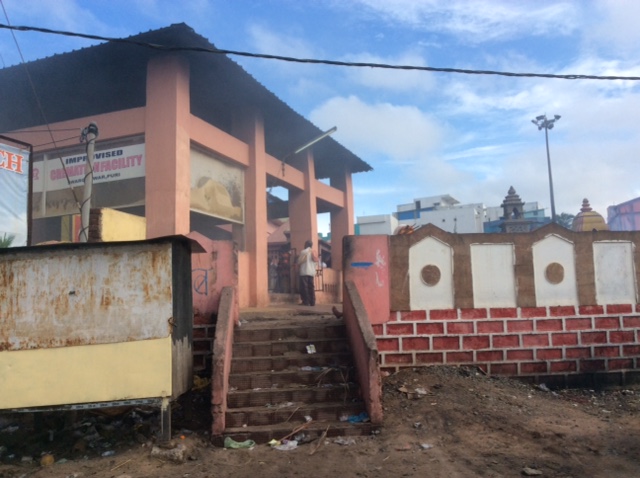
Down the street from where I stayed with my husband and friends in Puri, is a crematorium–a holy place for Hindus. To be cremated in

Crematorium across from the beach

Puri is highly desired as it allows one to enter moksha and to be released from the cycle of life. Interestingly, directly across the street from Puri’s crematorium is the beach on the Bay of Bengal, crowded with people barbecuing fish, eating, shopping, and riding camels with a decorative red and gold cloth to sit on.The waves stretch along the coast beside Puri, though no one is swimming, preferring the activity on the shore. This is not a country or culture that isolates death from the ongoing experience of life. Death while necessary, it’s very presence is woven into the fabric of the town’s hotels and seaside attractions, as a natural partner to other activities such as a barbecue or a seaside stroll.

South of Puri, along the coast, lies Chilka Lake, one of Asia’s major areas for bird migration and nesting. The road to Chilka Lake from Puri, wanders through a wetland area of trees, verdant green rice fields, and buffalo watering holes. Black dolphin live in the lake, and you can see them on a boat ride that takes you out to where the lake opens into the sea. On our boat ride, we got caught in a monsoon downpour. As the sky turned dark and the thunder rolled, we crouched behind umbrellas, hoping to stave off some of the rain and sea spray. At the lake’s opening to the Bay of Bengal, we pulled up to the shore and climbed off the boat to huddle under a palm leaf hut with plastic tarp, watching the wind blow and the rainwater drain off the roof as the boat driver wrung the water from his shirt. Locals working at the tea hut knocked open oysters and pulled out perfect pearls time after time as well as stones hoping to sell us a few. I never saw clams produce shaped and polished stones before, but people on other boats believed it was possible, and willing bought the jewels.

Later, we headed back to Puri, to the Jagannath temple–the Lord of the Universe’s home on earth: Vishnu’s abode. The temple, according to the Jagannath temple information site, has 6,000 priests, as well as the largest kitchen in the world, where it has prepared meals for 1,000,000 people on festival days and frequently up to 25,000 on other days. If you are Hindu, you can enter the temple, but if you aren’t, even from outside the temple there is a world of wonders to see because half of India seems to be gathered there in a celebratory mood–balloon, flute and toy sellers, fruit sellers with their carts, a woman selling grass for the wandering cattle, devotees washing themselves, beggars with open palms–all part of the throng in the plaza and funneling toward the temple gate.

The temple complex is large, covering an area of 10.7 acres, and as I circumnavigated its walls, I got a glimpse of an idea of the world inside. A group of men wearing white and clanging a bell trudged by carrying a wooden plank decorated with flowers, women wearing gold colored saris walked by in a group, and everywhere food sellers pandered their wares and cows wandered the streets. On the opposite side of the street from the temple, were the broken-off walls of apartment buildings and shops where some men worked to rebuild the half dilapidated walls, while others sledge hammer in hand heaved into walls, blow by blow hoping to bring them down.  One thing was certain: I was in a different world. No sterile streets with trimmed hedges and clipped lawns here, no malls or neat and tidy traffic flowing to regulated lights. Instead, a cacophony of human activity filled the world on all sides. Here, the world was turned inside out. You can literally see inside houses, and everything appeared to be in a state of simultaneous construction and deconstruction–which is actually a pretty good physical embodiment of what is actually happening at any particular point in time or history. Things have a way of breaking open and breaking out of the boxes they are put in. Life, like many things found in India, is bigger than the boundaries we build to contain it. It spills out and pours over–is larger than what we can define or name. Order is there beneath the change we experience, but the birth and death of everything is happening all at once right before your eyes.

Like some kind a satellite, asteroid or meteorite from a world other than the one people in Puri were familiar with, I circled the Jagannath temple, my eyes absorbing what my mind had the tiniest fragment of comprehension of. Here is a world to itself, one that doesn’t care that your your hair is falling out, that you once held an athletic record, that you aren’t able to walk as you used to, that you can sing, dance or draw, that you might be unable to do what someone else does or thinks is important. These are things of the world you might have been born into or come from but none of this matters when you cross into another world, and clearly the space around the Jagannath temple is another world. If it is possible to be reborn into another life without dying, than certainly, that is what occurred. Doorways mark the liminal spaces between two worlds, and to stand outside the Jagannath temple amongst the honk of mopeds, the cows and dogs lazing in the streets, the clanging bells, marigold offerings, and the sun casting a golden light across the street is to definitely see into a different reality. This was no place anything I knew in my childhood would prepare me to know or understand. Except that it was wondrous.

There are things in this world far beyond our comprehension. This I knew as a child. I climbed the hill opposite from where I lived with my mother and two of my sisters when I was four, and when I looked back at where I came from, at the small house in the valley below, I knew my home in an entirely new way. Circling the Jagannath temple walls is one way that allows you to see where you call home in a new way if you call home a place other than India or Puri. Walking around the temple wall, you can glimpse into the universe of mysteries and to realize that of all the world holds, we know very little. The world, the universe is much bigger than our minds can hold. Birth is mystery, as is relationship–the fathomless bond of love. The intricate connections and interweaving of natural systems of animal life, of whales’ migration patterns, for example, serving to mix the ocean’s water columns and spreading nutrients, that according to National Geographic, enables more fish to eat and grow–just this one example of the vast natural systems that we interact with daily that have evolved over eons of which humans are just one part–all these things are working together, holding us up and together. These are far more powerful than the power of any ruler, government plan or force on earth. As in the poem I opened this post with, it’s good to be reminded of these things. We often get wrapped up in our small worlds and plans, in our way of seeing things, making it easy to forget our view is just one perspective in the wider, wilder world and universe we are a part of.

Comprehending the complexities of Hinduism takes an outsider an effort of serious study; but I can comprehend this: by living we partake in mystery.  We move from mystery to mystery as we move from birth to death, and isn’t this a fundamental truth to all religions–that we are not a world unto ourselves? Bruce Cockburn has a song you might enjoy listening to, “Lord of the Starfields.” I appreciated it for the awe it evokes with lyrics that begin like this:

Lord of the starfields
Ancient of Days
Universe Maker
Here’s a song in your praise

Wings of the storm cloud
Beginning and end
You make my heart leap
Like a banner in the wind