
“Oh dear! Oh dear! I shall be too late!” but when the White Rabbit actually took a watch out if its waistcoat pocket, and looked at it, and then hurried on, Alice startled to her feet. – Lewis Carroll, Alice’s Adventures in Wonderland
Since living in London, I’ve noticed how people seem to walk the streets with purpose and determination, and they walk fast, or at least faster than I’m used to seeing. Recently, I’ve begun to think of the rabbit in Lewis Carroll’s, Alice’s Adventures in Wonderland, and how easy it is to be a like him—anxious about where we’re going and if we’re going to make it on time. Time as marked by watches and clocks is an invention, yet as Glenn Aparicio Parry mentions in his article in the January/February issue of Resurgence and Ecologist, “Think of Time as Nature Thinks,” Time as we think of it today, measured out in precise linearly calculated capsules of existence, is an abstraction, and a somewhat recent phenomena. Previously, time was something people noticed as seasons change and animals migrated. Time was perceived as more circular, and things weren’t necessarily perceived as progressing and becoming better in the present than they were previously, Parry explains. Perry goes on to describe the Hopi, who had no words for the past, present or future. Instead, they believed things that things that happened previously were stored up and could be manifested later on. Events in this vision of time are a kind of interweaving.
I read Parry’s ideas, and wonder what the world would look and feel like if we lived with a different view of time. When you travel or live in a different culture, you enter a different reality, see through different windows. Richard Lewis, a linguist and one who studies cross-cultural phenomena, in his article in Business Insider, “How Different Cultures Understand Time,” describes some of the varying views of time. “Spaniards, Italians and Arabs will ignore the passing of time if it means that conversations will be left unfinished. For them, completing a human transaction is the best way they can invest their time.” The Japanese, Lewis describes, “must experience an unfolding or unwrapping of the significant phases of the event. It has to do with Asian indirectness, but in Japan it also involves love of compartmentalization of procedure, of tradition, of the beauty of ritual.” The view of time in Madagascar is different yet again, according to Lewis. “The Malagasy imagine the future as flowing into the back of their heads, or passing them from behind, then becoming the past as it stretches out in front of them. The past is in front of their eyes because it is visible, known and influential. They can look at it, enjoy it, learn from it, even “play” with it.”

While Lewis’s descriptions are generalizations regarding the various cultures, the Anderson Institute, a high technology research institute devoted to finding scientific solution to space time physics problems, describes most Americans as “feeling rushed,” and that because the culture pressures people to “do more, earn more, and consume more,” people, feel rushed. While Americans essentially lack free time, because for us White Rabbits, checking our watches and how much we can get done, it’s difficult to relax. This is utterly different from the Pirahã people of the Amazon rainforest. The Anderson Institute website explains the Pirahã as using no art, having no letters, or numbers, and no concept of time. For them, everything exists in the present.
With these varying cultural concepts of time, we can see a connection between how people perceive time will create qualitatively different perceptions of existence as well. The question this raises is how might we live within a culture where time is linear, and yet still step into a wider, more generous sense of being so that we allow ourselves to experience the sacredness of existence and our relationship to the world around us. It seems this might only be possible if we have a clear vision of another way of being, and we hold other worlds inside us. The Caterpillar in Alice’s Adventures in Wonderland asks Alice, “Who are YOU?” Who we are is somewhat a mystery, even to ourselves. We hold multiple worlds within us. Who others see we are often depends on the context they know us in. Who we are can also vary depending on where we came from. Experiencing significant changes or defining moments in our lives such as deaths, births, or moving to a new culture, we might see ourselves like Alice who replied to the Caterpillar, “I–I hardly know, sir, just at present– at least I know who I WAS when I got up this morning, but I think I must have been changed several times since then.” But beyond the significant changes we might experience in our lives, and the multitude of transformations we might go through, underneath the exteriors of our housing, or occupations, our clothes, or cars, lies our essence, our common humanity, in touching that, we find our selves.
When I stand in the subway tunnels here in London, I look into the windows that flicker past as the trains move off down the tracks, and notice the myriad faces fluttering by, faces I glimpse for just a moment—the tired man wearing a baseball cap head bent in sleep, the woman with her perfectly combed hair and dangling earrings heading out for the evening, the travelers holding on to their luggage, lovers deep in conversation, a child leaning into a parent’s arm—the myriad of lives rushes by as in a moving picture. We move from one place to another, we see each other but don’t meet or know each other. We are not what we own, what we have or do. How can we find each other in our common humanity? “I am because you are,” is the meaning of Ubuntu, a way of being together understood by Africans who hold to traditional ways and shown on this short video from the Global Oneness Project.
 Recently, I read a book of poems by the Turkish poet Nazim Hikmet. Though Hikmet later won the International Peace Prize, as a Marxist, he spoke out against the use of power to oppress the common person in his home country, and wrote in his poems about his longing for those who were poor to have a better life. For his political beliefs, Hikmet was imprisoned for thirteen years and spent thirteen years in exile. Though his life was threatened even by those from within the communist party, Hikmet fervently held to his beliefs throughout his life. Reading his poems is moving. While in solitary confinement in 1938, Hikmet wrote his poem, “Letters From a Man in Solitary.” In this poem, he describes carving his wife’s name into his watchband with his fingernail. He’s not allowed to see the sky, not allowed to talk with anyone. He describes to his wife the passing of time by the shadows that climb the walls. At the end of his poem, Hikmet writes,
And inside this is spring’s darkest hour.
In short, the demon called freedom,
with its glittering scales and fiery eyes,
possesses the man inside
especially in spring…
I know this from experience, my dear wife,
from experience…
Sunday today.
Today they took me out in the sun for the first time
And I just stood there, struck for the first time in my life
by how far away the sky is,
how blue
and how wide.
Then I respectfully sat down on the earth.
I leaned back against the wall.
For a moment no trap to fall into,
no struggle, no freedom, no wife.
Only earth, sun, and me…
I am happy.
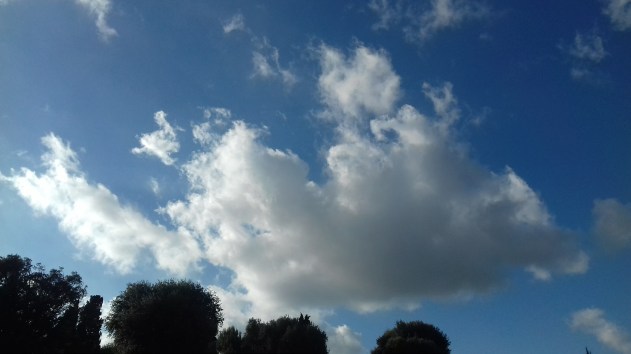
What time is to a man in solitary confinement is utterly different than those pressed by time, and who like the White Rabbit are in a state of constant low grade anxiety, rushing to meet a schedule (though this is certainly an oppression and confinement of its own kind.) When Hikmet describes sitting down on the earth at last, after being held inside walls for so long, I felt the respect he describes, and the way the sky opened to him like the deepest heart of love, and gave him its blueness, its breadth—how utterly broken open he must have felt at that moment, and utterly alive with the full presence of being. Time is broken here. There is no clock. Just an entering into of all that is. These are moments we long for, when the world shifts, and we see we aren’t caught in watching the clock tick or the shadow move slowly up a wall. Instead of staring at face endlessly flickering past us tunneling their way toward the next station, we step inside the phenomenal essence of the material world and experience it as spirit and gift, perhaps even as love.
In her poem, “I Worried,” Mary Oliver writes,
Finally I saw that worrying had come to nothing.
And gave it up. And took my old body
and went out into the morning
and sang.
Time doesn’t have to be a prison to escape from. Perhaps it’s time we find ways to learn from different cultures—to purposefully notice the walls we are living with. We can learn to tell ourselves different stories about time and what matters, and look for those who will join us in finding ways to sit respectfully on the earth, and lift our faces, to see the sky in all its blueness.


 Anna Citrino---Poetry, Place, Pilgrimage