Uncategorized

Drawing From Great Roots

We did not come to remain whole. We came to lose our leaves like the trees, Trees that start again, Drawing up from the great roots.–Robert Bly

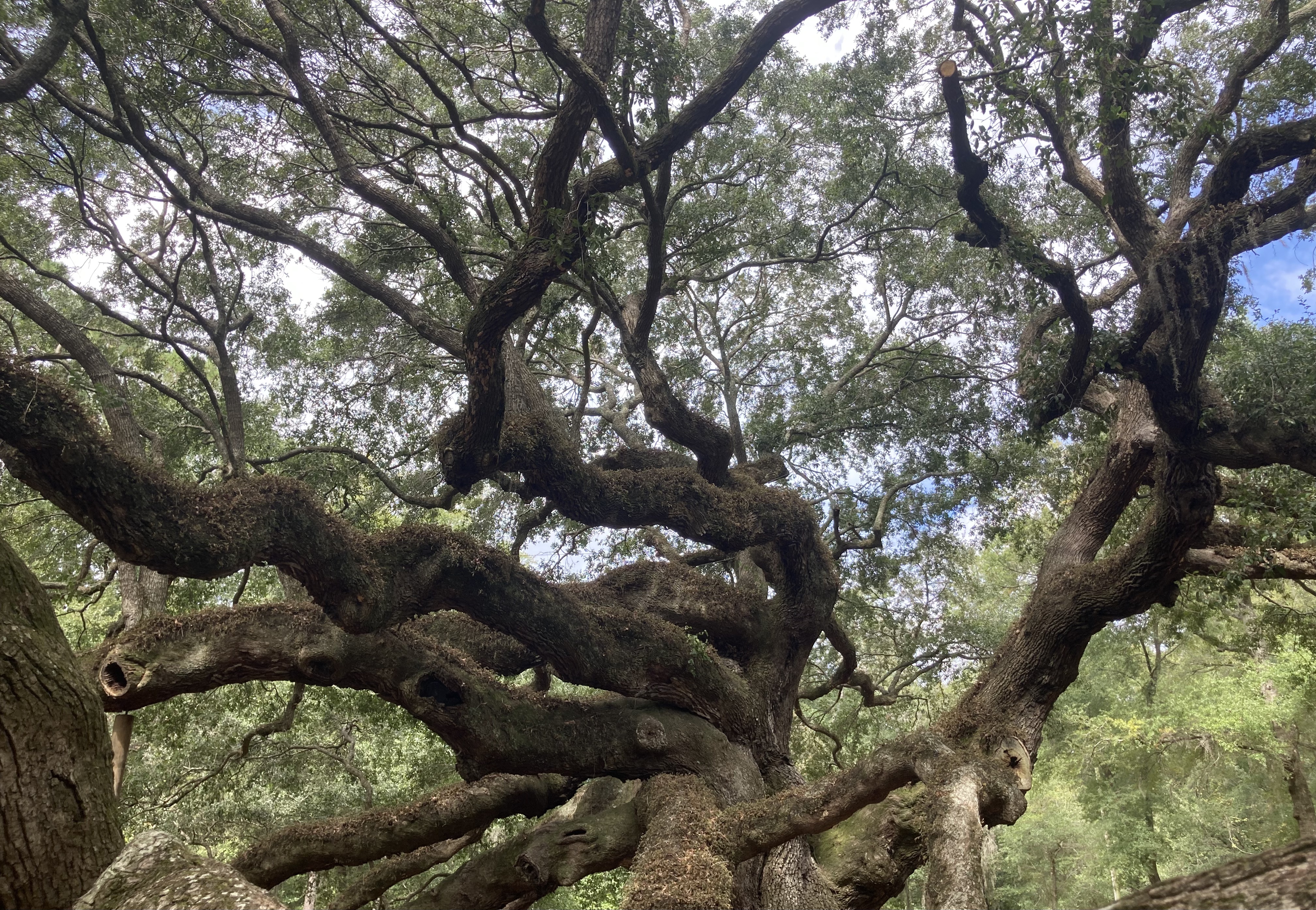
A short time ago, I visited the Angel Oak in South Carolina. A live oak tree that shades 17,000 square feet, is 65 feet tall, and has a circumference of 31.5 feet. It received its name from those who owned the property in the 1700s, Martha and Justus Angel and is thought to be the largest tree east of the Mississippi. So many trees were cut down as settlers made their way across what has now become the United States. It’s estimated that less than 10% of the forests remain that once covered North America (see more here.) To stand in the outstretched presence of such an old and enormous tree felt like a blessing. While this aged oak is thought to be 400 years old, the age of the Cypress of Abarqu in Iran is estimated to be between 4,000-5,000 years old, and is thought to be the oldest tree in Asia. Imagining the weather, wars, and other disruptions the cypress has been through in that stretch of time and the many changes the tree endured, it’s astonishing that it survived. Yet there are other ancient trees throughout the world as well. The baobabs in the African continent can live as much as 2,000 years. A Patagonian cypress known as Lañilawal or Alerce Milenario is estimated to have sprouted 5,000 years ago, and the Tjikko spruce in Norway is thought to be an astonishing 9,550 years old. 

Reflecting on time and trees, the concept of the family tree comes to mind. While researching for the book I’m currently writing connected to ancestors who lived in Nebraska, Wyoming, Iowa, and South Dakota, I’ve noticed that I don’t have to go more than a few generations back in time and my ancestor’s lives fall into deep shadows of the unknown. I have photos that were given to me of ancestors I don’t know the names of. Because their stories weren’t told, I’m left to imagine them. I’m like the character Pip in the opening lines of Charles Dicken’s Great Expectations, who never saw his father or mother, and conjures up what they are like based on the shape of the letters on their tomb stones. That’s a bleak world to be born into. The writer Barry Lopez states, “Everything is held together with stories. That is all that is holding us together, stories and compassion.” I can’t help but think that part of the collective grief of our era is at least in part that we have lost the stories that connect us to the land and the people we come from and are connected to. 

In various parts of the world people set up altars to their ancestors. I recall seeing these in Asia, often containing photos of family members who have passed on. Ancestral altars are a way of remembering how our individual lives are part of a much larger interconnections reaching back in time to places and ways of being and knowing beyond wherever it is one currently situated. Mariella Segarra, in her NPR article, “How to deepen your connection with your ancestors,” describes the altar she has set up in her home. “Altars are for everybody,” she states, and goes on to explain how to create one using objects your ancestors may have carried, used, or that assist you in imagining them—a pen, piece of jewelry, handkerchief, dried leaf or flower, a pebble, or scrap of wallpaper. The point of doing this is to help people recognize we’re woven into a social, historical, environmental fabric and the objects help us remember this. Our lives are not single threads blowing about in the wind. Scientists are discovering the bacteria in our gut can affect our emotional wellbeing, and trauma people experience can be passed on to those around us and possibly to those who come after us as well. How we respond to ourselves, to each other, and the earth we walk on matters. The struggles we may be experiencing are connected to a wider, longer story. We are, so to speak, part of a larger tree. The cambium layer of our present life is connected to branches and deep roots.

Within one’s own town there are many intersecting worlds and histories, so much we don’t know about the stories of the land around us, as well as each other’s stories and the stories of our ancestors. How do we begin to hear the stories of the land we walk on, the stories of ancestors that were never told. George David Haskell spends a great deal of time listening to trees. “To attend to a tree’s song is therefore to touch a stethoscope to the skin of a landscape, hearing what stirs below,” he writes in his article published in the Scientific American article “Ten Ways to Listen to Trees.” Haskell describes listening with one’s hands, feet, as well as nose. “Gusts of wind sonify plant diversity,” Haskell explains. “Oak’s voice is coarse-grained, throaty; maple’s is sandy and light. These differences have their origins in plant evolution and adaption. Drought-resistant oak leaves are thicker, tougher than the water-hungry maple. The different sounds of trees on a dry mountain ridge and in a moist forested hollow speak to the particularities of the ecology of each place.” These are fine distinctions, ones that come with close attention nurtured over time. I can’t help but wonder how I might better understand my own relationship to the world around me if I reached more often to touch the branches and roots of my life, attended more fully to the different textures beyond the boundaries of my current comprehension, listened more carefully inside the silences of history.

We often don’t know the stories of trees and see them as strangers on the street, explains Haskell in an interview with Sam Mowe titled “Listening to Trees.” “It often takes an act of will to learn these stories because, in general, cities present trees as passive, municipal objects that are completely stripped of their stories. We need to swim upstream against that tide to find their stories and, therefore, start to belong to each other.” The article ends by suggesting the following as a way to begin to transcend our emotions’ and minds’ limitations and to grow in awareness of our connection to life’s web: 

Pick a tree.
Commit to return to it again and again.
Bring an enthusiastic openness of your senses to the tree.
Don’t think it will lead to enlightenment, insight, or sacrament.
Try and visit the tree in various weather conditions.
Notice how different people interact with the tree.
Notice your own thoughts and experiences.
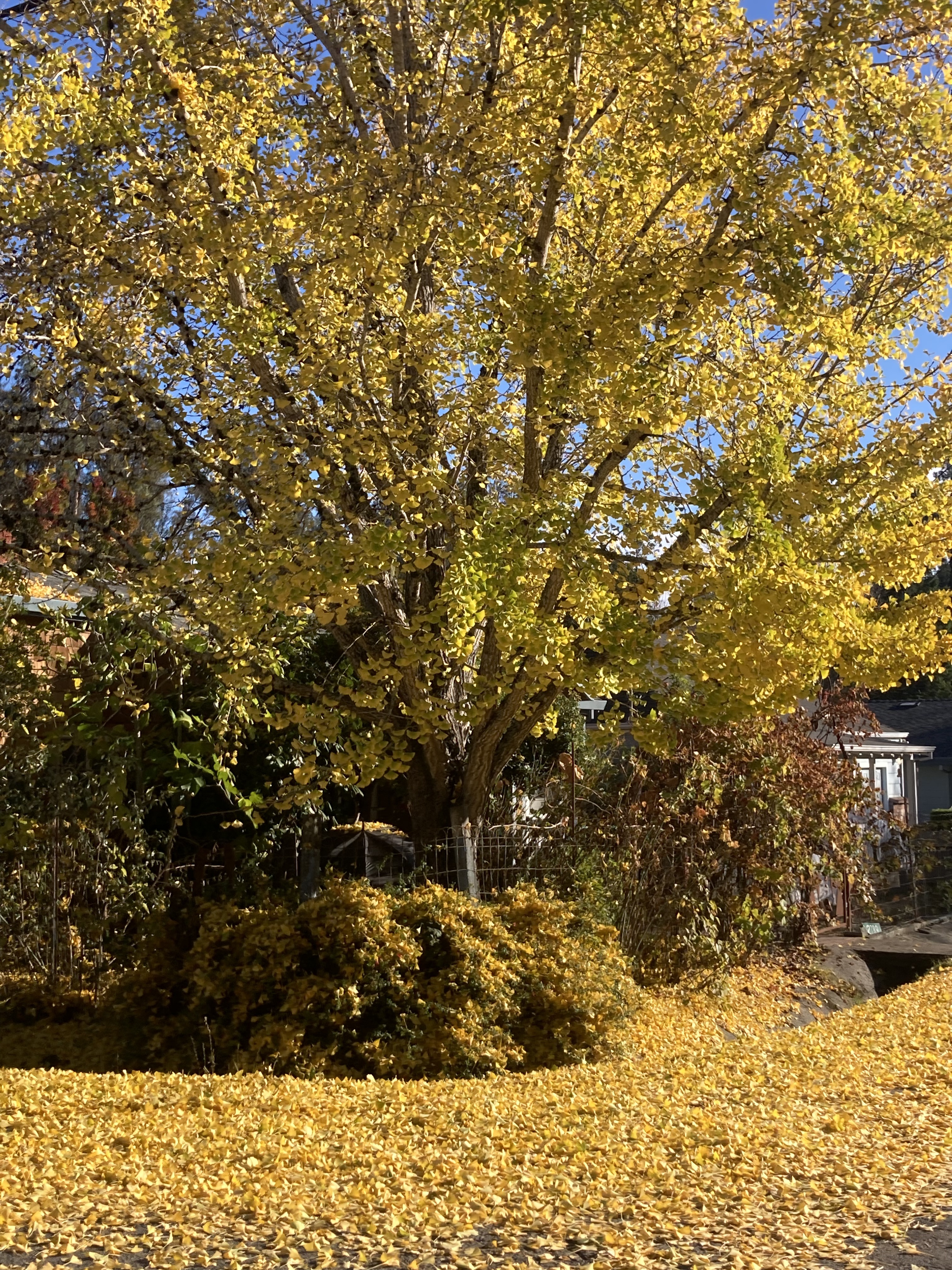
A similar practice could be followed in connection with ancestors on a family tree. Pick an ancestor. Select an object, photo, or word to represent the ancestor. Make a place for the object, photo, or other chosen reminder and place it in a location where you can greet your ancestor every day. If you want, light a candle or bring an offering. Without any particular expectation, spend a few moments just being present in remembrance of that life. Notice your thoughts and emotions.

Before getting on my bicycle yesterday afternoon, I received a text saying my pregnant niece was going into labor. A new child was about to enter the world. Climate change, combat between Israel and Hamas, missile strikes on Ukraine, ongoing hate crimes, rising inflation—this is the world new children are born into. While these many alarming things are going on, Danielle LaPorte via Mary Standing Otter highlights other aspects of our interbeing that are simultaneously occurring that are sometimes overlooked,

Something is being invented this year that will change how your generation lives, communicates, heals and passes on…
Some civil servant is making sure that you get your mail, and your garbage is picked up, that the trains are running on time, and that you are generally safe.
Someone is dedicating their days to protecting your civil liberties and clean drinking water.
Someone is regaining their sanity.
Someone is coming back from the dead. 
Someone is genuinely forgiving the seemingly unforgivable.
Someone is curing the incurable.

For all the heart-breaking realities present in the world, giving birth to a child is an affirmation that despite its many hardships, challenges, and the probability of suffering, life is immensely precious. Around us everywhere we have reminders of the long roots and branches of life that allow us to stand beneath their arms and marvel at the wonder of life. 

All of us living now will someday become ancestors. I ask myself, what kind of ancestor do I want to be? What am I doing now to participate in creating the kind of world I will pass on and the stories that will be told? Walking under the ancient limbs of the Angel Oak, leaning into its trunk I sensed the astonishing thing it is to be alive. I hope to pass on that sense of wonder and the knowledge that life is a gift.

As Mary Oliver wrote in her poem, “When Death Comes,”

When it’s over, I want to say: all my life
I was a bride married to amazement.
I was the bridegroom, taking the world into my arms.

When it’s over, I don’t want to wonder
if I have made my life something particular, and real.
I don’t want to find myself sighing and frightened,
or full of argument.

I don’t want to end up simply having visited this world.

Beauty, place, Uncategorized

Wildflowers and Forgotten Worlds

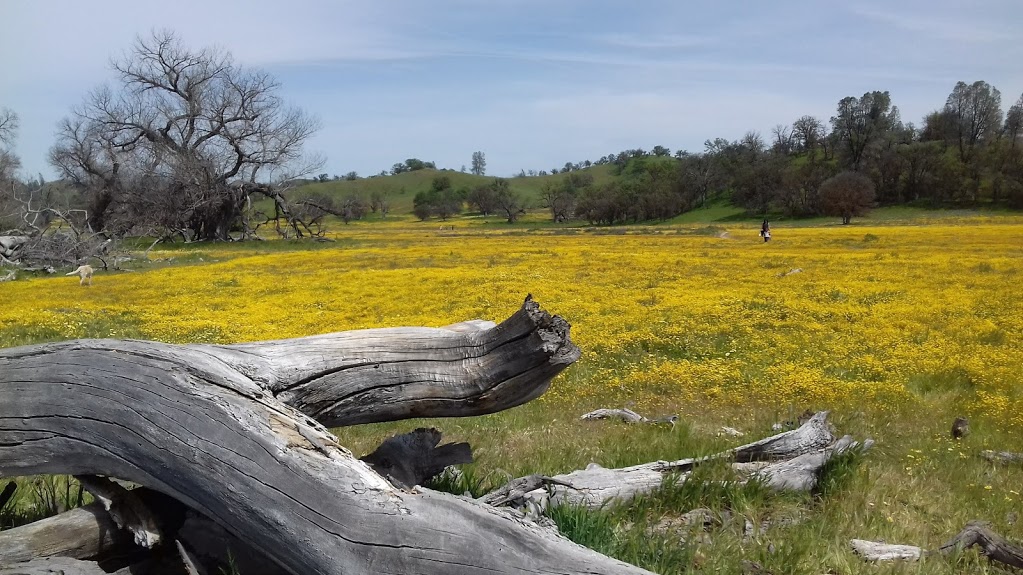
A place of abandoned windmills, trailers and tractors, the Carrizo Plains north of San Luis Obispo, California carries a kind of sadness, an emptiness that fills the landscape’s wideness. In her poem, “Elegance,” Linda Gregg writes, about the neglected world,

All that is uncared for.

Left alone in the stillness
in that pure silence married

to the stillness of nature.

And there is, indeed, an undisturbed stillness to the landscape of the Carrizo Plains, a silence that absorbs you when you step out onto the sea of land and peer out into the far distance, a world that goes on being itself with out much notice from anyone. The wind rises a bit and rattles the grass. Clouds drift by in their silent carousel. Crow sits in her nest atop a tower where once the windmill turned. The countryside here is full of light, but you can feel the shadows waiting beneath the surface, a kind of loneliness.


Tractor, Carizzo Plains

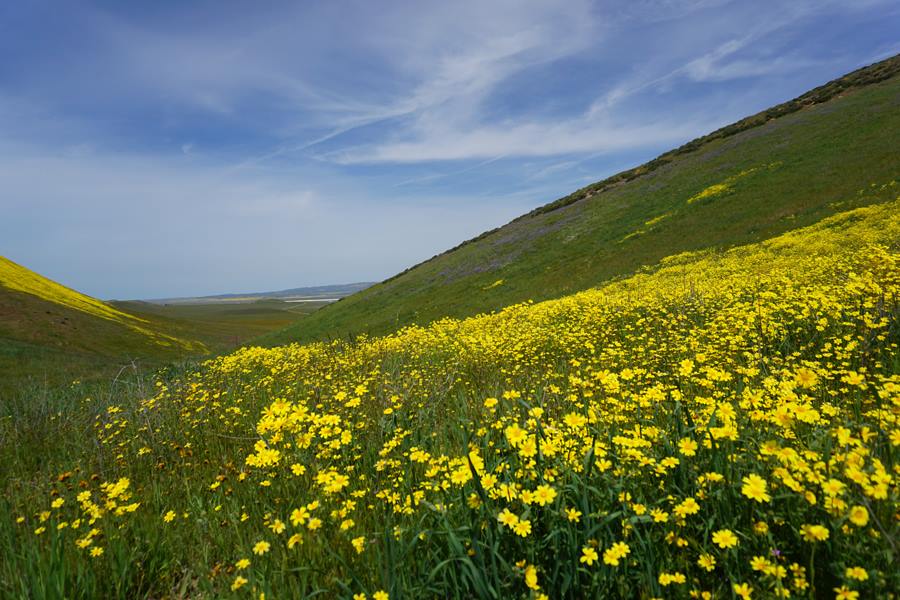
Nevertheless, because these plains are a place left undisturbed by humanities’ hustle, traffic and expectation, something truly grand has the opportunity to appear: wildflowers. After a winter with abundant rain, a super bloom occurs in backcountry areas like the Carrizo Plains. Flowers that have waited for years, at last have the conditions they need to spring forth, forming lakes of lupin and pools of baby blue eyes. Beauty spills its bounty across the hillsides, dusts them in the pink blush of owl’s clover, clothes them in her bejeweled cape of brocaded yellows–gold poppies, topaz fiddlenecks, mustard, butter cups, and bright-eyed tidy tips. The hills reverberate with sun.

People who typically view nature as a backdrop, and who may not know the names of plants in their front yard or on the street where they live drive hours to stare at flowers. They climb hills to get a good view, spread a picnic blanket at the edge of the road, and lug their crying children along with them all for the opportunity to glimpse at the splashes of color for a few hours before making the journey back home. What is there about these flowers that pulls on our spirits so powerfully?

Carrizo Plain


Temporal and rare, we know the burst of color these flowers produce doesn’t last long. If you want to see them, you know you can’t put the journey off for weeks. Flowers do not bend to our schedules and timelines. They live and thrive when they choose, and wither quickly beneath the heat.

There’s something beyond the flowers’ narrow life span that pulls us to them though. Something deep inside us physically responds to what we see and experience, allowing us to feel more at ease, interconnected with the world around us, and with ourselves. We feel more whole. When standing amidst the wildflowers, like others around me, I found myself wordlessly staring out at their colorful bounty, fumbling for how to express the awe I experienced.

Something in us responds to a presence in nature that we recognize as much larger than ourselves and intricately, beautifully complex. Though nature speaks a language we in our consumer oriented society barely comprehend, when we step inside a natural world that has not been severely impaired by human interaction, we can nevertheless sense it imparting something significant into our very being. Neurologist Oliver Sacks in Everything in It’s Place describes the profound effect these experiences in the natural world have on us. “As a writer, I find gardens essential to the creative process, as a physician, I take my patients to gardens whenever possible. All of us have had the experience of wandering through a lush garden or a timeless desert, walking by a river or an ocean, or climbing a mountain and finding ourselves simultaneously calmed and reinvigorated, engaged in mind, refreshed in body and spirit. The importance of these physiological states on individual and community health is fundamental and wide-ranging. In 40 years of medical practice, I have found only two types of non-pharmaceutical “therapy” to be vitally important for patients with chronic neurological diseases: music and gardens.”

Carrizo

The natural world is interconnected, and our own lives interwoven into its fabric. Nature preserves are also called sanctuaries. The word sanctuary is linked to the idea of what is holy, a word the etymology dictionary indicates connects to that which is whole or uninjured. Nature continues on its vast spiral, working under its own rules to carry on its own story within the constraints of its own rhythms, its own timing. Awe of the natural world reaffirms our connection to it, allows us to feel alive and whole.

As they walked from place to place or rode an an animal, for centuries people lived closer to the land than we do now. Before factory farming, many more of us were farmers interacting daily with plants and the land. According to Sara Burrow’s article in Newsweek’s October 27, 2017 article, ‘”one in nine children “have not set foot in a park, forest, beach or any other natural environment for at least 12 months.'” These patterns of disengagement from Earth alienate us from a life-giving source whose wideness is beyond comprehension, her boundlessness presence ready to carry us into a spaciousness, to use Hopkins’ words, that “flame out, like shining from shook foil.” National parks in the US are threatened by human activity. Perhaps this is because as a whole, people in our culture spends so little time in nature we don’t comprehend its value to our inner lives, and therefore don’t nurture our connection to it. As a result, we’re willing to treat it mostly as a commodity to be used and sold. 

Sadness does, indeed, roam about the world, but there are also wildflowers seeds waiting to be watered beneath the surface of loss, and despair. With blossoms and perfume, Earth call us to come join her, walk with her, listen to her voice. The story she’s telling is far bigger than our fears and worry. It’s a story of renewal, and she’s calling us to be part of it. While watering a plant on our windowsill, walking by a river, waiting beside a tree for the the local bus or looking out our window as rain clouds gather, we can open our roofs to the moment of her presence, let the seasons and scents drift in. The meadow of her refuge awaits. As Hafiz writes in his poem, “All the Hemispheres”

Leave the familiar for a while.
Let your senses and bodies stretch out

Like a welcomed season
Onto the meadows and shores and hills.

Open up to the Roof.

art, gratitude, Italian-American, poetry, spirtuality

Lifting Our Heads


“Nature is the art of God,” wrote Dante, whose tomb is in Ravenna, and to enter the Basilica Sant’Apolinarre Nuovo in Ravenna, Italy, built by Theodoric (493-526) is to stand inside a garden and behold some of the world’s oldest and most beautiful mosaics. Walls wrapped with tiny stone chips create a paradise surrounding the viewer in nature’s luminous spring green. The walls lift us into a great meadow of starry skies, awe shining from vertical heights–light lifted into an infinitely rich blue. Viewing these, we can’t help but be changed, transformed by the beauty merely standing in its presence. (You learn more about the mosaics’ meaning here and can see more images of them here.)

Today, far from Ravenna, I walk outside to water the garden, thinking of those walls and how nature, including images of nature in art, can lift the spirits. There is so much in this world that can weigh us down–worries about our jobs, our purpose, finances, health, our relationships or lack of them. Surrounded by these woes and worries, we long for transformation–and we can receive that when go outside and gaze into the face of nature. Dante writes, “Heaven wheels above you displaying her eternal glories, and still your eyes are on the ground.” Outside my door I see the sunflowers planted months back lifting or trying to lift their heavy heads on the long, slender stems. Things can be difficult for them, too, yet their faces gleam gold amidst the sky’s lustrous blue, and I can’t help but be grateful for their presence–the way their color, their height, the wide-eyed faces help me see the world differently.

“i thank You God for most this amazing/day:” writes E.E. Cummings, “for the leaping greenly spirits of trees/and a blue true dream of sky;and for everything/ which is natural which is infinite which is yes,” and though I feel the weight of the morning’s news weighting my head, I can see, too, that there is a larger world– the trees patiently lifting their arms to the sky, the sky swirled with cloud–the largeness of creation itself. Cummings’ poem, as it continues, also describes this sense of expansiveness.

(i who have died am alive again today,
and this is the sun’s birthday;this is the birth
day of life and of love and wings:and of the gay
great happening illimitably earth)

If it happens that you’re sometimes not sure what your purpose is or what value you might have, it’s good to have a few plants nearby that need watering because when you water plants and can know you make a difference. You see you are nurturing something, enabling it to flourish. Gradually, eventually, your plant grows and takes on new leaves. Maybe a flower blooms or the plant bares fruit. When caring for plants you understand how slowly things grow and change, and yet how given time and thoughtful attention, you can bring a little beauty into the world.

Our hearts long to be lifted in difficult times. We may not be able to visit Ravenna. We may not be able to change much in our external events, but the illimitable earth is a gift of love offered every day and it can give us wings. When we practice noticing and naming the gifts, our hearts, our worlds expand.

art, poetry, spirtuality

Listening For What the Desert Says

“The visible creation is the terminus or the circumference of the invisible world.” –Emerson, “Nature”

Smoke trees, creosote shrubs, puffball bushes, ancient granite balancing rocks, vast seas of sun-soaked sand scattered with spiny cholla cactus and the splash of fire red blossoms on the ocotillo’s spindly spines–this is Joshua Tree National Park outside of Los Angeles in Southern California. Gone are the clogged traffic and freeways, LA’s colossal sprawl. To arrive here is to be made aware of the earth’s vast openness. Enormous basins stretch into far horizons rimmed by rugged mountains–a wide cup of immense beauty to drink in. Mountains here are stippled, variegated, and wear stripes. Everything in this desert is laid bare; not even the spiny thorns lay hidden, and to witness this place is to be filled with wonder.

The world at Joshua Tree is sculptural. Stone and soil. These are the foundations Earth is built from. At Joshua Tree we see the Earth’s purity. The rocks hold supple shape; their natural balance and grace evoke awe, and even the grains of sand hold form.

Nature has only to be itself to be beautiful, and her weathered age only makes her more interesting. This is a mythic world made visible where reality plays with the imagination and what you think you know about what reality is–how things are. In this world, rock seems to fold like butter, jack rabbits grow to the size of a dog, plants white and rounded as cloud pierce the skin more painfully than a needle, skeletons of trees cast calligraphic shadows, flowers can be the size of a grain of sand, and plants grow from rocks.

In its unique and stark form, there is a surreal quality to the desert, as well as a oneness to the landscape that causes me to ponder what it is that forms reality. In his poem, “Metaphor as Identity,” Nicholas Samaras writes,

I am a warm pocket of earth,
shaped like this and living for a while.

I am the memory of my good mentor who said,
“I only borrowed this dust.”

I am the dusty path out of sight.

Though Samaras wasn’t writing about the desert per se, to walk away from civilization for a few days to sleep and wake in a desert, allows me to enter a different rhythm of life and to glimpse an understanding that all our life is only a borrowing of “this dust.”

People have viewed the desert as a wasteland, a place where bombs could be dropped, and sewage dumped. Yet there are those, like Jesus, who emerged from the desert awakened. For me, the desert holds metaphors and messages. For example–we don’t have to be big or loud or young to be beautiful, the landscape seems to say. Strength isn’t necessarily the opposite of openness. We can be spacious, open, and yet survive. We can be empty. You can endure and be vulnerable as well. To gain character takes time, and you don’t have to be flawless. Ancient places can feed our spirits. Ancient places are necessary. Water and renewal are essential for survival. Too much light blinds. Shadows are beautiful.

In the desert, because of the scarcity of resources necessary for life there, I am confronted with the fragility of life, as well as my own emptiness and the real and imminent possibility of death. In that awareness, I’m brought to a place of humility and deep gratitude for the many life-giving things that sustain me. Spending time in a desert such as Joshua Tree, I also see that death and life are part of each other; “I am the dusty path out of sight,” as Samaras writes. In the desert’s sparseness, I experience a sense of solitude and a longing for a connection to all that is–a yearning for that which whispers beneath and inside the rhythms of life’s creative force–leading beyond the forms this creative effort has assumed–rock, sky, and plants–to speak to my state of being.

Though they commonly live from 150 to 200 years, one Joshua Tree lived to be an astonishing thousand years old. According to Soft Schools, however, Joshua Trees were also used for newspaper pulp for the London Daily Telegraph in the 19th century. Many say spiritual awareness and connection to a spiritual practice aren’t necessary to living well in our world. The world and all it holds are objects or resources, there for us to use to fulfill our needs and wishes. This way of thinking, though, can lead to our treating the world as paper pulp, so to speak. The Los Angeles Basin was once a wild desert place. Its loss is irrecoverable, as will be the loss of future spaces such as the Grand Escalante Staircase, under threat by our current U.S. government leader, who wants to reduce it by 900,000 acres, so it can be opened for mining interests or used for other potential commercial development.

Natural environments are far more essential to our being than ornamentation in our front yards, the backdrop to cities or a scenic spaces we see on a holiday visit. Our interactions with nature benefit us immensely, and can help heal us both emotionally and physically, as Adam Alter describes in Atlantic Monthly’s article, “How Nature Resets Our Minds and Bodies.” We still have in our language the usage of the word sanctuary when referring to nature–a remanent of the idea that the natural world is somehow a holy place, set aside and something to be protected, but this value is endangered by the desire for money and the impression that we can use our power over the natural world and disregard its needs or what is necessary for it to function well. To destroy nature is to destroy ourselves and demonstrates a lack of ability to see ourselves as connected to the land and it’s eco systems. Our very survival depends on the protection and health of the environment, and we have the choice not to accept the loss of natural environments as inevitable and necessary.

It’s worth noting that previous to modernity, Earth was seen by most to contain a spiritual presence. In her Orion magazine article, “Speaking of Nature,” Robin Kimmerer writes “indigenous philosophy recognizes other beings as our relatives…We have no choice but to consume, but we can choose to consume a plant or animal in a way that honors the life that is given and the life that flourishes as a consequence. Instead of avoiding ethical jeopardy by creating distance, we can embrace and reconcile that tension. We can acknowledge food, plants and animals as fellow beings and through sophisticated practices of reciprocity demonstrate respect for the sacred exchange of life among relatives.” There is an immeasurable worth in wild spaces beyond their commercial value– their beauty, their ability to connect us to the source of life, to restore and renew, and to teach us.

Kimmerer isn’t alone in her perspective. Since ancient times, the Greek Orthodox, too, affirm God is not separate or detached from creation. As a Greek Orthodox prayer to the Holy Spirit states, there is a spiritual “presence in all places filling all things.” The essayist Wendell Berry explains that “Creation is thus God’s presence in creatures. The Greek Orthodox theologian Philip Sherrard has written that ‘Creation is nothing less than the manifestation of God’s hidden Being.’ This means that we and all other creatures live by a sanctity that is inexpressibly intimate, for to every creature, the gift of life is a portion of the breath and spirit of God.” (Christianity and the Survival of Creation, p. 30)

In another of his poems, “Old Calendar,” Samaras writes,

Arrived at home again, you disembark
from your satchel to attend Vespers.

You sleep in darkness, and rise in darkness.

The now-far clock tower resonates satisfaction

Over time,  your body will become used to these hours.

Over time, your body will become these hours.

You hold to silence and chanting filters up to the stars.

You hold to the silence and let the years come.

The speaker in Samaras’s poem rises at Vespers to pray. Why do we need spiritual practices, including things like walking in nature, doing art, contemplative reading, and purposeful acts of generosity. In our culture, we want to run away from time. We revere youth and scorn age. If we look at the aged earth, however, we notice how beautiful it is, and are moved to recognize its majesty, and realize to be present on earth is to be more than an object. We are alive, and that is a sacred. Spiritual practices can help us grow into a place of understanding that our bodies and time are melded together in the creative fire of life’s cycle. We can become aware that we are living prayers moving through the landscape. Like wind, frost, and sun, slowly we shape the stones and grow the flowers of our existence.

Similar to encountering serious illnesses or losses, desert landscapes ferry us into a world where we grow silent. The desert exposes life’s bare bones, lifts its shapely stones into the wilderness of cold, sun, and the boundless sky where time and wind work them into shapes of beauty. Its vast silence holds a wholeness. We practice holding the silence inside the bare and bald desert places of our world, and through the hours there can learn to find the gratitude that will hold us like granite through the years and weather to come.

place, poetry, spirtuality

Going Wild–Walking Out Into Nature

“Odd as I am sure it will appear to some, I can think of no better form of personal involvement in the cure of the environment than that of gardening. A person who is growing a garden, if he is growing it organically, is improving a piece of the world. He is producing something to eat, which makes him somewhat independent of the grocery business, but he is also enlarging, for himself, the meaning of food and the pleasure of eating.”– Wendell Berry

In a few weeks I will be back home in California and able, once again, to walk out my door onto the earth and stand in the garden. I will pick berries and pull weeds, prune and plant. Growing a garden connects us directly to the earth. To garden is to learn something of what the earth needs and to care for it–to have a relationship with the earth and to love it. I miss that garden, that particular piece of earth. If earth is our mother, then I am its child, and sometimes I just want to go home–home to that particular landscape that looks and smells like home, where I have dug and weeded and planted, have walked many times–where I’ve given the trees names. When I go home, I will look out my window to see trees and mountains. I will be surrounded by nature. What a gift that is to the soul; what a pleasure to walk through greenery in forests and wild places.

But all this is still a few weeks away. For now, I am still in India. Last week was labor day holiday, and I took a short trip with friends to Musoorie, a city in the Himalaya foothills, a hill station resting at 6,500 feet, and place with roots from the time of the British Raj that is today popular with honeymooners. A walk along Camelback Road, brought views of iris growing wild on the forest covered hills, steep valleys, and the snowcapped Himalaya in the distance. We arrived during a rain storm, and the following morning, the sky was as blue as I’ve seen skies get in India. Tree leaves literally glowed in the light. This is the India I love to be in, the mountains, where the urban coat can be cast off, and the world’s natural form emerges. I felt myself alive again, filled with a sense of wholeness, looking out at the world in wonder.

Often after being out in nature, I feel more whole, as if I have returned to myself, as if in some odd way I’m being healed even though I may not have been particularly aware that I was “ill.”  Since returning to Delhi, I’ve come across an Atlantic Monthly article explaining new research showing how, as the article’s title says, “Nature Resets Our Minds and Bodies.” People who can view nature from their windows after operations generally recover more quickly, for example. “The business of everyday life — dodging traffic, making decisions and judgment calls, interacting with strangers — is depleting, and what man-made environments take away from us, nature gives back,” reports Adam Alter. The theory for how nature does this is called Attention Restoration Therapy, Alter explains. Human made environments ramp up our attention. Nature, on the other hand, asks little of us, and therefore calms our attention. The Japanese, the article goes on to say, have long advocated what they term forest bathing– long walks amongst trees, breathing in the wooded air, and the research on the effects of this activity “compared with people who walked through urban areas, shinrin-yoku patients had lower blood pressure, lower pulse rates, and lower cortisol levels, a marker of reduced stress.” That’s pretty nice! You don’t have to go to Japan to experience forest bathing, however. People in California, are promoting this idea as well, and you can head out into any forest. The idea, according to Brian Wu of the LA Times, is to go slowly, not walking more than three miles in four hours, take rests as you like, drink water or green tea, read.

Going to the mountains, or going to the garden. As it turns out, gardening, too, is good for the soul. Sue, Stuart-Smith, in her Telegraph article, “Horticultural therapy: ‘Gardening makes us feel renewed inside,” suggest that when we plant seeds we interact with the earth in a way that binds us to the mystery of how a seed produces life and our minds connect that with the mystery of our own lives. When gardening, one learns the importance of cutting away and pruning, of digging and weeding–all metaphors for what we must do in our own lives if we are to nurture what it is we have as seeds within us that want to grows.

American culture seems filled with the notion of getting somewhere, setting goals, becoming somebody. We get caught in the stimulus, the distraction of competition. After a while, however, this all grows tiring or we can lose track of who are, what we care most about. We lose our zest for life and get caught up in trying to make our mark or make a living, when we’re not actually living very much. Instead, we are walking through one procedure to the next, only partly alive. Feeling this sadness, this loss, however can be a very good thing as it can lead us back to ourselves. Wendell Berry writes,

It may be that when we no longer know what to do,

we have come to our real work
and when we no longer know which way to go,
we have begun our real journey.

The mind that is not baffled is not employed.
The impeded stream is the one that sings.

As Berry implies, obstacles and questions we don’t have answers for can help us find what makes us sing. When we open ourselves to the Mystery, or to mysteries bigger than our own life, we can experience how everything that is worth something in life isn’t necessarily connected to our effort or accomplishment. Our life stream wants to move from behind the dam that blocks it. It wants to flow, and confronting the question of why it isn’t can help us find they way to let our lives sing again.

The Karmapa, Ogyen Trinley Dorje, in his book The Heart is Noble, writes, “The particular profession or job you do is not the most important factor…Whatever work you do, you have to give yourself opportunities to just be. Even if it is only once a day, you should find a moment to just be  yourself in the course of each day. This could be through a short period of meditation or quiet reflection in the morning or the evening, or in whatever way best suits you. The point is to reconnect with yourself. Otherwise, the whole day you are running around and busy, and it is easy to lose yourself. To guard agains this, you should make efforts to return to yourself and recollect what is essential for you.”

Whether it be forest bathing, gardening, or painting on pottery–as I have done this afternoon–whatever it is, let us find those things that return us to ourselves, that allow our hearts to sing so that when we come to the end of our day or days, we will find that we have lived, we have truly lived.