Uncategorized

Welcoming the Strangers

In America we read in the news of shootings, and Trump asks for the deportation of the nearly 11 million that are living in the US without permission. Last September, 17,000 Columbians fled Venezuela after 1,500 Columbians were deported from Venezuela. Syrians escaping their country as a result of the war have created the greatest migration since WWII. All this, and yet at Christmas we wish each other peace. At the start of the new year, even to strangers we often wish others happiness. Nevertheless, division lines between who is deemed as an insider and who is an outsider seem to be growing. Though it may seem that tensions are about race or religion, often times, if one digs deeper, however, the root of the tension is economic. Recent research in Germany, the  Washington Post reports, that those who are economically disadvantaged are those who are more likely to be persuaded that race and religion are causes of fear. “According to polls, whites with a high school degree or less disproportionately favor Trump. These are the same people who have seen their economic opportunities decline the most in recent years. This group also disproportionately favors tough restrictions on immigration.”

In Morocco the country I recently visited, however, a different story is promoted by the people on the street. Tourism is important to Morocco’s economy. They depend on welcoming diversity, and across Morocco you hear Moroccans tell you a story of living in harmony with others. In Tangier a synagogue, mosque, and church are within visual sight of each other. In Fez, a man tells us “We sit in the cafe talking together, Jew and Muslim. The prayer call comes. We go off and pray, then come back and pick up the conversation. We are friends.” It’s true that the majority of Moroccans are Muslim, and that only 1% are other–Christian, Jewish or Baha’i. Even so, people in Morocco have an attitude of open hospitality.

While walking around the area of Fez where the majority of Jews once lived before the sate of Israel was created and most moved to Israel, I saw an old man sitting on the street having difficulty getting up. A person near him saw his difficulty and came over to help him. To sit on the street is not an uncommon thing in Morocco. Many people do it in Morocco in order to take in the sun as well as to sell things. Some sit on the street because they are poor. To notice someone’s difficulty to stand demonstrates an awareness of others, and a sense of community. This wasn’t a singular act. Later that day, I also noticed an older man walking up a side street with a cane. His outer cape was slipping from his shoulder and the man walking up behind the older man noticed this, and stopped to lift the robe to the old man’s shoulders, then continued on his way as if helping the other were commonplace, the most natural thing in the world. Again, here I saw an awareness of others demonstrated in simple acts. On several occasions and by different people I was told that people who live near each other help one another. They share their lives with each other and are like family. They aren’t people who happen to live near each other. They communicate.

Even in the Fez medina–the winding open air market, one of the most known souqs in the world, and full of pedestrian traffic, a beggar woman looked at me kindly with a wide, open smile when I greeted her saying “Assalamu ‘alaykum.” Again, at the Moulay Idriss tomb, three women sitting on mats leaning against the wall greeted me with smiles much wider and longer than simple politeness when I said “Sabah al-khair.” At breakfast in the guesthouse where we stayed in Fez, the woman serving us breakfast went about her work with joy in her movements and her voice. It was clear her work wasn’t merely her job; it was her way to give happiness to others. The French woman at the table across from us said something, and the woman serving us food leaned over to hug her and say something to her in a cheerful voice, then went on with her work. In Bhalil, a Berber village outside of Fez, a woman invited us in to see her cave house when she saw my husband and I walking by. She was hanging her laundry out and happened to see us, and wanted us to visit. In Ait Bin Haddou a shop owner invited us to share his lunch, later insisting we return to share tea.

Not all encounters in Morocco were like this. On the streets there is the hustle bustle of business, and children wrestling with each other and running around in active play as they walk to and from school–people are involved in their own lives and worlds, as they would be anywhere. It’s also true that crime in Morocco has risen over recent years, according to the Numbeo web site as well as the Knoema website. Crime statistics are not like what you notice in the US, however, where according to BBC there were 353 mass killings in 2015,62 shootings at schools,12,223 people killed in gun incidents, and 24,722 people were injured in gun incidents.  Flight attendant Rose Hamid stands up in silent protest when, according to CNN Trump “suggested that Syrian refugees fleeing war in Syria were affiliated with ISIS.” She is booed and shouted at to get out, according to the article. In contrast, when visiting Morocco, non muslims are welcomed and shown hospitality, a quality often ignored by the media, but  found throughout this dominantly Muslim country. Why is it that Moroccans recognize the stranger and honor him or her and in America, we are afraid of the stranger? When in  Ait Bin Haddou, one man told me “To visit a country is not only to see, it is to learn something about the culture.”  Maybe the person greeting you as you walk by wants to sell you something from his shop, but he also wants to sit with you and get to know some of your story. It seems we could learn from the Moroccan’s approach to things.

image

As Barry Lopez writes, ““Everything is held together with stories. That is all that is holding us together, stories and compassion.” Maybe we need to become hospitable to our own selves and the the things we don’t understand, our questions and struggles–to the stranger inside us. Maybe conversations with the other–with those we are afraid of–would better help us understand not only their own story but our own. Lopez writes, “Conversations are efforts toward good relations. They are an elementary form of reciprocity. They are the exercise of our love for each other. They are the enemies of our loneliness, our doubt, our anxiety, our tendencies to abdicate. To continue to be in good conversation over our enormous and terrifying problems is to be calling out to each other in the night. If we attend with imagination and devotion to our conversations, we will find what we need; and someone among us will act—it does not matter whom—and we will survive.” If we can’t travel to foreign countries and immerse ourselves in another way of seeing and being, we can read novels by writers from or about other cultures. We can view documentaries. It is still possible to expand our understanding through others’ stories.

W. S. Merwin in his poem, “To the New Year,” writes,

so this is the sound of you
here and now whether or not
anyone hears it this is
where we have come with our age
our knowledge such as it is
and our hopes such as they are
invisible before us
untouched and still possible

The US Bill of Rights supports the right to diverse voices. We can recognize the strength in that diversity and honor it. Living together as citizens of a country is a kind of marriage. The German poet, Rilke, speaking of marriage said, “…once the realization is accepted that even between the closest people infinite distances exist, a marvelous living side-by-side can grow up for them, if they succeed in loving the expanse between them, which gives them the possibility of always seeing each other as a whole and before an immense sky.” As we come closer to hear each other’s stories, we will see and hear another world. Look and look again. You will see more. When we listen closely, we will understand better.

image


Uncategorized

Chefchaouen, Morocco Blues

image
Chefchaouen

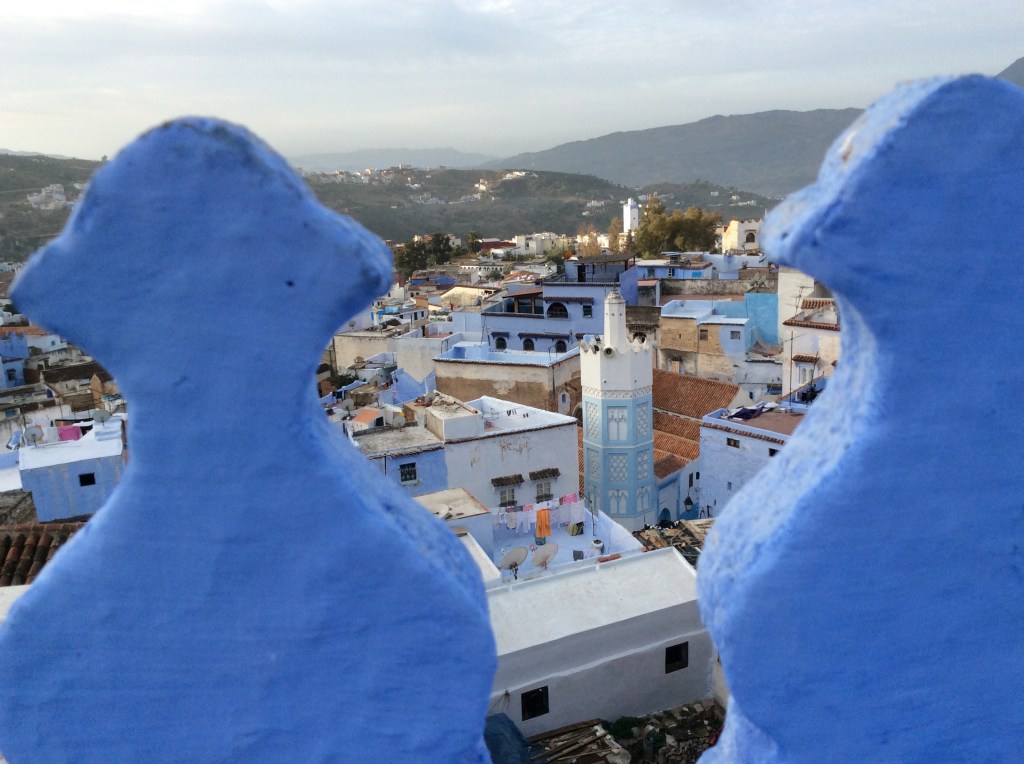
It’s a blue world in Chefchaouen, the small city of narrow, winding streets in the Riff mountains of northern Morocco. The blues here tell the story of the Jews who left Spain when in 1492 the monarchs, Isabel and Ferdinand, throwing off five hundred years of Muslim control, required Jews to leave or to convert to Christianity. Many Jews left behind their property at that time and migrated to Morocco, with many settling in Chefchaouen.

Though most of the Jews have left Chefchaouen now, immigrating to Israel and elsewhere after Morocco attained independence in 1956, the city is still blue. This is because the citizens have painted the walls various blue shades. Morocco can get very hot in the summer with temperatures reaching 40 degrees Celsius. The cool colors make the temperature feel cooler, and the blue color is thought by some to help keep mosquitos away. In Andalusia, in southern Spain, people painted their city walls, and the tradition was carried on when the Jews arrived in Morocco. Today, people come to visit Chefchaouen because its walls sing the blues in myriad tones. People come because Chefchaouen is beautiful.

What you want to do in Chefchaoen is wander the streets and discover its nooks where a fountain may flow out from a royal blue wall, or stand inside the blues that reflect off each other in narrow alleys, shining out from a street painted with moons and stars, blues that curl into quiet corners. The blues of Chefchaoen create a peaceful state. “Where are you from?” asks a man standing in the door where the community oven is located. We tell him, and he says, “Welcome to my country.” All over Morocco I’ve been asked this question, and always the reply is “Welcome to my country.”

It’s not just a saying. Morocco is a welcoming country. Just recently, Jews of New York City acknowledged Morocco’s extension of welcome and refuge to Jews during World War Two. Moroccan culture, like cultures in other Muslim countries I have visited, is generous spirited and open hearted. Always when visiting, and often when doing business, people offer you tea. I was taking a photo of my husband in a small street in Chefchaouen, and didn’t see a woman walking there, who stopped and waited while I took the photo. I was filled with delight at the beauty of the place. When I lifted my eye from the camera lens, I saw the woman and apologized. Her response was to smile. She reached out her hand, placed it on my heart, still smiling, and said a few words as she walked on, brushing gently by in her cream colored robe as she continued down the street. Though I hadn’t understood her words, I understood her intent, and felt I had been blessed.

Walking through the central plaza, I see a mother holding her baby close in her arms. Bent tenderly toward the child, over and over she speaks . An hour later, I stroll back through the same area, and she is still there, still cradling her small child in her arms. Wrapped snug in warm blankets and crooned to, this child is dearly loved, at peace. Islam means submission to God. The root of the word is the same as is used in the Arabic greeting, “Assalamualaikum,” meaning “Peace be with you.” Implied, is the idea that to submit to God is to submit to peace.  There is lots of business in Chefchaouen, people selling their wares, vegetable markets, people hanging out their laundry. Old men in jellabiyas tap along the stony pavement with their canes, women hang out the laundry atop the roofs. Amidst the activity of daily life, prayer call drifts across the streets. The people of Chefchaoen, continue on in their beautiful town, practicing a way of peace.


pilgrimage, place, poetry, spirtuality, Uncategorized

To Bodhgaya and Beyond

The great story weaves closer and closer, millions of
touches, wide spaces lying out in the open,
huddles of brush and grass, all the little lives.

–William Stafford, from “Over in Montana”

IMG_9362
Buddha on the side of the temple at Bodhgaya

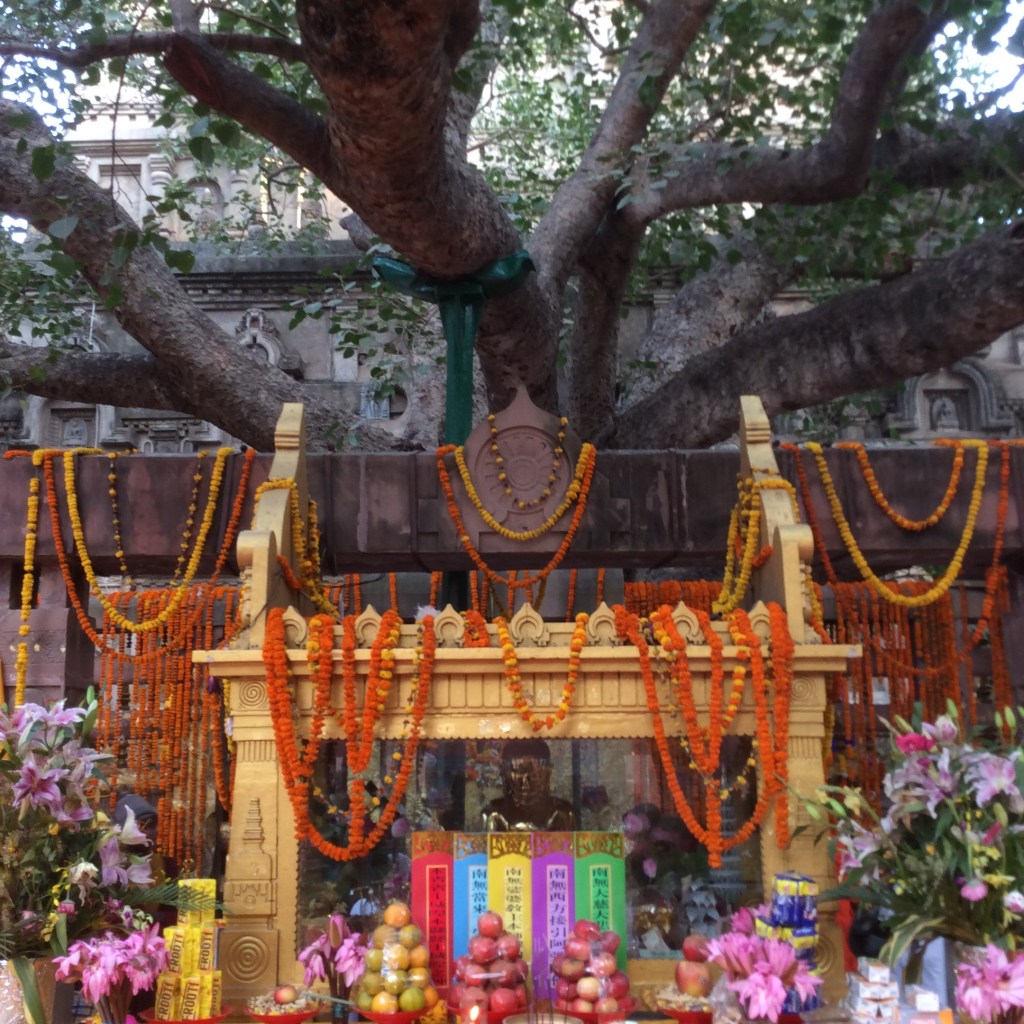
Bodhgaya, India, is the place where the Buddha attained enlightenment after forty-nine days of meditation under the ficus, otherwise known as the Bodhi tree, a tree related to the mulberry. Because Bodhgaya is a place of historical significance,  I wanted to visit it while living in India. Two weekends ago, I had that opportunity.

The Bodhi tree is a ficus religiosa . Its leaves, even without a breeze, are said to be continuously moving. “O Ashvatha, I honor you whose leaves are always moving…,” says a verse in the Bhagavad Gita about the tree. Gods are thought to live in the leaves causing them to move, and thus the official name, ficus religiosa–the religious fig. The name fits, in particular for the bodhi tree in Gaya. Though the tree standing in Bodhgaya now isn’t the actual tree the Buddha sat under, it’s a relative. Sanghamitta, the daughter of the 3rd century BC Indian emperor, Ashoka’s, brought a branch of the original tree the Buddha sat under to Sri Lanka and planted it in Anuradhapura. The original tree was destroyed, how is uncertain. There are various versions (see more here) of how this occurred, though most accounts state that the a shoot from the Sri Lanka tree was brought back to India and replanted at the original spot.

IMG_9405
Bodhi tree, Gaya, India, where the Buddha attained enlightenment

Bodhgaya is a holy site and a pilgrimage destination. One of the things that struck me the most while in Bodhgaya, was how many distinctive faces I saw as I sat near the tree, observing as people made their circumambulation around the shrine. Many visiting were monks and nuns performing ritual prayers, but others were like me, there to stand in a place considered holy, and to absorb what it had to share. For all the crowds, the place still manages to have a sense of calm, probably because so many there are intent on doing their prostrations and sending up prayers.

IMG_9367

It struck me how similar people are in the way they express devotion or carry out holy acts, though they are from different religions. Burning candles and incense, offering prayers, bowing down, ringing bells, bringing flowers,–these are commonly used in acts of worship in many religions. Bodhgaya attracts a wide spectrum of people from Buddhist countries, but people from many walks of life and countries in various parts of the world had come to stand in the spot where so many before have journeyed to send up their hearts’ longings–or possibly to set them down. Possibly, however, some pilgrims had come simply with an openness, willing to receive whatever understanding their minds brought to them while standing there, listening to their heart’s inner whisperings.

I’ve been learning about Buddhism, since arriving in India nine years ago, and somehow I expected to feel moved while standing in such a holy place. Instead, I found myself noticing people’s feet, and thought of the many journeys people had taken to arrive at this place where our lives briefly intersected with a smile or a short glimpse.

Once surrounded by forest, Bodhgaya it is now a city with apartments, shops, restaurants and hotels. To imagine the place as it was when the Buddha spent time there requires you to stretch your imagination. People continue to come to this place, because they wish to make a connection with the long chain of seekers, hoping to gain insight into how to live.

Pilgrimages are taken for many reasons, but one important reason is to the desire to expand beyond the boundaries one currently lives in– to break through the skin into something new, perhaps as the snake does when it sheds its old skin because it has grown bigger. Thoreau, purposefully set out to let his soul grow bigger when he spent a year living outside of Cambridge, Massachusetts on Walden Pond and wrote his famous meditations on living known as Walden. Thoreau speaks to the those of us who have felt the desire to step out of the hamster cage of events that keep us continuously rolling, and who long to live meaningfully. “Every man is tasked to make his life, even in its details, worthy of the contemplation of his most elevated and critical hour,” Thoreau asserts, and we are led to explore the idea that every life is worthy contemplation, of spending time reflecting on what our actions mean. This act isn’t meant to benefit just a few lucky ones who can take the time off to do so. We can do this daily as when we give our full attention to whatever it is we are doing, wherever we are walking or sitting. Listening deeply to those we are in relationship, listening to the world we walk through allows us to sense the holiness of life itself underneath the surface of all that is.

While wandering through the temple grounds at Bodhgaya, I read a quote on a plaque. The quote’s first portion eludes me, but the second portion read something like “Now I enter the forest of my old age,” and it struck me as a metaphor for transformation in general. We may have been walking through a plain before where things could be easily seen, but when we change, we enter a forest. Things aren’t necessarily easily found or understood. Perhaps we are even purposefully looking for a different path from the paths we once knew or walked. A whole new life can appear. As we age, though, I think of forests in the fall, flames arising from the myriad leaf faces, the sugar inside burning before the leaves let go to the earth.

Thoreau chose to go to the woods, and set aside a year to live in a small cabin on Walden Pond. Many of us can’t do that, or at least don’t feel it’s possible until reaching such an age where regular work ceases. Thoreau bravely took time out to consider to look for life before old age.  Thoreau chose to live simply during his year away, in order to find what it is that matters in life. He went to the woods, he said “because I wished to live deliberately, to front only the essential facts of life, and see if I could not learn what it had to teach, and not, when I came to die, discover that I had not lived. I did not wish to live what was not life, living is so dear; nor did I wish to practice resignation, unless it was quite necessary. I wanted to live deep and suck out all the marrow of life, to live so sturdily and Spartan- like as to put to rout all that was not life, to cut a broad swath and shave close, to drive life into a corner, and reduce it to its lowest terms, and, if it proved to be mean, why then to get the whole and genuine meanness of it, and publish its meanness to the world; or if it were sublime, to know it by experience, and be able to give a true account of it in my next excursion.” This is a brave statement. It requires an openness to life, to what you might understand if you listen to the world around you, including listen to the physical world.

The Buddha, as well, encouraged people to let go of their attachments in order to find life. We may be born in one place, have a particular history or speak a certain language, but we need each other’s differences. The interconnected nature of our physical environment itself demonstrates this reality. Other people in other places with perspectives different from our own have experiences worth listening to, insights worth understanding. I notice fear is such a strong motivating force in the media but it creates so much suffering. The Buddha’s path began with a question, “How do I relieve suffering?” What if we were to live differently? What if everyday in recognition of life’s dearness we deliberately asked “How do I live so I learn what life has to teach me today? How do I live today so that I don’t discover when I come to die that I’ve never lived?”

James Wright, in his poem “The Blessing,” shows the reader what it is like to live attentive to the details before us as he describes his encounter with ponies off the side of highway in Rochester, Minnesota who “have come gladly out of the willows/ To welcome my friend and me.” The ponies greet he and his friend with “shy bows,” then begin munching the grass again, as they have been all day. As the speaker of the poem carefully observes them, he becomes aware of the wonder breathing beneath the experience, “…Suddenly I realize/ That if I stepped out of my body I would break/ Into blossom.” We become more than we are when we let ourselves experience that we are connected to all that is.

May we all break into blossom.

IMG_9318


art, Looking For..., place

The Found Art of Hampi, India

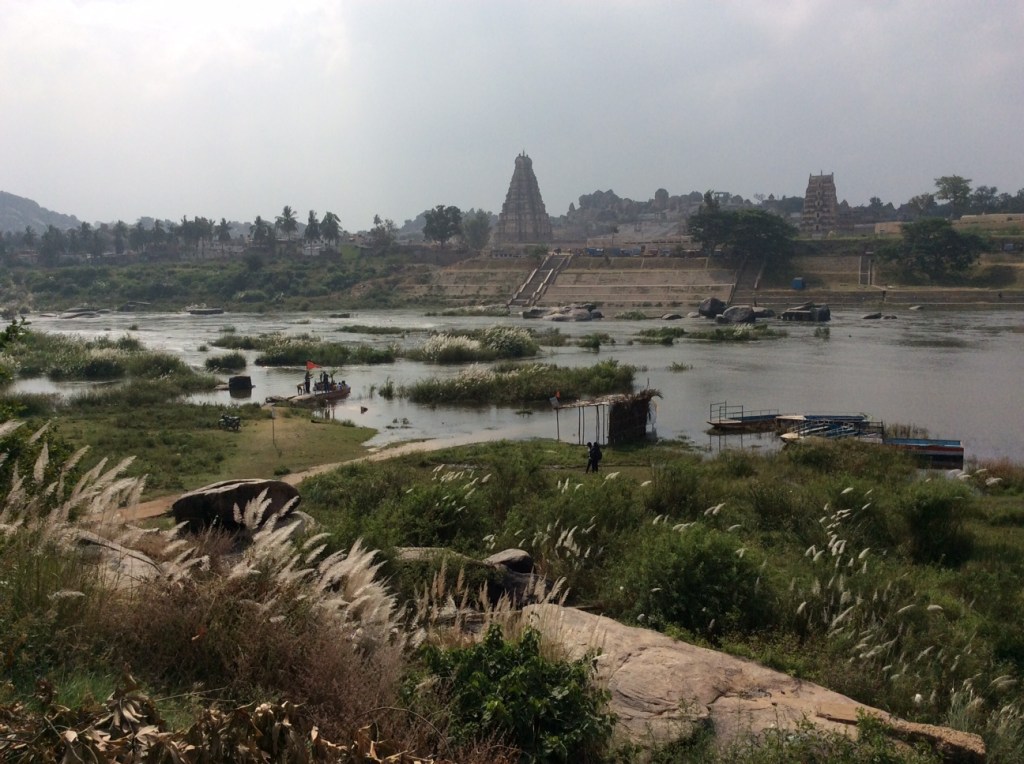
IMG_8615
Hampi from the Tungabhadra River

A plain dotted with trees and scattered with boulders, Hampi in the Indian state, Karnataka, is a beautiful landscape. My recent visit there during the Diwali holiday allowed me to wander into India’s rural outback, and to laze against sun heated granite by the Tungabhadra River. During the 1500s, the Vijayanagar had a population of 500,000. The empire covered the entire southern portion of India, but Deccan Plateau sultans joined together and defeated the Vijayanagar army. The temples’ treasures were carried off as loot, much of the population was killed, and of those who weren’t killed, many fled. One of the world’s mightiest kingdoms fell to ruin, and gradually into obscurity.

Four hundred years later, Robert Sewell, a British civil servant stationed in India, wrote about the empire in his book, A Forgotten Empire Vijayanagar: A Contribution to the History of India. Much later, in 1986, Hampi became a UNESCO World Heritage site.

In addition to being a World Heritage site, Hampi is also a place of important religious significance for Hindus. As the stories describe, Hampi is the hill where Shiva, the god of destruction, did penance before marrying Pampa. After Shiva married, the gods poured gold onto the Heamakuta hill. According to the Hampi India website, Heamakuta, means heap of gold.

Hampi’s temples and ruins are spread over more than 10 square miles, or 25 square kilometers. There is much to see, and the carvings are fantastic. Though a place of enormous significance for many people on the subcontinent in the 1400 and 1500s, Hampi and the Vijayanagar empire are mostly unknown to people outside of India. As I walked along near the queen’s palace, I ran my hand along one of the carved walls. “My hands are touching history,” I thought to myself. “My hands touch what the ancients have touched, yet I understand so little.” Whether at a ruins of an ancient empire, or walking down the street of our hometown, our lives are enveloped in mysteries. We just don’t often recognize it.

After our day of exploration at the ruins, we went on a walk on the grounds near our hotel. We stepped across bamboo bridges stretching over the river, looped up across massive granite faces. Turning a corner, we tucked ourselves through a wooden door between leaning rock slabs. As we stepped inside, it seemed we had entered into a rock cathedral with windows of sky beaming through the stacked boulders. We continued climbing a short distance to an opening where we stood, at last, to view the valley spread before us in a 360 degree view. It was as if we had entered a secret door that enabled us to see the whole world. What a wonder it was, too–a plain filled with trees, and a river meandering through it with granite boulders balancing in precarious positions and leaning agains each other in dramatic angles. Nature like this is not a site often seen when living in one of the world’s mega cites like Delhi. We scanned our eyes across the landscape, fishing for greenery, for sky, for what we didn’t even know how to name. Our hearts simply opened to the world, and when we left the hilltop, we knew something inside us had shifted. We were lighter, and ,paradoxically, somehow more solid. Nature writer Barry Lopez says, “real beauty is so deep you have to move into darkness to understand it.” This is because when beauty touches you, you slip into a place that is beyond rational thought and abstraction. The divisions between the physical and spiritual worlds collapse into one unified presence. That presence is far bigger than the mind can hold. You are humbled and made whole again.

IMG_9022

The beauty of Hampi’s temples is definitely worth traveling a long distance to see. The setting of the ruins themselves, though, is what sets Hampi apart from other locations. In this landscape, you can learn that everywhere is a temple if we have eyes to see it. To be there is to walk around in a colossal expanse of found sculpture, an installation art piece of gargantuan proportions, the origins prehistorical. Everywhere I looked, I saw art emerging from the earth.

The earth is in an ongoing creative act. If you listen, you can hear it speak through its myriad forms. The wind in palm trees chatters with stiff, clattering branches. Wind through bamboo scratches and cracks like arthritic bones. Wind through neem trees speaks with a restless, dry and fragile sound like crinkled onion skins. The earth tells its stories.

In my continuing desire to learn Spanish, I’m reading Mary Pope Osborne’s Magic Treehouse book series in Spanish. Currently, I’m reading Una momia al amanecer, or in English, A Mummy at Daybreak. The children in the novel, Annie and Jack, learn how the Egyptians “tried to protect the body against death by preserving it for eternity.” (p. 45) Travel to the Vijayanagar empire’s ruins, however, assures the visitor that empires are temporary. All we have can be lost in a moment. Even stone wears away and topples. In Hindi, Vijay means victory. Victory, if found, is elsewhere, not in empires.

The final stanza of Louise Gluck’s poem “Summer Nights” reads,

Balm of summer night, balm of the ordinary,
imperial joy and sorrow of human existence,
the dreamed as well as the lived–
what could be dearer than this, given the closeness of death?

Life is so dear, and life is full of both imperial joy as well as sorrow. You don’t seem to get one without getting the other too, at least that is what I’ve observed from living in India. Everything is being destroyed and made at the same time. Maybe that is, in part, why art is necessary. It reminds us that we participate in the creative act of life. Perhaps this is why temples have so much art. Religion means to rebind, and the creative act helps us to re-member–to put our selves together again.

Uncategorized

A Story in Ceramic: The Mad Hatter’s Wife

Mad Hatter's Wife teapot front
Mad Hatter’s Wife teapot

“Everything is held together with stories. That is all that is holding us together, stories and compassion.”

–Barry Lopez

The newest ceramic collaboration between my husband, Michael, and I came out of the kiln this week. Last spring I wrote about painting on this piece, The Mad Hatter’s Wife teapot. She was only half baked before, so to speak, but after sitting for the summer, she’s now fully cooked and ready for the world. Michael made the piece, explained that she was the Mad Hatter’s wife, then told me he was giving it to me to paint my masterpiece. When I heard that, I knew I had to push myself to do something more than what I’d done before. I began imagining what a woman would have to be like if she were married to someone who was crazy.  She already had bold features and a sassy gesture with her hand on her hip, inferring she knew how to deal with whatever she might be confronted with. She’d also need to draw on the power of nature–the sun, moon, stars, and rivers to keep herself together through whatever came her way. She’d be a free spirit, not bound by expectations of others, but instead acting out of the inner resources of herself  in order to keep sane. This would mean that her inner child would be very much alive. Flowers, creativity spirals, humming birds, bees, a river of hearts, blue nazar to keep away the evil, wild colors and patterns–they all weave together in her mind, part of the fruit in the garden of her inner self.

I’ve not yet come up with her name–perhaps readers can suggest a name. Maybe it is Norma (meaning of the north) as her hair is blond, and looks windblown. She’s not a tidy woman. She is, however, alive with spontaneity and she never wears hats–even in the winter. Her hair has to move. She’s got a heart-shaped bindi on her forehead, and hearts on her finger tips. Whatever she touches is imprinted with heart. Jewels encircle her arms, and the sun explodes off her hip in a sunflower burst. Yes, she’s a force to contend with. The Mad Hatter knows this of course. Life with her scintillates with energy. Her tea always tastes good.

Barry Lopez in his children’s book, Crow and Weasel, says, “Sometimes a person needs a story more than food to stay alive. That is why we put these stories in each other’s memories. This is how people care for themselves.” The story I invented for the Mad Hatter’s Wife, and the act of painting itself restores. I’ve painted this teapot, and like all the work of done with drawing or painting, I surprise myself each time that what I am making approaches what I am hoping for. I don’t think the teapot is my masterpiece yet, but it is compared to what I’ve done previously. I love how the subject has got me thinking of stories behind the stories we know. How is it we survive the craziness of the world? This is what painting on the Mad Hatter’s Wife got me thinking about.

People go to places like the Rothko Chapel in Houston to meditate, the dark colors bringing them into a deep interior space where in that quietness they can reconnect with the stillness that lies underneath experiences, a different story with a presence waiting to be heard. Jane Hirschfield, in her book, Ten Windows, says in her preface, “Good art is a truing of vision, in the way a saw is trued in the saw shop, to cut more cleanly. It is also a changing of vision. Entering a good poem a person feels, tastes, hears, thinks, and sees in altered ways. Why ask art into a life at all, if not to be transformed and enlarged, by its presence and mysterious means… “And by changing selves, one by one, art changes also the outer world that selves create and share.” This is what happens to me when I sit down to paint or to write; I am transformed, and something in the act of creating compels me to return again and again. It is a spring of water that refreshes. We enter into the world of creating and we are made new. This is why tea from the Mad Hatter’s Wife teapot is so restorative. You drink it, and you take time to reconnect to that time when you were a child rolling down a hillside of grass, climbing a hillside and lazing on a granite stone for an hour, listening to the wind as it moved a dead branch, watching as birds circle overhead. You know that place inside, and making art takes you there again to rediscover the way you interconnect to the world, the way life moves through you–the gift it is to be alive.

poetry, spirtuality

Awaiting a Renaissance of Wonder, Varanasi’s Portal

FullSizeRender (24)
Ganges River, Varanasi

I AM WAITING 

I am waiting for my case to come up
and I am waiting
for a rebirth of wonder
and I am waiting for someone
to really discover America
and wail
and I am waiting
for the discovery
of a new symbolic western frontier
and I am waiting
for the American Eagle
to really spread its wings
and straighten up and fly right
and I am waiting
for the Age of Anxiety
to drop dead
and I am waiting
for the war to be fought
which will make the world safe
for anarchy
and I am waiting
for the final withering away
of all governments
and I am perpetually awaiting

a rebirth of wonder

(See the full poem here)

Days before leaving for the Hindu holy city of Varanasi, I read Ferlinghetti’s poem from his book, Coney Island of the Mind. The poem ends, “and I am awaiting/ perpetually and forever/a renaissance of wonder.”  Ferlinghetti repeats a variation of these words at the end of each stanza, and since reading them, I can’t get the poem out of my mind, especially since visiting Varanasi where you don’t have to turn a corner to be surprised by wonder. Wonder walks down every street, floats down the river, and fills the sky with light and smoke. The Celts believed there are certain places on earth where the veil between heaven on earth is so thin that you can see through to the other side. Varanasi is such a place.

A city inhabited for 5,000 years, Varanasi is a stoop-backed, broken down, broken open ancient place where life, death, joy and suffering live openly side by side. Its narrow, (approximately) four foot wide streets spill over with foot traffic, broken brick, refuse, water, cows, cow pies, motorcycles, bicycles, and pilgrims, all hoping to move. Waiting in long lines winding through the humid streets in 40 Celsius (104 Fahrenheit) degree heat holding offerings of flowers, rice and red tika powder, pilgrims wait for hours to enter temples. Though it might not fit my ideal of how I want heaven’s portal to look or be, Varanasi embodies how things likely come to be at the end of one’s life: poor–left with nothing in the end but our failing bodies, bent down in humility, and waiting to be released into the elsewhere. Varansi is one of India’s most holy cities. Though there is suffering most everywhere you look in India, suffering, for Hindus, meets its end on the banks of the Ganges. To die in Varanasi and have your ashes cast into the river is to enter moksha–to never have to be reborn again into the cycle of birth and death. Death after death, millenia after millenia, this 2,525 km/ 1,569 mile river absorbs the ashes of a multitude of suffering and more.

For the Hindus, the Ganaga (Ganges) is sacred–a goddess. According to the World Wildlife Federation, “Approximately 1 in 12 people in the world (8%) live in its catchment area…Together the Brahmaputra and Ganges water sheds span 10 biomes and contain the widest diversity of all large river systems.”The river supports somewhere around 500 million people. Nevertheless, “Every day, over 3 billion litres of pollution, mostly toxic chemicals and untreated sewage, enters the Ganga, putting countless lives at stake,” Reports the Global Alliance for the Rights of Nature. Watch this 20 minute National Geographic Live, Chasing Rivers, Part 2, The Ganges, and you will see a fascinating and  fantastic insightful, and powerfully engaging look into the Ganges, its social and religious significance, as well as the environmental issues surrounding it.

The word sacred means to be set apart, while the English word, holy, or whole, uninjured “that must be preserved whole or intact, that cannot be transgressed or violated,” according to the Online Etymology Dictionary. Alongside this river of life flowing down from the high Himalaya and our desire to be released from suffering, flows the river of our industrialized and overpopulated world with its humming electric wires and ever charging lithium batteries in our iPads and cellphones. Sewage, chemicals from leather production–all go into the river, the goddess who can take it all, because she is, after all, a goddess, is the thought of some.

At some point while growing up, I remember hearing that in days gone by people didn’t place anything on top of their Bibles because they were thought to be sacred. Similar to this notion of treating the sacred differently, when visiting an ancient temple on the island of Samos in Greece, I recall being asked to remove my shoes because the area was still considered sacred, even though people no longer worshiped the gods that were once housed in that temple. What makes something sacred involves an awareness, a setting apart and a setting aside. We do this with portions of the earth that we decide are special in some way. The Monterrey Bay in California is one of these areas. After decades of abuse resulting from pollutants and over fishing was made into a marine sanctuary, the Monterrey Bay is now a place where sea life thrives, and where “Every summer, a vast array of animals travel thousands of miles to reach the waters of the Monterey Bay — home to one of the biggest wildlife gatherings on Earth,” according to the Mercury News article, ‘”Big Blue Live’: Monterrey Bay to star in its own ‘Reality Show.'” (You can see more about this documentary here.) In the Monterrey Bay, you can find “humpback whales, blue whales, sea lions, dolphins, elephant seals, sea otters, great white sharks, shearwaters, and brown pelicans,” says the PBS, who, together with BBC, is creating the Big Blue Live documentary on this wildlife gathering. The sacredness of something requires our recognizing its sacredness and treating it as such. This is what has happened in the Monterrey Bay, and it has made a difference. Treating something as sacred can include holy practices in offerings of flowers and light, but as understanding of our interaction with the world grows, it can also include doing other things such as protecting the life in a bay or river and that demonstrate our respect.

According to the The World Bank’s site on “The National Ganga River Basin Project,” domestic sewage accounts for 70-80 percent of the wastewater that flows into the Ganga, Industrial effluents add another 15 percent, with far-reaching impacts on human and aquatic health due to their toxic nature. And, in the absence of adequate solid waste management in most cities, mounds of uncollected garbage add to the pervasive pollution.” Along with prayers, ritual bathing and offerings, waste water management, controlling industrial pollution, and making and enforcing guidelines regarding development along the banks, are all things people can do to show their recognition of the river as sacred. To keep it whole and healthy, the Ganges, like the Monterrey Bay can be treated like a sanctuary.

“The world is charged with the grandeur of God,” wrote Hopkins, in his poem, “God’s Grandeur.

Generations have trod, have trod, have trod;
    And all is seared with trade; bleared, smeared with toil;
    And wears man’s smudge and shares man’s smell: the soil
Is bare now, nor can foot feel, being shod.

And for all this, nature is never spent;

Nowadays, National Geographic discusses the dead zones in our oceans. If you look at the facts regarding places like the Ganges, and other rivers around the world, you will notice everywhere the blight we’ve left upon God’s grandeur. When we no longer recognize a reality larger than ourselves, God’s grandeur gets harder and harder to see. We aren’t choosing to notice it. As a result, we lose an understanding of what is sacred. In this context, Nietzche’s idea that man’s self-centeredness had killed God makes sense. If you look at the worst polluted places in the world the pollution is created because of human action. In Varanasi, the amount of wood needed to cremate bodies in Varanasi causes deforestation, according to Living On Earth’s article “Ritual and Deforestation in India.” To burn a body takes about a 1,00o pounds of wood. It’s also true that soap used for washing in the Ganga’s water causes pollution. The bigger polluters, however, are industries. If industries do not recognize the sacred that is because those who own and control them are looking to see profits instead of God’s grandeur. Religion could provide a motivation, but regulations are needed.

In his poem, “Poet as Fisherman,” Ferlinghetti writes about the fisherman out on the sea, looking out and “listening for the sound of the universe,”

Whole poems whole dictionaries
rolled up in a thunderclap
And every sunset an action painting
and every cloud a book of shadows
through which wildly fly
the vowels of birds about to cry

The earth speaks to us when we are listening. When nearing death, Hindus want to go down to the water–the earthly element of transformation. Something in us intuitively understands our connection to the earth helps us understand the sacred. Entering the water, the body lets go and opens itself to the ultimate transformation–death. Birth in death, death in birth. This is always the way in India–opposites are bound together–so perhaps out of the death of rivers, an awareness can be born: the need everywhere for people to find the sacred again. We find that awareness, at least in part, through choosing to set aside our self-centeredness, and to recognize the intrinsic value of nature and our connection to it.

Through the centuries, poets have drawn nature as a central source of inspiration and metaphor. Poetry explores where the sacred touches the earth, touches the heart. Our current inability to recognize the sacredness of the earth seems connected in my mind to why poetry is so little read or valued today. Buddhist affirm the interdependence of all things, Hindus, that there is a bit of God in all things. The Psalms state, “The heavens declare the glory of God, and the firmament shows his handiwork.” When you love someone, you show him or her respect. You take care of the person. You listen, you look for a way to touch the person, to connect. We barely look at the night sky these days, however, or notice the moon, what the trees have to say in the afternoon, or notice the way “the sun streaming down/ in the meshes of morning,” as Ferlinghetti describes dawn in his poem, “Uses of Poetry.” Poetry, like dance or art, can help us connect again, help us find the sacred.

My last morning in Varanasi, I rose before dawn to travel down river to watch a ceremony honoring the sun. Men dressed in magenta silk stood on risers facing east. Lifting brass cobras with flames leaping from their bellies, the men swung them in slow, repeated circles while at the side of the audience women sang hypnotic mantras with humming vowel sounds, interrupted in intervals by the men on the risers ringing handbells for minutes at a time. Gradually, the night’s dark turned to dusky apricot, then blazing gold. The sun emerged above the horizon, and struck its rays across the water. There, amidst the funeral pyres and bathers, the worshipers raised their arms to hail surya, the sun, the life giver. I thought of the intensity of the previous day’s heat, the struggle and effort so many took to come to this city, the effort it takes so many in India just to live. As I watched a man slowly row his boat across the illuminated gold water, I breathed in the smoke of death from the funeral pyres, the loss, the heat, and breathed it out again with a new awareness and respect for the sun, for the earth. The ceremony had made the space between this world and the next a little thinner. In spite of the earth’s worn and weary state, in this city, its beauty is still visible.

If we want to rediscover the sacred, perhaps something in us, in our way of living must die in order for us to receive it. For a little while, I am here on this planet. With my words, with my whole self, I am trying to learn how to listen to the world, and as Ferlinghetti states, “I am perpetually awaiting/ a rebirth of wonder.”

Street side well
Streetside well, Varanisi
Uncategorized

Black Mold and Bravery

Black mold has invaded our apartment and is growing in the walls. For days now I’ve not slept well. First workers came and pulled off the tiles in the bathroom to fix the leaky pipe, releasing the reeking smell into the air. They have since tiled the wall back in this week, but the caustic smell is still there. The mold is masked, but continues on inside the wall and is pushing its way through into the living room.

Clearly, the mold had been there for some time, though we didn’t realize it. Red or puffy eyes in the morning, wheezing at night, draining sinuses, rashes on the skin, and yes, even hair loss, which I’ve been noticing for some time now and wondering why it is happening, these (and more) are the signs of reaction to mold, but because we couldn’t see it, we didn’t know the mold was growing behind the walls until the neighbors complained their walls were showing stains.

When the workers broke open the walls they released the toxic smells. Recently, a colleague and I were discussing how we might get better at connecting with people and situations we found difficult in our work. She asked if I had listened to Brene Brown‘s TED talk “The Gift of Imperfection.” I hadn’t, but went home that evening and listened to several of her talks. One of Brown’s statements, out of many that resonate with me is this: “Unused creativity is not benign; it metastasizes. It turns into grief, judgement, sorrow, and shame.” I thought of the mold behind the wall. A pipe behind a wall leaks. You don’t realize it, but the mold begins growing, and eventually you have a problem you can’t fix simply by breaking open the tile, repairing the leak, and then tiling the wall back up. The mold is growing now, and you’ve got to remove it and create something new.

Since the apartment I live in isn’t mine, I don’t get to make the choice about removing the mold growing in the wall or covering it back up with tile, however. The choice of putting something in the wall that kills the mold, or to mask it with clorox instead, isn’t mine. As I lie in the bed at night coughing, I think of the people everywhere who are living with mold or who have lived in oppressive environments.

When the Czech writer and illustrator Peter Sis, came to the American Embassy School here in Delhi several years back, he explained over dinner with a small group of teachers that he is a man without a country. The country he was born into, Czechoslovakia, no longer exists. Those words have echoed in my mind ever since. It took Odysseus 10 years to make it back home after the Trojan wars. That is a long time, but some people can never return home because there is no home to return to. There is suffering in situations like these. Once you are gone a decade from your home, you are changed. You might return home, but you won’t necessarily every be at home again as the world of home, like a ship under sail, continues on its own trajectory while you have been sailing along a different route encountering land and storms not like those you might have experienced had you stayed on the ship you began on. All seas are not the same.

When some people leave home, they don’t want to return, however. My husband’s grandparents came from Italy, but when asked if he would like to go on a trip with us to visit Italy, his father expressed absolutely no interest in it. “Why would I want to go there?” was his response. That was the end of the conversation. As someone who loves travel, is curious about the world, and wants to understand the roots I’m connected to, that statement perplexed me. Currently, I’m reading Milan Kundera‘s book of essays, Encounter.  In his essay, “Exile as Liberation According to Vera Linhartova,” Kundera quotes her saying, “The writer is above all a free person, and the obligation to preserve his independence against all constraints comes before any other consideration. And I mean not only the insane constraints imposed by an abusive political power, but the restrictions–all the harder to evade because they are well-intentioned–that cite a sense of duty to one’s country.” People have fled their countries because of war, have been exiled for their ideas or their writing. But some people don’t chose to return because greater than a bond to history or language, is the person’s desire to choose his or her own path, one that has given them what they sense to be a greater freedom, freedom they wouldn’t have if they returned to the world their history is rooted in. France allowed Linhartova’s creative freedom. Freedom is connected to struggle.

My husband’s grandparents gave up their lives in Italy, and struggled under great difficulty to make a life in the United States. Similar to Linhartova, remaining outside the country of their birth was a choice. The struggle to make a life in another country and culture allowed their children and grandchildren greater opportunity and freedom. Standing between two worlds, they found a home outside of the definitions of home they knew. They lived on the edge of great challenges and risk. Brene Brown says in her interview with Krista Tippett “The Courage to Be Vulnerable”  on Tippett’s site On Being, “The …beautiful thing I look back on in my life is coming out from underneath things I didn’t know I could come out from underneath…the moments that made me, were moments of struggle.” Our family’s Italian grandparents, like immigrants in general, were brave. Their stories aren’t without loss and grief, but they they followed the path that called to them, and today, without ever having met them, I feel gratitude for the daring their lives demonstrated in giving up the world they knew in exchange for a life still full of difficulty, but one lived with hope and a sense of possibility.

Living here in India, I constantly see people struggling for survival. I want the people I encounter to know they will get to eat every day, to be able to go to school, to realize they have stories worth telling and hearing, that their lives have meaning and their creative expression is valuable. But the poor of the world, and those without opportunity are often unseen and ignored. To go to school in Delhi, a child needs a uniform. Some families are too poor to buy the uniforms, and therefore, their children don’t attend school. There is need.

Outside the gates of our school here in Delhi this morning, children who live in the slum across the street waited to be measured for school uniforms that teachers here at our school are raising money to buy for them. Education will give these children opportunity.

John Ciardi, in his poem, “Matins,” writes about a poor woman who died on the streets of Paris,

It froze in Paris last night and a rag doll
that had been a woman too tattered-old to notice
turned up stiff on a bench. So the police,
who spend least on the living, paid to haul
nothing to nothing. She could have lived for a week
on what the bureau will spend on paper work;

The poem goes on to describe how more was spent on the woman after she died than it might have taken to help her live, and find how to give her a place in the world. Ciardi’s poem closes with these words:

…Every child
risked from love and held must be put down
to walk itself away, and turn by turn
become another. This dirty doll unheld
by any arm is one altar piece
from which mad Francis learned to be a priest.

It takes courage to notice the things in our lives and our world that aren’t going so well, that are like the mold growing behind the wall, and to move out into a life of challenge, but the possibility of greater freedom. If we continue to ignore those things that are eating away at us, however, or don’t give creative expression to it when it’s not in our power to change things, eventually the mold breaks through the wall and we’re no longer living in a life engendering place.

Inside the world of discomfort and the wreaking smell of mold, some are brave enough to break open walls and persevere as they reach to find a path with their lives that offers hope and makes a difference. Noticing the poverty around him is what called St. Francis to live his life under the vow of poverty, a life given to empathy and compassion that still touches our lives centuries later. The world could use more people as brave as he.

It is late afternoon and we have returned from the art room where my husband, Michael, holds an adult art afternoon on Sundays where many people (like myself) are exploring art for the first time, learning they can make things they didn’t know they could. Now he’s out in the community garden planting seeds because tonight is the blood moon, a rare lunar eclipse of a super moon, and a good time for planting, he says. It’s an effort, he explains, to make a healthy life for people. “To love ourselves and support each other in the process of becoming real is perhaps the greatest single act of daring greatly,” Brene Brown states. From organizing the effort to raise the funds for having the children’s uniforms made so they can go to school, to helping people discover ways to be creative, to planting seeds, to preparing this evening’s meal, which he is about to do, my husband is a man who day by day is following St. Francis’s path of giving himself to the world around him. If we are going to change the world, surely it will take each of us being faithful in the small things with those around us daily. As Mother Teresa said, “that is where our strength lies.”

Geography, place, Uncategorized

The Geographies That Shape Us

What are the geographies that have entered your heart? As we embark on our exploration of how the physical world affects culture, consider the ways that the places you have lived have shaped you and your understanding of the world.

Nature writer, Barry Lopez, in his book, About This Life, says “Over the years, one comes to measure a place, too, not just for the beauty it may give, the balminess of its breezes, the insouciance and relaxation it encourages, the sublime pleasures it offers, but for what it teaches. The way in which it alters our perception of the human. It is not so much that you want to return to indifferent or difficult places, but that you want to not forget.”

How has the cultures and your interactions with the physical environments in the places you’ve lived influenced and shaped the way you think and the experiences you have had? How might your reflection on this question guide the kinds of things you want to learn and discover about the country you are researching about?  How might your experiences help you focus your research, write up your understandings, and talk with the class about topics you think are personally meaningful and important?

Uncategorized

The Multiple Worlds and Wonders of India

Of all that God has shown me,
I can speak just the smallest word,
not more than a honeybee takes on her foot
from an overspilling jar.   Mechthild of Magdeburg

To live in India, and to ponder what it is one is experiencing when wandering out to explore what waits in the streets, is to be humbled. This is my ninth year living here in Delhi. There is a myriad of things still to see in India and a myriad more to understand–or realize I will never understand. India is immensely diverse with a long, long history. Though many things after nearly a decade of living here seem familiar to me now that are utterly different than the world I was born into–things such as buying groceries at street side stalls, monsoon heat and rain, dogs and cows wandering the streets, and erratic electricity–the more I experience and learn about India, the deeper the mystery of this culture goes until it seems I have entered the waters of the ocean and the universe beyond.

This past weekend I traveled to the state of Odisha (Orissa), and the cities of Bhubaneswar and Puri, one of India’s holiest cities. Traveling through these cities colorful streets full of ancient stone temples, is to enter a place wonder.

A few short kilometers from Bhubaneswar, we visited the Udayagiri and Khandagiri Jain caves, cut into two facing hills over 2,000 years ago. Ascetics once lived here, but now along with visitors and devotees, langur families roam the area, eating from shrubs, as well from the hands of the many Indian visitors to the temple atop the hill.

A bit over an hour’s drive down the coast from Bhubaneswar and north of the coastal city of Puri is the Konark Sun Temple. Made of  stone and facing the east-west direction, as if carrying the sun, the temple is a World Heritage site built in the 13th century. The temple’s shape is modeled after the giant cart that Hindus pull through city streets in various locations in India during religious festivals. Though no longer safe to enter the temple, it’s exterior carving is both extensive and beautiful. There must have been an enormous bank of skilled sculptors available in order to make the temple with its beautiful carvings–something that would be rare to find in most any place in the world today in such abundance.

Down the street from where I stayed with my husband and friends in Puri, is a crematorium–a holy place for Hindus. To be cremated in

Crematorium across from the beach

Puri is highly desired as it allows one to enter moksha and to be released from the cycle of life. Interestingly, directly across the street from Puri’s crematorium is the beach on the Bay of Bengal, crowded with people barbecuing fish, eating, shopping, and riding camels with a decorative red and gold cloth to sit on.The waves stretch along the coast beside Puri, though no one is swimming, preferring the activity on the shore. This is not a country or culture that isolates death from the ongoing experience of life. Death while necessary, it’s very presence is woven into the fabric of the town’s hotels and seaside attractions, as a natural partner to other activities such as a barbecue or a seaside stroll.

South of Puri, along the coast, lies Chilka Lake, one of Asia’s major areas for bird migration and nesting. The road to Chilka Lake from Puri, wanders through a wetland area of trees, verdant green rice fields, and buffalo watering holes. Black dolphin live in the lake, and you can see them on a boat ride that takes you out to where the lake opens into the sea. On our boat ride, we got caught in a monsoon downpour. As the sky turned dark and the thunder rolled, we crouched behind umbrellas, hoping to stave off some of the rain and sea spray. At the lake’s opening to the Bay of Bengal, we pulled up to the shore and climbed off the boat to huddle under a palm leaf hut with plastic tarp, watching the wind blow and the rainwater drain off the roof as the boat driver wrung the water from his shirt. Locals working at the tea hut knocked open oysters and pulled out perfect pearls time after time as well as stones hoping to sell us a few. I never saw clams produce shaped and polished stones before, but people on other boats believed it was possible, and willing bought the jewels.

Later, we headed back to Puri, to the Jagannath temple–the Lord of the Universe’s home on earth: Vishnu’s abode. The temple, according to the Jagannath temple information site, has 6,000 priests, as well as the largest kitchen in the world, where it has prepared meals for 1,000,000 people on festival days and frequently up to 25,000 on other days. If you are Hindu, you can enter the temple, but if you aren’t, even from outside the temple there is a world of wonders to see because half of India seems to be gathered there in a celebratory mood–balloon, flute and toy sellers, fruit sellers with their carts, a woman selling grass for the wandering cattle, devotees washing themselves, beggars with open palms–all part of the throng in the plaza and funneling toward the temple gate.

The temple complex is large, covering an area of 10.7 acres, and as I circumnavigated its walls, I got a glimpse of an idea of the world inside. A group of men wearing white and clanging a bell trudged by carrying a wooden plank decorated with flowers, women wearing gold colored saris walked by in a group, and everywhere food sellers pandered their wares and cows wandered the streets. On the opposite side of the street from the temple, were the broken-off walls of apartment buildings and shops where some men worked to rebuild the half dilapidated walls, while others sledge hammer in hand heaved into walls, blow by blow hoping to bring them down.  One thing was certain: I was in a different world. No sterile streets with trimmed hedges and clipped lawns here, no malls or neat and tidy traffic flowing to regulated lights. Instead, a cacophony of human activity filled the world on all sides. Here, the world was turned inside out. You can literally see inside houses, and everything appeared to be in a state of simultaneous construction and deconstruction–which is actually a pretty good physical embodiment of what is actually happening at any particular point in time or history. Things have a way of breaking open and breaking out of the boxes they are put in. Life, like many things found in India, is bigger than the boundaries we build to contain it. It spills out and pours over–is larger than what we can define or name. Order is there beneath the change we experience, but the birth and death of everything is happening all at once right before your eyes.

Like some kind a satellite, asteroid or meteorite from a world other than the one people in Puri were familiar with, I circled the Jagannath temple, my eyes absorbing what my mind had the tiniest fragment of comprehension of. Here is a world to itself, one that doesn’t care that your your hair is falling out, that you once held an athletic record, that you aren’t able to walk as you used to, that you can sing, dance or draw, that you might be unable to do what someone else does or thinks is important. These are things of the world you might have been born into or come from but none of this matters when you cross into another world, and clearly the space around the Jagannath temple is another world. If it is possible to be reborn into another life without dying, than certainly, that is what occurred. Doorways mark the liminal spaces between two worlds, and to stand outside the Jagannath temple amongst the honk of mopeds, the cows and dogs lazing in the streets, the clanging bells, marigold offerings, and the sun casting a golden light across the street is to definitely see into a different reality. This was no place anything I knew in my childhood would prepare me to know or understand. Except that it was wondrous.

There are things in this world far beyond our comprehension. This I knew as a child. I climbed the hill opposite from where I lived with my mother and two of my sisters when I was four, and when I looked back at where I came from, at the small house in the valley below, I knew my home in an entirely new way. Circling the Jagannath temple walls is one way that allows you to see where you call home in a new way if you call home a place other than India or Puri. Walking around the temple wall, you can glimpse into the universe of mysteries and to realize that of all the world holds, we know very little. The world, the universe is much bigger than our minds can hold. Birth is mystery, as is relationship–the fathomless bond of love. The intricate connections and interweaving of natural systems of animal life, of whales’ migration patterns, for example, serving to mix the ocean’s water columns and spreading nutrients, that according to National Geographic, enables more fish to eat and grow–just this one example of the vast natural systems that we interact with daily that have evolved over eons of which humans are just one part–all these things are working together, holding us up and together. These are far more powerful than the power of any ruler, government plan or force on earth. As in the poem I opened this post with, it’s good to be reminded of these things. We often get wrapped up in our small worlds and plans, in our way of seeing things, making it easy to forget our view is just one perspective in the wider, wilder world and universe we are a part of.

Comprehending the complexities of Hinduism takes an outsider an effort of serious study; but I can comprehend this: by living we partake in mystery.  We move from mystery to mystery as we move from birth to death, and isn’t this a fundamental truth to all religions–that we are not a world unto ourselves? Bruce Cockburn has a song you might enjoy listening to, “Lord of the Starfields.” I appreciated it for the awe it evokes with lyrics that begin like this:

Lord of the starfields
Ancient of Days
Universe Maker
Here’s a song in your praise

Wings of the storm cloud
Beginning and end
You make my heart leap
Like a banner in the wind

Uncategorized

Beauty and Justice

IMG_7053
Mountains in Abruzzo National Park

 “Man is hungry for beauty. There is a void.”—Oscar Wilde

In the streets of my Delhi neighborhood, workers are building new apartments. Women carry sand on their heads. Bricks are stacked on the walkway. Yesterday the populous celebrated Republic Day, and I was reading Pamela Timms’ book, Korma Kheer & Kismet, the chapter titled “Independence Day in Sadar Bazar” where she describes the civic protests of 2011 where social activist, Kisan Baburao “Anna” Hazare, began a hunger strike in protest of government corruption. Concerned with the amount of interest Hazare stirred up in the populace, prime minister of the time, Manmohan Singh responded, ‘”Corruption manifests itself in many forms. Funds meant for schemes for the welfare of the common man end up in the pocket of government officials. In some other instances, government discretion is used to favor a selected few. There are also cases where government contracts are wrongfully awarded to the wrong people. We cannot let such activities continue unchecked.”’ Hazare’s hunger strike began the day after the prime minister made the statement, reports Timms, and goes on to describe some of the corruptions in the system—food vendors paying as much as a quarter of their salaries to the police to be able to stay open, and rickshaw drivers paying as much as 20% of their salaries to police to prevent their tires from being slashed, families having to pay bribe money to secure a place for their child at school. (p. 55) (You can read an overview of large-scale corruption in India here if you wish.)

It’s no surprise that corruption is present not only in India. It is a worldwide problem in both businesses, see a list here of top business corruption cases, and governments. Take a look at the thematic map from Transparency International here, to see a visual representation of corruption levels in countries across the world. Justice doesn’t prevail. In many cases, it’s simply the way the world functions where people live, and the everyday person, if he or she wants to function in society, doesn’t have a lot of choice about it.

With corruption and misuse of power so widespread, an enormous percentage of people in the world are pawns to those who hold the power. How do people manage? How do people—any of us and all of us—caught in such systems go on living with good conscience? I remember listening to Garth Lenz describing on his TED Talk about the effects of mining for oil in Canada’s tar sands had on the native people of the area. Parents in that area are caught in the dilemma of needing to feed their children, yet the toxins in the river are causing cancers at the rate of 10 times what it is in other parts of Canada. Because it’s very costly to fly in all the food a person needs in order eat, the aboriginal people are forced to eat the food “..as a parent, I just can’t imagine what that does to your soul. And that’s what we’re doing,” says Lenz. (transcript available here.) Certainly there were people during the time of Spain’s inquisition, in Nazi Germany and in Pol Pot’s Cambodia who didn’t agree with the government’s position but felt compelled to go along with the crowd mentality for fear of their own lives and those of their children’s. Certainly, there are people today in our own institutions who disagree with the use of power and yet are afraid of speaking out for fear of losing their jobs and the livelihood for their families. Not everyone can just move on or move out to a new situation, new job, new country, new life, and even if that were possible, where might one live or work where corruption was not part of the way of life? We have to learn to live in a fallen world.

I’m reminded of Maria Mazziotti Gillan’s poem, “I Open a Box,” in her book, Ancestor’s Song, where she describes her Italian immigrant mother’s doctor coming to her New Jersey tenement to assist her in the delivery of her baby. He arrives late, and Gillan’s mother has already given birth, cut the umbilical cord, and washed her child. When the doctor finally arrives, he doesn’t even enter the room. Instead, he distances himself from the situation.

“He washed his hands, wiped
them on one of the rough linen towels
I brought from Italy, stood in the doorway.
“You’ll be okay,” he said, and left.
“Oh, well,” my mother said, “I think
he was afraid of catching it.”
“Catching what?” I asked.
“Poverty,” she said.

IMG_7119
New Delhi neighborhood street.

Poverty is often perceived by wealthier countries as something out there over there, not mine not related to one’s own life. Like the doctor at the door, people want to distance themselves from the poor, not realizing their lives are connected. We may want to stand at the door like the doctor of this poem observing a world we don’t want to be a part of. We may think we can wash our hands, bid others well and walk away, and disconnect ourselves from what we don’t want and live in a different neighborhood. But our lives are intertwined. One example: A few years back, students in my speech class debated whether the lithium beneath Bolivia’s salt flats should be mined. The area is of tremendous beauty yet the area holds more than half the world’s lithium. Lithium is a lightweight metal used in powering our high tech products—iPhones, iPods, and other handheld devices. Now, as the world searches for alternative energy and looks towards ways to store electricity in batteries in order to meet more of our needs, including the use of batteries for electric vehicles, the need for lithium grows in greater and greater demand.

Dan McDougal, in his article on Mail Online “In search of Lithium: The battle for the third element” quotes a lithium-ion battery producer, Mary Ann Wright of Johnson Controls-Saft, ‘Since a vehicle battery requires 100 times as much lithium carbonate as its laptop equivalent, the green-car revolution could make lithium one of the planet’s most strategic commodities.’“ There’s not enough lithium to power the world’s 900 million vehicles, however, McDougal observes. Bolivia has significantly large amounts of the needed lithium to produce the batteries for the growing electric car industry, an industry that most people perceive as a green technology. Mc Dougal reports that according to “William Tahil, research director with technology consultancy Meridian International Research, ‘to make just 60 million plug-in hybrid vehicles a year containing a small lithium-ion battery would require 420,000 tons of lithium carbonate – or six times the current global production annually.” To continue, McDougal goes on to report that “The US Geological Survey claims at least 5.4 million tons of lithium could be extracted in Salar De Uyuni, while another report puts it as high as nine million tons.”’ Bolivia is a very poor country. Child workers are exploited, but children work to help their families. While mining the mineral would bring needed jobs and money into the country, a problem is that mining the mineral requires an abundance of water, and water is a rare commodity in Bolivia’s high desert. Bolivia has experienced exploitation by outsiders before in the tin and silver mining industries. An overuse of water could significantly affect the country and its people in numerous ways—making it difficult to have enough water for daily use, as well as for farming. Additionally, mining pollutes water with toxins as well. McDougal asks his readers “Is the world’s need for a green solution to transport worth the destruction of this unique environment and way of life that it lives on?”

Transportation is necessary. Our society is structured in such a way that few of us can walk to work. We need some way of getting to work. We want to do that in the least harmful way to the environment and others. As a result, in the desire to move away from our dependence on oil, many people are looking toward buying an electric car. These same people may be unaware that in doing so they are connected to moral dilemmas of another sort. We are all part of the greater web of being.

IMG_6990
Walls and grass in Vicalvi, Italy sunset.

Parker Palmer, in his book, The Courage to Teach, which I’m currently reading, talks about the biologist Barbara McClintock, who was given the Nobel Prize in 1983 for her work that changed our understanding of genetics. Prior to her work, people thought of genes as separate things, not in connection to the environment they were a part of. Palmer explains that McClintock’s interviewer who wrote her biography, Fox Keller, “wanted to know, ‘What enabled McClintock to see further and deeper into the mysteries of genetics than her colleagues?’ McClintock’s answer, Keller tells us, is simple: “Over and over again she tells us one must have the time to look, the patience to ‘hear what the material has to say to you,’ the openness to ‘let it come to you.’ Above all, one must have ‘a feeling for the organism.’” We co-create our world. We can’t stand at the door. The burden of the cost of anything is born by all eventually. As Palmer goes on to say, “Modern knowledge has allowed us to manipulate the world but not to control its fate (to say nothing of our own), a fact that becomes more clear each day as the ecosystem dies and our human systems fail.” (p. 57) Perhaps, then one important way of living inside of corrupt systems and move ourselves and society toward greater wholeness is to do what we can with those around us to build and restore relationships constructively. Some things or many things may not be in our power. But some things will. We can learn to listen closely to the interrelationships of people and things so we gain a greater connection to life. With this understanding, we can better comprehend what actions will create harmony both with others and with nature.

IMG_7054
Abruzzo National Park, Italy.

Dostoyevsky said, “Beauty can save the world.” While it may not appear to be a solution to growing environmental and social concerns, the idea deserves a closer look. What connection does beauty have in showing us a way through our dilemmas of how to live in unjust social systems? The New York Times “Books” section, published in 1987 includes an excerpt from Richard Ellman’s essay “Oscar Wilde.” Ellman relates the story of Oscar Wilde coming to New York City in 1882. “Beauty is nearer to most of us than we are aware,” Wilde explained talking to reporters. One of the reporters wanted to know if a nearby grain elevator was beautiful. Earlier in the conversation, Wilde had said, ‘I am here to diffuse beauty, and I have no objection to saying that.” As reporters continued probing, Wilde explained further his ideas about beauty. ”’It’s a wide field which has no limit, and all definitions are unsatisfactory. Some people might search and not find anything. But the search, if carried on according to right laws, would constitute estheticism. They would find happiness in striving, even in despair of ever finding what they sought. The renaissance of beauty is not to be hoped for without strife internal and external.” ”Where then is this movement to end?” ”There is no end to it; it will go on forever, just as it had no beginning. I have used the word renaissance to show that it is no new thing with me. It has always existed. As time goes on the men and the forms of expression may change, but the principle will remain. Man is hungry for beauty. . . . There is a void; nature will fill it. The ridicule which esthetes have been subjected to is the only way of blind unhappy souls who cannot find the way to beauty.”’ Creating a world of beauty is creating the ideal world. Creating a heaven, so to speak. To do so will take great effort. But people are hungry for it, as Wilde says. We are hungry for beauty, and that hunger connects to the desire for a world without corruption. Without corruption, beauty has a better chance of thriving.
Elaine Scarry, author of On Beauty and Being Just, speaks on her Harvard Thinks Big, “Beauty as a Call to Justice” about how experiences of beauty help to move humans toward justice. When we experience the beautiful, we are pulled out of our everyday way of interacting with our surroundings. We stand still. We are transfixed, she explains. In those moments, beauty pours into us an awareness of the “surfeit of aliveness.” It takes us out of ourselves, and connects us with a larger reality. Scarry makes the case that this experience of beauty helps lead us to love what we see and to want to care for it and have a relationship with it.

IMG_7048
Wildflowers, Vicalvi, Italy.

I don’t know if its true as Keats said in his “Ode to a Grecian Urn” that “Beauty is truth, truth beauty,–that is all/Ye know on earth, and all ye need to know,” but I do believe we need to have a much deeper knowing of beauty than we currently hold. There is a relationship between our loss of beauty in many of our urban environments, a loss resulting from our pragmatic values that relegates beauty to the bottom realms, and efficiency to the higher realms of priority. When I speak of beauty, I’m not talking about beauty in the decorative or commercial sense. I’m speaking of the beauty such as nature gives us in a star strewn sky or a valley sweeping down in green fields from stoney mountain peaks. I’m speaking of the beauty Scarry described above—that stops us short, that overwhelms, and then lifts us out of ourselves. Is our culture’s pragmatic love of efficiency causing us to structure society in such a way that it’s actually challenging to make deep connections with others? We have connection to people on Facebook, but does the minimalistic communication that exists there nurture deep conversation and relationship? I doubt it. Could it also be true that our lack of seeing ourselves as connected to the beauty of the Bolivian salt flats and the lives of Bolivian miners as we pursue our technological development (and other similar realities) is part of the reason corruption continues to thrive? Do people act in ugly ways because they live in a world where connection to the natural world is broken? In glimpses of beauty, we can see the world we want to belong to, a world of balance and wholeness, and are drawn to it. If we gave beauty a place of respect and honor in our cultures, possibly we would treat the world with more respect. If we developed more of a relationship with those around us and with the natural world, wouldn’t we understand our connection to the world and realize more fully the effects of our choices? Is our collective loss of beauty causing us to lose our souls?

IMG_6955
At the castle ruins, Vicalvi, Italy.

I never used to understand the Jesus prayer—the ancient prayer that says, “Have mercy on me.” I felt it seemed too focused on the negative and I already struggle to move beyond my failures. But as I see myself more and more intertwined with the existence of all that is, I see the value of this prayer. What the world is or isn’t, isn’t all up to me, but I’m also a part of all that is. How do we live in a corrupt world and yet continue to grow toward wholeness? The problems are all much bigger than me but mercy is extended. “For the Beauty of the Earth” is an old song that carries with it the idea of giving praise for the world around us and to the skies. Perhaps the ongoing practice of noticing and valuing beauty in the world, as the words of this song illustrate, acts to create a greater awareness of our interconnectivity. It’s worth trying.

One of the especially valuable aspects of creative work—of art and literature, of writing—is the way it nurtures the inner life. The artist must look very carefully at whatever she or he is drawing in order to see it and how it functions in relationship to itself and to the world it inhabits. In writing, an author must delve inside the subject with imagination in order to understand the subject and the interrelationship of the subject to oneself and the world. To write or to do art is to cultivate beauty. It is a way to reconnect to the world, is a way of making whole again as telling our story is a way of making us whole again. The flourishing of this kind of empathetic understanding that comes through our interaction with literature and the arts is important to not only the continuance of the world, but the continuance of a world that is good to live in.

Wherever we are, we can work with others to create greater wholeness. If we are going to change at all, it will be a step-by-step movement toward wholeness. In the mean time, we can pray as we walk, “have mercy,” and, by grace, we will continue on.

IMG_6975
At Vicalvi castle, above the Comino Valley, Italy