“Everything is held together with stories. That is all that is holding us together, stories and compassion.”
–Barry Lopez
The newest ceramic collaboration between my husband, Michael, and I came out of the kiln this week. Last spring I wrote about painting on this piece, The Mad Hatter’s Wife teapot. She was only half baked before, so to speak, but after sitting for the summer, she’s now fully cooked and ready for the world. Michael made the piece, explained that she was the Mad Hatter’s wife, then told me he was giving it to me to paint my masterpiece. When I heard that, I knew I had to push myself to do something more than what I’d done before. I began imagining what a woman would have to be like if she were married to someone who was crazy. She already had bold features and a sassy gesture with her hand on her hip, inferring she knew how to deal with whatever she might be confronted with. She’d also need to draw on the power of nature–the sun, moon, stars, and rivers to keep herself together through whatever came her way. She’d be a free spirit, not bound by expectations of others, but instead acting out of the inner resources of herself in order to keep sane. This would mean that her inner child would be very much alive. Flowers, creativity spirals, humming birds, bees, a river of hearts, blue nazar to keep away the evil, wild colors and patterns–they all weave together in her mind, part of the fruit in the garden of her inner self.
I’ve not yet come up with her name–perhaps readers can suggest a name. Maybe it is Norma (meaning of the north) as her hair is blond, and looks windblown. She’s not a tidy woman. She is, however, alive with spontaneity and she never wears hats–even in the winter. Her hair has to move. She’s got a heart-shaped bindi on her forehead, and hearts on her finger tips. Whatever she touches is imprinted with heart. Jewels encircle her arms, and the sun explodes off her hip in a sunflower burst. Yes, she’s a force to contend with. The Mad Hatter knows this of course. Life with her scintillates with energy. Her tea always tastes good.
Mad Hatter’s Wife teapot side
Barry Lopez in his children’s book, Crow and Weasel, says, “Sometimes a person needs a story more than food to stay alive. That is why we put these stories in each other’s memories. This is how people care for themselves.” The story I invented for the Mad Hatter’s Wife, and the act of painting itself restores. I’ve painted this teapot, and like all the work of done with drawing or painting, I surprise myself each time that what I am making approaches what I am hoping for. I don’t think the teapot is my masterpiece yet, but it is compared to what I’ve done previously. I love how the subject has got me thinking of stories behind the stories we know. How is it we survive the craziness of the world? This is what painting on the Mad Hatter’s Wife got me thinking about.
People go to places like the Rothko Chapel in Houston to meditate, the dark colors bringing them into a deep interior space where in that quietness they can reconnect with the stillness that lies underneath experiences, a different story with a presence waiting to be heard. Jane Hirschfield, in her book, Ten Windows, says in her preface, “Good art is a truing of vision, in the way a saw is trued in the saw shop, to cut more cleanly. It is also a changing of vision. Entering a good poem a person feels, tastes, hears, thinks, and sees in altered ways. Why ask art into a life at all, if not to be transformed and enlarged, by its presence and mysterious means… “And by changing selves, one by one, art changes also the outer world that selves create and share.” This is what happens to me when I sit down to paint or to write; I am transformed, and something in the act of creating compels me to return again and again. It is a spring of water that refreshes. We enter into the world of creating and we are made new. This is why tea from the Mad Hatter’s Wife teapot is so restorative. You drink it, and you take time to reconnect to that time when you were a child rolling down a hillside of grass, climbing a hillside and lazing on a granite stone for an hour, listening to the wind as it moved a dead branch, watching as birds circle overhead. You know that place inside, and making art takes you there again to rediscover the way you interconnect to the world, the way life moves through you–the gift it is to be alive.
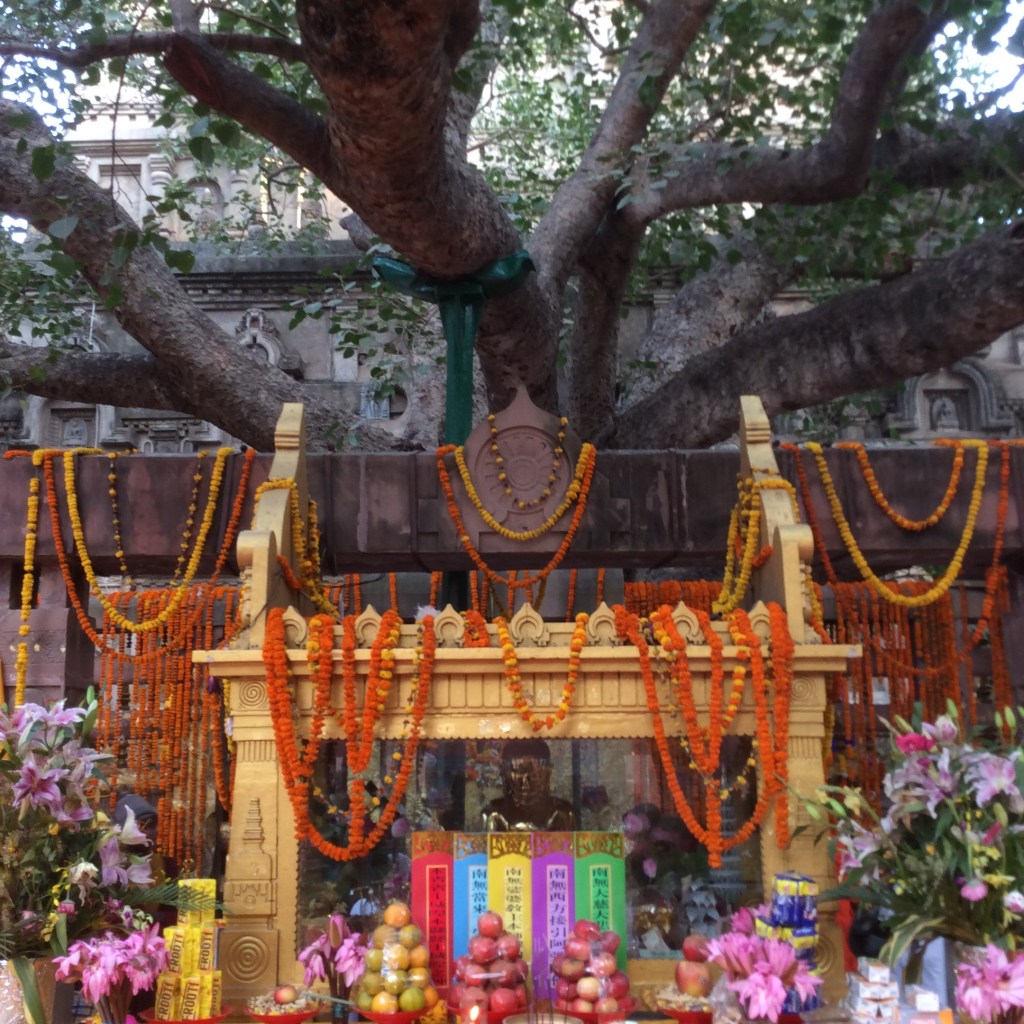
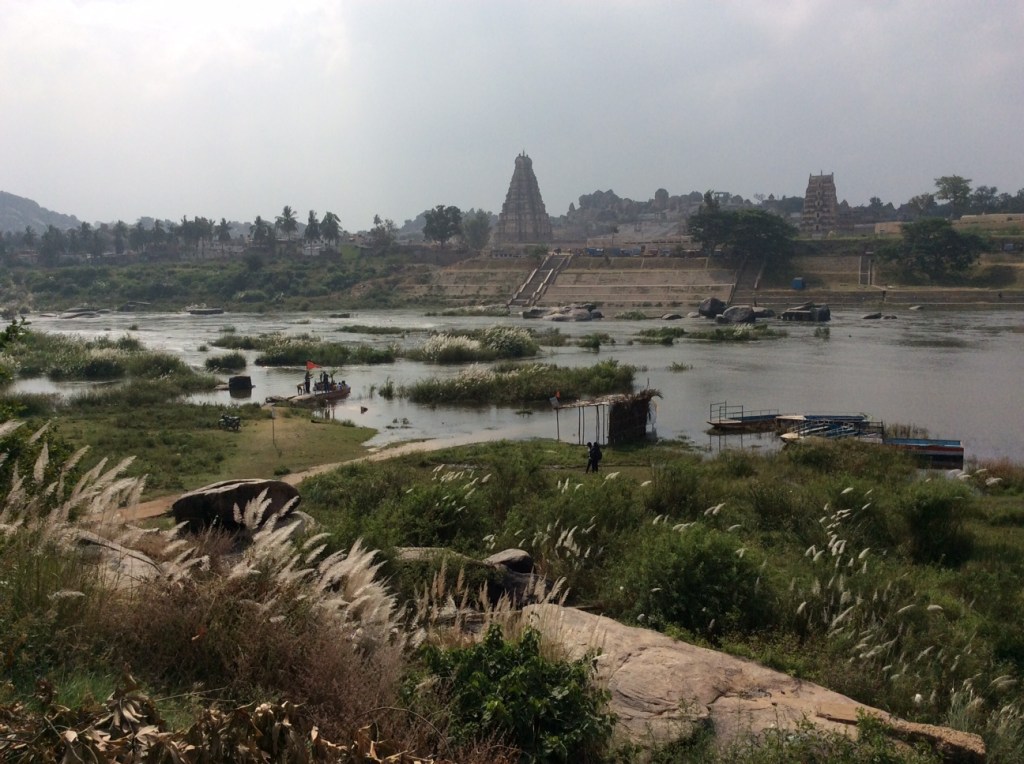
Days before leaving for the Hindu holy city of Varanasi, I read Ferlinghetti’s poem from his book, Coney Island of the Mind. The poem ends, “and I am awaiting/ perpetually and forever/a renaissance of wonder.” Ferlinghetti repeats a variation of these words at the end of each stanza, and since reading them, I can’t get the poem out of my mind, especially since visiting Varanasi where you don’t have to turn a corner to be surprised by wonder. Wonder walks down every street, floats down the river, and fills the sky with light and smoke. The Celts believed there are certain places on earth where the veil between heaven on earth is so thin that you can see through to the other side. Varanasi is such a place.
A city inhabited for 5,000 years, Varanasi is a stoop-backed, broken down, broken open ancient place where life, death, joy and suffering live openly side by side. Its narrow, (approximately) four foot wide streets spill over with foot traffic, broken brick, refuse, water, cows, cow pies, motorcycles, bicycles, and pilgrims, all hoping to move. Waiting in long lines winding through the humid streets in 40 Celsius (104 Fahrenheit) degree heat holding offerings of flowers, rice and red tika powder, pilgrims wait for hours to enter temples. Though it might not fit my ideal of how I want heaven’s portal to look or be, Varanasi embodies how things likely come to be at the end of one’s life: poor–left with nothing in the end but our failing bodies, bent down in humility, and waiting to be released into the elsewhere. Varansi is one of India’s most holy cities. Though there is suffering most everywhere you look in India, suffering, for Hindus, meets its end on the banks of the Ganges. To die in Varanasi and have your ashes cast into the river is to enter moksha–to never have to be reborn again into the cycle of birth and death. Death after death, millenia after millenia, this 2,525 km/ 1,569 mile river absorbs the ashes of a multitude of suffering and more.
Hindu pilgrim
Sadu on street corner by temple
pilgrim on Varanasi street
For the Hindus, the Ganaga (Ganges) is sacred–a goddess. According to the World Wildlife Federation, “Approximately 1 in 12 people in the world (8%) live in its catchment area…Together the Brahmaputra and Ganges water sheds span 10 biomes and contain the widest diversity of all large river systems.”The river supports somewhere around 500 million people. Nevertheless, “Every day, over 3 billion litres of pollution, mostly toxic chemicals and untreated sewage, enters the Ganga, putting countless lives at stake,” Reports the Global Alliance for the Rights of Nature. Watch this 20 minute National Geographic Live, Chasing Rivers, Part 2, The Ganges, and you will see a fascinating and fantastic insightful, and powerfully engaging look into the Ganges, its social and religious significance, as well as the environmental issues surrounding it.
The word sacred means to be set apart, while the English word, holy, or whole, uninjured “that must be preserved whole or intact, that cannot be transgressed or violated,” according to the Online Etymology Dictionary. Alongside this river of life flowing down from the high Himalaya and our desire to be released from suffering, flows the river of our industrialized and overpopulated world with its humming electric wires and ever charging lithium batteries in our iPads and cellphones. Sewage, chemicals from leather production–all go into the river, the goddess who can take it all, because she is, after all, a goddess, is the thought of some.
At some point while growing up, I remember hearing that in days gone by people didn’t place anything on top of their Bibles because they were thought to be sacred. Similar to this notion of treating the sacred differently, when visiting an ancient temple on the island of Samos in Greece, I recall being asked to remove my shoes because the area was still considered sacred, even though people no longer worshiped the gods that were once housed in that temple. What makes something sacred involves an awareness, a setting apart and a setting aside. We do this with portions of the earth that we decide are special in some way. The Monterrey Bay in California is one of these areas. After decades of abuse resulting from pollutants and over fishing was made into a marine sanctuary, the Monterrey Bay is now a place where sea life thrives, and where “Every summer, a vast array of animals travel thousands of miles to reach the waters of the Monterey Bay — home to one of the biggest wildlife gatherings on Earth,” according to the Mercury News article, ‘”Big Blue Live’: Monterrey Bay to star in its own ‘Reality Show.'” (You can see more about this documentary here.) In the Monterrey Bay, you can find “humpback whales, blue whales, sea lions, dolphins, elephant seals, sea otters, great white sharks, shearwaters, and brown pelicans,” says the PBS, who, together with BBC, is creating the Big Blue Live documentary on this wildlife gathering. The sacredness of something requires our recognizing its sacredness and treating it as such. This is what has happened in the Monterrey Bay, and it has made a difference. Treating something as sacred can include holy practices in offerings of flowers and light, but as understanding of our interaction with the world grows, it can also include doing other things such as protecting the life in a bay or river and that demonstrate our respect.
A god at the side of the street
Prayer on Ganges River bank
Temple offerings for sale
Hanuman
According to the The World Bank’s site on “The National Ganga River Basin Project,” domestic sewage accounts for 70-80 percent of the wastewater that flows into the Ganga, Industrial effluents add another 15 percent, with far-reaching impacts on human and aquatic health due to their toxic nature. And, in the absence of adequate solid waste management in most cities, mounds of uncollected garbage add to the pervasive pollution.” Along with prayers, ritual bathing and offerings, waste water management, controlling industrial pollution, and making and enforcing guidelines regarding development along the banks, are all things people can do to show their recognition of the river as sacred. To keep it whole and healthy, the Ganges, like the Monterrey Bay can be treated like a sanctuary.
“The world is charged with the grandeur of God,” wrote Hopkins, in his poem, “God’s Grandeur.”
Generations have trod, have trod, have trod;
And all is seared with trade; bleared, smeared with toil;
And wears man’s smudge and shares man’s smell: the soil
Is bare now, nor can foot feel, being shod.
And for all this, nature is never spent;
Nowadays, National Geographic discusses the dead zones in our oceans. If you look at the facts regarding places like the Ganges, and other rivers around the world, you will notice everywhere the blight we’ve left upon God’s grandeur. When we no longer recognize a reality larger than ourselves, God’s grandeur gets harder and harder to see. We aren’t choosing to notice it. As a result, we lose an understanding of what is sacred. In this context, Nietzche’s idea that man’s self-centeredness had killed God makes sense. If you look at the worst polluted places in the world the pollution is created because of human action. In Varanasi, the amount of wood needed to cremate bodies in Varanasi causes deforestation, according to Living On Earth’s article “Ritual and Deforestation in India.” To burn a body takes about a 1,00o pounds of wood. It’s also true that soap used for washing in the Ganga’s water causes pollution. The bigger polluters, however, are industries. If industries do not recognize the sacred that is because those who own and control them are looking to see profits instead of God’s grandeur. Religion could provide a motivation, but regulations are needed.
Sunrise ceremony
Sunrise on the Ganges
Varanasi from the Ganges River
Funeral pyres, Varanasi
In his poem, “Poet as Fisherman,” Ferlinghetti writes about the fisherman out on the sea, looking out and “listening for the sound of the universe,”
Whole poems whole dictionaries
rolled up in a thunderclap
And every sunset an action painting
and every cloud a book of shadows
through which wildly fly
the vowels of birds about to cry
The earth speaks to us when we are listening. When nearing death, Hindus want to go down to the water–the earthly element of transformation. Something in us intuitively understands our connection to the earth helps us understand the sacred. Entering the water, the body lets go and opens itself to the ultimate transformation–death. Birth in death, death in birth. This is always the way in India–opposites are bound together–so perhaps out of the death of rivers, an awareness can be born: the need everywhere for people to find the sacred again. We find that awareness, at least in part, through choosing to set aside our self-centeredness, and to recognize the intrinsic value of nature and our connection to it.
Through the centuries, poets have drawn nature as a central source of inspiration and metaphor. Poetry explores where the sacred touches the earth, touches the heart. Our current inability to recognize the sacredness of the earth seems connected in my mind to why poetry is so little read or valued today. Buddhist affirm the interdependence of all things, Hindus, that there is a bit of God in all things. The Psalms state, “The heavens declare the glory of God, and the firmament shows his handiwork.” When you love someone, you show him or her respect. You take care of the person. You listen, you look for a way to touch the person, to connect. We barely look at the night sky these days, however, or notice the moon, what the trees have to say in the afternoon, or notice the way “the sun streaming down/ in the meshes of morning,” as Ferlinghetti describes dawn in his poem, “Uses of Poetry.” Poetry, like dance or art, can help us connect again, help us find the sacred.
My last morning in Varanasi, I rose before dawn to travel down river to watch a ceremony honoring the sun. Men dressed in magenta silk stood on risers facing east. Lifting brass cobras with flames leaping from their bellies, the men swung them in slow, repeated circles while at the side of the audience women sang hypnotic mantras with humming vowel sounds, interrupted in intervals by the men on the risers ringing handbells for minutes at a time. Gradually, the night’s dark turned to dusky apricot, then blazing gold. The sun emerged above the horizon, and struck its rays across the water. There, amidst the funeral pyres and bathers, the worshipers raised their arms to hail surya, the sun, the life giver. I thought of the intensity of the previous day’s heat, the struggle and effort so many took to come to this city, the effort it takes so many in India just to live. As I watched a man slowly row his boat across the illuminated gold water, I breathed in the smoke of death from the funeral pyres, the loss, the heat, and breathed it out again with a new awareness and respect for the sun, for the earth. The ceremony had made the space between this world and the next a little thinner. In spite of the earth’s worn and weary state, in this city, its beauty is still visible.
If we want to rediscover the sacred, perhaps something in us, in our way of living must die in order for us to receive it. For a little while, I am here on this planet. With my words, with my whole self, I am trying to learn how to listen to the world, and as Ferlinghetti states, “I am perpetually awaiting/ a rebirth of wonder.”
Black mold has invaded our apartment and is growing in the walls. For days now I’ve not slept well. First workers came and pulled off the tiles in the bathroom to fix the leaky pipe, releasing the reeking smell into the air. They have since tiled the wall back in this week, but the caustic smell is still there. The mold is masked, but continues on inside the wall and is pushing its way through into the living room.
Clearly, the mold had been there for some time, though we didn’t realize it. Red or puffy eyes in the morning, wheezing at night, draining sinuses, rashes on the skin, and yes, even hair loss, which I’ve been noticing for some time now and wondering why it is happening, these (and more) are the signs of reaction to mold, but because we couldn’t see it, we didn’t know the mold was growing behind the walls until the neighbors complained their walls were showing stains.
When the workers broke open the walls they released the toxic smells. Recently, a colleague and I were discussing how we might get better at connecting with people and situations we found difficult in our work. She asked if I had listened to Brene Brown‘s TED talk “The Gift of Imperfection.” I hadn’t, but went home that evening and listened to several of her talks. One of Brown’s statements, out of many that resonate with me is this: “Unused creativity is not benign; it metastasizes. It turns into grief, judgement, sorrow, and shame.” I thought of the mold behind the wall. A pipe behind a wall leaks. You don’t realize it, but the mold begins growing, and eventually you have a problem you can’t fix simply by breaking open the tile, repairing the leak, and then tiling the wall back up. The mold is growing now, and you’ve got to remove it and create something new.
Since the apartment I live in isn’t mine, I don’t get to make the choice about removing the mold growing in the wall or covering it back up with tile, however. The choice of putting something in the wall that kills the mold, or to mask it with clorox instead, isn’t mine. As I lie in the bed at night coughing, I think of the people everywhere who are living with mold or who have lived in oppressive environments.
When the Czech writer and illustrator Peter Sis, came to the American Embassy School here in Delhi several years back, he explained over dinner with a small group of teachers that he is a man without a country. The country he was born into, Czechoslovakia, no longer exists. Those words have echoed in my mind ever since. It took Odysseus 10 years to make it back home after the Trojan wars. That is a long time, but some people can never return home because there is no home to return to. There is suffering in situations like these. Once you are gone a decade from your home, you are changed. You might return home, but you won’t necessarily every be at home again as the world of home, like a ship under sail, continues on its own trajectory while you have been sailing along a different route encountering land and storms not like those you might have experienced had you stayed on the ship you began on. All seas are not the same.
When some people leave home, they don’t want to return, however. My husband’s grandparents came from Italy, but when asked if he would like to go on a trip with us to visit Italy, his father expressed absolutely no interest in it. “Why would I want to go there?” was his response. That was the end of the conversation. As someone who loves travel, is curious about the world, and wants to understand the roots I’m connected to, that statement perplexed me. Currently, I’m reading Milan Kundera‘s book of essays, Encounter. In his essay, “Exile as Liberation According to Vera Linhartova,” Kundera quotes her saying, “The writer is above all a free person, and the obligation to preserve his independence against all constraints comes before any other consideration. And I mean not only the insane constraints imposed by an abusive political power, but the restrictions–all the harder to evade because they are well-intentioned–that cite a sense of duty to one’s country.” People have fled their countries because of war, have been exiled for their ideas or their writing. But some people don’t chose to return because greater than a bond to history or language, is the person’s desire to choose his or her own path, one that has given them what they sense to be a greater freedom, freedom they wouldn’t have if they returned to the world their history is rooted in. France allowed Linhartova’s creative freedom. Freedom is connected to struggle.
My husband’s grandparents gave up their lives in Italy, and struggled under great difficulty to make a life in the United States. Similar to Linhartova, remaining outside the country of their birth was a choice. The struggle to make a life in another country and culture allowed their children and grandchildren greater opportunity and freedom. Standing between two worlds, they found a home outside of the definitions of home they knew. They lived on the edge of great challenges and risk. Brene Brown says in her interview with Krista Tippett “The Courage to Be Vulnerable” on Tippett’s site On Being, “The …beautiful thing I look back on in my life is coming out from underneath things I didn’t know I could come out from underneath…the moments that made me, were moments of struggle.” Our family’s Italian grandparents, like immigrants in general, were brave. Their stories aren’t without loss and grief, but they they followed the path that called to them, and today, without ever having met them, I feel gratitude for the daring their lives demonstrated in giving up the world they knew in exchange for a life still full of difficulty, but one lived with hope and a sense of possibility.
Living here in India, I constantly see people struggling for survival. I want the people I encounter to know they will get to eat every day, to be able to go to school, to realize they have stories worth telling and hearing, that their lives have meaning and their creative expression is valuable. But the poor of the world, and those without opportunity are often unseen and ignored. To go to school in Delhi, a child needs a uniform. Some families are too poor to buy the uniforms, and therefore, their children don’t attend school. There is need.
Outside the gates of our school here in Delhi this morning, children who live in the slum across the street waited to be measured for school uniforms that teachers here at our school are raising money to buy for them. Education will give these children opportunity.
John Ciardi, in his poem, “Matins,” writes about a poor woman who died on the streets of Paris,
It froze in Paris last night and a rag doll
that had been a woman too tattered-old to notice
turned up stiff on a bench. So the police,
who spend least on the living, paid to haul
nothing to nothing. She could have lived for a week
on what the bureau will spend on paper work;
The poem goes on to describe how more was spent on the woman after she died than it might have taken to help her live, and find how to give her a place in the world. Ciardi’s poem closes with these words:
…Every child
risked from love and held must be put down
to walk itself away, and turn by turn
become another. This dirty doll unheld
by any arm is one altar piece
from which mad Francis learned to be a priest.
It takes courage to notice the things in our lives and our world that aren’t going so well, that are like the mold growing behind the wall, and to move out into a life of challenge, but the possibility of greater freedom. If we continue to ignore those things that are eating away at us, however, or don’t give creative expression to it when it’s not in our power to change things, eventually the mold breaks through the wall and we’re no longer living in a life engendering place.
Inside the world of discomfort and the wreaking smell of mold, some are brave enough to break open walls and persevere as they reach to find a path with their lives that offers hope and makes a difference. Noticing the poverty around him is what called St. Francis to live his life under the vow of poverty, a life given to empathy and compassion that still touches our lives centuries later. The world could use more people as brave as he.
It is late afternoon and we have returned from the art room where my husband, Michael, holds an adult art afternoon on Sundays where many people (like myself) are exploring art for the first time, learning they can make things they didn’t know they could. Now he’s out in the community garden planting seeds because tonight is the blood moon, a rare lunar eclipse of a super moon, and a good time for planting, he says. It’s an effort, he explains, to make a healthy life for people. “To love ourselves and support each other in the process of becoming real is perhaps the greatest single act of daring greatly,” Brene Brown states. From organizing the effort to raise the funds for having the children’s uniforms made so they can go to school, to helping people discover ways to be creative, to planting seeds, to preparing this evening’s meal, which he is about to do, my husband is a man who day by day is following St. Francis’s path of giving himself to the world around him. If we are going to change the world, surely it will take each of us being faithful in the small things with those around us daily. As Mother Teresa said, “that is where our strength lies.”
What are the geographies that have entered your heart? As we embark on our exploration of how the physical world affects culture, consider the ways that the places you have lived have shaped you and your understanding of the world.
Nature writer, Barry Lopez, in his book, About This Life, says “Over the years, one comes to measure a place, too, not just for the beauty it may give, the balminess of its breezes, the insouciance and relaxation it encourages, the sublime pleasures it offers, but for what it teaches. The way in which it alters our perception of the human. It is not so much that you want to return to indifferent or difficult places, but that you want to not forget.”
How has the cultures and your interactions with the physical environments in the places you’ve lived influenced and shaped the way you think and the experiences you have had? How might your reflection on this question guide the kinds of things you want to learn and discover about the country you are researching about? How might your experiences help you focus your research, write up your understandings, and talk with the class about topics you think are personally meaningful and important?
Of all that God has shown me, I can speak just the smallest word, not more than a honeybee takes on her foot from an overspilling jar. —Mechthild of Magdeburg
To live in India, and to ponder what it is one is experiencing when wandering out to explore what waits in the streets, is to be humbled. This is my ninth year living here in Delhi. There is a myriad of things still to see in India and a myriad more to understand–or realize I will never understand. India is immensely diverse with a long, long history. Though many things after nearly a decade of living here seem familiar to me now that are utterly different than the world I was born into–things such as buying groceries at street side stalls, monsoon heat and rain, dogs and cows wandering the streets, and erratic electricity–the more I experience and learn about India, the deeper the mystery of this culture goes until it seems I have entered the waters of the ocean and the universe beyond.
This past weekend I traveled to the state of Odisha (Orissa), and the cities of Bhubaneswar and Puri, one of India’s holiest cities. Traveling through these cities colorful streets full of ancient stone temples, is to enter a place wonder.
A few short kilometers from Bhubaneswar, we visited the Udayagiri and Khandagiri Jain caves, cut into two facing hills over 2,000 years ago. Ascetics once lived here, but now along with visitors and devotees, langur families roam the area, eating from shrubs, as well from the hands of the many Indian visitors to the temple atop the hill.
Khandagiri steps
Rani Gumpha or Queen’s Cave, Udayagiri
Serpent cave
Langur, Khandagiri
A bit over an hour’s drive down the coast from Bhubaneswar and north of the coastal city of Puri is the Konark Sun Temple. Made of stone and facing the east-west direction, as if carrying the sun, the temple is a World Heritage site built in the 13th century. The temple’s shape is modeled after the giant cart that Hindus pull through city streets in various locations in India during religious festivals. Though no longer safe to enter the temple, it’s exterior carving is both extensive and beautiful. There must have been an enormous bank of skilled sculptors available in order to make the temple with its beautiful carvings–something that would be rare to find in most any place in the world today in such abundance.
Stone chariot wheel, Konark Sun Temple
Konark Sun Temple
Dance Hall, Konark Sun Temple
Food vendor, Chilka Lake
Wheel hub, Konark Sun Temple
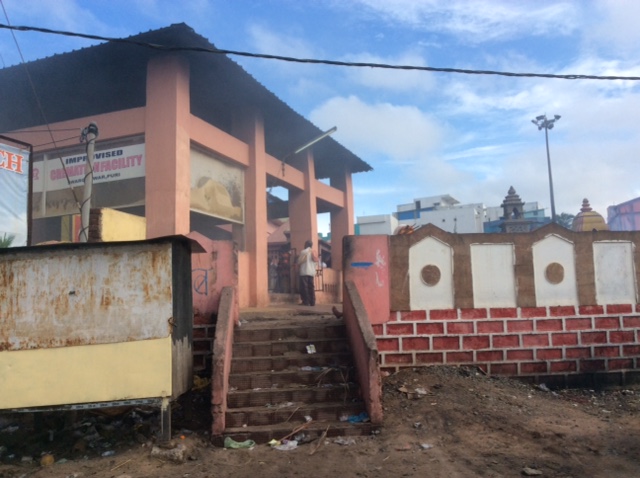
Down the street from where I stayed with my husband and friends in Puri, is a crematorium–a holy place for Hindus. To be cremated in
Crematorium across from the beach
Puri is highly desired as it allows one to enter moksha and to be released from the cycle of life. Interestingly, directly across the street from Puri’s crematorium is the beach on the Bay of Bengal, crowded with people barbecuing fish, eating, shopping, and riding camels with a decorative red and gold cloth to sit on.The waves stretch along the coast beside Puri, though no one is swimming, preferring the activity on the shore. This is not a country or culture that isolates death from the ongoing experience of life. Death while necessary, it’s very presence is woven into the fabric of the town’s hotels and seaside attractions, as a natural partner to other activities such as a barbecue or a seaside stroll.
South of Puri, along the coast, lies Chilka Lake, one of Asia’s major areas for bird migration and nesting. The road to Chilka Lake from Puri, wanders through a wetland area of trees, verdant green rice fields, and buffalo watering holes. Black dolphin live in the lake, and you can see them on a boat ride that takes you out to where the lake opens into the sea. On our boat ride, we got caught in a monsoon downpour. As the sky turned dark and the thunder rolled, we crouched behind umbrellas, hoping to stave off some of the rain and sea spray. At the lake’s opening to the Bay of Bengal, we pulled up to the shore and climbed off the boat to huddle under a palm leaf hut with plastic tarp, watching the wind blow and the rainwater drain off the roof as the boat driver wrung the water from his shirt. Locals working at the tea hut knocked open oysters and pulled out perfect pearls time after time as well as stones hoping to sell us a few. I never saw clams produce shaped and polished stones before, but people on other boats believed it was possible, and willing bought the jewels.
Boats, Chilka Lake
Sea eagle, on post, Chilka Lake
Wetlands near Chilka Lake
Wetlands on the way to Chilka Lake
Later, we headed back to Puri, to the Jagannath temple–the Lord of the Universe’s home on earth: Vishnu’s abode. The temple, according to the Jagannath temple information site, has 6,000 priests, as well as the largest kitchen in the world, where it has prepared meals for 1,000,000 people on festival days and frequently up to 25,000 on other days. If you are Hindu, you can enter the temple, but if you aren’t, even from outside the temple there is a world of wonders to see because half of India seems to be gathered there in a celebratory mood–balloon, flute and toy sellers, fruit sellers with their carts, a woman selling grass for the wandering cattle, devotees washing themselves, beggars with open palms–all part of the throng in the plaza and funneling toward the temple gate.
Balloon seller in front of the Jagnnath temple
Opposite the Jagnnath Temple
Fruit seller outside Jagnnath temple
Food Sellers near the temple
Rickshaw driver near the side the Jagnnath Temple
Treats on a food stall cart
Street stall sellers beside the Jagnnath Temple
Grass seller in front of the Jagnnath Temple
The temple complex is large, covering an area of 10.7 acres, and as I circumnavigated its walls, I got a glimpse of an idea of the world inside. A group of men wearing white and clanging a bell trudged by carrying a wooden plank decorated with flowers, women wearing gold colored saris walked by in a group, and everywhere food sellers pandered their wares and cows wandered the streets. On the opposite side of the street from the temple, were the broken-off walls of apartment buildings and shops where some men worked to rebuild the half dilapidated walls, while others sledge hammer in hand heaved into walls, blow by blow hoping to bring them down. One thing was certain: I was in a different world. No sterile streets with trimmed hedges and clipped lawns here, no malls or neat and tidy traffic flowing to regulated lights. Instead, a cacophony of human activity filled the world on all sides. Here, the world was turned inside out. You can literally see inside houses, and everything appeared to be in a state of simultaneous construction and deconstruction–which is actually a pretty good physical embodiment of what is actually happening at any particular point in time or history. Things have a way of breaking open and breaking out of the boxes they are put in. Life, like many things found in India, is bigger than the boundaries we build to contain it. It spills out and pours over–is larger than what we can define or name. Order is there beneath the change we experience, but the birth and death of everything is happening all at once right before your eyes.
Goddess beside the Jagnnath Temple
Jagnnath Temple entrance
Beside the side the Jagnnath Temple
At the Jagnnath Temple
The Jagnnath Temple
Like some kind a satellite, asteroid or meteorite from a world other than the one people in Puri were familiar with, I circled the Jagannath temple, my eyes absorbing what my mind had the tiniest fragment of comprehension of. Here is a world to itself, one that doesn’t care that your your hair is falling out, that you once held an athletic record, that you aren’t able to walk as you used to, that you can sing, dance or draw, that you might be unable to do what someone else does or thinks is important. These are things of the world you might have been born into or come from but none of this matters when you cross into another world, and clearly the space around the Jagannath temple is another world. If it is possible to be reborn into another life without dying, than certainly, that is what occurred. Doorways mark the liminal spaces between two worlds, and to stand outside the Jagannath temple amongst the honk of mopeds, the cows and dogs lazing in the streets, the clanging bells, marigold offerings, and the sun casting a golden light across the street is to definitely see into a different reality. This was no place anything I knew in my childhood would prepare me to know or understand. Except that it was wondrous.
Doing puja
Door in Puri
Temple on street leading up to Jagarnnath Temple
There are things in this world far beyond our comprehension. This I knew as a child. I climbed the hill opposite from where I lived with my mother and two of my sisters when I was four, and when I looked back at where I came from, at the small house in the valley below, I knew my home in an entirely new way. Circling the Jagannath temple walls is one way that allows you to see where you call home in a new way if you call home a place other than India or Puri. Walking around the temple wall, you can glimpse into the universe of mysteries and to realize that of all the world holds, we know very little. The world, the universe is much bigger than our minds can hold. Birth is mystery, as is relationship–the fathomless bond of love. The intricate connections and interweaving of natural systems of animal life, of whales’ migration patterns, for example, serving to mix the ocean’s water columns and spreading nutrients, that according to National Geographic, enables more fish to eat and grow–just this one example of the vast natural systems that we interact with daily that have evolved over eons of which humans are just one part–all these things are working together, holding us up and together. These are far more powerful than the power of any ruler, government plan or force on earth. As in the poem I opened this post with, it’s good to be reminded of these things. We often get wrapped up in our small worlds and plans, in our way of seeing things, making it easy to forget our view is just one perspective in the wider, wilder world and universe we are a part of.
Goat among the cars, Puri
Hindu gods for sale
Temple carving, Bhubaneswar
Comprehending the complexities of Hinduism takes an outsider an effort of serious study; but I can comprehend this: by living we partake in mystery. We move from mystery to mystery as we move from birth to death, and isn’t this a fundamental truth to all religions–that we are not a world unto ourselves? Bruce Cockburn has a song you might enjoy listening to, “Lord of the Starfields.” I appreciated it for the awe it evokes with lyrics that begin like this:
Lord of the starfields
Ancient of Days
Universe Maker
Here’s a song in your praise
Wings of the storm cloud
Beginning and end
You make my heart leap
Like a banner in the wind
“Man is hungry for beauty. There is a void.”—Oscar Wilde
In the streets of my Delhi neighborhood, workers are building new apartments. Women carry sand on their heads. Bricks are stacked on the walkway. Yesterday the populous celebrated Republic Day, and I was reading Pamela Timms’ book, Korma Kheer & Kismet, the chapter titled “Independence Day in Sadar Bazar” where she describes the civic protests of 2011 where social activist, Kisan Baburao “Anna” Hazare, began a hunger strike in protest of government corruption. Concerned with the amount of interest Hazare stirred up in the populace, prime minister of the time, Manmohan Singh responded, ‘”Corruption manifests itself in many forms. Funds meant for schemes for the welfare of the common man end up in the pocket of government officials. In some other instances, government discretion is used to favor a selected few. There are also cases where government contracts are wrongfully awarded to the wrong people. We cannot let such activities continue unchecked.”’ Hazare’s hunger strike began the day after the prime minister made the statement, reports Timms, and goes on to describe some of the corruptions in the system—food vendors paying as much as a quarter of their salaries to the police to be able to stay open, and rickshaw drivers paying as much as 20% of their salaries to police to prevent their tires from being slashed, families having to pay bribe money to secure a place for their child at school. (p. 55) (You can read an overview of large-scale corruption in India here if you wish.)
New Delhi construction worker at work
Burning roadside trash can. Mussoorie, India
Bricks on New Delhi roadside ready for use.
It’s no surprise that corruption is present not only in India. It is a worldwide problem in both businesses, see a list here of top business corruption cases, and governments. Take a look at the thematic map from Transparency International here, to see a visual representation of corruption levels in countries across the world. Justice doesn’t prevail. In many cases, it’s simply the way the world functions where people live, and the everyday person, if he or she wants to function in society, doesn’t have a lot of choice about it.
With corruption and misuse of power so widespread, an enormous percentage of people in the world are pawns to those who hold the power. How do people manage? How do people—any of us and all of us—caught in such systems go on living with good conscience? I remember listening to Garth Lenz describing on his TED Talk about the effects of mining for oil in Canada’s tar sands had on the native people of the area. Parents in that area are caught in the dilemma of needing to feed their children, yet the toxins in the river are causing cancers at the rate of 10 times what it is in other parts of Canada. Because it’s very costly to fly in all the food a person needs in order eat, the aboriginal people are forced to eat the food “..as a parent, I just can’t imagine what that does to your soul. And that’s what we’re doing,” says Lenz. (transcript available here.) Certainly there were people during the time of Spain’s inquisition, in Nazi Germany and in Pol Pot’s Cambodia who didn’t agree with the government’s position but felt compelled to go along with the crowd mentality for fear of their own lives and those of their children’s. Certainly, there are people today in our own institutions who disagree with the use of power and yet are afraid of speaking out for fear of losing their jobs and the livelihood for their families. Not everyone can just move on or move out to a new situation, new job, new country, new life, and even if that were possible, where might one live or work where corruption was not part of the way of life? We have to learn to live in a fallen world.
I’m reminded of Maria Mazziotti Gillan’s poem, “I Open a Box,” in her book, Ancestor’s Song, where she describes her Italian immigrant mother’s doctor coming to her New Jersey tenement to assist her in the delivery of her baby. He arrives late, and Gillan’s mother has already given birth, cut the umbilical cord, and washed her child. When the doctor finally arrives, he doesn’t even enter the room. Instead, he distances himself from the situation.
“He washed his hands, wiped
them on one of the rough linen towels
I brought from Italy, stood in the doorway.
“You’ll be okay,” he said, and left.
“Oh, well,” my mother said, “I think
he was afraid of catching it.”
“Catching what?” I asked.
“Poverty,” she said.
New Delhi neighborhood street.
Poverty is often perceived by wealthier countries as something out there over there, not mine not related to one’s own life. Like the doctor at the door, people want to distance themselves from the poor, not realizing their lives are connected. We may want to stand at the door like the doctor of this poem observing a world we don’t want to be a part of. We may think we can wash our hands, bid others well and walk away, and disconnect ourselves from what we don’t want and live in a different neighborhood. But our lives are intertwined. One example: A few years back, students in my speech class debated whether the lithium beneath Bolivia’s salt flats should be mined. The area is of tremendous beauty yet the area holds more than half the world’s lithium. Lithium is a lightweight metal used in powering our high tech products—iPhones, iPods, and other handheld devices. Now, as the world searches for alternative energy and looks towards ways to store electricity in batteries in order to meet more of our needs, including the use of batteries for electric vehicles, the need for lithium grows in greater and greater demand.
Dan McDougal, in his article on Mail Online “In search of Lithium: The battle for the third element” quotes a lithium-ion battery producer, Mary Ann Wright of Johnson Controls-Saft, ‘Since a vehicle battery requires 100 times as much lithium carbonate as its laptop equivalent, the green-car revolution could make lithium one of the planet’s most strategic commodities.’“ There’s not enough lithium to power the world’s 900 million vehicles, however, McDougal observes. Bolivia has significantly large amounts of the needed lithium to produce the batteries for the growing electric car industry, an industry that most people perceive as a green technology. Mc Dougal reports that according to “William Tahil, research director with technology consultancy Meridian International Research, ‘to make just 60 million plug-in hybrid vehicles a year containing a small lithium-ion battery would require 420,000 tons of lithium carbonate – or six times the current global production annually.” To continue, McDougal goes on to report that “The US Geological Survey claims at least 5.4 million tons of lithium could be extracted in Salar De Uyuni, while another report puts it as high as nine million tons.”’ Bolivia is a very poor country. Child workers are exploited, but children work to help their families. While mining the mineral would bring needed jobs and money into the country, a problem is that mining the mineral requires an abundance of water, and water is a rare commodity in Bolivia’s high desert. Bolivia has experienced exploitation by outsiders before in the tin and silver mining industries. An overuse of water could significantly affect the country and its people in numerous ways—making it difficult to have enough water for daily use, as well as for farming. Additionally, mining pollutes water with toxins as well. McDougal asks his readers “Is the world’s need for a green solution to transport worth the destruction of this unique environment and way of life that it lives on?”
Transportation is necessary. Our society is structured in such a way that few of us can walk to work. We need some way of getting to work. We want to do that in the least harmful way to the environment and others. As a result, in the desire to move away from our dependence on oil, many people are looking toward buying an electric car. These same people may be unaware that in doing so they are connected to moral dilemmas of another sort. We are all part of the greater web of being.
Walls and grass in Vicalvi, Italy sunset.
Parker Palmer, in his book, The Courage to Teach, which I’m currently reading, talks about the biologist Barbara McClintock, who was given the Nobel Prize in 1983 for her work that changed our understanding of genetics. Prior to her work, people thought of genes as separate things, not in connection to the environment they were a part of. Palmer explains that McClintock’s interviewer who wrote her biography, Fox Keller, “wanted to know, ‘What enabled McClintock to see further and deeper into the mysteries of genetics than her colleagues?’ McClintock’s answer, Keller tells us, is simple: “Over and over again she tells us one must have the time to look, the patience to ‘hear what the material has to say to you,’ the openness to ‘let it come to you.’ Above all, one must have ‘a feeling for the organism.’” We co-create our world. We can’t stand at the door. The burden of the cost of anything is born by all eventually. As Palmer goes on to say, “Modern knowledge has allowed us to manipulate the world but not to control its fate (to say nothing of our own), a fact that becomes more clear each day as the ecosystem dies and our human systems fail.” (p. 57) Perhaps, then one important way of living inside of corrupt systems and move ourselves and society toward greater wholeness is to do what we can with those around us to build and restore relationships constructively. Some things or many things may not be in our power. But some things will. We can learn to listen closely to the interrelationships of people and things so we gain a greater connection to life. With this understanding, we can better comprehend what actions will create harmony both with others and with nature.
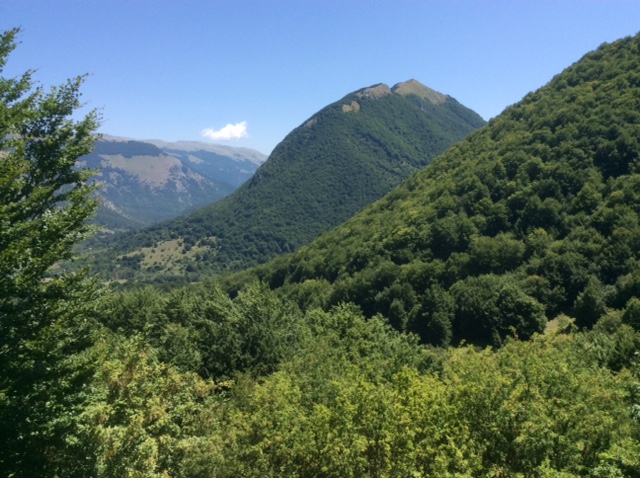
Abruzzo National Park, Italy.
Dostoyevsky said, “Beauty can save the world.” While it may not appear to be a solution to growing environmental and social concerns, the idea deserves a closer look. What connection does beauty have in showing us a way through our dilemmas of how to live in unjust social systems? The New York Times “Books” section, published in 1987 includes an excerpt from Richard Ellman’s essay “Oscar Wilde.” Ellman relates the story of Oscar Wilde coming to New York City in 1882. “Beauty is nearer to most of us than we are aware,” Wilde explained talking to reporters. One of the reporters wanted to know if a nearby grain elevator was beautiful. Earlier in the conversation, Wilde had said, ‘I am here to diffuse beauty, and I have no objection to saying that.” As reporters continued probing, Wilde explained further his ideas about beauty. ”’It’s a wide field which has no limit, and all definitions are unsatisfactory. Some people might search and not find anything. But the search, if carried on according to right laws, would constitute estheticism. They would find happiness in striving, even in despair of ever finding what they sought. The renaissance of beauty is not to be hoped for without strife internal and external.” ”Where then is this movement to end?” ”There is no end to it; it will go on forever, just as it had no beginning. I have used the word renaissance to show that it is no new thing with me. It has always existed. As time goes on the men and the forms of expression may change, but the principle will remain. Man is hungry for beauty. . . . There is a void; nature will fill it. The ridicule which esthetes have been subjected to is the only way of blind unhappy souls who cannot find the way to beauty.”’ Creating a world of beauty is creating the ideal world. Creating a heaven, so to speak. To do so will take great effort. But people are hungry for it, as Wilde says. We are hungry for beauty, and that hunger connects to the desire for a world without corruption. Without corruption, beauty has a better chance of thriving.
Elaine Scarry, author of On Beauty and Being Just, speaks on her Harvard Thinks Big, “Beauty as a Call to Justice” about how experiences of beauty help to move humans toward justice. When we experience the beautiful, we are pulled out of our everyday way of interacting with our surroundings. We stand still. We are transfixed, she explains. In those moments, beauty pours into us an awareness of the “surfeit of aliveness.” It takes us out of ourselves, and connects us with a larger reality. Scarry makes the case that this experience of beauty helps lead us to love what we see and to want to care for it and have a relationship with it.
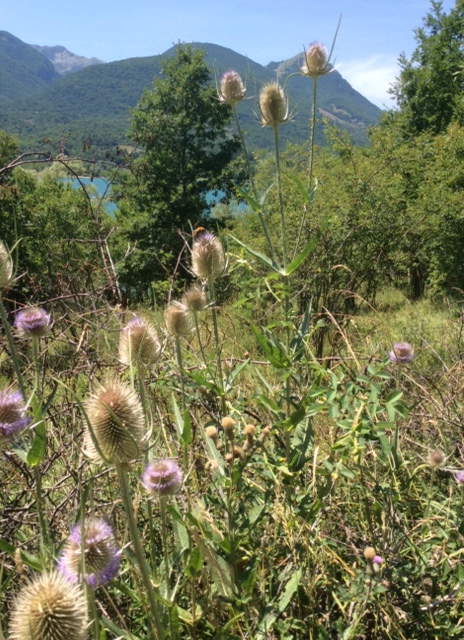
Wildflowers, Vicalvi, Italy.
I don’t know if its true as Keats said in his “Ode to a Grecian Urn” that “Beauty is truth, truth beauty,–that is all/Ye know on earth, and all ye need to know,” but I do believe we need to have a much deeper knowing of beauty than we currently hold. There is a relationship between our loss of beauty in many of our urban environments, a loss resulting from our pragmatic values that relegates beauty to the bottom realms, and efficiency to the higher realms of priority. When I speak of beauty, I’m not talking about beauty in the decorative or commercial sense. I’m speaking of the beauty such as nature gives us in a star strewn sky or a valley sweeping down in green fields from stoney mountain peaks. I’m speaking of the beauty Scarry described above—that stops us short, that overwhelms, and then lifts us out of ourselves. Is our culture’s pragmatic love of efficiency causing us to structure society in such a way that it’s actually challenging to make deep connections with others? We have connection to people on Facebook, but does the minimalistic communication that exists there nurture deep conversation and relationship? I doubt it. Could it also be true that our lack of seeing ourselves as connected to the beauty of the Bolivian salt flats and the lives of Bolivian miners as we pursue our technological development (and other similar realities) is part of the reason corruption continues to thrive? Do people act in ugly ways because they live in a world where connection to the natural world is broken? In glimpses of beauty, we can see the world we want to belong to, a world of balance and wholeness, and are drawn to it. If we gave beauty a place of respect and honor in our cultures, possibly we would treat the world with more respect. If we developed more of a relationship with those around us and with the natural world, wouldn’t we understand our connection to the world and realize more fully the effects of our choices? Is our collective loss of beauty causing us to lose our souls?
At the castle ruins, Vicalvi, Italy.
I never used to understand the Jesus prayer—the ancient prayer that says, “Have mercy on me.” I felt it seemed too focused on the negative and I already struggle to move beyond my failures. But as I see myself more and more intertwined with the existence of all that is, I see the value of this prayer. What the world is or isn’t, isn’t all up to me, but I’m also a part of all that is. How do we live in a corrupt world and yet continue to grow toward wholeness? The problems are all much bigger than me but mercy is extended. “For the Beauty of the Earth” is an old song that carries with it the idea of giving praise for the world around us and to the skies. Perhaps the ongoing practice of noticing and valuing beauty in the world, as the words of this song illustrate, acts to create a greater awareness of our interconnectivity. It’s worth trying.
One of the especially valuable aspects of creative work—of art and literature, of writing—is the way it nurtures the inner life. The artist must look very carefully at whatever she or he is drawing in order to see it and how it functions in relationship to itself and to the world it inhabits. In writing, an author must delve inside the subject with imagination in order to understand the subject and the interrelationship of the subject to oneself and the world. To write or to do art is to cultivate beauty. It is a way to reconnect to the world, is a way of making whole again as telling our story is a way of making us whole again. The flourishing of this kind of empathetic understanding that comes through our interaction with literature and the arts is important to not only the continuance of the world, but the continuance of a world that is good to live in.
Wherever we are, we can work with others to create greater wholeness. If we are going to change at all, it will be a step-by-step movement toward wholeness. In the mean time, we can pray as we walk, “have mercy,” and, by grace, we will continue on.
Most days we move through a world of familiar routines, often with unsurprising outcomes. The past few days I spent time with friends who own a house in Peschio, a tiny village situated above Alvito, Italy, a small community located on the edge of the Comino Valley a couple of hours below Rome in the state of Lazio. In Peschio, traditions still hold sway in people’s everyday lives. Bells ring on the hour, people have close connections with their neighbors and still live where they were born. Neighbors share gifts of food such as handmade pasta. In the evening, people gather for conversation at the local ice cream parlor or sit with friends on benches in the street. The town adorns the roads with ribbons for a celebration of the Madonna, carrying an icon of her through the streets. Here, communities aren’t driven by competition or pressed down with the weight of tasks to complete in a limited period of time. Life here is simple. Houses are not fancy, neither are their clothes. It’s true that the area struggles economically and that the population is aging, yet at the same time people have time to chat on the street or gather for an impromptu dinner on the neighborhood piazza. Human connection remains central to life.
View of Comino Valley, from Peschio village, Lazio, Italy
Neighborhood gathering for pizza on the piazza, Peschio, Italy
Ice cream shop in Alvito, Italy
Homemade pasta, a neighbor’s gift, Peschio village,
Peschio village, Lazio, Italy
Comino Valley from Peschio, Italy
Peschio village, Lazio, Italy
Comino Valley, Lazio, Italy
I feel a connection to those living in a world where tradition is still a vital part of people’s understanding and way of being, but this way of being can’t be mine. I wasn’t raised with traditions that go back to the old world. I have lived in too many worlds with too many other lives, but there is a beauty there. Unlike the world in Alvito, the world most of us live in is filled not with space for human connection, but instead with human competition and the drive to get ahead, make a name, or gain power in some area, even if a narrow one. Minutes count, and finding time to sit outside and enjoy the evening air or to chat with a friend can be challenging. In such a world it is difficult to find satisfaction or wholeness. It’s challenging to find the time to reflect on life, hard to assume an attitude of receptivity instead of needing to act or be in charge, though receptivity is a central attitude that enables us to learn respect for our limitations and to value our interdependence with others, qualities that in turn engender connectivity with others and help us experience life as meaningful.
Occasionally, however, amidst the clatter and squeeze of everyday life that pushes us along from one event to the next, the extraordinary, like a giant fish rising from the sea’s depths or storm wind shaking a tree to its roots, occurs, and we are given a window into our lives that touches us at our roots and helps us see what we are. Having recently read Nicholas Samaras’s book, Hands of the Saddlemaker, I feel I have experienced the extraordinary. Echoes from the poems’ imagery and language move through my mind, rising at unexpected moments, floating up from the subconscious where the poems have been at work. The poems probe the struggle to live purposefully with meaning when traditional values and ways of being no longer hold the world together.
Though we have access to unprecedented volumes of knowledge in our day, to live meaningfully and purposefully, all of us must negotiate between enormous areas of ongoing, continuous and rapid social, economic and technological fluctuation and change. It is no easy task to assimilate ourselves into these various worlds and learn how to integrate them into our lives in a way that allows us to develop wholeness. Each of us must explore how to direct ourselves through the current of these changes. Existentialist theologian Paul Tillich said, “Faith consists in being vitally concerned with that ultimate reality to which I give the symbolical name of God. Whoever reflects earnestly on the meaning of life is on the verge of an act of faith,” and Samaras’s poetry is an exploration of meaning making while swimming in the sea of the postmodern era. The intensely vivid quality of Samaras’s descriptions, language and poetic narratives in Hands of the Saddlemaker pulled me below the surface of words into an interior current flowing between places of exile and belonging, faith, and loss, love and death.
From the opening poem, “Lost,” describing the ease with which a person can lose his or her way, to the final piece, “Decade,” depicting the transformative moment where pain and brokenness from a relationship are let go, the poems in this volume traverse the territory between the traditions, beliefs and practices that both bind and open us. The book’s ending poem, “Decade” returns to a place of confrontation with grief and loss that allows one to come to finally release from its hold and come to a place of stasis where healing might begin. Philosopher Soren Kierkegaard said, “The greatest hazard of all, losing one’s self, can occur very quietly in the world, as if it were nothing at all. No other loss can occur so quietly; any other loss – an arm, a leg, five dollars, a wife, etc. – is sure to be noticed.” The ground we stand in our era is constantly shifting and most of us don’t have lives that thread us back to origins, place or carefully followed tradition. The poems explore the territory between and beyond borders, tradition and predefined boundaries, stretching into broader realms of experience and emotion where transformation is forged and meaning created amidst brokenness. This is a book of poems that speaks to our time and worthy of careful and repeated readings.
One of the poems in the volume, “Easter in the Cancer Ward” describes the process of coloring and decorating eggs for Easter, while confronting the certainty of death and contemplating the significance of belief in life after death ends. One of the children in the ward with cancer directly states “I’m dying.” Another unexpectedly later asks the poem’s narrator if he believes in Christ and living forever, prompting him to search within in himself for an honest answer. Easter, as we know, is about life after death, but the poem places us in the moment where death lives inside of life and helps us see how the two are connected. The poem ends where the children put the narrator’s hands into the red dye, staining them red, the color of resurrection. The poem’s last line, “and we are laughing,” is especially poignant. Here is an image of life in death, death in life, and the hard territory one walks between the two. The child has led the speaker to touch that place, a world of pain and wonder inseparable from each other.
In his poem about crossing borders, “Passport,” Samaras writes, “In counties of the temporary, we are forever/ accumulating, possessing, leaving behind./ In the end, our hands will finally be empty.” This is an absolutely powerful piece about impermanence. In some sense, we are always standing at a border, the border between today and tomorrow, youth and age, innocence and experience. The border is a place of transformation–leaving a country, possessions, or a life. We exchange one way of being for another, one life for another. “I cannot help but be a citizen of transience,” writes Samaras, “always looking for the land beyond language.” Forever life is changing and we are leaving behind what we were, “our pale winter/ breaths losing the shape of our bodies.” There is death, but there is also the possibility of entering “the land beyond language,” a place where presence moves beyond the clothes we carry or the language our tongues wear, or any particular belonging, and we are “fresh and farthingless[ly]” ourselves.
Earlier this summer while walking in downtown Santa Cruz, California, I walked past a street preacher standing on his soap box calling out to passers by telling them they were sinners and to come to Jesus. While it’s true that we are all incomplete and need renewal daily, the word sin, is hardly in anyone’s vocabulary these days. I found the soapbox preacher’s tone disturbing. It didn’t compel me to examine my life. Instead, I wanted to push him away. I don’t like anyone yelling at me.
WW2 monument in Alvito, Italy
Religion today is bound up in politics, is full of lines drawn on many sides defining right from wrong. What may have once been clear divisions of morality has been manipulated by motivations of profit, of revenge and the love of control, often confusing our understanding of what is really being said so that it’s difficult to know and act on the truth, even as we understand it. While some people are certain they know what is right (as I suspect the street preacher did because of his tone) in this world–the correct beliefs and actions, or at least want to convince us that they do, Samaras’a poetry presents a different vision of belief in the Divine. “In the Shell of a City Cathedral” two men enter an abandoned NY city cathedral that is condemned and scheduled to be torn down, paralleling what is in fact a reality in Christianity today, where the church is being blotted out in its geographical place of origin (see William Dalrymple’s From the Holy Mountain) and where the church has lost respect in the general population as a result of misconduct by priests, attitudes of bigotry, injustice, and through other acts contrary to the teaching of Christ who called people to love their neighbor. Even though the church in Samaras’s “In the Shell of a City Cathedral” is boarded up, abandoned, and set for destruction, though the homeless are lined up and sleeping outside it, the two men intuitively recognize there something inside the vestiges of its structure that nevertheless still offers refuge. “There is nothing worse than a safe life,” writes Samaras, and the faith demonstrated in this poem is not one of safety. The world inside the cathedral is broken. Wires and tubes twist across the floor, the staircase is dilapidated, and the roof opens to the sky and moon. What was once sacred is strewn together with the profane. The two men find it disturbing that “such a building, such a solidity can fall to man’s priorities.” The church’s broken state reflects our human inability to discern what is holy or pure. Svetozar, one of the two men, steps on a nail that pierces his foot. Similar to this unexpected wounding in a place once sacred but now desecrated, innocents across the world have been harmed in the darkness of wars that have changed lives forever, and in particular since the World Wars. Like the homeless sleeping outside the church walls, we are all in some sense homeless now, without belief and holding a general societal disregard or nonchalance regarding injustices. Ignore the nail that has pierced the foot, however, and we die.
Why enter the cathedral? Why call on faith in a time when to believe in God is to many an absurdity? “We climb to resist/ ourselves in a complacent country,” writes Samaras. “To enter this cathedral/ this edifice was necessary.” Faith isn’t arrogance or a person calling from a soapbox on a city street. It is the climb in a church of uncertain structure to
…a level footing, an icon
and a dusty mirror.
All through palpable darkness, the ginger
feeling for where the foot should go next,
the leaning the weight into it.
Here is humility. Here is a spirituality that connects to the suffering of humanity in the dark places of difficulty and pain. Here is where Samaras brings us to at the end of the poem, “wind filters throughout clothes. For a moment, I thought/ I heard the connected lives of others.” The speaker is holding the memory of one’s own hands wrapped around the broken bannister’s weight. The Christian ritual of communion and bread breaking represents Jesus’s self broken, like the bread, and the shared selfless giving with the community of humanity. Yes the church is broken, like all human institutions. But there is also the church that is still what a church is meant to be–God living through people on earth; Mother Theresa, Desmond Tutu, Dietrich Bonhoeffer, Teresa of Avila, Oscar Romero, Parker Palmer, and the myriad of every day people who do the work in the world and in themselves that creates wholeness. Faith is more than a set of beliefs. As Kierkegaard says, “It is so hard to believe because it is so hard to obey.” The poem shows us those who take the risk and enter in can learn spiritual truths that remain beneath and inside the brokenness and with it, we can find strength to change our lives.
Perhaps I feel drawn to the poems in Hands of the Saddlemaker because inside the poems I hear a voice that tells me there are no easy answers. Several of the poems in the book deal with the hard work of reconciliation. We are all living in some form of exile and we must work out our own salvation. Having lived in other countries outside my own for 25 years, I feel an affinity for the voices of those living outside the boundaries of what might have once been home. I am from the borderlands. My parents moved to California from South Dakota and I was the first in my family to be born there. SanDiego County bordering Mexico was my childhood home. For me, everywhere and nowhere is home. I’m reminded of the old gospel song, “This World is Not My Home” (and here is a bluegrass version.) Though I live in one world, I am of another world too.
Woven through this volume of poems is the sense that the writing is born from a distinct, even painful awareness of the incompleteness of one’s own life, and the willingness to confront it honestly in order to cut through to the marrow of bone where the soul is laid bare and offered up on an altar like a prayer. I think of the Rembrandt painting I saw this summer in the Hermitage in St. Petersburg, Russia, of Abraham offering up Isaac and the angel holding back Abraham’s hand. The story and painting is a metaphor for what powerful art and writing is. It functions as a sacred offering. In the act of making and reading poetry and art we can be saved, so to speak, through the power of art and words to restore.
It was 3:00 am at the border as I reentered India last night, serendipitously, just like the line in Samaras’s poem, “Passport” where he says “It is always three am at the border.” I had my bag with my yearly supply of vitamins, my clothes, my journal. Men pushed a long line of luggage carts, some leaned against a wall, listless with the weight of waiting. My shoes are old and wearing through the bottoms, but again I begin. Beyond the airport doors waited the city’s broken walls, the millions who sleep on the street. Tired, without sleep, aware of the world I left behind, the world I was about to step into, I left the airport’s bright lights and glossy tiles and rode out into India. There are so many brave people living on India’s streets, each day not knowing where or how their food will come, how they will meet with illness or loss. Continuously, I am reminded here of the need to step beyond my own lack of faith, to be brave–to better understand the need around me and to listen for the voices that help me understand and how to serve out of my own depths the world around me.
The poems in the volume embody faith in periods of grief and loss, a willingness to bear that loss in order to find a way through it. I learn from the poetry in this book, and am changed. Samaras’s poems are more than descriptive words with an insightful message. They have soul. The poems in the book speak to each other in a way other poetry books I’ve read do not. The poems echo off and weave back into each other. They breathe together, become more than they were individually. These are poems whose words hold integrity, life and spirit. They help us find how to bear the hard things of this world. By example, they demonstrate poetry’s power to show us our humanity and bring us back to ourselves. Reading the poems in Nicholas Samaras’s Hands of the Saddlemaker calls me to live more deeply, to feel gratitude for the many small joys of our existence. There is a humility present in the spirit that comes through the writing at the same time that the writing demonstrates mastery and beauty. Such writing is rare, and to read it is a wonderful gift.
-how fortunate are you and i,whose home is timelessness:we who have wandered down from fragrant mountains of eternal now to frolic in such mysteries as birth and death a day(or maybe even less)
E.E. Cummings, “stand with your lover on the ending earth-”
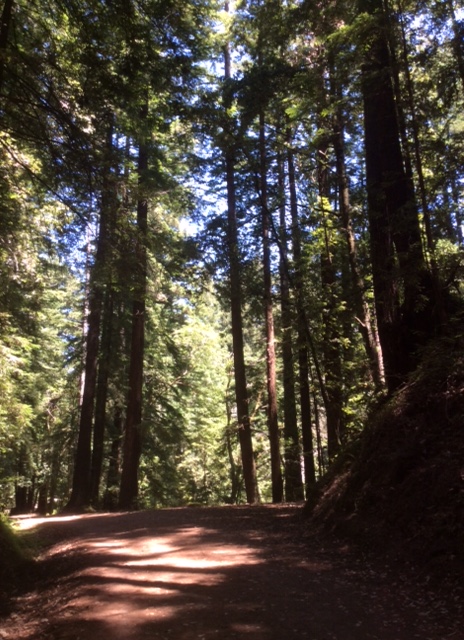
Redwoods, Nisene Marks State Park, CA
I will soon be celebrating the marriage of one of my family members that has lasted several decades, 40 years to be exact, and I’ve been giving some thought as to what it is that enables a love relationship to endure over such an extended period of time. When my parents were in their 60’s, I interviewed them about their lives, asking how it was they met and married. My parents married during the Great Depression and it was a simple affair–no party, no special wedding dress, no photos. It was a regular day except they got married, and that event changed their lives. Neither of them emphasized the romantic aspect of their relationship in relating their history to me, and yet I never doubted that they loved each other and were committed to the relationship even though there was a period of years that my father lived away from home managing jobs in other states and came home once or twice a month. What was it that enabled their love to endure through time? Communication seemed an important key to my parents’ connection to each other. I remember hearing the low hum of my parents’ voices through the walls in the mornings and after we children went to bed. There was also a a commitment to the relationship in the bigger, long-term sense–that they were there for each other and for their children, even when apart. During WWII Dad worked in Hawaii, and also worked out of town for a number of years when I was in junior high and high school–but my parents wrote each other letters frequently and regularly made trips to be with each other. Dad wrote stories and poems that he shared with us as well.
My parents were also committed to being there for people in the larger community–to helping neighbors, friends and other people that they came in contact with or learned about that needed help. Dad built and repaired things for many people, and brought people turkeys at holidays, for example, while Mom sewed quilts and clothes for others. My parents didn’t live simply to improve their own lives, they contributed to their community. Helping others was an important part of living. Together they embodied what Martin Seligman in his study of the science behind of what creates a meaningful life has found–that people who feel their lives offer them a deep sense of meaningful fulfillment are those that use their personality strengths for a purpose larger than themselves. Much of this kind of caring, this love, can be carried on without words. It is a way of being together. Love is given in the tone inside and underneath the words, and is the mood inside the actions spoken with the body. As one of my friends told me, “A lot of what love is is simply showing up–being there for each other.”
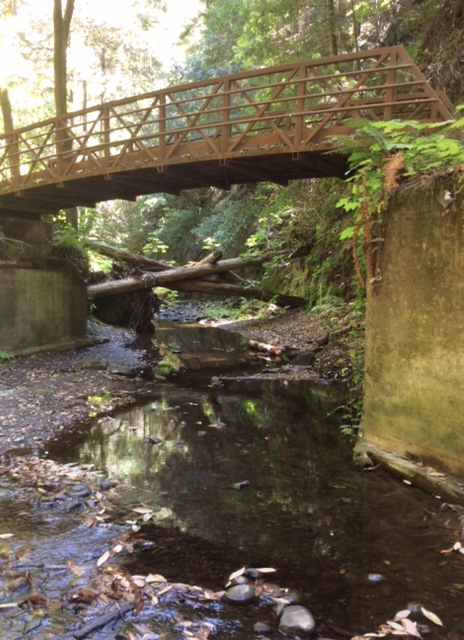
Forest Path, Nisene Marks State Park, CA
Being there for each other. What does that look like? The Buddhist leader and monk from Vietnam Thich Nhat Hahn in an interview with Oprah, explained when asked if he meditates every day, that he is also meditating “while drinking, while talking, while writing, while watering our garden, it’s always possible to practice living in the here and the now.” (Read more on the Oprah website “Oprah Talks to Thich Nhat Hahn” here.) Thay (as Thich Nhat Hahn is also called) goes on to say that when sitting with someone, “Darling I am here for you,” is his mantra. He explains. “When you love someone, the best you can offer is your presence. How can you love if you are not there? ” This attitude of a listening heart is what I mean by showing up for the ones you love: in your full being you are intentionally, consciously present. You are listening not just to the other person’s words and actions, but to his or her heart, to the silences and things the person can’t quite articulate, even if you’re not sure what everything means that you are hearing or noticing. You are present for the other with your full self, and you work to know who you are so you can give yourself in a caring, open way.
Pamela Dussault in her The Huffington Post article, “5 Essential Steps to a Happy, Enduring Relationship” suggests that couples need to know their purpose for being together. The base for the relationship rather than focused on fear or the desire to control, has the focus of sharing life of companionship. Also, she describes that enduring relationships are those where partners have the ability to give and receive without having expectations. Lastly, she says partners in happy relationships connect with each other both emotionally and spiritually, appreciating the partner’s uniqueness. A key, she suggests is that “your partner must be seen, loved, appreciated and cherished for who they are, as they are.”
Romantic love has been central to the idea of marriage in the Western world since the time of the Middle Ages and the troubadours when knights accomplished their deeds for the love of their lady. While enduring love can include romance as well as traditions, negotiating between both passion and what makes a love stable, creating a relationship of lasting love encompasses a larger territory than romantic love or tradition alone. To ask what makes love endure is to ask what is the source or foundation of the love. To ask what creates love’s foundation is to ask what is it that makes love meaningful. To ask that is to ask what makes life meaningful, and to ask what makes a life. Is life just going through the days sharing food and shelter? Is it doing a sport or if talking about a relationship, is it participating in a sport or (any other activity) together? Is it having children together or accomplishing tasks at work? Certainly, these are parts of what life is, and some of these things could be called necessary elements of life, but if that were the whole of what it was, life could still feel empty. If life were composed of going through certain actions, or saying the right words at the right time in the right way, that also wouldn’t be enough to make one feel he or she was really living life.
E.E. Cummings’ poem at the start of this post begins with the line, “stand with your lover on the ending earth.” The earth is a physical object, and all objects wear out or wear down over time. At some point the earth and everything on it will end. Cummings begins this love poem in the awareness that all is at the “mercy of time.” We will die. The earth will die. But love is somehow beyond time. The home of all love abides in a mysterious essence beyond time. It is part of what Cummings describes as “the fragrant mountains of eternal now.” We frolic in the mysteries of birth and death, but acts done in love, living done with love, time where we sit with someone with the attitude and heart that communicates both with words or without them, “Darling, I am here for you,” that lives on in a place both in and beyond time. That love allows us a taste of eternity. Annie Lighthart’s, poem, “The Second Music,” elaborates on this idea where describing the everyday events of life she says,
Now I understand that there are two melodies playing, one below the other, one easier to hear, the other
lower, steady, perhaps more faithful for being less heard yet always present.
There is the world we live in–all the wondrous sights our eyes have seen, our ears heard, our bodies felt; the wide oceans with their ten thousand colors of blue, the forests of intense greens, the smiles of a child, birds in flight, clouds drifting by in the vast sky, the hollows and hills of everywhere, rain splashing on stone streets, the icy lace clinging to trees, the laughter of the ones we love, the last touch of a hand from one who is leaving us, all these experiences, and so many, many more wonders known while walking in this world, these are ours, and inside of them “If the truth of our lives is what it is playing,” Lighthart goes on to write, there is a “second music” that she stops to listen to that is underneath and through all these moments, sights, sounds and experiences. She ends the poem by saying “I set my ear to it as I would to a heart.” This is the love that is living–I could say hiding–inside of the physical world. We perceive it with the heart because what is known with the heart is what lives on. That is the love that endures–the part of life when we are fully present with another. Love that endures connects to this larger love. That is the love that weaves the world together.
Bridge, Nisene Marks State Park, CA
Recently, we had a guest visiting our house who is approaching her 80th birthday in September. When I asked her what is something that age has taught her, she replied, “Your age isn’t who you are. You are more than body, emotions or thoughts, more than any of these or all of these together.” None of us loves perfectly. Loving someone, anyone, is more than what we do or say, more than time together, more than body or emotions shared. Love is a journey, just as marriage is a journey, a pilgrimage toward love. You have to get out there and walk the trail. Sometimes you take a road you think is the right one but you get off track. Sometimes you might walk a long way through dry, flat land. You walk in rain and sun. You walk up hill. Sometimes you get tired. Nevertheless, love begins each day living in attitude of walking together. You walk and you listen to each other. Thoreau said, “If you have built castles in the air, your work need not be lost. Now put the foundations under them.” This is the work of enduring love: you practice being present in small moments (and most of life is lived in those small moments, the daily acts) so that we will be able to be present for the big moments when they come. Our giving ourselves to learn to walk together and to listen to each other is what carries marriage across the threshold into the sacred and allows us to taste what is eternal.
It was the fourth of July, American Independence Day, and I was out hacking weeds on our property, in particular poison oak, a beautiful plant, but not so pleasant for the skin. This has been my effort for the past several days: chop out the poison oak and wild raspberries growing along the pathway on the side of our property. It’s sweaty work and my arms get tired but it feels great to be doing the work, an act that I know is caring for the land here. I don’t like to cut flowers growing in the garden, as I think they will last longer on the plant itself, and it is a joy to see them in the garden, but in taking care of a garden and nurturing the plants on our land, I’ve come to see the value of trimming plants. Just as people need to cut their hair and fingernails, plants grow better with a bit of trimming. It takes time to learn how to care for the land you live on and the plants that grow there. As I think of it now, gaining that understanding and making the effort to care for that bit of earth where you live could be viewed as a patriotic act. More than singing a song or saying a pledge, getting out to water and weed is literally caring for the country where you live–wherever it is you live.
In the United States, we sing the song “America the Beautiful,” and one of the things that keeps America, or any country’s land beautiful are people who grow to know the land they live on and to nurture that relationship to it. If you want your family to function well, or if you are in a close relationship with someone, you need to act in caring ways on a daily basis if you want the relationship to continue and to be satisfying. You do the things that keep the growth going and the communication close. You pay attention to each other’s needs. Different people in a family have needs unique from each other according to their personality and their history. You might have a babysitter for the children now and then, but connection between people deepens when there is a long term commitment and connection, such as a parent has for a child as he or she grows. A parent is there for the long haul. It is similar in developing a relationship with the land we live on. If we see the place we live as just a place we crash, or if it is merely a place for commercial investment, we will not care for it in the same way as if we see it as our home, the place we belong. When we see it as a relationship, as a place of belonging, we are willing to get out there and weed for hours and weeks over periods of years. We study the best way to trim back the vines, we give the vegetables compost. We learn what activities erode what you want to remain solid, and which not.
I. Land that is used will be ruined unless it is properly cared for.
II. Land cannot be properly cared for by people who do not know it intimately, who do not know how to care for it, who are not strongly motivated to care for it, and who cannot afford to care for it.
III. People cannot be adequately motivated to care for land by general principles or by incentives that are merely economic—that is, they won’t care for it merely because they think they should or merely because somebody pays them.
IV. People are motivated to care for land to the extent that their interest in it is direct, dependable, and permanent.
V. They will be motivated to care for the land if they can reasonably expect to live on it as long as they live. They will be more strongly motivated if they can reasonably expect that their children and grandchildren will live on it as long as they live. In other words, there must be a mutuality of belonging: they must feel that the land belongs to them, that they belong to it, and that this belonging is a settled and unthreatened act.
VI. But such belonging must be appropriately limited. This is the indispensable qualification of the idea of land ownership. It is well understood that ownership is an incentive to care. But there is a limit to how much land can be owned before an owner is unable to take proper care of it. The need for attention increases with the intensity of use. But the quality of attention decreases as acreage increases.
VII. A nation will destroy its land and therefore itself if it does not foster in every possible way the sort of thrifty, prosperous, permanent rural households and communities that have the desire, the skills, and the means to care properly for the land they are using.
Just as a relationship with another person would be unsatisfying and dehumanizing if people entered into it only for what they could get out of it, as if it were a commercial enterprise, so it is with our connection to the place we live. You stay with the land through drought, as we are currently experiencing in California and give what you can to help things along, conserving water while still thinking ahead to the future–not knowing what will come, how long you will need to wait before the skies bring rain. I want to think of loving the country of my birth as literally loving and caring for the earth I stand on, the earth I work to understand and nurture.
On one blog I follow, Mozzarella Momma, Patricia Thomas, journalist for the AP in Italy, quotes Pope Francis’s recent description of humans’ relationship with the earth, “We have come to see ourselves as her lords and masters, entitled to plunder her at will. The violence present in our hearts, wounded by sin, is also reflected in the symptoms of sickness evident in the soil, in the water, in the air and in all forms of life. This is why the earth herself, burdened and laid waste, is among the most abandoned and maltreated of our poor….” The pope goes on to express concern for the “environmental challenge we are undergoing, and its human roots, concern and affect us all,” reports Thomas. It’s critical that loving the country we belong connects to carrying for the earth itself and doing the things that will help it to flourish into the future. Without nurturing the earth, our country, as well as the earth will eventually not be able to sustain itself. If we keep taking from a relationship without giving back little of the relationship will be left at all. This begins by paying attention to where it is we live, and its physical needs, to the things that make it healthily beautiful, and that will help it continue to be this way into the future.
Soon, a family member of mine will be celebrating a wedding anniversary of several decades. After years of living together as a couple, you know each other, just like you know the house you grew up in, just as you know the land you walked daily down your driveway as a child to the bus stop or the end of your block. You know the tunnels and dark places, as well as the open field or yard, know when and why certain plants flower when they do. You know that place in all its seasons. In Wendell Berry’s poem,”They Sit Together on the Porch,” Berry describes a couple that have been in relationship with each other for a long time.
They sit together on the porch, the dark
Almost fallen, the house behind them dark.
Their supper done with, they have washed and dried
The dishes–only two plates now, two glasses,
Two knives, two forks, two spoons–small work for two.
She sits with her hands folded in her lap,
At rest. He smokes his pipe. They do not speak,
And when they speak at last it is to say
What each one knows the other knows. They have
One mind between them, now…
The poem goes on to describe how the couple awaits the coming darkness, not knowing who will be the first to go and who will be left sitting alone, but the love is there, and felt between the silence. They are at rest with each other and with the place they inhabit. They have taken care of each other for many years. They are at peace with each other and with the earth. This is a vision to work toward, people at one with each other and with the earth.
Abril venia, lleno
todo de flores amarillas
amarillo el arroyo
amarillo el vallado, la colina,
el sementario de los ninos
el huerto aquel donde el amor vivia.
El sol unjia de amarillo el mundo,
con sus luces caidas;
!ay, por los lirios aureos, el agua de oro, tibia;
las amarillas mariposa
sobre las rosas amarillas!
Guirnaldas amarillas escalaban
los arboles; el dia
era una gracia perfumada de oro
en un dorado despertar de vida.
Entre los huesos de los muertos,
abria Dios sus manos amarillas.
I’ve loved this poem by Jimenez since the moment I first read it several years back. I love the rhythm and the way Jimenez uses repetition. I love how the sound of the poem read in Spanish so perfectly complements the ideas. It is fully beautiful; beautiful like spring.
Bee on flower, Delhi
Butterfly and yellow garden, Delhi
YELLOW SPRING Juan Ramon Jimenez
April came, all
filled with yellow flowers.
Yellow the stream,
yellow the fence, the hill,
the children’s cemetery
the orchard where once love bloomed.
The sun anointed the world yellow in its fallen light; Oh! for the haloed irises, the gold-lit water, warm; the yellow butterflies over the yellow roses! Yellow garlands scale the trees; the day is a grace perfumed with gold, in a golden awakening of life. Between the bones of the dead, God opens his hands of yellow.
casia fistula tree, New Delhi
Yellow wasn’t my favorite color growing up, though it was my younger sister’s. She looked terrific in yellow, wore it often, and her room was yellow as well. Yellow was a nice enough color, but somehow too bright, too loud like brass horns. Over the years, however, I’ve come to appreciate the color yellow. When you see wide fields of sunflowers blanketing rolling hills in Italy, holding their golden faces to the summer sun, their beauty and the way they lift the heart can’t be denied. Similarly, when walking down Sorrento’s streets with gold and ochre painted buildings sitting above the sea, and lemon groves growing on the hills, the lovely tablecloths and ceramics with lemon designs displayed in shops along with Sorrento’s appreciation of limoncello, it’s easy to grow an affection for the color yellow.
Because I’m currently writing poems about food, I’m also exploring some of their history and stories and the lemon has an interesting history. I grew up associating the fruit with California, as it is a citrus, and California is noted for its citrus groves that date back to the 1840’s in Los Angeles area, though citrus fruits were first brought to California by Spanish missionaries in the 1700s. The word is of Persian origin, limun, and entered English through Old French, limon, related to the Italian limone. My parents had a lemon tree growing at our house when I was a child, along with a grove of orange trees.
Meyer’s lemon from Santa Cruz
I also associate lemons with the Mediterranean because of the fairly warm climate there. Its origins are further east, however. Though its exact origins are a bit unclear, they are thought to be India, the country where I currently spend most of my year, in the Assam region near the Chinese border. Over time, the fruit made its way into Persia and then on to the Mediterranean, carried by Arab traders into the Middle East, North Africa, and then southern Italy before entering the rest of Europe during the time of the Crusades . At first, the lemon was used as an ornamental plan as well as medicinally. Currently, according to the New World Encyclopedia, Italy and the US are the world’s leading lemon producers.
My husband’s grandmother drank a glass of lemon juice with water in the morning to aid digestion. The fruit’s juice has antibacterial qualities, and is thought to be good for the skin. It also tastes incredibly delicious in homemade lemon pasta (see a recipe here) that I’ve made together with my husband. If you happen to be in Rome, aim to try eating the lemon pasta at Vladimiro Ristorante, Marcello, 39 06481 94 67 Via Aurora 37 (Via Veneto), 00187 Rome, Italy. The sauce of rich cream with lemon is truly memorable.
Detail of Henri Fantin-Latour’s Lemon, Apple, Orange, and Tulips, 1865
In addition to all mentioned previously, Citrino is my surname, which I believe means yellow like the stone, citrine. Possibly the surname means citrus, though, too, as the origin of the English word citrus is Latin and refers to the citron tree, and the citron tree has a fascinating history. You might be most familiar with the citron fruit as part of fruitcake you’ve eaten. The LA Times writer, Jeff Spurrier, explains in his article, “Growing the etrog citron, A tree full of symbolism” that the “etrog citron (Citrus medica) is a fruit with thousands of years of human use.” Originally also from India’s Assam region, the citron is a separate species from the lemon according to Encyclopedia Britannica. Helena Atlee in her book, The Land Where Lemons Grow: the Story of Italy and its Citrus Fruit, explains how the citron fruit is used in the Jewish observance of Sukkot and is one the oldest of cultivated citrus trees. According to Spirrier’s article mentioned above in the LA Times, archeologist found the citron’s seeds in Mesopotamia dating back 8,000 years. The citron may even have been the fruit referred to in the story of the garden of Eden, not the apple! A thorny tree, the citron grown in Italy is from the region between Tortora and Diamante, an area that is even referred to as the “Citron Riviera.” You can read more about this plant and its history here, and even more here with a detailed horticultural origin analysis if you’re curious.
Eureka lemon tree in our California garden
Especially noted for its wonderful scent, Atlee, in her book, The Land Where Lemons Grow, describes her attempt to make a broth with the citron following Apicus’s ancient recipe. Not willing to sacrifice the entire fruit to the broth, she cut off the fruit’s tip and suddenly, she noticed the air was “drenched with perfume. By cutting the rind I had released essential oils from the pores just beneath its surface, and the smell of violets that comes from a citron’s outer skin had been replaced by a scent reminiscent of crushed geranium leaves in the sun, mixed as ever, with warm but indefinable spices.” Reading that description made me want to travel to find the fruit just so I could smell it!
Though the tree is too bushy to provide shade, though its is wood brittle and not good for building or adequate for burning, though its fruit isn’t particularly pleasant to eat, and though it fails at possessing qualities for most any practical use, it does have something nearly miraculous going for it, Atlee explains. It produces its huge globes of fruit at the same time it bears “a full cargo of beautiful flowers.” Not only that, wood, flowers and fruit, in essence, the whole of the tree is perfumed, and the fruit seems to never decay–all qualities giving it interest and respect from ancient people.”(The Land Where Lemons Grow) According to the Online Etymology Dictionary, citron was the first citrus fruit cultivated in the West.
Another type of citron with additional unique qualities is the Buddha’s Hand citron which has multiple finger-like sections, somewhat resembling a flower. The fruit appears in paintings on India’s Ajanta cave walls. It, too, isn’t a fruit with much to offer regarding taste, though some research supports its medicinal benefits demonstrate it contains anti-cancerous, and anti-inflammatory properties, as well as possibilities to slow the development of both Alzheimer’s and diabetes. (See more here.) Though fussy about its conditions, the citron is a unique food with a fascinating history and I will have to search out finding one. Luckily, I’ve discovered someone in my county is growing them and they are for sale at Santa Cruz County farmers’ markets!
Lemons at Vienna’s Naschtmarkt
I am grateful to those who first carried the seeds for these fruits to their homelands in the Middle East, and the gifts they have been to so many for so many centuries. The interconnections between India, Italy and California in the history of lemons and citrons, are surprising and wonderful to learn. The discovery makes me curious about what other ways our lives are connected beyond the boundaries of what we know or understand.