art, Wonder

Holding Time in the Presence of Art

As I walked down the subway tunnel in St. Petersburg, Russia recently, observing the living river of people moving in the opposite direction, I thought about how vast the world is and the ideas it contains in people’s thoughts beyond the world I know and live in. Emily Dickinson wrote, “I am nobody, who are you?” It is a line of poetry I identify with as one who has lived outside my own country for more than two decades. When traveling to a new country and encountering entire cities filled with people who have a different history, who wear clothes with a different sense of style, and who don’t speak my language, I’m again made aware of my smallness.

I had come to St. Petersburg to see the art as its museum, the Hermitage, an art museum known as one of the finest in the world. Once inside the vast building, we found ourselves wandering through rooms of Rubens, Rembrandt, Gauguin and crystal chandeliers.

Stepping into the room that held the da Vinci paintings, I noticed how crowds clamored in front of them, hoping to get a glimpse. One man I noticed worked his way up to the front to look at the painting of the Madonna Litta through his phone’s camera lens just long enough to take his snapshot, then turned immediately away. Observing this behavior repeated by others as well made me wonder what is it we actually see when we gaze at a painting? Most of us aren’t trained artists. What are we looking for and what do we find when viewing art? When does a painting speak to you and why? What makes it stand out in someway beside all the others of similar subject matter? Is it the name of the artist that tells us this painting is from a master and therefore valuable, or is there something more? To what level do we actually see something of ourselves and our world in the art we view?

One of the reasons I appreciate visiting art galleries is for the glimpse they give into other minds, other ways of being. It is also a way to time travel. If you recall when you last visited an art gallery, you probably remember seeing paintings of people you’ve never heard of, or paintings by artists you know little about. Perhaps you see the portrait of a duke or a countess who were considered to be somebody in their day, and an artist painted their portrait, maybe even a well-known artist, but today hardly anyone passing by even knows who they are. Thinking again, of the anonymity in crowds, I began to take more notice of paintings of people and by artists I’ve never heard of when I came across a painting that said it was by an unknown artist. Neither the artist or the subject are known by name, yet here the portrait or sculpture was, hanging in the gallery. No one crowds around to view the paintings by the less well known, but thousands see them every day in galleries like the Hermitage, and someone recognized the value of the artist’s work so that it ended up in the gallery. What might these pieces have to say?

When I encountered this painting of Ivan Kramskoi by Ivan Shishkin in the Russian Museum, it seemed as if Shishkin could step out of the painting and have a conversation with the people in the room. He appears so alive, ready to engage. Shishkin was a landscape painter, and Kramskoi was a leader in the Russian democratic art movement. The realistic quality of these paintings is echoed by another painter of the 1800’s, Nikolai Ge, in his Portrait of Olga Kostycheva, a girl whose eyes reflect a kind interior sadness.

Standing before the portrait of Marina Derviz, by Jean-Joseph Benjamin Constant, I felt I wanted to know her thoughts. She appears sensible and the upturned edge of her lips suggest she is kind. Her face seems open and approachable, even though she wears a stiff high collar and pearls demonstrating wealth and status.

FullSizeRender (6)
Pavel Chistiako, “Jovannina Sitting at the Window Sill”

Art reflects life and the artists’ way of seeing and interpreting life. There are a variety of reasons an art piece might speak to a person, of course. Some paintings I observe for what they might say about how the artist used the brush strokes to create the form. Other paintings I recognize from seeing copies of them in books. Still others depict familiar stories or embody larger ideas or responses to events. It’s interesting to see the artist’s interpretation and perspective of these events and stories, and this is an activity that requires close observation and interpretation of gesture and facial expressions. This painting by Pavel Chistiako, Jovannina Sitting at the Window Sill is beautiful in the quality of quiet reverie it evokes.

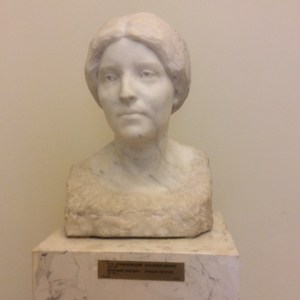
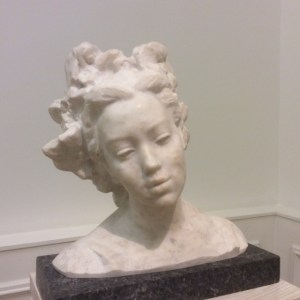
The sculpture on the left below by Gleb Deriuzhinsky is of an unnamed woman and is simply titled Female Portrait. Next to it is, Youth by Ekaterina Belashova-Alexeyeva. Both depict a woman without a name and instead, reflect life at a particular age and moment.

None of these artists or art pieces was I familiar with before seeing them in St. Petersburg, and yet they are of excellent quality.

2,000 years ago, Socrates taught people by asking questions. He didn’t work in an established school. Instead he taught in the streets. He was a “nobody” in the sense that he didn’t write anything down himself. Plato’s written version of his dialogs has helped students of succeeding generations to see how curiosity and reflective inquiry can help us to better understand our thinking and that of others around us. The older I grow and the more I travel, however, the more I realize there is so little I truly understand or grasp of the world around me. Constantly, I’m lead back to the mystery that life is, and this is what happens to me when I stand before art such as these few pieces I’ve mentioned. Vistors walk by a thousand art pieces and see their beauty, the immense skill, the hours and hours of dedicated work and effort they represent. There are rooms and rooms of art, and “experts say that if you were to spend a minute looking at each exhibit on display in the Hermitage, you would need 11 years before you’d seen them all,” says the Hermitage museum site. We can hardly take in what it means. It’s too large to grasp. Socrates said, “I know that I do not know,” and we consider him a wise man. Maybe the beginning of any kind of understanding is the humble acknowledgement of our smallness. Our life experience can lead us into an understanding of what is important in life, but in the face of all the flow of humanity and the experience represented there, in face of all the art, it’s also worth recognizing that there is much we don’t know and can’t do. We are led back to a place of humility, and perhaps even awe at what it means to be alive, to be part of history’s vast river. This, again, is a valuable reason to view art–to gaze into other worlds and to listen to what is being expressed beneath the words because art, by its nature, leads us into a world that communicates beyond words and is both inside of time and is in some sense timeless–speaking to us of our bonds to humanity beyond a particular period. When viewing art, we look into the face of humanity in its variety of activity, moods, and moments, and for a few moments we hold time before us to savor and wonder at its meaning.

IMG_5852
Queue, by Alexi Sundukov

Art works are invitations for reflection and serve as mirrors of the time and society. They communicate a way of seeing and expressing the world, inviting us to see something about ourselves, ourselves in relationship to the world, or the artist’s vision of the world. Art asks us to notice texture, color, shape, line and form—the fundamental essences that compose physical reality. In how much of our lives do we function on routine procedure? Art is there to bring us back into a place of being, to rejoin us with the awareness our humanness and to enable us to connect consciously to the life we live.

So, what do we see when we look at art? We can ponder the open face that appears ready to engage in communication and those that are haughty. We can notice Kadinsky’s playful lines, the energy explosion on a Pollock canvas, the quietness of a Monet haystack under morning light. We can also learn from those who wanted to be “nobodies,” whose aim wasn’t to be known, but instead focused on doing their work. We can make it our aim to be the unknown life-giving presence to the unknown face in the gallery by the unknown artist who reveals his or her life’s message, a message that might be simple as taste the water, watch the circling bird, listen to the song inside a boysenberry’s bursting juice as you bight in, dance with the village, or notice the pain inside the choice you made and what it teaches. Rest in the window. The Persian poet, Hafiz, wrote in his poem “Deepening the Wonder”

The impermanence of the body
Should give us great clarity,
Deepening the wonder in our senses and eyes

Of this mysterious existence we share
And are surely traveling through.

If I were in the Tavern tonight,
Hafiz would call for drinks

And as the Master poured, I would be reminded
That all I know of life and myself is that

We are just a midair flight of golden wine
Between His Pitcher and His Cup.

Art asks us to deepen our wonder, to recognize we are but the liquid flight between the Master’s picture and his cup. Art asks us to look at life as a felt experience, to notice humanity and the world in its myriad expressive forms and appreciate its diversity. We want our lives to have meaning, so why not practice noticing the life we live. Next time we look at an art piece, or the things in our world that art depicts— the cup resting on your table, the face of a stranger or the one you love, notice the texture of things, the color, the turn of line. To practice noticing as a way of returning to being. What are the questions the people and things you observe are asking underneath the surface of their presence? Let’s listen to the things, to faces and bodies and beings.

Uncategorized

Perseverance and Practice: Doing Art

“Art is a spiritual practice. We may not, and need not, do it perfectly. But we do need to do  it…Focused on our art, we connect to the artful heart of life. The creative pulse that moves through us moves through all of creation. It could be argued that creativity is a form of prayer, a form of thankfulness and recognition of all we have to be thankful for, walking in this world.” –Julia Cameron, Walking in this World

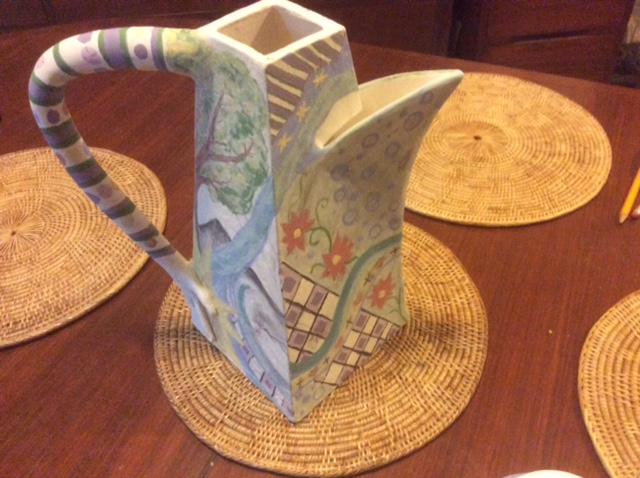
All morning I’ve been painting on a ceramic teapot that my husband made and called “The Mad Hatter’s Wife.” It’s a tall pot that narrows as it reaches the top. The lid is actually the head of the Mad Hatter’s wife. My husband gave her to me to paint, and in coming up with an idea of what she looked like, I figured that if she is married to the Mad Hatter, I had to make her be a woman who has a good deal of inner power. This would be necessary if living with a crazy man. Though hatters at the time Lewis Carroll was writing went mad as a result of repeated exposure to mercury vapors in the felting process, like also attracts like, and my hunch is that the Mad Hattter’s wife was probably a bit “mad” as well.

IMG_5333
Mad Hatter’s Wife tea pot lid (work in progress)

Married to a “mad” man, she’s likely a bit more individualistic and unique than others around her, and a bit more socially unacceptable as a result. She would’ve had to listen to her own inner voice and follow her own path. Thomas Moore said, “It is only through mystery and madness that the soul is revealed.” The underglaze painting for the Mad Hatter’s Wife needed to reveal the soul of woman connected to her inner power and creativity, I decided. Perhaps she’s named Breena or Brucie, Alva, Erline, Orla, or Tiana– a name having to do with elves or fairies. She’s got to be a bit sassy, too, I’m guessing, as her hand is placed on her hip, and her hip explodes in a sunflower. A woman who has never lost her inner child, I’ve made her body a bit ocean, tree, river, bee, bird, mountain and rainbow. Hers is the kind of madness that keeps one sane. She wears crystals on her arm, and my guess is that she probably can fly (at least in her dreams.)

Mad Hatter's Wife teapot in progress
Mad Hatter’s Wife teapot in progress
Mad Hatter's Wife teapot in progress view 2
Mad Hatter’s Wife teapot in progress view 2

My husband, Michael, gave me the teapot to work on last week, suggesting in a off hand comment to someone that I was going to make it my masterpiece. After hearing that, I realized I needed to paint her in the way that pushed the craftsmanship boundaries beyond what I’ve previously done. (You can see my previous work by going to the Art and Poetry Connections page here on my blog.) Though I want to make her wonderful, the work isn’t turning out as wonderful as I’d like. I want my craftsmanship to be better, but I’m still learning how to control my brush and the flow of the glaze. Different glazes have different textures, and they don’t all flow smoothly or the same. Drawing a perfectly straight line with the brush is difficult. I want the glaze to flow exactly where I want it, and that doesn’t always happen. The materials have their own way of being. I have to marry my effort to the nature of what I’m working with so that I communicate compatibly. Like any relationship, the understanding of how to make the connection look effortless and take on the magic expression of soul takes time.

The element of time and perseverance is something I’ve been thinking about repeatedly this past couple of weeks. It is nearing the end of the school year here, and as often happens when things come to an end, some things unravel while others fall apart so that something new can come into existence. Sometimes reality seems like a series of dreams. You live in one world for a time, and then that phase comes to an end. The location you’ve made your home is no longer yours, and you move somewhere else, take on a new job, or whatever: reality shifts. The whole world changes, almost as if you’re reincarnated. There are so many possible worlds! Even for those of who stay in the same place decade after decade, things still change. All around us the world is changing. What I’ve really been wondering about, though, are the people who have lived in countries where there has been a civil war, or an event like the earthquake in Nepal, where suddenly everything they thought they understood about their world and the foundations they stood on has changed. It takes decades to recover. How do they cope with it? How does anyone keep going in such situations?

Light is such a wonderful thing. I love a room full of light, sun streaming through the trees on a cloudless summer day. When I lived in Riyadh, though, I treasured clouds, and with it, the rain and the darkness–storms, because these were rare. I remember sitting on the edge of the escarpment outside the city and hearing the camels far below calling. If you have the opportunity to watch camels walk, you can notice how graceful they are. The heat can be relentless, the light unbearable, but camels somehow continue on. It made me think about the dark areas in our lives, the shadow places on earth that lie beneath the surface, or that track by in shifting movement–the things, people and places that do not or cannot speak directly. These things speak in language without words, giving voice to the things that can’t be said. Here is the poem I wrote about this when living there:

PERSEVERANCE
Anna Citrino

Black camels lift their calligraphic legs writing invisible letters
across the desert sand, as if drawing up the shadowed calm
hidden inside the light imprinted on the desert floor.

The camels raise their dark, slender limbs and casually wander
through the heated brightness, wooly heads held up
with muscled grace, an act of ease

with no thought of pain or fire. They know how to store water
to carry them through dry and cloudless seasons.
I have heard them groan, the guttural sound

reverberating from deep in the belly like the rumble
miles down inside the earth before the shudder
of tectonic plates. Their voices pull up

the yearnings of hidden worlds, let go the grief
from inside the nameless forms that cannot speak or see.
The camels are the shadows we seek.

Watch them from high up on a cliff, the trails they etch
into blind and heavy earth, letters of unsaid
stories the sun refuses to speak.

________

The writer, Edna Ferber said, “Perhaps too much of everything is as bad as too little.” Camels’ embody perseverance–this nameless longing we have, the suffering of waiting as we trek across deserts, but how do we keep going like they do through the times of heat and emptiness? Though camels can keep walking through the heat, before heading out into shade-barren land, they drink enough to help them hold out. This is something we, too, need to do. We need resources to keep us going. For me, one of the great resources to help me through times like these is art–art in the form of music, poetry, writing, painting, or dance.

IMG_5301
Flight of the Mind writing workshop. Lucille Clifton third from right. Anna next to Lucille Clifton on the right.

Back in the 1990’s I took a workshop with the poet, Lucille Clifton at the Flight of the Mind writer’s workshops (now no longer in existence) outside of Eugene, Oregon. At that workshop, I recall Clifton explaining how poetry humanizes us. “As long as one person is writing poetry,” she said, “the world will be a more human place.” Her words stuck with me, and have gained weight and significance over time. In the act of creating, we transform ourselves and our world. When creating, we are communing with our inner selves, but art, music, poetry, and dance are also communal acts in that they are meant to be shared with others, and in so doing, we reconnect ourselves to others and to our Source.

In Rattle’s interview with Maria Mazziotti Gillan, Gillan describes her journey as a writer to find her truth. “I think poems are in a very deep place inside yourself,” she explains. It took her time to realize who she was as a poet, and this is the risk she encourages others to take as well, to “move down into yourself, and tell the truth.” This confrontation with the truth of ourselves is what transforms us. When creating, we enter into a place of deep listening. We are making a poem, for example, but we are also listening for the words to rise up and connect us with our work. This is what prayer is too: listening. Communing. And art, whether it is writing, music, painting, photography, or dance is a vehicle for listening to our own truth. The deeper we can go into that place, the more we can be transformed. Fiction writer Frederich Busch explained “Good art is a form of prayer. It’s a way to say what is not sayable.” When I write, when I paint, I am connected body to soul, and it allows me to feel alive again, to feel whole. This is how we can all persevere: we go back to a place where we reconnect body and soul–to the creative act, the practice of art.

A couple of millennia ago, St. Paul wrote to the Romans, “For we know that the whole creation groans and suffers the pains of childbirth together until now. And not only this, but also we ourselves, having the first fruits of the Spirit, even we ourselves groan within ourselves, waiting eagerly for our adoption as sons, the redemption of our body.” Everyone suffers the pains of waiting, of trying to hold on and hold out–to persevere–even creation itself. It’s almost as if loss and suffering are necessary parts of beauty. We sense beauty more keenly when we are aware of loss. Yet, it’s out of this longing and suffering beauty arises.

In Arun Kolatkar’s poem, “An Old Woman” an old woman grabs hold of the speaker’s sleeve, an experience I’ve had myself here in Old Delhi. The woman follows the speaker, begging, and she won’t let go. The speaker wishes to be rid of her, but when the old woman says, “What else can an old woman do/ on hills as wretched as these?” something in the speaker shatters. Her question splits him open, and the world around him as well.

You look right at the sky.
Clear through the bullet holes
she has for her eyes.

And as you look on
the cracks that begin around her eyes
spread beyond her skin.

And the hills crack.
And the temples crack.
And the sky falls

with a plateglass clatter
around the shatterproof crone
who stands alone.

And you are reduced
to so much small change
in her hand.

Beneath our clumsy actions, our imperfect voices and art, somehow, sometimes, someone hears us. They see right into us, and inside that look we see the brokenness that interconnects us all. This is India’s gift to me–the myriad people on the streets like the beggar woman in this poem that mirror my own brokenness and need.

And so, we persevere. We live out Lorca’s “Theory and Play of the Duende,”

“The roads where one searches for God are known, whether by the barbaric way of the hermit or the subtle one of the mystic: with a tower, like St. Teresa, or by the three paths of St. John of the Cross. And though we may have to cry out, in Isaiah’s voice: Truly you are a hidden God,’ finally, in the end, God sends his primal thorns of fire to those who seek Him.

Seeking the duende, there is neither map nor discipline. We only know it burns the blood like powdered glass, that it exhausts, rejects all the sweet geometry we understand.”

Art is not just for special people who call themselves artists. Though it is very personal, and an expression of the self, art is for everyone. It is meant to be given to the community. In the expression of our particular story, our dance, or song, we see that we have given expression to the larger community, and in that we find our place again in the human family. We are seen and heard, and through the container of that expression we find a way to endure the particular trials of our day or life–we find a way to continue on.

Art transforms us. So, though my lines on the Mad Hatter’s Wife teapot are crooked, my words not all I wish them to be, though my life continuously falls short, I keep practicing. In the end, the work is not only about the object created. The object is merely the container. The practice is the prayer. This is why we do as Kurt Vonnegut suggested, “To practice art, no matter how well or badly, is a way to make your soul grow. So do it.”

place, poetry, spirtuality

Going Wild–Walking Out Into Nature

“Odd as I am sure it will appear to some, I can think of no better form of personal involvement in the cure of the environment than that of gardening. A person who is growing a garden, if he is growing it organically, is improving a piece of the world. He is producing something to eat, which makes him somewhat independent of the grocery business, but he is also enlarging, for himself, the meaning of food and the pleasure of eating.”– Wendell Berry

In a few weeks I will be back home in California and able, once again, to walk out my door onto the earth and stand in the garden. I will pick berries and pull weeds, prune and plant. Growing a garden connects us directly to the earth. To garden is to learn something of what the earth needs and to care for it–to have a relationship with the earth and to love it. I miss that garden, that particular piece of earth. If earth is our mother, then I am its child, and sometimes I just want to go home–home to that particular landscape that looks and smells like home, where I have dug and weeded and planted, have walked many times–where I’ve given the trees names. When I go home, I will look out my window to see trees and mountains. I will be surrounded by nature. What a gift that is to the soul; what a pleasure to walk through greenery in forests and wild places.
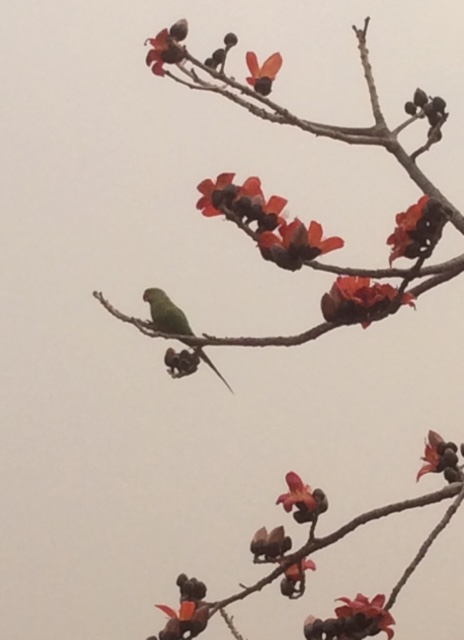
But all this is still a few weeks away. For now, I am still in India. Last week was labor day holiday, and I took a short trip with friends to Musoorie, a city in the Himalaya foothills, a hill station resting at 6,500 feet, and place with roots from the time of the British Raj that is today popular with honeymooners. A walk along Camelback Road, brought views of iris growing wild on the forest covered hills, steep valleys, and the snowcapped Himalaya in the distance. We arrived during a rain storm, and the following morning, the sky was as blue as I’ve seen skies get in India. Tree leaves literally glowed in the light. This is the India I love to be in, the mountains, where the urban coat can be cast off, and the world’s natural form emerges. I felt myself alive again, filled with a sense of wholeness, looking out at the world in wonder.

Often after being out in nature, I feel more whole, as if I have returned to myself, as if in some odd way I’m being healed even though I may not have been particularly aware that I was “ill.”  Since returning to Delhi, I’ve come across an Atlantic Monthly article explaining new research showing how, as the article’s title says, “Nature Resets Our Minds and Bodies.” People who can view nature from their windows after operations generally recover more quickly, for example. “The business of everyday life — dodging traffic, making decisions and judgment calls, interacting with strangers — is depleting, and what man-made environments take away from us, nature gives back,” reports Adam Alter. The theory for how nature does this is called Attention Restoration Therapy, Alter explains. Human made environments ramp up our attention. Nature, on the other hand, asks little of us, and therefore calms our attention. The Japanese, the article goes on to say, have long advocated what they term forest bathing– long walks amongst trees, breathing in the wooded air, and the research on the effects of this activity “compared with people who walked through urban areas, shinrin-yoku patients had lower blood pressure, lower pulse rates, and lower cortisol levels, a marker of reduced stress.” That’s pretty nice! You don’t have to go to Japan to experience forest bathing, however. People in California, are promoting this idea as well, and you can head out into any forest. The idea, according to Brian Wu of the LA Times, is to go slowly, not walking more than three miles in four hours, take rests as you like, drink water or green tea, read.

Going to the mountains, or going to the garden. As it turns out, gardening, too, is good for the soul. Sue, Stuart-Smith, in her Telegraph article, “Horticultural therapy: ‘Gardening makes us feel renewed inside,” suggest that when we plant seeds we interact with the earth in a way that binds us to the mystery of how a seed produces life and our minds connect that with the mystery of our own lives. When gardening, one learns the importance of cutting away and pruning, of digging and weeding–all metaphors for what we must do in our own lives if we are to nurture what it is we have as seeds within us that want to grows.

American culture seems filled with the notion of getting somewhere, setting goals, becoming somebody. We get caught in the stimulus, the distraction of competition. After a while, however, this all grows tiring or we can lose track of who are, what we care most about. We lose our zest for life and get caught up in trying to make our mark or make a living, when we’re not actually living very much. Instead, we are walking through one procedure to the next, only partly alive. Feeling this sadness, this loss, however can be a very good thing as it can lead us back to ourselves. Wendell Berry writes,

It may be that when we no longer know what to do,

we have come to our real work
and when we no longer know which way to go,
we have begun our real journey.

The mind that is not baffled is not employed.
The impeded stream is the one that sings.

As Berry implies, obstacles and questions we don’t have answers for can help us find what makes us sing. When we open ourselves to the Mystery, or to mysteries bigger than our own life, we can experience how everything that is worth something in life isn’t necessarily connected to our effort or accomplishment. Our life stream wants to move from behind the dam that blocks it. It wants to flow, and confronting the question of why it isn’t can help us find they way to let our lives sing again.

The Karmapa, Ogyen Trinley Dorje, in his book The Heart is Noble, writes, “The particular profession or job you do is not the most important factor…Whatever work you do, you have to give yourself opportunities to just be. Even if it is only once a day, you should find a moment to just be  yourself in the course of each day. This could be through a short period of meditation or quiet reflection in the morning or the evening, or in whatever way best suits you. The point is to reconnect with yourself. Otherwise, the whole day you are running around and busy, and it is easy to lose yourself. To guard agains this, you should make efforts to return to yourself and recollect what is essential for you.”

Whether it be forest bathing, gardening, or painting on pottery–as I have done this afternoon–whatever it is, let us find those things that return us to ourselves, that allow our hearts to sing so that when we come to the end of our day or days, we will find that we have lived, we have truly lived.

writing

Why Write?

A quote from Henri Nouwen:

One of the arguments we often use for not writing is this:   “I have nothing original to say.  Whatever I might say, someone else has already said it, and better than I will ever be able to.”  This, however, is not a good argument for not writing.  Each human person is unique and original, and nobody has lived what we have lived.  Furthermore, what we have lived, we have lived not just for ourselves but for others as well.  Writing can be a very creative and invigorating way to make our lives available to ourselves and to others.

We have to trust that our stories deserve to be told.  We may discover that the better we tell our stories the better we will want to live them.

from Bread for the Journey

Beauty, creativity, spirtuality, Uncategorized

At The Edge of Emptiness

“Prayer begins at the edge of emptiness.”–Abraham Joshua Heschel

IMG_4144

Heschel’s words strike me because there are a lot of things I don’t have answers for. Aware of my smallness in face of the suffering around me every day, I stand at the edge of emptiness and cry out.

When riding out into traffic, I’ve started a practice of looking into beggars’ faces who come to my window, or when someone speaks to me in the market asking for money, or when I see who is suffering, a family living on the street, for example, also animals who suffer, and in my mind I say, “I wish you well.” It’s a kind of prayer, and though it’s not directly answering the needs they have, it’s a way to keep my heart open–to keep noticing even though I might not be able to help the person in the way they ask of me. I want to see their humanness, and to be reminded of my own weakness and vulnerability.

Certainly, even in the lives of the desperately poor, there also must be times of joy. Even so, the human need in Delhi, is great. All the arms reaching out, the eyes–the world’s needs are immense. This week Nepal has its worst earthquake since 1934. The suffering is enormous. It will take decades, to recover, life times to become new, and we feel the grief hanging in the air as we go about our day.

The poverty in this world is not made up of physical poverty only, however. There is poverty of spirit, poverty of heart, and this is where I think that those of us in the developed world have a great lack. Everywhere around us today, from psychologists like Martin Seligman and his ideas about flourishing, to religious leaders like Matthieu Ricard, people are talking about how to be happy. Even Pope Francis has come up with his list of 10 tips for a happier life such as taking time off to be with your family, and spending time in nature. People who study what makes us happy tell us that focusing on what brings us a sense of well being actually helps us to become happier, and of course that is a good thing. But sadness and melancholy are also a part of life, and experiencing sadness and melancholy can help us become more compassionate, as Courtney Stephens explains on this animated TED Ed lesson. We learn from our sadness how to be more human.

I don’t know how best to respond to the sadness in the world, the grief so many feel, but want to give something of myself to meet that need. One must start somewhere, however small. It’s the start that counts. It makes room for greater opening, and I know I need to open.

FullSizeRenderFor months now I have been working on poems on the subject of food. It has taken some time, longer than I expected because new ideas for poems keep surfacing. I am now nearing the end of the poems I want to write for this series. I hope I’ve written well enough that after putting the poems into a manuscript I’ll find a publisher so I can use the proceeds from its sale to give to an organization that helps prevent hunger here in India. I hope it will be of some good. In the process of writing these poems, I’ve also been rereading about creativity, and returned today to Rilke’s Letters To a Young Poet where I read,

“…Everything is gestation and then birthing. To let each impression and each embryo of a feeling come to completion, entirely in itself, in the dark, in the unsayable, the unconscious, beyond the reach of one’s own understanding, and with deep humility and patience to wait for the hour when a new clarity is born: this alone is what it means to live as an artist: in understanding as in creating.

In this there is no measuring with time, a year doesn’t matter, and ten years are nothing. Being an artist means: not numbering and counting, but ripening like a tree, which doesn’t force its sap, and stands confidently in the storms of spring, not afraid that afterward summer may not come. It does come. But it comes only to those who are patient, who are there as if eternity lay before them, so unconcernedly silent and vast. I learn it every day of my life, learn it with pain I am grateful for: patience is everything!”

The need in India has been here for decades. It’s not going to go away in the near future. The sidewalk on the street where I live is in a perpetual state of change. It’s put together one month only to be torn up the next, a metaphor for my own incompleteness–of starting over, trying to make things work, change, to get things “right.” Whatever it is that causes that sidewalk to have to be torn up so often is a mystery. It’s just the way things are here. Likewise, whatever it is we are making or doing with our lives, it isn’t necessarily what we see on the surface. What’s really happening comes from a place far deeper, beyond the reach of our own understanding. I look into the face of my partner who I’ve known for decades now, and find him still a mystery, and stand in wonder. Who am I, I don’t even really know. Definitions, lists and examples aren’t enough to explain. Similarly, how can I in any way touch or meet the vast needs of a world as immense as India? I can’t. As Shakespeare wrote in Sonnet 65,

Since brass, nor stone, nor earth, nor boundless sea,IMG_4080
But sad mortality o’er sways their power,
How with this rage shall beauty hold a plea,
Whose action is no stronger than a flower?
O! how shall summer’s honey breath hold out,
Against the wrackful siege of battering days,
When rocks impregnable are not so stout,
Nor gates of steel so strong but Time decays?
O fearful meditation! where, alack,
Shall Time’s best jewel from Time’s chest lie hid?
Or what strong hand can hold his swift foot back?
Or who his spoil of beauty can forbid?
O! none, unless this miracle have might,
That in black ink my love may still shine bright.

We are all frail and mortal. Beauty’s action may be no stronger than a flower, but still we need that flower. We all need to be touched, to be met, to be needed. So, I write on, my words, tiny splotches on computer screens of light wavering inside the colossal of India’s immensity, prayers of pale petals– ink floating down the Yamuna hoping to touch other lives.

Uncategorized

Finding How to Write–Some Quotes From Author Natalie Goldberg

“If you’re having difficulty coming up with new ideas, then slow down. For me, slowing down has been a tremendous source of creativity. It has allowed me to open up — to know that there’s life under the earth and that I have to let it come through me in a new way. Creativity exists in the present moment. You can’t find it anywhere else.”
― Natalie Goldberg

“Write what disturbs you, what you fear, what you have not been willing to speak about. Be willing to be split open.”
― Natalie Goldberg, Writing Down the Bones: Freeing the Writer Within

““Sometimes when you think you are done, it is just the edge of beginning. Probably that’s why we decide we’re done. It’s getting too scary. We are touching down onto something real. It is beyond the point when you think you are done that often something strong comes out.” ― Natalie Goldberg

“There is freedom in being a writer and writing. It is fulfilling your function. I used to think freedom meant doing whatever you want. It means knowing who you are, what you are supposed to be doing on this earth, and then simply doing it.”
― Natalie Goldberg, Writing Down the Bones: Freeing the Writer Within

“Happy?” He stared her down. “You can’t expect happiness. If it comes along—consider yourself lucky, but that’s not what life’s about.”
― Natalie Goldberg, Thunder and Lightning: Cracking Open the Writer’s Craft

place

Love is a Place–How Place Shapes Us

Two weeks ago as I rode home from the airport, Delhi was enveloped in smoke, the city’s signature perfume. One evening later the skies were full of lightning with rain pouring down heavily. Since returning from a trip to the Czech Republic and Austria, I’ve been thinking about what it is that makes a place. Some time back, when I first moved overseas, my husband and I sat in our Izmir, Turkey apartment, explaining the culture to ourselves–as we understood it at the time–our first experience of living in a foreign country, through using the designs in a carpet on our floor. It was world full of life, energy, color and sound, but still contained and shaped by tradition’s forms. Turkey is still the favorite place I’ve lived outside of my own home, still holds wonder and happiness in my memory.

Years ago, I visited Spearfish, South Dakota a small town where my parents had lived for some time, and where I still have relatives. While exploring the downtown, I came across a book in the bookstore window titled Dakota, A Spiritual Geography.  At the time, I didn’t know the author, Kathleen Norris, but noticed that she was living in Lemmon, South Dakota in a home she had inherited from her grandmother. Lemmon was the same town my father was born in. I had come to South Dakota for the purpose of getting to know a bit more about my family’s background. I had grown up in California, far from relatives except for my father’s parents who lived at the time lived nearby in Lemon Grove, California. I knew little of my family history except through the descriptions of my parents. I was drawn to Norris’s book and its subtitle in particular, because for some time I’d held the belief that the geography we grow up with shapes us in mysterious ways we don’t quite understand–affecting the way we think, what we value–shaping our souls. A few days previous to discovering the book, I had gone with my Aunt to see where my grandmother’s family was buried. My Aunt’s friend was an oral historian whose family knew my great grandparents. She had shown me the graves of my great uncles, and before walking back to the car, I went to stand in the middle of a field nearby. There, I found myself surrounded by the green wheat, an ocean of grass, the sky above infinite and blue. No sound pierced the silence as the earth’s  scent earth and the weight of its quietness seeped into my feet. This was my parents’ homeland, a geography they knew and that shaped how they saw the world–its colors, sounds, rhythms. My body felt the quality of its presence, affirming my sense that the land speaks to us. Dana Gioia’s poem, “Palabras,” talks about this idea as well. “El mundo no necesita de palabras. Sabe expresarse/en luz solar, hojas y sombras,” Gioia writes, “The earth doesn’t need words. It knows how to express itself/ in the sun, the leaves and shadows,” and it’s true. There is a kind of voice inside of the material world that speaks without words–something akin to music, but more abstract. Though Nature speaks volumes to us in its vast library of sound and movement, one artist has tried to show this voice visibly in an interesting way, attaching pens to a willow tree’s branches, making visible the branch’s movement, a fascinating idea. Small scratchings embodying the language inside the leaves’ dance.

My belief in geography’s affect on humans was affirmed some time later when I came across an article in Discover Magazine “Are the Desert People Winning?”  by Stanford anthropologist Robert Saplosky, where Sapolsky explains how anthropologist Robert Textor in his 3,000 page book, A Cross-Cultural Summary, written in 1967, noted after examining 400 world cultures and classifying them into nearly 500 traits that a “striking proportion of rain forest dwellers are polytheistic, worshipping an array of spirits and gods.” This pattern, Textor points out, can be observed in places like the Amazons, and Borneo, whereas “desert dwellers—the bedouin of Arabia, the Berbers of the western Sahara, the Kung of the Kalahari Desert, the Nuer and Turkana of the Kenyan/Sudanese desert—are usually monotheistic.” Sapolsky goes on to point out how there is a kind of singularity to the landscape in desert locations, where the world is reduced to essentials. Rain forest people, on the other hand, live amidst an abundance of plants, herbs, and animals. “Letting a thousand deities bloom in this sort of setting must seem natural,” states Sapolsky. Every place and culture has its uniqueness, and each place touches our lives and shaping us. We live in a place, and we respond to it, interact with it.

As we travel from one place to another, we carry with us the other places we have been, and the memory of those places. I have often wondered if this is why I enjoy countries very different in landscape from those similar to where I grew up, but am emotionally drawn to countries like Greece, Spain, and Italy, or the state of New Mexico in the U.S., because they remind me of where I grew up in the dry southern California desert with rolling hills and yellow grass spotted with granite boulders and chaparral. Dana Gioia in his TED talk about place explains that “the world looks different depending on where you see it from and who you see it with. It sounds different. It looks different. It tastes different.” He goes on to describe how until recently, people had to pay attention to the local landscape to provide them with the means to live, and that people visit foreign cities today because they enjoy the diversity that local art, architecture, soil, produce, weather, presents in any particular place. Related to this idea, the biologist, E.O. Wilson has written about biophilia–how humans have a natural affinity for nature. It is our source of life. Today, however, we often don’t know the names of the trees outside their windows or the plants we live beside on a daily basis. Gioia asserts that the standardization of the world in its architecture and foods, clothing, and other numerous effects of globalization on cultures, while increasing affordability, creates a loss in diversity. This is a “huge impoverishment of human spirit”–a loss in connection to where we live, Gioia stresses.

We are always changing and so are places. When I first moved to Santa Cruz, California from San Diego County, I wore sweaters most the summer long until about noon each day. It was cold! The world looked different–there were so many trees, and the coastline was rocky, and it didn’t seem to matter how you casually you dressed. These were small things, but many small things put together create a sense of place. During the Creativity Workshop I recently attended in Prague, the workshop leaders asked us to sit in a cafe and draw the soul of a person–not the physical features, but the soul. That was challenging. I observed a mid-aged woman with blond hair and noticed how calm she was. Her voice was quiet, as were her manners. She was in no hurry to eat or to make her point with her partner. I envisioned her to be the shape of a cloud, all edges soft, content to wrap around objects without having to take control. She would glide from place to place without rushing. She contained no sharp edges. She could float above the world and see things clearly. It was interesting to think of visualizing a person’s spirit embodied in material qualities. When I came back to Delhi, though, noting the city’s distinctive differences from where I had just been, I wondered what a drawing of the soul of a place would like–specifically, what would a drawing of Delhi’s soul look like? I’m still pondering that question, but the art piece would need to be kinetic with glints of glass, a mosaic of colors swirling, moving, rising out of dark space then turning into smoke, the scent of smoke filling the room.

Leaving a place you have known and loved and lived always carries with it a grief. A place grows inside us, we have a relationship with it, and to let go of it is loss. We mourn. I remember my dad standing on the path outside my house when he came to visit me just before I moved overseas. “You’re never coming home again,” he said, crying. I had never seen him cry but once before. I was looking at the move as the adventure of my life. He was looking at it as loss. Even though I’ve been living and wandering abroad for years now, I still carry the longing for open space, wide and wild space–the kind of landscape the western part of the United States still holds. I’ve lived in mega cities for many years. I enjoy tidy gardens where they can be found.  They are wonderful to behold with their shaped and contained designs, especially when greenery is rare, but to feel truly alive, I need wild space. E.E. Cummings writes in his poem, “Love is a Place,”

Love is a place
& through this place of
love move
(with brightness of peace)
all places

Not only is love a place, but I say place is also love. Through our connection to place our understanding of the world and of love begins. Last summer as I lay on the floor with the doors open so the sun and breeze could float in while I did my exercises, the sudden subtle perfume from the redwoods wafted in through the door and tears welled up in my eyes. The absolute perfection of that clean,  woodsy sweetness. There are more dramatic places in the world to live, I’m sure, and I recognize different people need different things. What is it about a place we call home that makes us want to go back to it? There are people, the familiar routines, the memory connect to place, but there is also something fundamental–the physicality of the place itself. You are in love with the land, you want to know it, care for it, understand it and its mystery. When you find the home of your heart, as I felt I had lying there on the floor inhaling the afternoon’s quiet and perfumed air in California’s Soquel Hills, you know it’s where you belong.

I look forward to the day when I can go home.

Uncategorized

Why read poetry? #2

“[O]ne of the reasons to invite poetry into our lives… [is] to meet our invisible guests—grief, joy, anger, doubt, and confusion. We read poetry from this deep hunger to know ourselves and the world.”

“…poetry is the genre of the inner life; therefore, the first, and most important, poetry door is the door of our hearts.” —Georgia Heard

Uncategorized

Poems To Reach Across Worlds–The Poetry Post


This fall I had a poetry post made for the school where I work. It’s a simple post with a plastic box for the poems and every couple of weeks I put copies of a different poem in the box. I include the author and publication site for the poem. To add interest and newness to the post, I made a ceramic plaque for it. It’s a pleasure to share poems I love in the box and to see them disappear day by day. I put about 15 poems in at a time and within a couple of weeks, enough people have found the poem meaningful enough to take with them. Occasionally, people write me a note telling me how much they appreciate the poem, or how it moved them, as someone did again this week for Maria Mazziotti Gillan’s poem, “Betrayal.”

This week I read the white paper for the Pioneer Institute, Public Policy Research, written by Anthony Esolen, Jamie Highfill, and Sandra Stotsky, “The Dying of the Light,” about the value of poetry instruction. Whereas the current trend in education is utilitarian and values data collection and sameness, poetry is something that enlivens the human spirit and the imagination. Poetry is an art form, doesn’t fit in a utilitarian category, and perhaps this is why it is minimized in the Common Core education standards. The Common Core, as the Huffington Post says, is “an education push that aims to make sure students across the United States are learning the skills they need to succeed in a global economy.” While one of education’s purposes is to help people find their place in the world where they can contribute to the common good using their abilities and skills, humans are much more than cogs in an economic machine, and education should nurture the human element as well–that part of us that is asks questions about existence and that stands in humility and awe before creation’s beauty. Or have we in our competitive workaday world and habitual rhythms lost our awareness of a world larger than our own–of creation in all its wonder?

Perhaps we need to ask ourselves what kind of world we want to live in and how are we nurturing our children through our education system to create that world. As Exolen, Highfill and Stotsky assert in “The Dying of the Light,” we might need to ask ourselves “What is a child for?” Do we want to raise our child to simply fill a role or do we want the child to be awake to life? One of poetry’s functions is to help the reader to see the world’s beauty, to notice life, and to experience it deeply in all its complexities and paradoxes. Poetry can help us see ourselves and our interconnection to the world and to each other. “One does not read poems to learn about poetic techniques. That again is backwards. One learns about poetic techniques, if one learns about them at all, the better to read poems; and one reads poems for their own sake–that is, because they are beautiful and wise,” say Exolen, Highfill and Stotsky. 

Though more poetry is being published than ever, poetry is not read by the general public nowadays. As we have culturally moved toward modernism and postmodernism, as in other fields artists, and poets, in general, no longer sense themselves as a voice of their culture or their time and place in history when they write. Gardner points out in his book, Truth, Beauty, and Goodness Reframed: Educating for the Virtues in the Twenty-first Century, that there is no longer any common agreement about what is beautiful. Beauty is more a matter of subjectivity he states. But does this mean it should not be nurtured? Humans were created in the image of God, our Biblical myth tell us. Robots may be able to do a lot of the thinking we used to do and do it more rapidly, but as E.O Wilson in his book, The Meaning of Human Existence, points out, “With more and more decision making and work done by robots, what will be left for humans to do? Do we really want to compete biologically with robot technology by using brain implants and genetically improved intelligence and social behavior? This choice would mean a sharp departure away from the human nature we have inherited, and a fundamental change in the human condition.” The humanities and the arts connect us to the essence of ourselves. They explore meaning amidst the myriad gray areas of life. We are alive when we are connected to a creative act. Wilson advocates that we “promote the humanities, that which makes us human, and not use science to mess around with the wellspring of this, the absolute and unique potential of the human future.” Our humanness and our relationship to the world is the very subject literature and poetry explore.

Pushing aside poetry and the arts in our educational system demeans our humanness and lessens the “unique potential of the human future,” to use Wilson’s words. Because it can’t be measured easily, because the processes are organic and slow, because they are subjective, does it necessarily mean poetry and the arts are not important? Dana Gioa, previously chairman of the National Endowment for the Arts, explains in his essay, “Can Poetry Matter? Essays on Poetry and American Culture,” how people who write poetry and work in academic setting often are required to publish frequently in order to keep their jobs. He goes on to say, however, that “In art, of course, everyone agrees that quality and not quantity matters.” Creating anything takes time, and years of effort in most cases, to create quality.

Poetry is not reviewed seriously, Gioa says, and this is one of the reasons it’s not taken seriously. It used to be that poets once held many different occupations other than writing poetry. Nowadays, most poets are also teachers. Still, poetry matters to the “entire intellectual community,” Gioa explains, because it “involves the role of language in a free society. Poetry is the art of using words charged with their utmost meaning. A society whose intellectual leaders lose the skill to shape, appreciate, and understand the power of language will become the slaves of those who retain it—be they politicians, preachers, copywriters, or newscasters.” Gioa suggests that when writers share poetry, we share not only our own, but others’ as well, that we combine it with other arts, and that we devote more of our time in schools not to analyzing poetry, but to performing it. “Poetry needs to be liberated from literary criticism. Poems should be memorized, recited, and performed. The sheer joy of the art must be emphasized.” This is what kept it alive for centuries, Gioa asserts. Though I have referred to Gioa’s essay that I’ve quoted from on this blog in previous posts, I come back to it again in this post because of the insights it offers.

Poetry matters deeply to me, and I want others to be able to experience for themselves the gift it is to our lives–how it can wake us up, connect us to each other, and help restore us. A poetry post is one way to keep poetry’s voice alive and to allow people to see how it is that poetry enriches, inspires and strengthens us– how it continues to speak to our spirits.

The poem copies I put in the poetry post box this week are already gone. It encourages me to know Gillan’s poem has spoken to others the way it spoke to me. A poetry post is a simple way to share poems with others, and as one parent recently wrote me, “It is amazing to see how far the poems from this small box reach.”