Uncategorized

Writing to Learn What We Think

Writing, Opening a Deep Well

Writing is not just jotting down ideas.  Often we say:  “I don’t know what to write.
I have no thoughts worth writing down.”  But much good writing emerges from the
process of writing itself.  As we simply sit down in front of a sheet of paper
and start to express in words what is on our minds or in our hearts, new ideas emerge,
ideas that can surprise us and lead us to inner places we hardly knew were there.

One of the most satisfying aspects of writing is that it can open in us deep wells
of hidden treasures that are beautiful for us as well as for others to see.

– Henri J. M. Nouwen

Uncategorized

Invitation to My Poetry Reading

Poetry Reading Invitation

I hope you will be able to come to my poetry reading and celebrate with me my soon to be published chapbook of poems, Saudade, with poems about art, food, love, and loss.

MS/HS Library @ 4:00 pm.         Thursday, February 28

There will be music from Hayley Groen, Chase Small, and Mr. Melgaard, as well as a reading of one of my poems by Josie Groen and Michelle Zabinsky. Hope you can come!

Uncategorized

Tending Our Gardens

Yesterday, the wind blew much of the day, tossing the leaves on the trees outside my window, pushing against the walls. I love the way the wind stirs the world, and reminding us things are about to change. Life is always changing, of course, but when you hear branches creaking, and see the birds swirling and turning in the sky, it’s a good visual reminder.

While reading yesterday, I serendipitously came across Antonio Machado’s poem, “The Wind One Brilliant Day”, that talks about the wind that comes into the speaker of the poem’s garden, calling out to his soul with a jasmine scent. The wind, however, wants his soul’s rose scent in exchange for the jasmine scent it offers. Sadly, the  soul realizes it doesn’t have a garden from which to offer up anything, so the wind takes the dead petals and leaves along with water from the fountain, and departs. Then is when the poem’s speaker recognizes he should have done something earlier on to protect the garden given him so that he would have something to give the wind when it came–an understanding that many of may have come to in our own lives at some point as well, especially during times of transition.

Filmmaker Chel White has a beautiful video of wind where Alec Baldwin narrates Machado’s poem in a way that makes the view examine what we have done with the Garden of our earth. For me, however, it seems that what we are doing to our planet is  a reflection of what is collectively happening in our inner world of our mind and heart, as the two are connected. I live in a very polluted city. There are few days when Delhi’s pollution level is below dangerous, and this presents a challenge to the spirit. How do we deal with our inner gardens when in the outside world, things are just not good, maybe even downright dangerous? There are some things in the world outside that aren’t in our power to change. Somethings we have to live with. But we can change our inner world so that in the midst of the difficulty, we can still feel alive, can still breathe. We can tend to the heart.

If you’ve ever kept even a single houseplant, you recognize that you can let a plant go for a few days, without attention, but plants need attention if they are to thrive. If you give them light and a bit of water a few days a week, however, they can grow happily for a long time. If we want to keep our inner gardens alive, maybe we don’t need to make grand plans–some light, some water, and some weeding now and then would be a good start–just one small thing each day so we know we are keeping ourselves alive inside. Robert Bly reads another of Machado’s poems, “Last Night As I Was Sleeping”, a beautiful poem, affirming that “sweet honey” can be made of our failures–that even in the midst of our shortcomings and incompleteness, beauty can grow.  Great mystery–light and love, as the poem suggests, are present even now in our lives, humming. The more we open to them, the more they thrive.

Though it’s winter now, spring is coming. Today, however, after several days of cloudy darkness, I need the reminder that there are gardens already blooming, inside my heart as well as in the world now, what I water is growing. For all of us who need gardens or the reminder of flowers today, here is Coleman Barks reading Rumi‘s beautiful, “What Was Said to the Rose”.

Uncategorized

Creativity Matters

Creative work matters to me. It wakes me up to life, restores me and makes me whole again. It makes me feel human and alive–reconnects me to wonder. The importance of creativity, however, is more than just a personal preference. It’s actually important to our individual well-being, and to our culture. While attending a workshop for middle school educators in Rome recently (ELMLE), one of the presenters, Danielle Veilleux, from the IB organization, explained that studies show that after age 30, creativity declines for the rest of your life unless you travel, change your career, or you interact with new colleagues at work. Contrary to what it might sometimes seem like, then, disruption to our habitual patterns of thinking, and being pushed in a new direction can be good for us!

Creativity–seeing things in new ways, making new connections between ideas, solving problems, as well as making something new like a piece of art or a poem, or your personal recipe for minestrone soup, helps to keep us happier, and I love that idea! In fact, positive breakthroughs are more likely to happen when people were feeling happy the previous day.

Keeping creativity alive is not easy, however, as so much in our lives is structured. We define standards and work toward them, rather than aiming to think divergently. Making mistakes in order to learn is not necessarily rewarded. An education professor at William and Mary, Kyung Hee Kim, did research on creativity using the Torrance Tests of Creative Thinking, tests that are highly correlated with adult success in creative areas. Kim’s research, carried out on children from kindergarten through grade 12 over a period of several decades, indicates that children’s scores on the TTCT began to decline in the mid 80’s, and have been declining ever since. Kim states that “children have become less emotionally expressive, less energetic, less talkative and verbally expressive, less humorous, less imaginative, less unconventional, less lively and passionate, less perceptive, less apt to connect seemingly irrelevant things, less synthesizing, and less likely to see things from a different angle.” (Read more about this research here.)

Creativity matters. As Peter Gray, professor at Boston College, says in his Psychology Today article, “As Children’s Freedom has Declined, So Has Their Creativity,” “In the real world few questions have one right answer, few problems have one right solution: that’s why creativity is crucial to success in the real world.” Creativity is needed in the workplace. In 2010, an IBM NYSE survey of over 1,500 CEOs from 60 countries and 33 nationalities indicated that “successfully navigating an increasingly complex world will require creativity.” Certainly, there is a world of need in our world that businesses could address that require new thinking–how to heat our homes efficiently without relying on oil might be one, how to create nurture economic development without destroying the environment could be another. But creativity isn’t important just because businesses say it is. There are personal reasons to develop and nurture creativity: you’ll not only live longer, you’ll be happier. If you practice creativity through doing things like reading books, go different places on your holidays, talk to different people, and do things that make you think divergently, you will actually live longer. The Scientific American journal quotes a study by Nicholas Turino in the Journal of Aging and Health that collected data on more that 1,000 older men between 1990 and 2008. The study found that “[k]eeping the brain healthy may be one of the most important aspects of aging successfully—a fact shown by creative persons living longer in our study,” Turino explained.

Though creativity can decline as we age past childhood because we tend to become more concerned about fitting in and begin to live more habitual lives, aging doesn’t have to lead to this way of being. In his article in Psychology Today, Steve Sisgold quotes research from the director of UCLA’s Center on Aging, indicating that because older people can “better tease out patterns and see the big picture,” age actually works in people’s favor when it comes to motivation, and because the capacity for empathy is “refined as we age.” If we want to perk up our lives, or continue growing creatively, maybe it’s a good idea to put ourselves purposely into different contexts and to pose questions for ourselves that make us see things from new angles. Everyone can be creative, it’s not something you’re born with or that applies only to certain fields. There are a list of things we can do to help nurture our creativity, but I want to start small, with just one thing. This week I want to spend more time nurturing creativity by taking time during the week for my own creative work.

Uncategorized

The Value of Waiting

“Adopt the pace of nature. Her secret is patience.” –Ralph Waldo Emerson

Outside of Riyadh, Saudi Arabia, during the month of February wild iris grow in ribbons of purple across the desert in an area called Tumair. They open between 1:00 and 2:00 in the afternoon. Not before. You can light a flame near them, shine bright lights near them, but they don’t open before it’s their time. There are things you can control, and things you can’t. It’s good to know the difference. From nature we learn that all things have a natural timing. Seasons are cyclical. Most of us find it difficult to wait for things we long for. We don’t like waiting for a web site to load up on the computer, we don’t like waiting in lines or in traffic. We eat on the run. Making things go fast is important to so many so much of the time but learning to wait is also both important and undervalued.

Before Christmas this year, I woke early, the room still full of darkness, and I remember how when I was a child I would wake several times in the night, wondering if it was Christmas morning yet. Though we don’t have a Christmas tree in our house, as a child, I loved lying under the tree in the evenings when the colored lights were on. I would peer up through the branches with the tensile and decorations and imagining the thoughts of the tree when it lived in the forest, and then the thoughts it had as it stood in our living room. One of the best parts of Christmas, though, was waiting for Christmas day to arrive. At our house, we put the packages under the tree ahead of time. As we sat around the Christmas tree in the evenings, we could see all the packages, but we knew we couldn’t open them. We had to wait. When I think of it now, perhaps one of the things that made Christmas was so special was the waiting for it to arrive.

This year, a friend gave us a wreath. I didn’t know much about the tradition of a wreath earlier, but have been reading and learning more about them and how they are connected to the season of advent in the Christian church, as well as that of pre-Christian traditions to represent the cycle of seasons and of life’s presence in the midst of winter. This wisdom is a helpful one to nurture and practice, as it provides a structure in which to consciously practice how to wait. Waiting is an important part of understanding something’s value. In his essay, “The End of Advent” that I recently read in The Best American Spiritual Writing, Joseph Bottum, described Christmas as a season of “anticipation run amuck, like children so sick with expectation that the reality, when at last it arrives, can never be satisfying.” Most of us want to live a life that is satisfying. Our life situations are constantly changing. We have to be flexible and be able to stick with difficult situations, how to wait them out, in order to better understand how to live happily and well. You may have heard of the marshmallow experiment at Stanford where researchers gave children a marshmallow with a choice to either have one immediately or wait longer and be able to get two. The researchers followed up with the children latter, and those who were able to resist had SAT scores that were “on average, 210 points higher than those of those who waited only 30 seconds.” That’s astonishing, and it suggests that those who can think about the choices, and those who practice learning how to wait have nurtured an important character trait that can help them in life.

Connecting the idea of impulsive behavior and the inability to wait to the world at large, we are all aware of the way our modern life has used natural resources without restraint causing widespread environmental problems such as deforestation and desertification. Perhaps our desire and systematic use of these resources without restraint or adequate consideration of the long term effect on the world or our lives are our metaphorical marshmallow. With the ecological problems we are facing today, restraint could be a very good quality to practice that over time could create a shift in consciousness that would create a healthier environment for both us and for the planet.

Genesis tells us the earth was formed in darkness. The Celts told stories in the dark half of the year. Darkness, an organic pace of growth, waiting—these are all qualities associated with creativity. Currently, I’ve been working on a series of related narrative poems about immigrants from Calabria, in southern Italy, to San Francisco during the early 1900’s. The writing has required research about the time period, culture, and the locations of both Calabria and San Francisco. It’s a challenging, engaging and new kind of writing for me, and many times I have written into a situation where I’m not sure where to go next. Many of the poems in the series are told through the point of view of a particular person, and I’ve had to push deeply into the imagination to try and grasp the meaning that might emerge from a life dealing with the particular historical problems or relationship issues a particular poem explores. Finding what will work best for the poem means being open to a variety of possibilities and trying them out. There is a spectrum of possible ways to develop an idea, and to dig into the inner core of what situations or events suggest so that they reveal a deeper meaning in the writing that is honest and true takes time. Sometimes a piece needs to sit for days, weeks, or even months before the way through to completion appears. Other times the whole form needs to be altered, or entire sections cut out. When you are creating something you care about, what matters is not the speed at which the task is accomplished, but the quality of the work. Forcing the creativity to come out usually results in ruining or breaking the work. Perseverance is essential to the creative act. You have to put in the time but the path towards the end product isn’t typically a direct line. You also need to nurture the environment that will enable the idea to emerge, and then let it surface.  Anne Morrow Lindbergh said, “The sea does not reward those who are too anxious, too greedy, or too impatient. One should lie empty, open, choiceless as a beach—waiting for a gift from the sea.” Essentially, the creative act requires a kind of waiting for a gift from the sea. You do your work, practice your skill, you prepare, but you also need to hold a receptive mind, and this involves active observation, purposeful noticing, listening deeply and staying attune to what’s coming up from the questions you hold, play as well as time away from the work itself. I recall Naomi Shihab Nye’s quote on the Bill Moyer’s Language of Life series where she is talking to a group of young writers and says something about how you may be writing your poem thinking you are going to church and it takes you to the dog races instead. You have to listen to the writing, the work and tune your ear so you can learn to understand what it is telling you it needs. Even with years of practice and study, this takes time to learn.

When making a speech or delivering a monologue or a joke, we are aware of the value of the pregnant pause. Timing, waiting is important and can make the delivery of the message more powerful. Restraint, learning to wait is a practice that in time, brings fruit we benefit from both individually and collectively. Its a new year. It seems a good season for planting the seeds for that fruit.

Presence, spirtuality

Gifts of the Hands

Hard work is good for us. It teaches us the value of what we have and it builds character. My mother used to say, “Do something hard every day. It builds character.” There are so many things to learn and do in life–the world is full of a myriad of possibilities, and it’s satisfying to rise every day with a purpose set before you. Something I’ve been paying more attention to recently, though, is the need to let go of goals and take time to nurture being. Brian McLaren, in his book, Finding Our Way Again, the Return of the Ancient Practices, talks about seven ancient practices in the Abrahamic faith traditions: fixed-hour prayer, fasting, Sabbath, the sacred meal, pilgrimage, observance of sacred seasons, and giving. These life practices, McLaren calls humane practices, because they “help us practice being alive and humanely so. They develop not just character but also aliveness, alertness, wakefulness, and humanity.” Sometimes I get caught up in the pressures of goals I set for myself or the pressures or obligations I have or perceive I have related to work. Too often I let my mind dwell on this concern or that, then the pressures close in, and I fall into a place of forgetting that what happens in my life is not all up to me. If I can consciously accept limitations, and live with being incomplete, it can help me learn that I will never actually “arrive” in life. All of life is process, stretching, growing. My task is to grow more and more into myself. Inner fulfillment or satisfaction will not come through competition or through other’s vision of who I am or should be.

So, taking some time each day to purposefully go slow seems especially important when living in a fast paced or competitive environment. McLaren explains, “That’s why, through the ages, people have tried to find ways to tend themselves, to do for their souls what exercise does for the body, or study for the minds. Through these character exercises, they give birth to the person they are are proud of becoming, the person they are happy to be, the one who is trying to be born in them every day…Spiritual practices are actions within our power that help us narrow the gap…They are about not letting what happens to us deform us or destroy us…(They are) about realizing that what we earn or accumulate means nothing compared to who we are.”

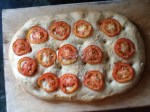
Married to someone who loves to cook, I’ve learned to understand how preparing food for others is an act of love. Years of practice making a zesty salsa with the perfect balance of tomatoes, onion, lemon and cilantro, or hours in the kitchen making foccacias to get the perfect texture in the bread, sewing up the deboned turkey and filling it with oyster, cornbread, nuts, celery and pomegranate stuffing–none of this is fast food. It’s not meant to be, and taking it slow–the physicality of slicing the tomatoes, cutting the nuts, getting your hands in the dough, moves food out of the realm of a commodity of something that is bought and paid for, and back into realm of relationship. Greens in your hands as you run them through the water, you think of those have grown the food, and you become aware of your interconnection to others, to the web of life itself–the force of life that blesses us over and over with the earth’s gifts.

Today in the middle of a very busy time, we took time to have a gathering at our house, and tonight we are preparing a turkey for a gathering of friends for a belated Thanksgiving dinner tomorrow. It can take years to make a good salsa or bean dip that makes people stand by your table for hours, but it’s a happy thing to notice when it happens. All week, all year we work hard, then we take time out to be with others, believing that somehow the rest of the work that’s pressing in and needs to be done we will somehow get done. We consciously choose to let time move slowly. The work can wait for a few hours or a day. Instead, we spend time pouring love into the food we make food to share with others, we spend time in the presence of friends.

Michael's focaccia
Michael’s focaccia

Feasting is a part of every culture and every religious tradition, but every day we can make our meals as a conscious act of connection to the earth and of gratitude for each other. Cooking a meal with the hands is a gift of love.

Uncategorized

My Next Big Thing

Recently, I was invited by Vinnie Hansen, author of the Carol Sabala mystery series, to participate with other writers in posting about their “next big thing” that they are working on as a writer. Vinnie is currently working on her seventh murder mystery in her series. The story takes place in Cuba where Carol Sabala is hired to locate a wealthy woman’s daughter. You can find out more about Ms. Hansen’s series and the upcoming mystery on Vinnie’s website by going to her page and then clicking on her Next Big Thing announcement link.

I have written earlier about Finishing Line Press accepting my chapbook manuscript, Saudade, for publication. The chapbook will be coming out in May, 2013, and pre-publication sales for the chapbook open in January. I will be sending more details about how to do this in January. For now, let me tell you a bit more about the book.

LG CoverEmail

What is the working title of your book?
Saudade. The word is Portuguese and means longing or sense of emptiness for something no longer present in your life but that you still love and feel the absence of.

Where did the idea come from for this book?
The idea came from living abroad, the travel while living in other countries, and the desire to explore and possibly answer the questions that living in foreign cultures inevitably makes a person wonder about regarding the meaning of the things we say and experience, and about what is that is ultimately important in life.

What genre does your book fall under?
Free-verse poetry.

How long did it take to write the first draft?
The poems in the chapbook are from a wide spectrum of time reaching from about 12 years ago until the present time.

What actors would you use for a movie rendition of your book?
Since Saudade is not a work of fiction, the actors would have to be those found naturally in the locations of the poems, which includes the orangutan of the Borneo rainforest, camels wandering the Saudi Arabian desert, Delhi’s citizens, the Alhambra’s architects and artists, the fado singer and musicians at the Santa Cruz Café, Coimbra, Portugal, and a cast of others.

What is a one sentence synopsis of your book?
If you look deeply enough even at those things that are difficult and painful, hope and beauty can be found.

Will it be self published or represented by an agency?
Finishing Line Press will be publishing the chapbook. Saudade will be available for pre-publication sale from January through April from Finishing Line Press, will come out in May, 2013, and will later also be available on Amazon.

Who or what inspired you to write this book?
The amazing perplexities and wonders of life, and the desire to understand how various cultures, worlds, experiences and places interconnect.

What other books would you compare this story to within your genre?
Saudade might compare with Carolyn Boyd’s DNA of Sand, or perhaps Michael L. Newell’s books, A Stranger to the Land, or Traveling Without Compass or Map, and possibly a few of Naomi Shihab Nye’s poems in that the settings of the poems are in a variety of world locations while appealing to themes that people everywhere experience of love, loss, hope, work, and longing to be whole.

What else about your book might pique the reader’s interest?
Music in a variety of forms—from jazz, to classical to Indian raga features in these poems.

Erica Lann-Clark is another author continuing this Next Big Thing thread where writers tell you about their upcoming work. Find out about Erica’s upcoming projects!  A professional storyteller, Erica’s lively piece, Shopping for God humorously explores the search for meaning in contemporary life. Learn more about Erica and her work, and check out Erica’s web page for her next big thing.

Uncategorized

Can Beauty Save the World?

“When nothing seems to help, I go and look at a stonecutter hammering away at a rock perhaps a hundred times without as much as a crack showing in it. Yet at the hundred and first blow it will split in two, and I know it was not that blow that did it–but all that had gone before.”– Jacob Riis

I spent this past week in the Himalaya foothills with students from my school on a camping trip. It was an excellent week of hiking, rappelling , creating art using things found in the natural environment, swimming in a mountain stream. I loved experiencing all the things I don’t get to participate in while living in Delhi. Walking up a forest road, I looked up to see a group of yellow butterflies swirl through the sky. Later, I stood at the foot of a waterfall, staring up into the mossy ledges of brilliant green through a rainbow arc. Another day, while hiking I noticed the shining gossamer wings of a dead cicada lying on the path as I walked by. The world is indeed full of wonder and magic, or at least it can be if you are in the right location.

As we drove down the mountain and back toward Delhi, I experienced a different kind of world–one filled with honking horns, a layer of trash covering the roadside for miles, traffic congestion, and road-side fires–a world where where smoke and the resulting haze made visibility increasingly difficult. As the sky grew increasingly dark and the sun went down in a great ball of pollution-orange, I thought to myself, “What has happened to beauty?” People who grew up in this world, who have never been outside of it, are bound to think that this is the whole of the world–the way life is. Three mornings in a row now the sun has risen as an orange ball into a haze-filled sky, the kind of sky I have seen before in California when the hills have caught on fire. We have made a kind of hell for ourselves to live in it seems. We light the fires. We burn the world. How is it that we have come to this state of being?

Yesterday I received this poem by Edna St. Vincent Millay in a letter from Monasteries of the Heart.

God’s World
by Edna St. Vincent Millay

O world, I cannot hold thee close enough!
Thy winds, thy wide grey skies!
Thy mists that roll and rise!
Thy woods, this autumn day, that ache and sag
And all but cry with colour! That gaunt crag
To crush! To lift the lean of that black bluff!
World, World, I cannot get thee close enough!
Long have I known a glory in it all,
But never knew I this;
Here such a passion is
As stretcheth me apart. Lord, I do fear
Thou’st made the world too beautiful this year.
My soul is all but out of me, let fall
No burning leaf; prithee, let no bird call.

What a very different world Millay was observing than the one I live in with its pollution filled skies–where the natural world is pushed aside for the demands of roads and buildings, where people live in substandard housing or live on the streets, where there is so much trash that it has become a literal mountain in the city. Given this reality with such pressing social and environmental needs, what is the role of beauty? A prince in Dostoyevsky’s novel, The Idiot, states that “Beauty will save the world.” How can this really be and what does this mean? Beauty can lift us above the mundane, restore and renew us when we feel worn down, but can it save us?

If we look at the work of the journalist and photographer Jacob Riis, we can see one way in which it’s possible for the artist’s eye can lead to change in the world. Riis is noted for raising social consciousness through his photographs in the late 1800’s of the tenement houses and slum areas of New York City, in particular of Mulberry Street, where many Italian immigrants lived in some of the city’s worst slums. The Italians were willing to live in these areas because many of them found them no worse than what they came from, and in some cases actually better, and they looked on their living situation as somewhat temporary. They had dreams of building a better world for themselves. Riis looked at the plight of those who lived in these conditions, and looked deeply. He used his photographs to not merely document or bear witness to other’s suffering, but to motivate others to make social reform. While some may have questioned his relocation efforts, nonetheless, the effect his photographic work had on others is remarkable. His work led to more diligent police patrol in NYC after President Roosevelt walked with him through areas Riis had been photographing. Riis photographs of sewage falling directly into New York state’s water supply led to the state becoming aware of the connection between these behaviors and the possibility of an outbreak of cholera after Riis spoke with doctors about the connection between this behavior and the disease. His photography work also helped others to see the need for replacing unsafe tenements with parks. Because he looked deeply, and use that sight to create powerful photos that helped convince people of the need for change, Riis made a difference for good in the world. While it was not Riis’s main goal to create works of art, nonetheless, his photos are a kind of work of art. Social reform, however, is not generally the goal of art. Should art be political? Maybe from a certain perspective all art is political, but I wouldn’t argue that art should be political, though artistic efforts can lead to social reform, as did Dickens’ writing.

Though I’ve not yet read Gregory Wolfe’s book, Beauty Will Save the World: Recovering the Human in an Ideological Age, the title attracts me, as does Wolfe’s own comments about the book, and I want to put it on my wish list of books to read because since living in Delhi, I’ve been struggling with this question of whether my need for beauty is frivolous or a true need. I long for access to the natural world, a walk in a forest rather than a city park. Maybe it’s because I grew up in a place where I could roam the hills behind my house, climb up granite bolders and look out over the valley and hills beyond. Maybe it is just a part of my spiritual geography that I think I need this access to the natural world. On the other hand, couldn’t it be that we really do need beauty to survive? Humans have made art since the days when we lived in caves and were hunter-gatherers. I have been working on accepting where I am–learning to be happy where I am, even if where I am doesn’t have the beauty I need that feeds my soul. In truth, I have been given much to be utterly grateful for every day of my life. Could it be, however, that I long for beauty because as human beings we truly do need it?

I don’t have to have the kind of beauty every day that Millay talks about in her poem where I feel  stretched apart. It would be too much to actually bear that kind of beauty every day. My first trip to Italy several years ago made me wonder how people could live every day with so much beauty all around them. After a while, one must just accept it as the world as it is, just as here in Delhi with the polluted skies people accept this as the given world. Though they saw it, the children on the bus ride down from the Himalaya weren’t focused on the lack of beauty around them. They simply continued singing as we rolled through the streets lined with trash and burning fires. This is a way to survive–to just keep singing. Which leads me back to the question of what role beauty can play in helping us act in ways that create a better world. Just because art exists around us or because people are producing art doesn’t necessarily make the air pollution go away. Riis took the photos which piqued people’s awareness, but he also had to get out there and motivate the change of policy. We need policy changes to make the world a more livable place, and in order to preserve the beauty.

Is the role of imagination, art and beauty at its base a political action, however? Does political action trump imagination? Dr. Eric Cunningham explains in his review of Wolfe’s book, Beauty Will Save the World: Recovering the Human in an Ideological Age that Wolfe asserts that it is beauty, not ideology, that will save the world. “Throughout this twenty-five year exploration Wolfe has struggled with the most nagging characteristic of the time, i.e., the tendency of modern consciousness to reduce all forms of cultural expression to the status of propaganda, leaving those who would strive for the spiritual redemption of our culture with few strategies other than political action.” I care about preserving that beauty so I can continue to enjoy it, yet my life is wrapped up in work not directly related to preserving the natural world. Our modern world’s love of “stuff” plays a big part in the destruction of natural beauty, and while I make efforts to reduce my needs and to recycle, I struggle with what I should be doing in order to make a difference in the world when I am not a political activist. Cunningham in his review of Wolfe’s book responds to this question and presents Wolfe’s alternative viewpoint, “Where I have long argued that the tendency of modern people to politicize every aspect of their lives, religion included, is the inevitable product of a flawed historical narrative, Wolfe argues, with convincing clarity, that “the problem” is essentially an aesthetic one, and can be remedied through a renewed appreciation, and a re-appropriation of the aesthetic sphere.” So, what is the role of aesthetics in saving the world? What part does the imagination play? Art does, indeed, bring people of divergent perspectives together. To what extent does it or can it change the way we relate to the world at large?

Aleksandr Solzhenitsyn when pondering Dostoyevsky’s statement about beauty said, “It is vain to affirm that which the heart does not confirm.” It is not a matter of one thing over the other he seems to suggest. If the heart isn’t involved, nothing is going to happen. The trajectory of western history has made us rely on reason and remain skeptical of the heart. If the heart is not involved, however, the brain isn’t in full function. The heart and brain work together. (You can attend a conference in Paris about this idea if you are interested!) The heart helps engage the brain, and in fact acts as a second kind of brain. Solzhenitsyn goes on to say in his essay about beauty, that if  “Truth and Good are crushed or amputated and cannot reach the light—yet perhaps the whimsical, unpredictable, unexpected branches of Beauty will make their way through and soar up to that very place and in this way perform the work of all three.” Beauty, he suggests, will serve in the place of Truth and Goodness if they are destroyed. Beauty is somehow stronger. When it comes to matters of basic survival, however, is it enough that a person offer poems, or make music, or take photos when people across the street from me live without water, when people are without adequate clothes, medicine or food? Is it okay that some offer beauty while others assist with the other more basic needs? Can we work together to meet the world’s needs?

Joan Chittister, a follower of the Benedictine tradition, talks about three aspects of what it means to do good works; celebrating beauty, honoring the word, and practicing nonviolence. It has never occurred to me before that celebrating beauty is doing a “good work.” Chittister explains that “The monastic life exists in pursuit of the beauty of the invisible God. Wherever you find the beautiful you discover another incarnation of God. Members of Monasteries of the Heart know that to revive the soul of the world, we ourselves must become beauty, become contemplatives. And to be contemplatives, we must surround ourselves with beauty, and consciously, relentlessly, give it away until the tiny world for which we are responsible begins to reflect the raw beauty that is God.” She lists the following as ideas for celebrating beauty:

•Begin a garden in an inner city neighborhood or your own neighborhood
•Donate art pieces to inner city schools
•Give away flowers or art postcards on street corners
•Take inner city children to hear an orchestra or to the museum or to a play or dance performance
• Join or start a threshold choir. These women choirs visit those who are sick and dying:www.thresholdchoir.org

Chittister suggests that yes, beauty is a basic need. After reading the list she provides, I can begin to see new ways in which beauty can, indeed begin to save the world by helping people to honor the natural world and to see ourselves in relationship to it as well as to each other. I love the idea of sharing beauty with people living on the street, of taking art to the homeless or offering flowers. Maybe I can’t assume that because I need beauty, they, too need it, but who could reject the beauty of a flower?

I remember several years back when our biking group had been out for a ride in the rural areas several hours outside of Delhi. Our van broke down on the way home, and we had to wait four or five hours on the road for a car to be sent from Delhi that could carry the van to a location where it could be repaired. In the mean time, we sat on a charpoy in a roadside farmhouse compound where joint Muslim families were living together. They fed us a dinner of chapati and vegetable curry. While there, I asked one of the children what he thought was the most beautiful thing where he lived. He replied, “The mosque, and the pond.” His response makes sense. In God’s house we are brought in touch with the wonder of life and the world. In nature, we are brought in touch with the wonder of God, and of Life itself–we see how we are part of the bigger wonder of the universe and can stand in awe.

Riis watched the stone cutter hit the stone with the hammer, and it wasn’t until the hundredth time that the blow made a difference. Singing our songs, writing our poems, telling our stories, carving our stones, maybe they don’t make the pollution go away but these acts in the least help to restore the soul and the more we grow toward wholeness, won’t it also help others to know how to create wholeness as well? I am not a politician. Neither am I Jacob Riis. I don’t know how to change the things in this world that are much bigger than what is in my power to change. Suffering, such as living in a world of polluted air, is part of life. We have collectively created our suffering. But inside this place of suffering it is still possible to find a way to share beauty with others. Are the ones who long for beauty those who Jesus was speaking of when he said, “Blessed are the poor in spirit?”  When we share beauty with others, we are brought into their heart, and perhaps through touching others we can be brought into the heart of seeign our connection to the world and to Life itself.

The threshold choirs sing to the dying, singing to people as an act of healing and beauty in the midst of suffering. Can beauty save the world? Mark Helprin in his novel, Solider of the Great War says, ” To see the beauty of the world is to put your hands on the lines that run uninterrupted through life and through death. Touching them is an act of hope, for perhaps someone on the other side, if there is another side, is touching them, too.” Perhaps if we all offer the beauty we have to those spirits choking in the world’s pollution in its myriad forms, an answer will emerge that we didn’t expect. Perhaps it takes more than a hundred strikes on the stone before we will be able to move into a different way of living and being. As in Poco’s song, we can keep on trying.

Uncategorized

Three Things That Can Make the Heart Glad

Pumpkin curry for dinner. How delicious! The supple pumpkin flesh surrounded in a sauce of coriander, ginger, tomato, onion, cashews, powdered coconut milk and spices, that has been zizzed in  blender. You bite in to the pumpkin, its subtle sweetness bathed in flavorful spice accompanied by plump golden raisin. Ah, the joy of eating. Eat slowly. Savor the food in your mouth. Every bite. No need to eat fast. Eat slowly and enjoy the fantastic presence of now, each swirl of flavor across the tongue. Who needs to go out for good food often when you can cook simple yet delicious meals night after night? It is such a pleasure to unwind from the day’s work with the tactile, aromatic experience of cooking the evening meal, and it is a wonderful way to transition into an evening at home.

You might recall the scene from the book Like Water for Chocolate, when Tita makes the dish of quail in rose petals, all of her love for Pedro going into the making of the dish. Those at the dinner party eat the food, and their emotions are powerfully effected. Food can do more than affect our bodies. It can affect our emotions too. Maybe not like Tita’s quail in rose cream, but it can bring us a sense of deep connection to those with whom we share the meal. I love the physicality of food, its beauty, and the caring hands that make and share it are a way of reaffirming our connection to each other and reconnecting to an awareness of the earth’s rich bounty that sustains us. When you work all day, spending a great deal of time in your head, coming home to scrub carrots as you hold them under cool water, to  chop red peppers, or breathe in the aroma of spices in a pan can physically ground and restore a person to her right self. Maybe that is why food is a part of so many religious traditions,  such as in the Christian ritual of breaking bread together at the communion table, or Muslims sharing the breaking of fast together. Such acts reconnect us. The etymology of the word “religion”, according to etymology dictionary is to go through again, rebind. Cooking and eating can be a kind or ritual that rebinds us in community. We can literally taste the goodness that relationships can bring. The Jewish religion has a wonderful way of grounding the spiritual life in physical reality. “Taste and see that the LORD is good; blessed is the man who takes refuge in him,” writes the psalmist. Sharing food with a heart of gratitude can, indeed, rebind us to each other, and the earth as well as to God.  “The heavens declare the glory of God and the firmament shows his handiwork.” Our feet are firmly planted on this earth, pointing us toward appreciation.

Music, too, is a wonderful way to lift the spirits. In reading about newly unfolding knowledge about brains, I have learned how, among other things, music can help improve young children’s intelligence, calm people with Alzheimer’s, and does things like boost immunity and reduces blood pressure. I don’t have first hand experience with any of these things, but have noticed repeatedly over the past couple of weeks that singing has done fantastic things for changing my stress level. Years ago, I remember working with a woman who used to sing often. I asked her about it and she said she had had cancer previously, and during that time she learned how much she had to be thankful for. As a result she sang more often. I remember that now as I sing portions of O Sole Mio on the way to work, on the way home, and from time to time during the day. When Michael got dengue recently and was lying in bed with a fever that didn’t go away for days on end, he wanted to hear it. I found this version by Mario Lanza. What a voice!  I remember my mother having a record of his when I was a child. The song is so expansive in its expression–the heart reaching up to the sky. Light rolls across the universe, and can’t help but flood your spirit and lighten your heart when you hear it. There is also the version by Il Volo, the three Italian young men in their teens, Piero Barone, Ignazio Boschetto and Gianluca Ginoble, who sing O Sole Mio with presence and vivacity. The intensity of life coming from them, like the words of the song, is shining sun. Even if you don’t sing or can’t carry a tune, you want to sing like Pavrotti, Plácido Domingo or José Carreras after hearing them sing O Sole Mio. You can read the Italian and English lyrics here. Try singing the song and see for yourself if you don’t feel happier after singing!

One other story that shows the power of poetry to change people’s behavior and return them to their senses is the story about Dante’s Beatrice in Alighieri’s poem, “Dante’s Inferno,” and the bridge on which Dante saw Beatrice. Robert A. Johnson, in his book, Inner Gold, explained how when he was a very young man, Dante saw Beatrice standing on the Ponte Vecchio, the bridge over the Arno River that runs through Florence, Italy. Dante fell in love with her, though he could not marry her, since marriages at that time were arranged, and he could not choose her. Nevertheless, he carries her in his heart through the rest of his life, , as a symbol of  beauty and purity. The most surprising thing, however, is the way this piece of literature affected the flow of history.  Johnson explained that during WWII, when the “Americans were chasing the German army up the Italian “boot.” The Germans were blowing up everything of aid to the progression of the American army, including the bridges across the Arno River. But no one wanted to blow up the Ponte Vecchio, because Beatrice had stood on it and Dante had written about her. So the German army made radio contact with the Americans and, in plain language, said they would leave the Ponte Vecchio intact if the Americans would promise not to use it. The promise was held. The bridge was not blown up, and not one American soldier or piece of equipment went across it.” (See more here.) Poetry can change us! That is a wonderful thought. It has in at least this one specific instance helped humans to not choose a destructive act. I remember Lucille Clifton saying at a Flight of the Mind women’s writing workshop in Oregon some years ago now how poetry humanizes us. This example Johnson gives of this decision to save the bridge during WWII exemplifies Clifton’s statement. There are too many people in this world keeping animosity between sides going, too many people feeding the engine that makes sure the lines between us are drawn and that we do not have to listen to each other and figure out how to stop blowing up the bridges between us. The name Beatrice means blessing, I vote for more of the blessing in this world that her presence inspired in Dante. I hope there are more stories about poems that have brought people together like this one. I’d love to learn of them. “Music in the soul can be heard by the universe,” says Lao Tzu. Poetry, music, making and sharing food together–these are creative acts that can unite the opposing forces in our own minds as well as those in the world.