
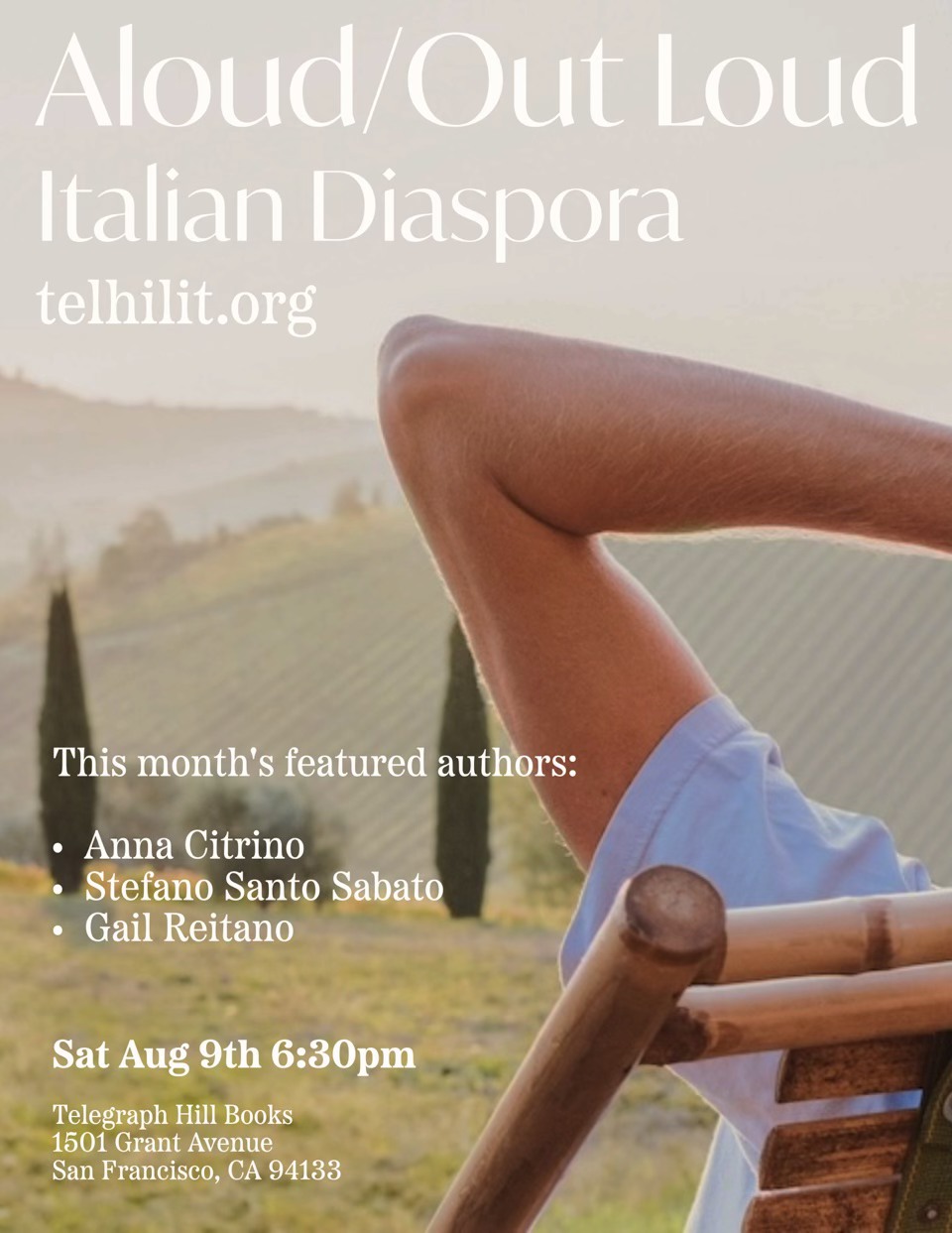
Making a home while living between worlds can fulfill dreams. It can also cost you your life. Enter San Francisco’s turn of the century world through the eyes of an immigrant Italian family as they cope with complex challenges to their traditional way of life during a time of speakeasies, government corruption, natural disaster, the opening of the Golden Gate, and neighbors being sent to internment camps. For those of you in the San Francisco Bay Area, I will be reading poems from A Space Between, a story in narrative poetry showing an Italian family’s decision to leave Calabria and move to the US, and their challenges after their arrival. If you live in the San Francisco Bay area, I hope you can attend.
As a bit of background, the late 1800’s and early 1900’s was an era of populist politics and political bosses were a central part of the political setting. People from widely diverse backgrounds were living together without shared sense of community, common history or articulated shared beliefs and values. Political bosses rose in urban settings such as San Francisco. They manipulated voting, and were not opposed to using bribes or violence, and used people’s tight connection to their national origins to their own advantage to gain wealth and power. People flocked to the San Francisco after gold was discovered in 1848. Before the earthquake and fire of 1906, San Francisco was the center of industry on the West Coast and also one of the largest centers of population.
The hardships and challenges immigrants faced in the world they entered a century ago is similar to those people are facing today as the poem from A Space Between below illustrates.
GAETANO’S VIEW OF PROTECTION
With five bambini and a wife to care for, I’ve cut more
than corners to own my barber shops. I saved for years
to bring Luisa from Calabria. Worked hard after the quake
when people needed an extra hand to help rebuild. This city
is home now. I don’t need any papers to become American,
didn’t want to crouch in a trench during the War to prove it.
Luisa, the children, they needed me more
than the government. I’ve got friends, attend mass.
I don’t want to pay any protection people. The men
keep coming by asking for their dues. Sure, I’m Italian,
and every Italian doing business owes them. You can’t stand
alone, but those guys are crooks—gun running loan sharks,
gambling on the money they take from me to run their business.
They’re the ones I need protection from.
When Schmitz was mayor, boss Ruef demanded bribes from businesses.
Now that Ruef is in jail and Rolph is mayor, the new crime kings,
the McDonough brothers, run the police department with bribes.
The bosses crave their cut.
“One way or another, you’ll pay,” my cousin Amadeo reminds me.
“It may be America, but earthquakes come. Storms.
You need protection.” It might be prohibition, but San Francisco
isn’t dry. Irish, German, genovese or calabrese, for us, alcohol
isn’t evil. Back in 1906, Italians helped put out the Great Fire
with the wine they’d made in their basements.
The government disregards its own rules, though.
Prisons fill with those who drink while gangsters gain
from politicians who want their alcohol. Politicians’ power—
it’s a big show. They buy people like objects, play them
for what they can get or get away with.
Mayor Rolph invents stories for the press, makes money
from the prostitution house he owns.
I’ve given what I’ve had to to keep the business going.
My second shop on Market Street is doing well.
The bosses don’t like it. I pay the rent,
but they want more. Prohibition has made them
greedy. Things aren’t simple.
I don’t need to be handed a Mano Nera letter
from the Black Hand to feel the threat of harm.
I don’t fit with the Irish, can’t compete with the bail bond king,
McDonnough, his police and politician friends.
I’m not blind. Winds rising off the ocean can turn.
Gangsters might chase me down, wait for me
in some hidden hole, but I’m creating a future
for my children. Call me a hard-headed
testa dura calabrese, but isn’t this America?
I came to work. Let me do it.
Life is hard.
In Italy, our firstborn fell from a chair and died.
Every healthy man suffers. Food, family, home.
I’m not asking more than this for the work I do.
I’m a barber. I know what to cut and where.
Let me have what’s mine.
I stuff today’s earnings in my pocket, shut the shop,
step into the damp and dark. It’s December 5,
St. Nicholas eve. Nicholas, he knew about protection.
He was a real Godfather. He dropped those sacks of gold
down the chimney for that family so the parents
wouldn’t have to sell their children into slavery.
I’ll stop at the Shamrock Saloon like I was asked,
have a drink. Got to keep friends on every side.
(originally published in A Space Between by Bordighera Press.)
Southern Italian immigrants were skeptical of government because they had often been overlooked or mistreated by the various countries and governments that had occupied the land that had little consideration for its inhabitants. This past history encouraged a generalized distrust of government authority, leading to Gaetano’s reasoning of not needing to go through the paperwork to become an American citizen. People who came to the US at the turn of the last century weren’t required to become US citizens to live and work here. It wasn’t until 1978 that an amendment to the Immigration and Nationality Act of 1952 that it was unlawful to leave or enter the United States without a passport.

Leaving one’s country to move to a place you’ve never seen and enter a life with an uncertain future is a hugely difficult decision in any time period, including today. Immigrants from the past century helped build the America we live in today, despite the difficulties they faced.
Public concern and fears of the previous century about immigrants hasn’t gone away, however. On July 1, the US Senate passed a bill that increases the Immigration and Customs Enforcement’s budget threefold, a 265 percent annual budget increase, “the largest investment in detention and deportation in U.S. history,” according to the American Immigration Council, even though “In 2022, people without a documented status paid an estimated $25.7 billion in Social Security taxes. And a 2013 report by the Social Security actuaries concluded that earnings from immigrants without a documented status have a net positive effect on the Social Security trust fund, finding that they contributed a net $12 billion into the Social Security trust fund in 2010.”
US immigration policy has not had a major update for current social and economic realities since 1990. The immigration system we function under today in the US was never built for asylum. Instead of addressing the need to update the system, the U.S. Refugee Admissions Program has been suspended, and asylum seekers are being turned away. Additionally, backlogged cases can take years to move through the system, in part because there aren’t enough people working on the cases. The current US immigration system needs adequate funding so it can process people’s paperwork at the border in a timely manner and prevent delays in obtaining a visa.

Italian immigrants made significant contributions to the US in service, agriculture, construction and fishing industries. They cut stones for many of San Francisco’s buildings and laid the cobblestones the city’s streets. You may recognize some of Italian American’s other contributions: Actors/film producers: Frank Capra, Jimmy Durante, Rudolph Valentino. Artists: Attilio Piccirilli, with his five brothers: carved the Lincoln Memorial, Roger Morigi & Vincent Palumbo: carved the sculptures at the Washington National Cathedral. Joseph Barbera, cartoon artist. Inventor: Frank Zamboni—ice resurfacer. Singers: Enrico Caruso, Luisa Tettrazzini, Mario Lanza, Perry Como, Tony Bennett, Connie Francis, Frank Sinatra composer Henry Mancini, Nick La Rocca first jazz recording. Sports: Joe DiMaggio: baseball player, Rocky Marciano, boxer, Mario Andretti, car racing. Government: Angelo Rossi, Samuel Alioto. Workers: Carlo Tresca, labor organizer, Rose Bonavita: “Rosie the Riviter” Writers: Lawrence Ferlinghetti, Maria Mazziotti Gillan, Diane DiPrima. Businesses: Amadeo Giannini: founded Bank of Italy–became the Bank of America, Barnes & Noble, Chef Boyardee (Ettore Boiardi), Ghirardelli chocolate, Gallo, Italian Swiss Colony, Jacuzzi, Robert Mondavi vineyards, Tropicana.
Like citizens of any particular country, immigrants want to provide for themselves and their families, but they also significantly benefit the places they live. When looking through just the economic lens, immigrants today contribute billions to the US economy. According to the American Immigration Council, “In 2023, immigrant households paid over $167 billion in rent in the housing market, and held over $6.6 trillion in housing wealth” among other significant contributions. As in the previous century, immigrants’ skills, cultural gifts, and offerings add exponentially to American cultural richness and life as well. (You can read more about the impact of immigration on the US and the many other ways immigrants benefit the US here.)
Years ago, I attended the Flight of the Mind writing workshop at a retreat center on the McKenzie River outside of Eugene, Oregon where Lucille Clifton was my workshop leader. Her statement of how poetry humanizes us has come back to me many times over the years. Now, as much as ever, we need to embrace those thoughts, practices, and actions that humanize us and bring us to a recognition of our mutual interdependence on each other.
None of us has all the skills or time needed to completely provide for even our basic physical needs of water, food, clothing, shelter and transportation. We need each other. My hope is that when reading A Space Between people will gain greater insight into the challenges immigrants face, that the book will open hearts and minds to see themselves in their neighbor’s faces.

In his statement about the book, Nicholas Samaras wrote, “A Space Between” is a massive, ambitious effort of epic proportions that rewards with its interweavings of history, consequence, heritage and legacy. How heartening it is to witness in these poems the resonance through generations of immigration and sacrifice to provide for living, surviving, prospering. As the author smartly observes in her tight oxymoron, “Light hauls its weight from stone to stone,” it is refreshing to see forward in appreciation by looking back into the past that never leaves us.”
If you live in the San Francisco Bay Area, I hope you will come to the August 9 reading at 6:30 pm at Telegraph Hill Books, 1501 Grant Avenue, San Francisco, CA. Register online here to reserve your space. If you can’t make it to the reading, I hope you will read the book.
 Anna Citrino---Poetry, Place, Pilgrimage