Uncategorized

Invitation to a Reading

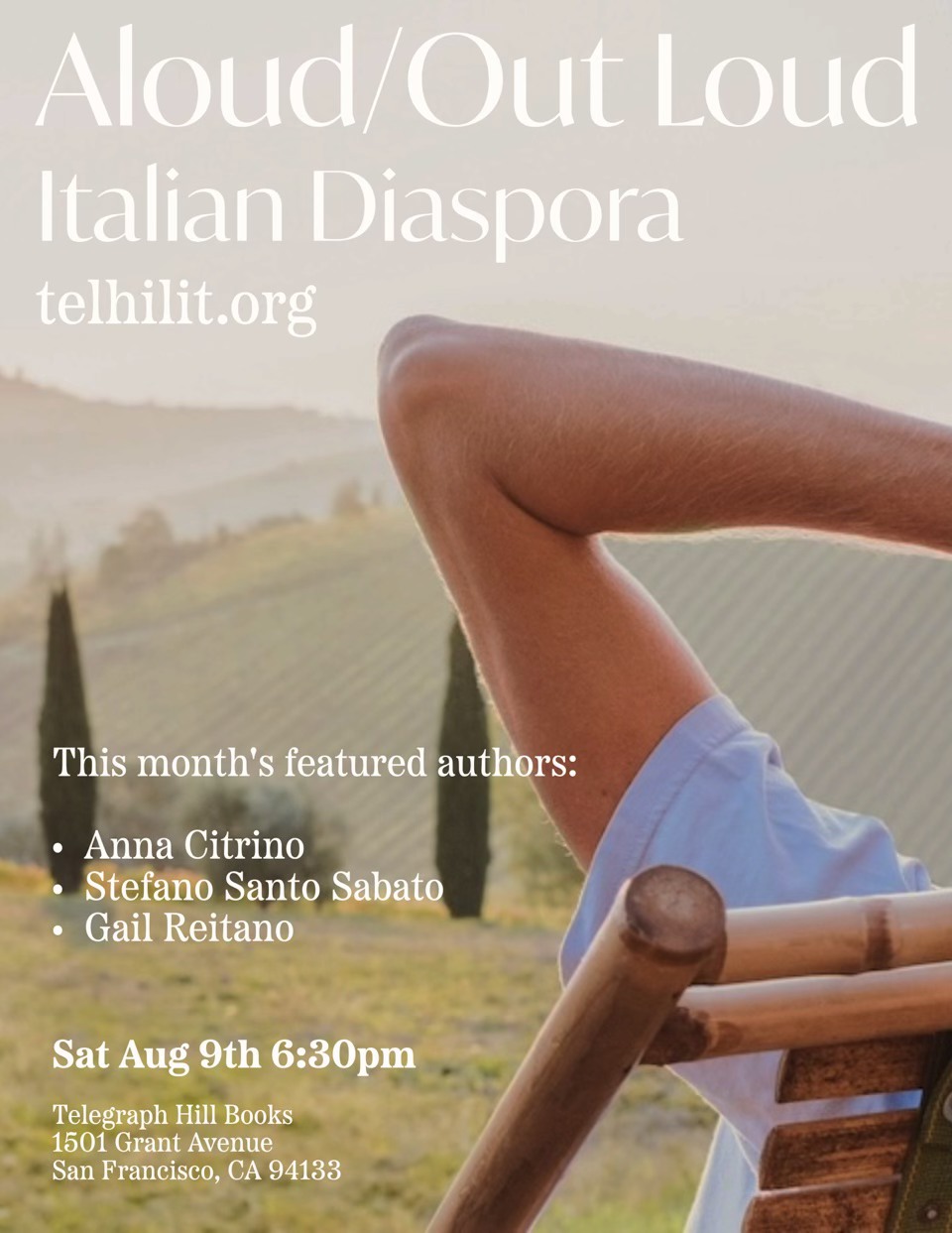
 Making a home while living between worlds can fulfill dreams. It can also cost you your life. Enter San Francisco’s turn of the century world through the eyes of an immigrant Italian family as they cope with complex challenges to their traditional way of life during a time of speakeasies, government corruption, natural disaster, the opening of the Golden Gate, and neighbors being sent to internment camps. For those of you in the San Francisco Bay Area, I will be reading poems from A Space Between, a story in narrative poetry showing an Italian family’s decision to leave Calabria and move to the US, and their challenges after their arrival. If you live in the San Francisco Bay area, I hope you can attend.

As a bit of background, the late 1800’s and early 1900’s was an era of populist politics and political bosses were a central part of the political setting. People from widely diverse backgrounds were living together without shared sense of community, common history or articulated shared beliefs and values. Political bosses rose in urban settings such as San Francisco. They manipulated voting, and were not opposed to using bribes or violence, and used people’s tight connection to their national origins to their own advantage to gain wealth and power. People flocked to the San Francisco after gold was discovered in 1848. Before the earthquake and fire of 1906, San Francisco was the center of industry on the West Coast and also one of the largest centers of population.

The hardships and challenges immigrants faced in the world they entered a century ago is similar to those people are facing today as the poem from A Space Between below illustrates.

GAETANO’S VIEW OF PROTECTION

With five bambini and a wife to care for, I’ve cut more
than corners to own my barber shops. I saved for years

to bring Luisa from Calabria. Worked hard after the quake
when people needed an extra hand to help rebuild. This city

is home now. I don’t need any papers to become American,
didn’t want to crouch in a trench during the War to prove it.

Luisa, the children, they needed me more
than the government. I’ve got friends, attend mass.

I don’t want to pay any protection people. The men
keep coming by asking for their dues. Sure, I’m Italian,

and every Italian doing business owes them. You can’t stand
alone, but those guys are crooks—gun running loan sharks,

gambling on the money they take from me to run their business.
They’re the ones I need protection from.

When Schmitz was mayor, boss Ruef demanded bribes from businesses.
Now that Ruef is in jail and Rolph is mayor, the new crime kings,

the McDonough brothers, run the police department with bribes.
The bosses crave their cut.

“One way or another, you’ll pay,” my cousin Amadeo reminds me.
“It may be America, but earthquakes come. Storms.

You need protection.” It might be prohibition, but San Francisco
isn’t dry. Irish, German, genovese or calabrese, for us, alcohol

isn’t evil. Back in 1906, Italians helped put out the Great Fire
with the wine they’d made in their basements.

The government disregards its own rules, though.
Prisons fill with those who drink while gangsters gain

from politicians who want their alcohol. Politicians’ power—
it’s a big show. They buy people like objects, play them

for what they can get or get away with.
Mayor Rolph invents stories for the press, makes money

from the prostitution house he owns.
I’ve given what I’ve had to to keep the business going.

My second shop on Market Street is doing well.
The bosses don’t like it. I pay the rent,

but they want more. Prohibition has made them
greedy. Things aren’t simple.

I don’t need to be handed a Mano Nera letter
from the Black Hand to feel the threat of harm.

I don’t fit with the Irish, can’t compete with the bail bond king,
McDonnough, his police and politician friends.

I’m not blind. Winds rising off the ocean can turn.
Gangsters might chase me down, wait for me

in some hidden hole, but I’m creating a future
for my children. Call me a hard-headed

testa dura calabrese, but isn’t this America?
I came to work. Let me do it.

Life is hard.
In Italy, our firstborn fell from a chair and died.

Every healthy man suffers. Food, family, home.
I’m not asking more than this for the work I do.

I’m a barber. I know what to cut and where.
Let me have what’s mine.

I stuff today’s earnings in my pocket, shut the shop,
step into the damp and dark. It’s December 5,

St. Nicholas eve. Nicholas, he knew about protection.
He was a real Godfather. He dropped those sacks of gold

down the chimney for that family so the parents
wouldn’t have to sell their children into slavery.

I’ll stop at the Shamrock Saloon like I was asked,
have a drink. Got to keep friends on every side.

(originally published in A Space Between by Bordighera Press.)

Southern Italian immigrants were skeptical of government because they had often been overlooked or mistreated by the various countries and governments that had occupied the land that had little consideration for its inhabitants. This past history encouraged a generalized distrust of government authority, leading to Gaetano’s reasoning of not needing to go through the paperwork to become an American citizen. People who came to the US at the turn of the last century weren’t required to become US citizens to live and work here. It wasn’t until 1978 that an amendment to the Immigration and Nationality Act of 1952 that it was unlawful to leave or enter the United States without a passport.

Leaving one’s country to move to a place you’ve never seen and enter a life with an uncertain future is a hugely difficult decision in any time period, including today. Immigrants from the past century helped build the America we live in today, despite the difficulties they faced.

Public concern and fears of the previous century about immigrants hasn’t gone away, however. On July 1, the US Senate passed a bill that increases the Immigration and Customs Enforcement’s budget threefold, a 265 percent annual budget increase, “the largest investment in detention and deportation in U.S. history,” according to the American Immigration Council, even though “In 2022, people without a documented status paid an estimated $25.7 billion in Social Security taxes. And a 2013 report by the Social Security actuaries concluded that earnings from immigrants without a documented status have a net positive effect on the Social Security trust fund, finding that they contributed a net $12 billion into the Social Security trust fund in 2010.”

US immigration policy has not had a major update for current social and economic realities since 1990. The immigration system we function under today in the US was never built for asylum. Instead of addressing the need to update the system, the U.S. Refugee Admissions Program has been suspended, and asylum seekers are being turned away. Additionally, backlogged cases can take years to move through the system, in part because there aren’t enough people working on the cases. The current US immigration system needs adequate funding so it can process people’s paperwork at the border in a timely manner and prevent delays in obtaining a visa.

Italian immigrants made significant contributions to the US in service, agriculture, construction and fishing industries. They cut stones for many of San Francisco’s buildings and laid the cobblestones the city’s streets. You may recognize some of Italian American’s other contributions: Actors/film producers: Frank Capra, Jimmy Durante, Rudolph Valentino. Artists: Attilio Piccirilli, with his five brothers: carved the Lincoln Memorial, Roger Morigi & Vincent Palumbo: carved the sculptures at the Washington National Cathedral. Joseph Barbera, cartoon artist. Inventor: Frank Zamboni—ice resurfacer. Singers: Enrico Caruso, Luisa Tettrazzini, Mario Lanza, Perry Como, Tony Bennett, Connie Francis, Frank Sinatra composer Henry Mancini, Nick La Rocca first jazz recording. Sports: Joe DiMaggio: baseball player, Rocky Marciano, boxer, Mario Andretti, car racing. Government: Angelo Rossi, Samuel Alioto. Workers: Carlo Tresca, labor organizer, Rose Bonavita: “Rosie the Riviter” Writers: Lawrence Ferlinghetti, Maria Mazziotti Gillan, Diane DiPrima. Businesses: Amadeo Giannini: founded Bank of Italy–became the Bank of America, Barnes & Noble, Chef Boyardee (Ettore Boiardi), Ghirardelli chocolate, Gallo, Italian Swiss Colony, Jacuzzi,  Robert Mondavi vineyards, Tropicana.

Like citizens of any particular country, immigrants want to provide for themselves and their families, but they also significantly benefit the places they live. When looking through just the economic lens, immigrants today contribute billions to the US economy. According to the American Immigration Council, “In 2023, immigrant households paid over $167 billion in rent in the housing market, and held over $6.6 trillion in housing wealth” among other significant contributions. As in the previous century, immigrants’ skills, cultural gifts, and offerings add exponentially to American cultural richness and life as well. (You can read more about the impact of immigration on the US and the many other ways immigrants benefit the US here.)

Years ago, I attended the Flight of the Mind writing workshop at a retreat center on the McKenzie River outside of Eugene, Oregon where Lucille Clifton was my workshop leader. Her statement of how poetry humanizes us has come back to me many times over the years. Now, as much as ever, we need to embrace those thoughts, practices, and actions that humanize us and bring us to a recognition of our mutual interdependence on each other.

None of us has all the skills or time needed to completely provide for even our basic physical needs of water, food, clothing, shelter and transportation. We need each other. My hope is that when reading A Space Between people will gain greater insight into the challenges immigrants face, that the book will open hearts and minds to see themselves in their neighbor’s faces.

Overview of San Francisco

In his statement about the book, Nicholas Samaras wrote, “A Space Between” is a massive, ambitious effort of epic proportions that rewards with its interweavings of history, consequence, heritage and legacy. How heartening it is to witness in these poems the resonance through generations of immigration and sacrifice to provide for living, surviving, prospering. As the author smartly observes in her tight oxymoron, “Light hauls its weight from stone to stone,” it is refreshing to see forward in appreciation by looking back into the past that never leaves us.”

If you live in the San Francisco Bay Area, I hope you will come to the August 9 reading at 6:30 pm at Telegraph Hill Books, 1501 Grant Avenue, San Francisco, CA. Register online here to reserve your space. If you can’t make it to the reading, I hope you will read the book.
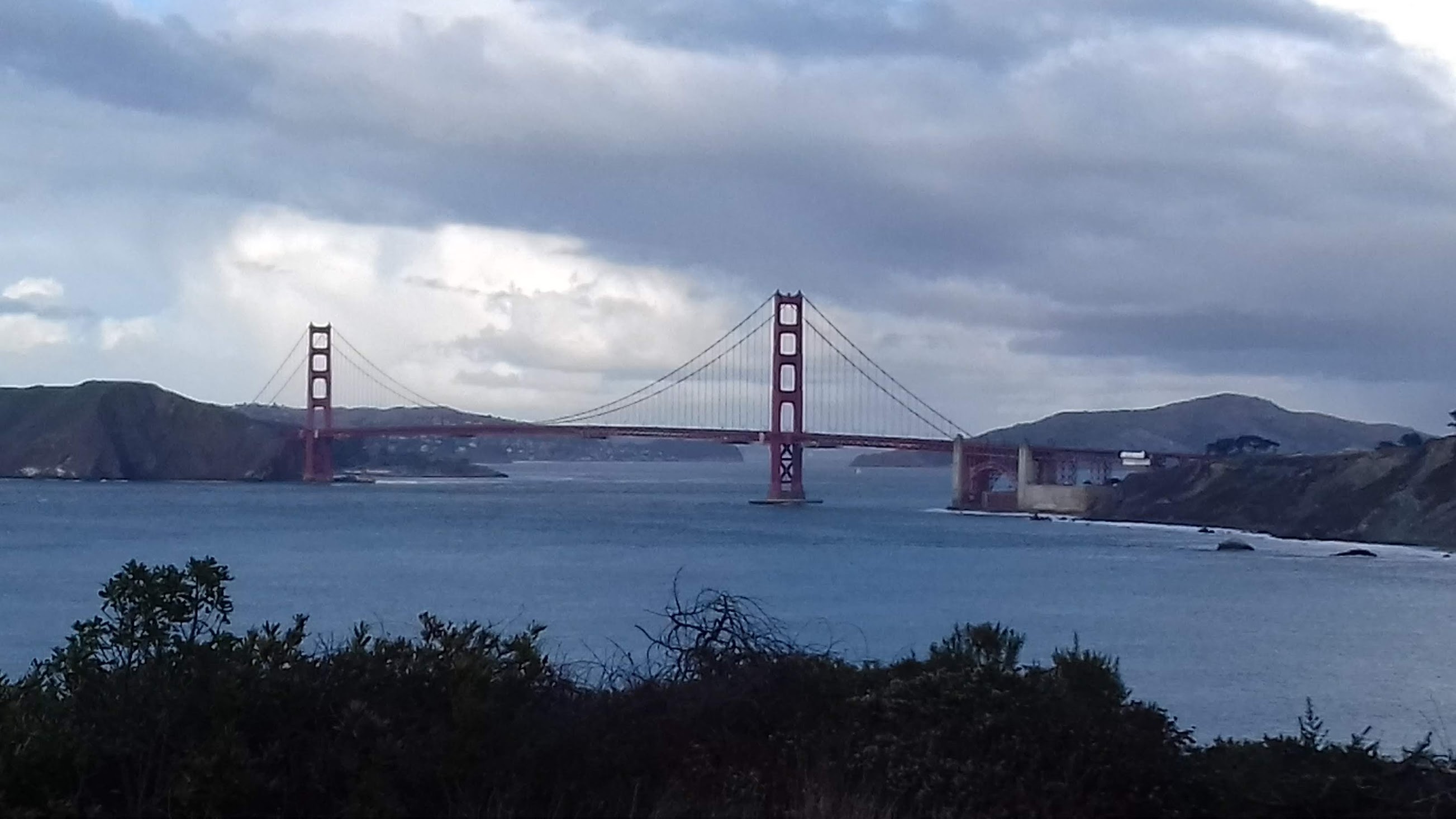
Golden Gate Bridge, San Francisco
Italian-American, music, poetry, Uncategorized

Music’s Power to Unify

20190922_103851“I will sing in San Francisco if I have to sing there in the streets, for I know the streets of San Francisco are free,” said Luisa Tetrazzini during a period when an unresolved dispute arose with Oscar Hammerstein who wanted her to sing only in New York. Considered one of the greatest opera singers of her day, on Christmas Eve, 1910, Tetrazzini sang to a crowd of a quarter million at Lotta’s Fountain in San Francisco. What a spectacle it must have been! When met with a wall in her negotiations with Hammerstein where no movement or resolution appeared possible, rather than continuing the fight head on, Tetrazzini moved around the obstacle. In that choice, a different world opened to her with open arms. For Luisa Tetrazzini, those arms were found in the people of San Francisco. The Chronicle’s headlines of that event demonstrate the city’s love for her.
Tetrazzini’s audience were those who had experienced the loss of family members during the great earthquake and fire of four years earlier, as well as the many who had left loved ones and their homelands behind in the difficult search to fulfill a dream of finding a better way to live than that of enduring the unbearably difficult hardships they faced in their home countries. Tetrazzini understood her audience that December night, and spoke to their hearts when she sang “The Last Rose of Summer.” The lyrics, written by the Irish poet Thomas Moore, describe the image of a remaining single rose holding on to its stem in winter’s cold, as a metaphor for being alone in a world where those you have loved are now gone.

Days grow short in December, and people long for warmth and light–desire to gather around a fire and drink something warm, and perhaps tell stories. The Christmas holiday is often a time where people return to be with their families to do these very things. We want our experiences during this time to be full of light and joy, though the reality is that many do not have family living nearby or family to turn to for warmth and acceptance. Sometimes situations we live with or in are very difficult, and loneliness and sorrow can roll over us like great clouds moving across the horizon, catching us up in its seemingly unending breadth and dimension.

20191210_163053

Present that Christmas Eve in 1910 to listen to Tetrazzini sing, and also named Luisa, is the character in my book, A Space Between. Newly immigrated from Calabria in southern Italy, she describes her story and the experience of Tetrazzini singing that evening.

MAKING A LIFE

In San Lucido I spun linen, silk and wool—thread sliding
through my fingers season after season
as I stared out at the sea’s horizon, wondering
how I could twist together my life’s frayed,
thin threads into something bigger than summer’s
white sun and winter’s cold, narrow room.

We’ve made a life here together, Gaetano and I,
loss, and hope, wound together in a garment of fog
that rolls in from across the Pacific. I walk through
my neighborhood, a thimble full of narrow streets—
a world no bigger than before but strange. Chinese,
Germans, Spaniards, Greeks, we are loose threads
dangling beneath this country’s clattering loom
of tongues, pale faces and pale ways, trying to see
how we might find our way into its fabric.

Gaetano has his barber’s shop, but I’ve given up
weaving. That was my other life. The children
are my weaving now—their lives binding this world
to the one we came from, their eyes, the rosary beads
I pray through, reinventing the world in America.

Arduino and Giovanni wait at the window
in the other room. I knead the bread, stir the soup.
Soon, Gaetano will arrive, his footsteps echoing
outside the door. All day he cuts hair, a little here,
more there, massages the scalp a bit, a splash
of cologne to go—our lives hang on thin strands of hair.

We’re not city people, though we’re living in one.
We miss our villages’ gold walls, the thousand
colors of blue swirling like music across the sea and sky.

We don’t know opera, but when Luisa Tetrazzini sang
at the corner of Market and Kearney on Christmas Eve
soon after I arrived in America, we joined the throng.

She sang “The Last Rose of Summer,” her white dress
glowing amidst the flood of dark coats and hats.

Clear, pure, her voice floated and danced on wings
above all two hundred fifty thousand of us standing in the crowd
that December night, clinging to its flame.

It lifted us from the bare dirt floors of our past, the longing
for the worlds we’d left behind, and let us believe
that fire and dreams are stronger than iron—
have substance equal to earth.

20191210_150926

To those huddled together in San Francisco’s winter streets that Christmas Eve in 1910, Tetrazzini created a shared experience that unified them with others. In doing so, she enabled them to recognize in the midst of their difficulties they were also part of each other and a shared hope.

We live in a world of growing struggle today as well. People across the continents feel bowed down, bent over with difficulties, and are struggling to right themselves. In Chile recently, opera singer Ayleen Jovita Romero broke curfew to sing into the streets from her window “El derecho de vivir en paz” (“The right to live in peace”) composed by folk singer Víctor Jara, who was murdered in the 1973 military coup by General Augusto Pinochet.

In India the Guardian reports Gandhi’s great grandson, Tushar Gandhi, saying, “”For the first time in independent India…laws or systems are being attempted to be imposed which discriminate, which differentiate, on the basis of religion…There should be a debate on the ramifications of [the CAA] internationally,” says Tushar. “It concerns every democracy and it concerns everybody who believes in inclusivity and in the liberal ideology…“It’s not what you profess, but what you practise that makes the world realise who you follow,” he said of Modi.” Protests in India are being met with increasing violence. Similar to Chile, in India, too, actors, artists and singers have raised their voices to speak against the injustices.

It is not in India or Chile alone, however, that the masses of everyday people are protesting injustices regarding the lack of basic human rights. Across the world from Myanmar to Colombia, current ways the systems we live inside are functioning are creating crises. Though democracies are built around the idea that diverse perspectives have value and need to be heard, and though our current economic systems are built around the exchange of each other’s diverse strengthens, we humans struggle with adapting to change, wrestle with how to communicate effectively across cultural divides, and, in general, fall short of making progress toward loving our neighbors as ourselves or treating them with respect. Finding a way to create social contexts where people are not merely toiling to survive, but can flourish is extremely challenging.

Stepping into a wider view during these troublesome times, it’s worth noting how everything in nature is interdependent on the life around it for survival. To live only unto ourselves and for ourselves is to die. Though we may think we stand on the outside of others’ problems or feel the natural world is ours to use as we wish, we are actually share struggles that arise, as what one person or one country does ripples through the interactions between other countries and their citizens as well, affecting the atmosphere of our social contexts, as well as influencing our relationships to the natural environment.

The words from Moore’s poem, “The Last Rose of Summer,” speak directly to this interconnectedness. “I’ll not leave thee, thou lone one! / To pine on the stem;” writes Moore. How empty and meaningless a world where no friendship is given or exchanged. We need each other, including interactions with the natural world that not only sustain, but regenerate life. As Moore’s poem goes on to say,

When friendships decay,
And from Love’s shining circle
The gems drop away.
When true hearts lie withered,
And fond ones are flown,
Oh! who would inhabit
This bleak world alone?

When our spirits are lifted, our bodies are lifted too. Music can sustain us, can heal. This is something most of us have experienced and intuitively know, but there is also a growing body of researched evidence to demonstrate this. Robin Seaton Jefferson’s recent article in Forbes, NIH Bets $20 Million Music Can Heal Our Brains describes music’s wide range of healing capacity. Our bodies physically benefit from music, as neurologist Alexander Pantelyat from John Hopkins University explains, in this video. Engagement in making music, activates more parts of the brain than just about any other activity,” Pantelyat states.

Imagine yourself standing alongside Luisa in the poem above, newly immigrated to America in the cold December night, or imagine yourself walking the streets of Santiago as Ayleen Jovita Romero sings into the street and you recall your disappeared family members who wanted the right to live in peace, but were instead killed, or imagine yourself a person of Muslim faith standing beside your Hindu neighbors asking for your life to be held in equal value as those you live alongside of in India, and listen here as Diane Syrcle singing the “The Last Rose of Summer” that she recorded for me to be able to share with you.  Perhaps as you listen, you, too, can find yourself in the story of those who have longed for friendship and care to be extended to them, so as to not be left in this bleak world alone.

In the midst of life’s challenging experiences, we need ways to find others’ stories in our own story. Music in its ability to unify both body and spirit, can help us discover a path to walk toward that place of being together.

20191220_100942-1


poetry, Uncategorized

Flower Pilgrimage to Crete

Sensation

On blue summer evenings I’ll go down the pathways
Pricked by the grain, crushing the tender grass—
Dreaming, I’ll feel its coolness on my feet.
I’ll let the wind bathe my bare head.

I won’t talk at all. I won’t think about anything.
But infinite love will rise in my soul,
And I’ll go far, very far, like a gypsy,
Into Nature–happy, as if with a woman.

—Arthur Rimbaud

Over a decade ago, I browsed through a book with photos of Crete at a friend’s house. The abundance of wildflowers depicted in the photos amazed me, and I hoped  someday to be able to visit Crete in the spring. That day arrived this past April. I came to Crete on a pilgrimage–a journey seeking renewal through connecting with a fleeting seasonal aspect of nature that offers so much joy to so many: wild flowers.

Driving to the ancient site of Aptera, just west of Chania, I wandered the hillside above the sea. Meadows of marguerites stood chest high. Red poppies boldly waved their colors beside the buttercups sprinkled across the grass. The entire world shimmered in spring petals. Bees, legs laden with pollen, drifted from flower center to flower center, their hum filling the fields. Lying on a rock surrounded by blossoms the sky wide above me, I felt I was buoyed up by beauty, floating on time’s wide sea. Alive. Replete. I knew I’d arrived at my journey’s destination.

Flowers have a way of opening our hearts. They unfold their petals, and our hearts unfold with them. Previously, on this blog I’ve written about forest bathing, an activity that is now gaining momentum in the US, as studies, according to this recent article by Meeri Kim, “‘Forest bathing’ is latest fitness trend to hit U.S. — ‘Where yoga was 30 years ago,’”  have demonstrated how it helps to lower blood pressure, heart rate and reduces stress, among other benefits, including helping elderly patients with COPD, according to another study done in China, reported in the Natural Medicine Journal.  The insights this research gives got me wondering about the effects flowers might have on the mind and body. It turns out that flowers, too, bring us numerous benefits. One study shows how office workers grew more relaxed when viewing roses. Flowers, studies have found, reduce stress and speed healing. They also change our behavior. The University of Florida website, in their post, “Flower power: ‘Brain Awareness’ lecturer to discuss flowers’ positive effect on emotions,” explains how research done by Jeannette Haviland-Jones, Ph.D., a professor of psychology and director of the Emotions Laboratory at Rutgers University, unexpectedly found that “people who got flowers performed much better in memory tests than those who did not get flowers,” suggesting that flowers may effect memory functions. Louie Schwartzberg, renowned for his phenomenal time-lapsed photography, tells audiences on his TED Talk, The Hidden Beauty of Pollination, that flowers’ beauty is connected to survival. “We protect what we fall in love with,” says Schwartzberg. These examples illustrate some of the new understandings about the effects the natural world, including flowers, have on our physical well-being.

Beyond the beauty flowers bring, however, I’ve been thinking how flowers are important reminders of the value of gentleness. A flower’s life is brief, all its beauty spent in a single season but flowers are an important antidote to life’s hardness. We live in a world where power over others is often respected, where we’re encouraged to be a leader, and to take charge of our lives or of the situations we’re connected with. Get tough and be strong. Climb mountains, push your limits, and go farther. These are saying and ideas commonly found in our culture. Flowers are an antidote to this kind of thinking.

Though they can also hold their faces to the sun all day, absorbing its heat, flowers aren’t known for their toughness. Their petals are soft and tear easily. We appreciate them for their bold blossoms, their illusive, sweet scents and sassy colors but we love them for their softness. Flowers, in their gentleness, remind us that we, too, are human. Their petals are flexible, fragile, vulnerable, even, as they bend and turn with the wind, and in their softness, they allow us to speak from the tender parts of our own lives for which we often can’t find words–the part where we allow others to enter when we want to be in relationship–when we want others to know us. Tennessee Williams helps us understand the importance of flowers’ softness in his line from his play Camino Real, “The violets in the mountains have broken the rocks.” We see the flower growing in the stony crack, and find its softness a relief. Life is not all hardness. There is a strength in softness that moves in a different mode. Flowers touch our souls the way music does, reaching past the stony walls of reason we protect ourselves with to lift our spirits, and let us know we are more than struggle. We are alive, joined to all that is–including joy.

Rimbaud’s poem, “Sensation” illustrates this idea of how allowing ourselves to be touched by the soft things of life can transform us. Rimbaud begins with the poem’s speaker walking into a blue summer evening. It is a vivid image, perfectly depicting the tranquil essence of summer’s calm depth. Though in the next line the poem’s speaker is “pricked by grain” and “crushing the tender grass,” we understand we’ve entered a soft world because the grass is tender. The grain that pricks us serves to make us aware that our senses are enveloped in a world that is delicate and alive, and therefore breakable. As we continue reading the poem, the words bathe the reader in a scene of natural beauty–coolness caresses the feet; wind immerses the head in its essence. The poem’s speaker doesn’t resist the blue evening he enters. Instead, he surrenders himself to the wind’s caress. The head is bare, unprotected, open to experience. There is no need to talk, to reason or ponder, yet there is an exchange. Like a flower opening, as the poem’s speaker gives himself to her, Nature reveals herself to him. The sequence is worth noting here. Infinite love arises in the soul as a result of opening to the relationship. In the poem’s last lines, Rimbaud brings the reader into the heart of the most intimate of connections– one that joins human to human and human to nature. The poem’s speaker describes himself wandering deeply into nature, connected to it as if with a woman. “And I’ll go far, very far, like a gypsy,/ Into Nature–happy, as if with a woman.” Going on a flower pilgrimage can bring a person to just such a place–to arrive at a destination of softness that lets us know we are alive and in union with the perfume and color of all that is.

This coming week I’m participating in San Francisco’s Lotus Live at the Asian Art Museum–creating with others a human flower as an expression of the value of diversity and peacefulness that can be seen from the sky. If you want to spread the healing power of flowers, you might want to check out this video describing how Larsen Jay began the organization called Random Acts of Flowers or maybe you simply want to pick flowers to bring someone, anyone, even a stranger, and see how it changes them.