Uncategorized

Things of Consequence

“As long as you don’t lose your mind, all outer strife is inconsequential.”  Teresa of Avila

One advantage of having a broken wrist and bronchitis at the same time is that since you know you can’t do much, you can more easily accept that you will be taking the days slowly. You can give yourself over to your body’s natural rhythms, rising with the sun’s blossoming light, and waiting until after the fireflies begin to blink in the meadow before going to bed. Meals and the after dinner walk down the driveway are focal points of the day. This all seems fairly good. You tell yourself you are learning to live with a different rhythm and not to worry about accomplishing things. Here at the farm cottage outside of Assisi, I wake each day to an enormous oak that expands its arms across the meadow. Its work as a tree is to sink down roots and grow. Little by little.  It takes all the time it needs to become what it is meant to  become and is not worried about getting anywhere fast. The birds sing their songs above its head, the sun shines in the grassy field where the tree sits. Shadows rise and fall across its face but the oak simply continues to do what oak trees do, lift its arms and breathe. Somehow, I think it’s easier for a tree to go slowly and live deliberately than it is for a person, but I’m practicing.

oak tree outside my cottage window at Casa Rosa, Assisi, Italy

Two days ago when I had to go to the hospital for a follow-up X-ray of my fractured wrist, I was curious about whether the idea of slow living would extend to the world of medicine or not. The answer is yes. People at the hospital both here in Assisi where I got the X-ray, and at Perugia where the doctors read the X-ray were cordial and helpful, but it all took a long time–most the day, in fact. First there was paperwork and then waiting to do, and then more paperwork and more waiting. No one seemed in any particular hurry to get the X- ray copy done quickly. It would be ready whenever it would be ready, and it was assumed you could wait. This portion alone took an hour. Then we were sent to the cashier where we waited in line again, after which we then had to go to another city for a doctor to read the X-ray. The hospital facilities looked significantly better, however, than the hospitals in the south. The World Health Organization rates Italy’s health care as very good. Is it better to go to doctors who don’t seem pressed for time, who work at a slower pace? Maybe this would enable them to make more considered decisions. On the other hand, maybe they are less motivated to do a good job because their reputation is not as important in a system where the government pays you the same amount of money regardless of how many patients you see or the quality of your reputation. I don’t think I have enough information to make that judgment. I am using the health care my workplace in New Delhi has provided me in order to receive help, but I am also very thankful I could go to a hospital and get help here. So many people tout the advantages of slow living as a less stressful way of life, making us healthier in general. It leads me to wonder what people from the medical profession would have to say about “slow” medicine? What would their definition of it be and would they advocate for it?

Illness is a place, a world of its own. Its borders aren’t always clearly marked, but you know  when you are there. The world of illness functions by different rules and works at a different pace. It’s a fuzzy sort of place where things appear slightly out of focus but you are too tired to care. You think more slowly, and odd activities that you normally wouldn’t do seem strangely attractive to you, like sleeping most the day, or drinking liters of water or juice. Strangers ask how you feel and offer to help you that normally would never occur to them. But that’s the point. You aren’t in your normal world. You are experiencing the world of illness, and though that world is rather limiting, the limitations are all for a greater good–to help you become whole again. Now that I’ve had the cast on my arm for more than a week, I can say that I have some idea of what it would be like to have an exoskeleton. There might be some advantages to an exoskeleton,  such as not getting sunburned easily, and you can prop your arm on the edge of a table and pivot it up and down without pinching your skin, but I can report unequivocally that I still prefer the bones under the skin. Though illness has a way of distorting and changing reality, it also has a way of retuning reality so that you can see more of what really matters most to you.

Admittedly,  there have been times in the last week when everything felt like it was moving all too slowly and I might have termed my experience as confining, not merely slow. I was stuck inside for lack of being able to breathe well when in my mind I wanted to go on long walks and explore the world. All year while living in Delhi I’ve been thinking of how narrow my life is–all lived within a radius of a few hundred yards for months on end. Sometimes I think of those people who sit in toll booths on the freeway, and wonder how they bear it. How do they feel day after day doing the same thing? How do they make meaning in their lives when so many hours a day are spent doing something routine and mindless? I’ve been longing for a change of scenery and for space, for new images, and here I am in Italy, a definite change, and yet, as a result of being ill, I’ve spent a lot of time sitting around in the same space. I could stay at home in California and enjoy the scenery of my yard there immensely. I did not have to come to Italy for that.

Or did I? I don’t know whether it’s a result of being ill and seeing things differently or if it is a result of enough trips to Italy now that I understand it on a different level, or if it because I have slowed my life down enough that I finally see what it is I really want, but what I see clearly now is that where I most want to be is at my home in California. Italy is beautiful, it’s true–the rolling hills of patchwork agriculture across the country, the ancient hilltop cities with their thousand year old churches made of stone. For several years now Michael and I have looked at property in Italy online, and have considered buying. But now I realize that I don’t want to live in a stone house with tiny windows off of a narrow stone street with no raw earth to walk on or ancient trees spreading their arms in my back yard. I need wild places. I need a garden. I need the redwoods. The ancient churches and cities of Italy have their stories to tell, and those stories have added to mine. Sitting here with the window open to the world in this little cottage in the hills where St. Francis walked and worked listening to the breeze rustle the trees and the birds sing, my sweet husband’s hand on my foot as I write, I know where I really want to be is at my home in Soquel.

This doesn’t mean I don’t ever want to travel any more. There are still places I want to see–Croatia, more of Greece, St. Petersburg, Prague, Morocco. And I also know it will take a few more years of living in the narrow situation of life in Delhi before I can afford to return home to CA, unless I can find some way to create an income there. But every life has its confinements, its narrow places that make it what it is. I’ve experienced a lot of ways of living over the past twenty one years of living and traveling in foreign countries but I want to live and make my home in Soquel where we are creating Gratitude Gardens. Look for further progress on the garden over the next few years.
Uncategorized

Slow Living

For some time now I’ve been thinking about how to live more slowly.  Three days ago we arrived in Cilento National Park, a few hours south of Naples, Italy, and we were eating dinner when Michael noticed how fast I was consuming my food. “Why are you eating so fast?” he asked. “We don’t have to be anywhere.” I realized he had a very good point. It wasn’t like I was on lunch break at school and had to rush off to class in a few minutes. So, I slowed down, deciding to savor the ability to eat slowly.

Now, however, a day later, I am going to learn the lesson of going slowly on a much deeper level as I have fractured my wrist while walking through a lengthy, dark tunnel in the Vallo di Diano. The tour advisor at the agritourismo where we stayed said there would be no water in the tunnel, and gave no indication that we would need a light. Our guide had one dim headlamp, and that made it difficult to see the holes. Though I was doing my best to be careful, my foot slipped on the narrow space between two larger holes filled with water. Down I went. Since I also got bronchitis upon my return from Ladakh and my arm is in a plaster cast, I am most definitely moving slowly.

Currently, we are in Matera, Italy. We did get out to walk around for an hour or so today, mostly, we are resting, though, and don’t have an agenda. I’m happy with that.

Some Examples of Slow Living:

Having no set itinerary for the day. Just step out of the door and follow your intuition.
Try something new on the menu that you’ve never eaten, and stay as long as you want to eat your food.
Take a nap in the afternoon, even a long and leisurely nap.
Walk, and follow the meandering route.
Look for something interesting and draw it, even if you think you don’t know how.
Stop to admire an overview.
Sit on a bench and watch the people walk by.
Typing with one finger as I am doing now.
Uncategorized

Impossible Situations

Domkhar Village, Ladakh
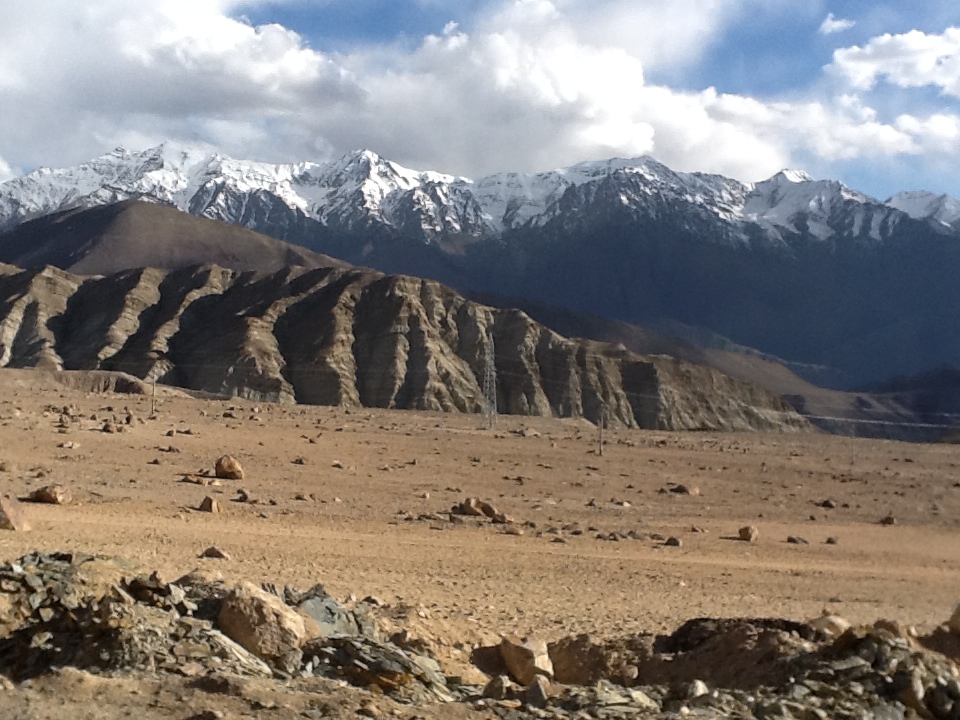
High desert, high mountains, thin air, ancient Buddhist monasteries, and intensely blue skies–this is Ladakh, or the Ladakh that most tourists know. But there are other Ladakhs to know, worlds inside of worlds that most visitors to Ladakh are not aware of.
On the Road to Domkhar from Leh
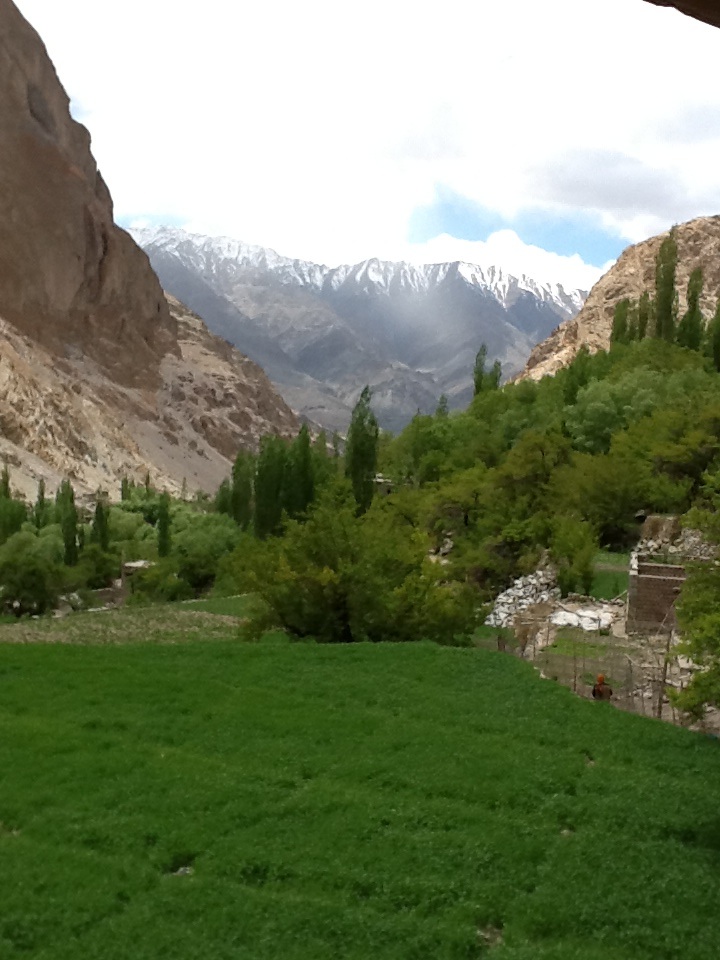
When we arrived in the village of Domkhar, 120 kilometers from Leh, I knew I had arrived in a different world. Village elders calmly rimmed the gathering area in front of the school, prayer wheels spinning in their hands, mothers sat with their children in their laps, and thermoses of tea from each family waited beneath the tent shade. The village’s community spirit was palpable as the entire village welcomed us in a ceremony that celebrated the community’s recent accomplishments. Located in a beautiful, narrow valley with sheer cliffs made of uplifted conglomerate earth on the side of the Indus River Valley, Domkhar is home to approximately 32 families who farm apricots, barley and a variety of vegetables on terraced plots. Intelligently, the villagers have channeled water to run by the houses and along the walkway that winds up through the village.  The night we spent in Domkhar, the moon’s light, one day short of full, shone so intensely that it lit up the whole valley–the immense, rust-red mountains, the fields of thick barley, the blue sky, all shyly emerging from beneath night’s cloak. Two years ago this past April, the area got in one day the amount of rain that they would normally receive  in 50 years, resulting in mudslides that carried away bridges, houses, people, and much of the valley’s good soil used for farming, replacing it with rock. The whole region is still recovering, as is Domkhar.
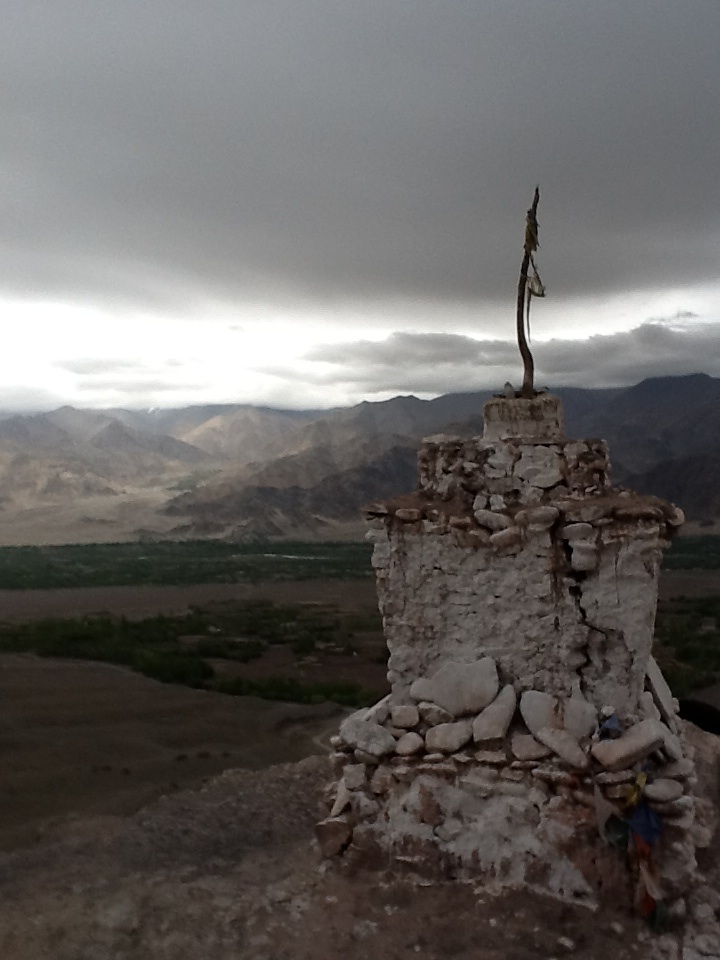
Ladakh Overview from Matho Monastery
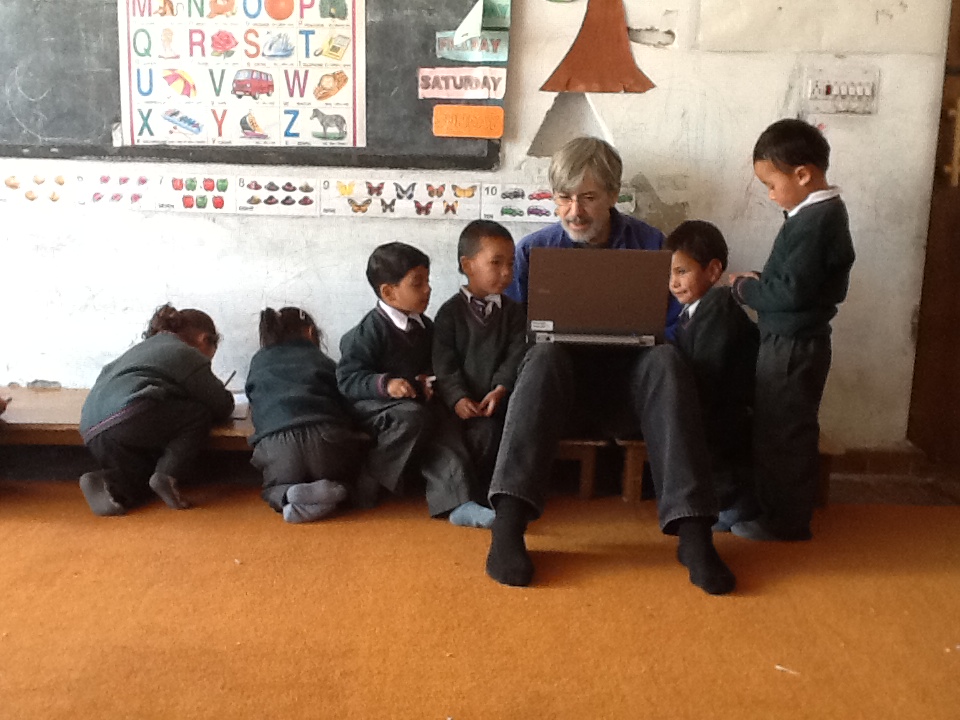
I went to Domkhar with my husband Michael as part of the Partners in Education teacher training work we do with teachers in Ladakh, and also with the Tibetan Children’s Village Schools here in India. This was our second visit to Ladakh, and our school principal from the American Embassy School and one of our technology teachers, Gagan Soni, accompanied us. The purpose for our visit was to observe teachers teaching in their classrooms in order to get a better understanding of their situation and needs, and to give them feedback on the ideas they have put into practice ideas from our previous teacher training workshops that they have attended over the past couple of years since we began our work with them.
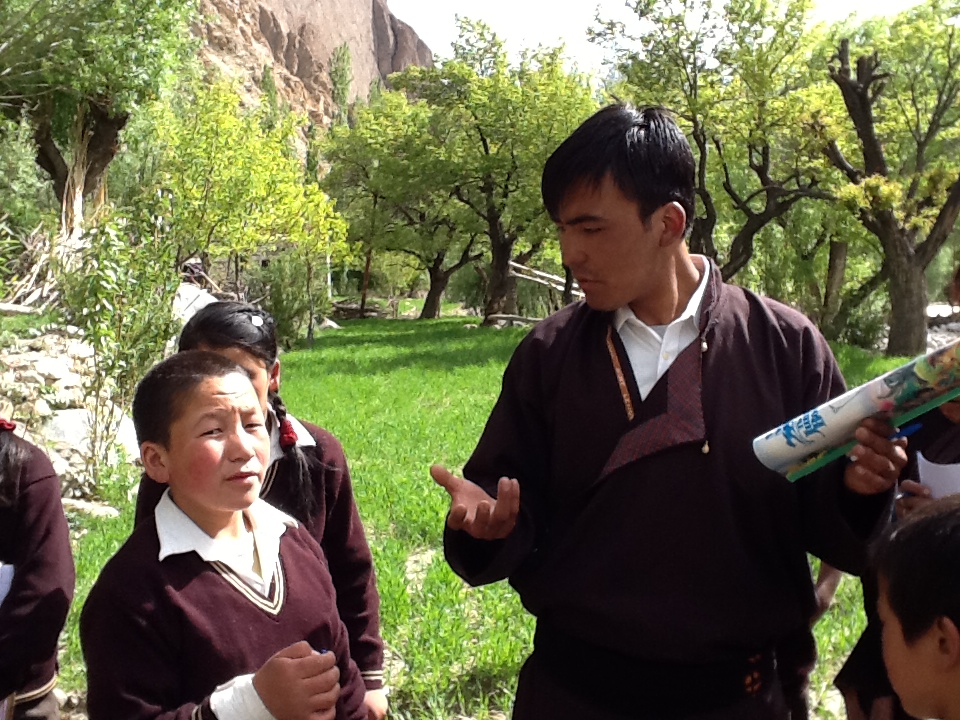
Rinchen teaching in Domkhar
Teaching in the Ladakh region is challenging for numerous reasons. The Indian government considers the Ladakh area a hardship posting, so the government moves teachers to different villages every three years, sometimes more often. One of the teachers in the village of Domkhar has been moved six times in one year. Her child is one year old and has rarely seen his father since birth. Children who have a parent who is a teacher often only have one parent present with them in the home. Another challenge for teachers in the region is that the tests and text books are in English, while the local language is Ladakhi, a language which is not taught in schools, and the official language of the country they live in is Hindi.  Neither teachers or students feel they are competent speakers, readers or writers in any of these languages. Also, schools often have very few books or resources to assist them, in addition to the fact that in India beginning teachers are required to have only one year of training beyond high school. These, and other other challenges make it difficult for teachers to be adequately prepared to teach, thus affecting the quality of the education they are able to give their students.
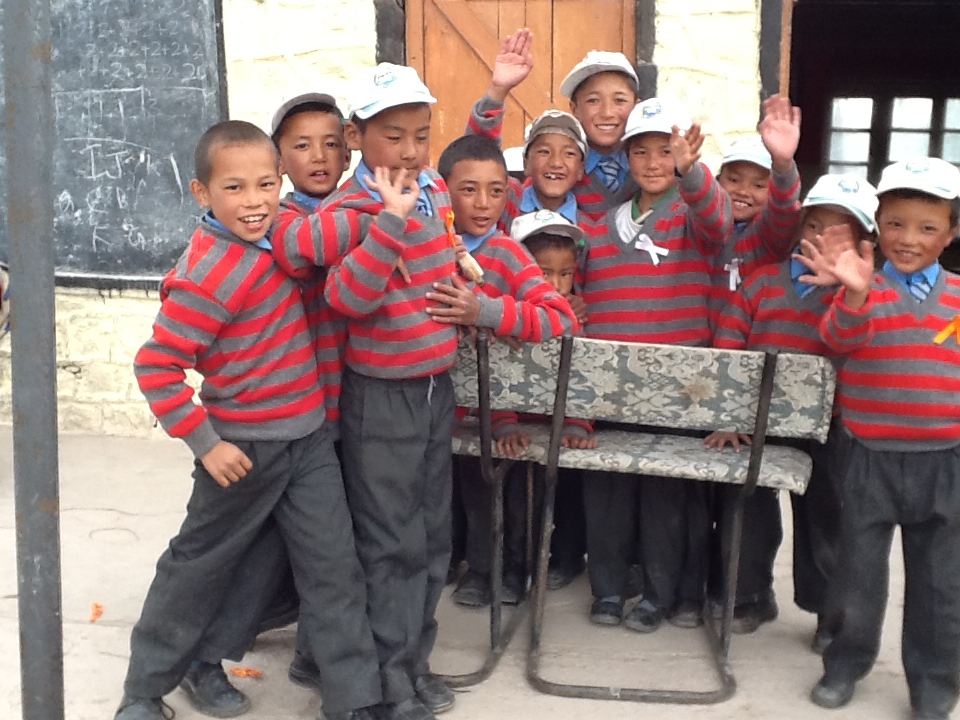
Students at Government School, Matho, Ladakh
While the situation is very challenging, teachers continue on with their work. Villages like Spituk, Matho and Dhomkhar believe in the value of education for their children. In Domkhar, for example, the village has raised the money for their own school building and for a satellite so they can communicate on the laptops that our school, AES, donated for their use. They have also raised money for a micro-hydro generator so that they can create electricity for their school and community. A new project for them now is that they are adding on a new section to their school using the plastic bottle construction method that a number of locations in Latin America have begun to use as a way of recycling plastics. Tashi Thokmat, the Domkhar village leader enthusiastically shared with us his news yesterday that as part of World Environmental Day, the villagers of Domkhar have made an appeal to tourists and citizens of Ladakh to place their used plastic bottles in collection containers. These containers as of yesterday are placed in various hotels in Leh. The villagers will then take the bottles back to their village and use them for their new building.  “We can’t stop the plastic bottles but we can reuse those empty plastic bottles in many other ways” the villagers explain in their appeal to hoteliers–an appeal which made it into last night’s TV news. The vision the villagers are creating together has built a strong sense of community and citizenship, so much so that the young people who have gone away to Delhi to university want to come back to the village to live because they feel committed to their community.
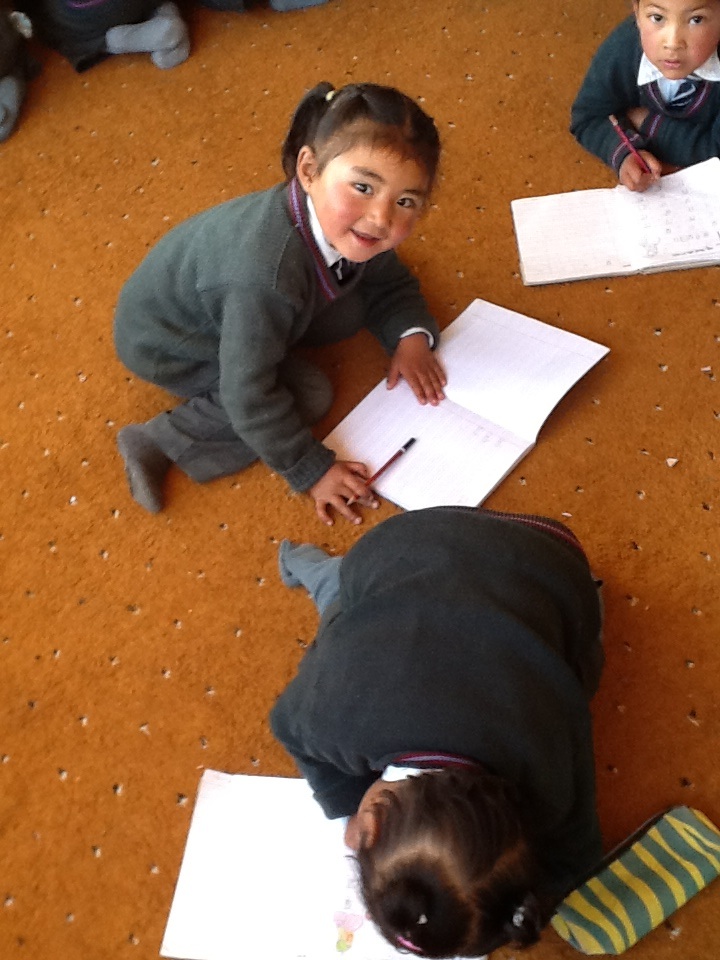
Children at Spituk Government School
People like Cynthia Hunt of HEALTH Inc., among other NGOs, are helping Ladakhis to improve their lives. Still, after their numerous accomplishments the Domkhar teachers ask “What can we do to improve?” This is the question we all have when we want to change our lives and make things better. In the midst of difficult situations, however, a number of Ladakhis are already doing a variety of things that create hope. While the main source of income for Ladakhis is tourism and more and more hotels are being built, the hotels use water from aquifers that is drawn up for use. This is an unsustainable process, however, as Ladakh is a desert. Water is scarce and the water withdrawn is not replaceable. One of the teachers who works at one  the local government schools, Chetan  Anchok, is writing scripts for production on local TV, and radio plays for a program called Family Serial, a popular program for Ladakhis. The purpose of the scripts he writes for these programs is to make Ladakhis more aware of social issues and of how to use environmental resources sustainably. The teachers in Domkhar are reaching out to attend teacher trainings and  they are working to understand and apply new skills and to improve their English, as are the other teachers we are working with in the schools around Leh and in the Tibetan Children’s Village Schools. It is a slow process and the need is great but small changes make bigger, systemic changes more possible, and they make difficult situations feel more bearable.
Michael with students from Spituk government school, Ladakh
Since moving to India five years ago, I have often struggled with how to respond compassionately to the enormous social problems present here. No matter what one might do to alleviate the poverty one sees, it seems it will be but a grain of sand in the vast desert of need. I have been reading the book 106 Impossible Things To Do Before Breakfast, by Robert Quine and John Nolan, a book of exercises to keep the mind creatively looking at solutions to problems that seem impossible such as doing laundry without soap, telling time with a broken clock, or taking a shower without water, etc.  The authors describe three key ideas for a person to keep in mind when dealing with impossible situations: “1. Consider all the possibilities, 2. Accomplishing the impossible takes a lot of work, 3. Everything is possible.” The authors describe that though problems may seem impossible, you have to open your mind to get rid of preconceptions to find ways around the obstacles. Once you do, you will start looking at the world in a different way. You’ll see it alive with possibilities, not barriers.”  Beneath Ladakh’s raw and elemental beauty is a world of work to do to create a better quality of life for its inhabitants. Working together, constructive change can be made. There is no way around the fact that the problems are large, that the work will be hard, and that it will take time,  lots of it, but the world remains alive with possibility.
Dechen Angmo, local Ladakhi teacher