

You may have seen 81 year old Sarah Paddy Jones dance the tango with Nico Espinosa and astonish crowds in Madrid, or on stage in Britain’s Got Talent for the fact that she is old and is yet able to do things that people even much younger than her can’t do. It’s amazing and inspiring to watch the grace and flexibility of these dancers. Ms. Jones has followed her passion, and worked very hard to be able to dance with such strength and beauty. Being tossed around over someone’s body and sliding across the floor with ease isn’t the norm, though probably, more elderly people might be able to move fluidly if they worked at building their strength and simply moved more often. Do we especially admire Ms. Jones, however, not because she dances well, but mostly because she is moving like a younger person would? Even with great determination, would such a dream of dancing like Ms. Jones be possible for many of those who might desire to dance like her at her age? When Ms. Jones comes on stage, the judges look highly doubtful of her ability. After they see what she can do, however, they praise her for her ability to move like a younger person. Ms. Jones is following her heart’s calling, and it’s wonderful to see her moving inside the flow of dance. Is emulating the ability of younger people, however, what older people should in general aspire to? Ms. Jones found in dance what feeds her heart and deepens her soul, and this is the reason to honor her efforts. This is what we, too, can follow into old age–the thread of who we are, so that we ripen further into what brings us wholeness. Nevertheless, while I marvel at Ms. Jones and admire her skill, I also wonder about our expectations of others and of ourselves as we age. We can’t always fix what wears out as we get older, and eventually, our bodies do wear out. It’s also important to recognize that aging and the narrowing of our powers is a normal part of everyone’s life. While we should still stretch to deepen our lives, it also might be important to understand who we are as we get older, and to move toward developing more of that, rather than emulating what younger people do, even if it’s what our culture applauds.
Diminishment comes in myriad forms. It’s not something we we want to think about or accept–losing our job, our health, a friend, a family member, our home, our country. Individually and collectively we define what quality of life means, and set our life compasses to move in that direction. What is the attitude and focus that engenders ongoing engagement and satisfaction in life, that creates wholeness all the way up to the end? We expand our understanding, develop new skills, polish others, yet for all this effort and growth, diminishment is still a destination we will all eventually arrive at before passing from this world, and we will need to understand how to stand in relationship it. How do we also learn to live into an era of loss, to accept weakness in ourselves, to invite and even welcome humility? What is the purpose of our life’s trajectory if in the end we lose everything? These are questions to live into.
Some time back, I saw this video shared on the Internet, of a man singing to his 92 year old wife on her death bed, and I thought, this couple has the something that keeps them whole, even through the stages of complete diminishment: They are fully alive to each other. I remember singing to my father as he lay dying, remember, too, reminding him of stories about things we did together, things he told me that he did when he was a child–climbing a windmill, running 16 miles through the forest at night because his feet were his only transport and he wanted to see my mother. As I watched my father during the evenings of his last days, the room seemed so utterly silent as he rested there, so still and unresponsive. As I now look back on this time, however, that experience of utter and complete silence has grown to seem significant. At the time, I so much wanted to feel the presence of something larger holding us during those final hours. What I felt most, however, was a profound silence weighted beneath everything–something like the weight of the ocean’s water at its great depths–the deepest blues fading into darkness. Nevertheless, underneath all the weight, there remained something light, something small like breath–and each breath seemed significant. We learn what love is through the love our parents bring us, and through our relationship with our partners and friends. As James Agee wrote in A Death in the Family, “I hear my father and my mother and they are my giants, my king and my queen, beside whom there are not others so wise or worthy or honorable or brave or beautiful in this world. I need never fear: nor ever shall I lack for loving-kindness.” When my father lay dying, though the room felt so empty, I became aware that love was larger than any one particular love. During those last days my father’s life diminishing before my eyes, I realized that the love I felt for him wasn’t an isolated thing. It was connected to the love I felt for my sister who had watched over my parents for more than a decade through as their health diminished, and connected, also, to the love of all the others in my life who have lifted me up, supported and sustained me from day to day, year to year. Love lives beyond death.
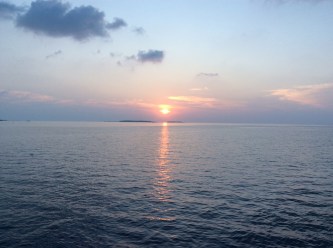
Rowan Douglas Williams, Archbishop of Canterbury, in his interview with Image magazine about the poet James Harpur’s book, The Wound of Knowledge, says, “interesting thing about great poetry is the silence it generates. This is a complex area, but the great holy silence at the heart of things is not just an absence or a cessation. It’s what happens when you’ve been led to this point…The silence, when you get there, has become pregnant.” Poetry, aims to articulate and give in words the presence of such moments of deep loss. Great poetry not only generates silence, however, it also rises up out the silence of the losses that press down to crush us. Loss somehow is necessary in order for us to move beyond the borders of ourselves. Beyond the borders of ourselves a wider something awaits.
Perhaps it seems odd to be writing about loss on Easter Sunday. You’d think it might be better to turn my mind to thoughts of renewal and rebirth. Yesterday, I lost my journal in the airport on a flight back to India, however, and I’m still grieving that loss. In it were half a year’s writing, reflections, travel observations, seeds of thought about projects I’m currently working on or planned to work on. What I feel as a result of this loss is grief. I can’t think of a better word. I realize that there are much greater losses in life than this. In comparison to so many other people’s losses, this is utterly miniscule. I recognize other ideas will arrive and I will write them in future journals. But I can’t replace the pages of reflections, images, awarenesses, or ideas written in that lost journal. They are more than words. They are my exploration and expressions of what it means to be alive in the world. And that is gone.
 Ages ago now, I remember sitting in a parking lot in St.Paul, Minnesota during winter listening to Robert Bly reading a poem on the radio. I don’t recall the poem’s title or the specific lines, but Bly’s lines astonished me with the picture they created of words emerging from the mouth into the air in visible puffs. I pictured the words taking on physical shapes, having presences. Form. Being. Words have presence and meaning beyond their mere articulation, though often incomplete or imperfect, they are mirrors of our souls. For me, they are the ladder I make to climb into a place of being.
Words guide and change our lives, but they also point to larger realities that live beyond words. Recently, Ben Slavic, a colleague I work with described how he had previously worked with Sauk, Myskoke, and Chickasaw people whose languages are dying out. Only a few native speakers remain. What is it like to lose your language? We are, in fact, losing many languages world wide per year. Do those languages go on existing in some form, he wondered? “Maybe they want to hear them again, loudly and everywhere amidst the laughter and tears of life – fully alive again…Where do words go after they are spoken?” My colleague wondered, “Is there a kind of residue, an echo, of them left over somewhere? Do they get to be fainter and fainter echoes of themselves in some parallel universe of sound?” In the BBC article, “Languages: Why we must save dying tongues,” author Rachel Nuwer writes that “languages are conduits of human heritage…convey unique cultures,…contain an accumulated body of knowledge, including about geography, zoology, mathematics, navigation, astronomy, pharmacology, botany, meteorology and more.” Also, as Nuwer explains, “languages are ways of interpreting the world, and no two are the same. As such, they can provide insight into neurology, psychology and the linguistic capacities of our species.” These all seem very important, yet, as Nuwer describes, “Over the past century alone, around 400 languages – about one every three months – have gone extinct, and most linguists estimate that 50% of the world’s remaining 6,500 languages will be gone by the end of this century.”
If all we say disappears into air, if the dear companion of our own body in the end loses all its capacity, if thirty years from now all people remember of who we are or what we said or did are a few dates and our occupation, if everything shifts and changes, where do lost words, lost time, lost lives and worlds go? What is their value and meaning?
In her poem, “Happiness,” from her book, Broken Cup, Margaret Gibson writes about her husband’s Alzheimer’s. She quotes her husband reading what the Dalai Lama says, “An art, not a right, happiness,” then later closes the poem with a memory,
long ago, after
a night of reading each other’s
poems aloud, every
blessed one of them,
the road beneath us seen through the rotting-out
porous floor of the old jeep
as we traveled at the
speed of light, and nothing, nothing
could slow us down
or keep us
separate from each other
or the road, wherever it took us.
The commitment to love is what creates meaning, Gibson suggests, even in our loss. This is a hard lesson, and Gibson’s writing about loss is surpassingly powerful. In the closing poem of Broken Cup, “A Good Death,” Gibson tells about her husband who she recognizes will in the end lose all words.
…may you also, while now there’s time
practice dying
before you die. May you daily stand outside time’s rush
whose rivering is
our natural light, and there on the steep lip of what we call
darkness,
call me angel, if angel I am; draw sunbursts in the rain lit air;
sing your heart out.
Great being, radiantly still. And near.
In learning to be present and open to all that is, Gibson seems to say, we find how to bear diminishment.
This past week I was scuba diving in the Maldives. On one of the dives, I found myself kneeling on the sandy ocean floor 25 meters below the surface in front of table coral raised before me like an altar. I watched as manta rays six 10 to 15 foot wide circled and circled over my head like enormous communion wafters in a repeated mantra of movement. Rocked and bowed by the surge, I absorbed the vision of the mantas’ presence. They had come to the table coral simply because they wanted the wrasse who live there to clean them, but as I watched them swoop over me with their great wings as if they were the Passover angel, I grew humbly aware of the immensity, mystery and wonder of being completely immersed in the arms of nature. I knew I was very much alive, and part of something enormous and beyond explanation or comprehension. Animals can be identified, their behaviors and environment explained, but something much greater happens than the sum of individual parts when we enter their world, and encounter them, something there will never be enough right words to describe.
I have lost my journal, and though I’m still able to go diving, though I can go on to keep new journals and write new poems, in the end, though I may cry for it all to come back to me, I will need to let it all go. Maybe this is when resurrection has the possibility to occur–after we go down into the depths of death or hell. We come to where we recognize we must or can let things be what they are, and trust that somehow in our diminishment we are still whole, that there is something significant moving in the depths of that diminishment beyond what the losses all add up to.

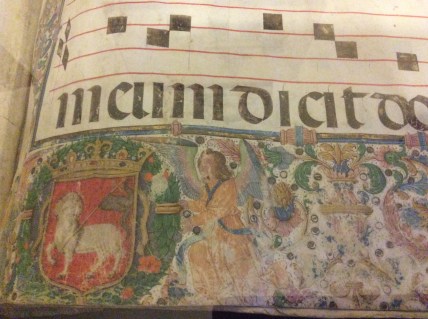
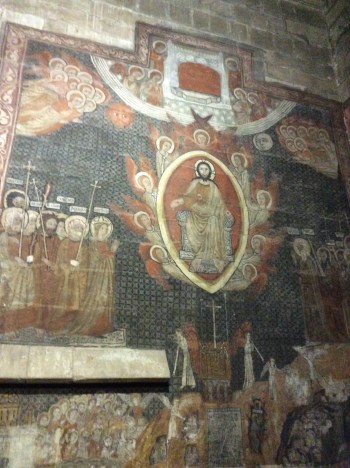 Though Dalrymple describes the cave where St. John of Damascene wrote these thoughts in The Fount of Knowledge, as “crude and primitive,” he goes on to say that, “Without Damascene’s work, Byzantine ars sacra would never again have been permitted, Greek painters might never have been able to pass on their secrets to Giotto and the Siennese, and the course of the Renaissance, if it had happened at all, would have been very different.” I’m very grateful for Damascene’s words and thoughts regarding art. Without them, we’d likely be deprived of much beauty, and the spirit that speaks through that beauty.


 Anna Citrino---Poetry, Place, Pilgrimage