Uncategorized

My Next Big Thing

Recently, I was invited by Vinnie Hansen, author of the Carol Sabala mystery series, to participate with other writers in posting about their “next big thing” that they are working on as a writer. Vinnie is currently working on her seventh murder mystery in her series. The story takes place in Cuba where Carol Sabala is hired to locate a wealthy woman’s daughter. You can find out more about Ms. Hansen’s series and the upcoming mystery on Vinnie’s website by going to her page and then clicking on her Next Big Thing announcement link.

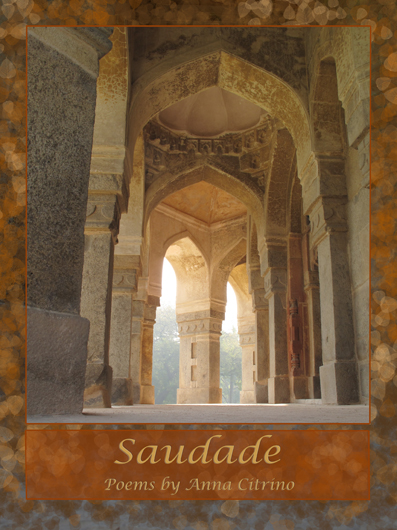
I have written earlier about Finishing Line Press accepting my chapbook manuscript, Saudade, for publication. The chapbook will be coming out in May, 2013, and pre-publication sales for the chapbook open in January. I will be sending more details about how to do this in January. For now, let me tell you a bit more about the book.

LG CoverEmail

What is the working title of your book?
Saudade. The word is Portuguese and means longing or sense of emptiness for something no longer present in your life but that you still love and feel the absence of.

Where did the idea come from for this book?
The idea came from living abroad, the travel while living in other countries, and the desire to explore and possibly answer the questions that living in foreign cultures inevitably makes a person wonder about regarding the meaning of the things we say and experience, and about what is that is ultimately important in life.

What genre does your book fall under?
Free-verse poetry.

How long did it take to write the first draft?
The poems in the chapbook are from a wide spectrum of time reaching from about 12 years ago until the present time.

What actors would you use for a movie rendition of your book?
Since Saudade is not a work of fiction, the actors would have to be those found naturally in the locations of the poems, which includes the orangutan of the Borneo rainforest, camels wandering the Saudi Arabian desert, Delhi’s citizens, the Alhambra’s architects and artists, the fado singer and musicians at the Santa Cruz Café, Coimbra, Portugal, and a cast of others.

What is a one sentence synopsis of your book?
If you look deeply enough even at those things that are difficult and painful, hope and beauty can be found.

Will it be self published or represented by an agency?
Finishing Line Press will be publishing the chapbook. Saudade will be available for pre-publication sale from January through April from Finishing Line Press, will come out in May, 2013, and will later also be available on Amazon.

Who or what inspired you to write this book?
The amazing perplexities and wonders of life, and the desire to understand how various cultures, worlds, experiences and places interconnect.

What other books would you compare this story to within your genre?
Saudade might compare with Carolyn Boyd’s DNA of Sand, or perhaps Michael L. Newell’s books, A Stranger to the Land, or Traveling Without Compass or Map, and possibly a few of Naomi Shihab Nye’s poems in that the settings of the poems are in a variety of world locations while appealing to themes that people everywhere experience of love, loss, hope, work, and longing to be whole.

What else about your book might pique the reader’s interest?
Music in a variety of forms—from jazz, to classical to Indian raga features in these poems.

Erica Lann-Clark is another author continuing this Next Big Thing thread where writers tell you about their upcoming work. Find out about Erica’s upcoming projects!  A professional storyteller, Erica’s lively piece, Shopping for God humorously explores the search for meaning in contemporary life. Learn more about Erica and her work, and check out Erica’s web page for her next big thing.

Uncategorized

Can Beauty Save the World?

“When nothing seems to help, I go and look at a stonecutter hammering away at a rock perhaps a hundred times without as much as a crack showing in it. Yet at the hundred and first blow it will split in two, and I know it was not that blow that did it–but all that had gone before.”– Jacob Riis

I spent this past week in the Himalaya foothills with students from my school on a camping trip. It was an excellent week of hiking, rappelling , creating art using things found in the natural environment, swimming in a mountain stream. I loved experiencing all the things I don’t get to participate in while living in Delhi. Walking up a forest road, I looked up to see a group of yellow butterflies swirl through the sky. Later, I stood at the foot of a waterfall, staring up into the mossy ledges of brilliant green through a rainbow arc. Another day, while hiking I noticed the shining gossamer wings of a dead cicada lying on the path as I walked by. The world is indeed full of wonder and magic, or at least it can be if you are in the right location.

As we drove down the mountain and back toward Delhi, I experienced a different kind of world–one filled with honking horns, a layer of trash covering the roadside for miles, traffic congestion, and road-side fires–a world where where smoke and the resulting haze made visibility increasingly difficult. As the sky grew increasingly dark and the sun went down in a great ball of pollution-orange, I thought to myself, “What has happened to beauty?” People who grew up in this world, who have never been outside of it, are bound to think that this is the whole of the world–the way life is. Three mornings in a row now the sun has risen as an orange ball into a haze-filled sky, the kind of sky I have seen before in California when the hills have caught on fire. We have made a kind of hell for ourselves to live in it seems. We light the fires. We burn the world. How is it that we have come to this state of being?

Yesterday I received this poem by Edna St. Vincent Millay in a letter from Monasteries of the Heart.

God’s World
by Edna St. Vincent Millay

O world, I cannot hold thee close enough!
Thy winds, thy wide grey skies!
Thy mists that roll and rise!
Thy woods, this autumn day, that ache and sag
And all but cry with colour! That gaunt crag
To crush! To lift the lean of that black bluff!
World, World, I cannot get thee close enough!
Long have I known a glory in it all,
But never knew I this;
Here such a passion is
As stretcheth me apart. Lord, I do fear
Thou’st made the world too beautiful this year.
My soul is all but out of me, let fall
No burning leaf; prithee, let no bird call.

What a very different world Millay was observing than the one I live in with its pollution filled skies–where the natural world is pushed aside for the demands of roads and buildings, where people live in substandard housing or live on the streets, where there is so much trash that it has become a literal mountain in the city. Given this reality with such pressing social and environmental needs, what is the role of beauty? A prince in Dostoyevsky’s novel, The Idiot, states that “Beauty will save the world.” How can this really be and what does this mean? Beauty can lift us above the mundane, restore and renew us when we feel worn down, but can it save us?

If we look at the work of the journalist and photographer Jacob Riis, we can see one way in which it’s possible for the artist’s eye can lead to change in the world. Riis is noted for raising social consciousness through his photographs in the late 1800’s of the tenement houses and slum areas of New York City, in particular of Mulberry Street, where many Italian immigrants lived in some of the city’s worst slums. The Italians were willing to live in these areas because many of them found them no worse than what they came from, and in some cases actually better, and they looked on their living situation as somewhat temporary. They had dreams of building a better world for themselves. Riis looked at the plight of those who lived in these conditions, and looked deeply. He used his photographs to not merely document or bear witness to other’s suffering, but to motivate others to make social reform. While some may have questioned his relocation efforts, nonetheless, the effect his photographic work had on others is remarkable. His work led to more diligent police patrol in NYC after President Roosevelt walked with him through areas Riis had been photographing. Riis photographs of sewage falling directly into New York state’s water supply led to the state becoming aware of the connection between these behaviors and the possibility of an outbreak of cholera after Riis spoke with doctors about the connection between this behavior and the disease. His photography work also helped others to see the need for replacing unsafe tenements with parks. Because he looked deeply, and use that sight to create powerful photos that helped convince people of the need for change, Riis made a difference for good in the world. While it was not Riis’s main goal to create works of art, nonetheless, his photos are a kind of work of art. Social reform, however, is not generally the goal of art. Should art be political? Maybe from a certain perspective all art is political, but I wouldn’t argue that art should be political, though artistic efforts can lead to social reform, as did Dickens’ writing.

Though I’ve not yet read Gregory Wolfe’s book, Beauty Will Save the World: Recovering the Human in an Ideological Age, the title attracts me, as does Wolfe’s own comments about the book, and I want to put it on my wish list of books to read because since living in Delhi, I’ve been struggling with this question of whether my need for beauty is frivolous or a true need. I long for access to the natural world, a walk in a forest rather than a city park. Maybe it’s because I grew up in a place where I could roam the hills behind my house, climb up granite bolders and look out over the valley and hills beyond. Maybe it is just a part of my spiritual geography that I think I need this access to the natural world. On the other hand, couldn’t it be that we really do need beauty to survive? Humans have made art since the days when we lived in caves and were hunter-gatherers. I have been working on accepting where I am–learning to be happy where I am, even if where I am doesn’t have the beauty I need that feeds my soul. In truth, I have been given much to be utterly grateful for every day of my life. Could it be, however, that I long for beauty because as human beings we truly do need it?

I don’t have to have the kind of beauty every day that Millay talks about in her poem where I feel  stretched apart. It would be too much to actually bear that kind of beauty every day. My first trip to Italy several years ago made me wonder how people could live every day with so much beauty all around them. After a while, one must just accept it as the world as it is, just as here in Delhi with the polluted skies people accept this as the given world. Though they saw it, the children on the bus ride down from the Himalaya weren’t focused on the lack of beauty around them. They simply continued singing as we rolled through the streets lined with trash and burning fires. This is a way to survive–to just keep singing. Which leads me back to the question of what role beauty can play in helping us act in ways that create a better world. Just because art exists around us or because people are producing art doesn’t necessarily make the air pollution go away. Riis took the photos which piqued people’s awareness, but he also had to get out there and motivate the change of policy. We need policy changes to make the world a more livable place, and in order to preserve the beauty.

Is the role of imagination, art and beauty at its base a political action, however? Does political action trump imagination? Dr. Eric Cunningham explains in his review of Wolfe’s book, Beauty Will Save the World: Recovering the Human in an Ideological Age that Wolfe asserts that it is beauty, not ideology, that will save the world. “Throughout this twenty-five year exploration Wolfe has struggled with the most nagging characteristic of the time, i.e., the tendency of modern consciousness to reduce all forms of cultural expression to the status of propaganda, leaving those who would strive for the spiritual redemption of our culture with few strategies other than political action.” I care about preserving that beauty so I can continue to enjoy it, yet my life is wrapped up in work not directly related to preserving the natural world. Our modern world’s love of “stuff” plays a big part in the destruction of natural beauty, and while I make efforts to reduce my needs and to recycle, I struggle with what I should be doing in order to make a difference in the world when I am not a political activist. Cunningham in his review of Wolfe’s book responds to this question and presents Wolfe’s alternative viewpoint, “Where I have long argued that the tendency of modern people to politicize every aspect of their lives, religion included, is the inevitable product of a flawed historical narrative, Wolfe argues, with convincing clarity, that “the problem” is essentially an aesthetic one, and can be remedied through a renewed appreciation, and a re-appropriation of the aesthetic sphere.” So, what is the role of aesthetics in saving the world? What part does the imagination play? Art does, indeed, bring people of divergent perspectives together. To what extent does it or can it change the way we relate to the world at large?

Aleksandr Solzhenitsyn when pondering Dostoyevsky’s statement about beauty said, “It is vain to affirm that which the heart does not confirm.” It is not a matter of one thing over the other he seems to suggest. If the heart isn’t involved, nothing is going to happen. The trajectory of western history has made us rely on reason and remain skeptical of the heart. If the heart is not involved, however, the brain isn’t in full function. The heart and brain work together. (You can attend a conference in Paris about this idea if you are interested!) The heart helps engage the brain, and in fact acts as a second kind of brain. Solzhenitsyn goes on to say in his essay about beauty, that if  “Truth and Good are crushed or amputated and cannot reach the light—yet perhaps the whimsical, unpredictable, unexpected branches of Beauty will make their way through and soar up to that very place and in this way perform the work of all three.” Beauty, he suggests, will serve in the place of Truth and Goodness if they are destroyed. Beauty is somehow stronger. When it comes to matters of basic survival, however, is it enough that a person offer poems, or make music, or take photos when people across the street from me live without water, when people are without adequate clothes, medicine or food? Is it okay that some offer beauty while others assist with the other more basic needs? Can we work together to meet the world’s needs?

Joan Chittister, a follower of the Benedictine tradition, talks about three aspects of what it means to do good works; celebrating beauty, honoring the word, and practicing nonviolence. It has never occurred to me before that celebrating beauty is doing a “good work.” Chittister explains that “The monastic life exists in pursuit of the beauty of the invisible God. Wherever you find the beautiful you discover another incarnation of God. Members of Monasteries of the Heart know that to revive the soul of the world, we ourselves must become beauty, become contemplatives. And to be contemplatives, we must surround ourselves with beauty, and consciously, relentlessly, give it away until the tiny world for which we are responsible begins to reflect the raw beauty that is God.” She lists the following as ideas for celebrating beauty:

•Begin a garden in an inner city neighborhood or your own neighborhood
•Donate art pieces to inner city schools
•Give away flowers or art postcards on street corners
•Take inner city children to hear an orchestra or to the museum or to a play or dance performance
• Join or start a threshold choir. These women choirs visit those who are sick and dying:www.thresholdchoir.org

Chittister suggests that yes, beauty is a basic need. After reading the list she provides, I can begin to see new ways in which beauty can, indeed begin to save the world by helping people to honor the natural world and to see ourselves in relationship to it as well as to each other. I love the idea of sharing beauty with people living on the street, of taking art to the homeless or offering flowers. Maybe I can’t assume that because I need beauty, they, too need it, but who could reject the beauty of a flower?

I remember several years back when our biking group had been out for a ride in the rural areas several hours outside of Delhi. Our van broke down on the way home, and we had to wait four or five hours on the road for a car to be sent from Delhi that could carry the van to a location where it could be repaired. In the mean time, we sat on a charpoy in a roadside farmhouse compound where joint Muslim families were living together. They fed us a dinner of chapati and vegetable curry. While there, I asked one of the children what he thought was the most beautiful thing where he lived. He replied, “The mosque, and the pond.” His response makes sense. In God’s house we are brought in touch with the wonder of life and the world. In nature, we are brought in touch with the wonder of God, and of Life itself–we see how we are part of the bigger wonder of the universe and can stand in awe.

Riis watched the stone cutter hit the stone with the hammer, and it wasn’t until the hundredth time that the blow made a difference. Singing our songs, writing our poems, telling our stories, carving our stones, maybe they don’t make the pollution go away but these acts in the least help to restore the soul and the more we grow toward wholeness, won’t it also help others to know how to create wholeness as well? I am not a politician. Neither am I Jacob Riis. I don’t know how to change the things in this world that are much bigger than what is in my power to change. Suffering, such as living in a world of polluted air, is part of life. We have collectively created our suffering. But inside this place of suffering it is still possible to find a way to share beauty with others. Are the ones who long for beauty those who Jesus was speaking of when he said, “Blessed are the poor in spirit?”  When we share beauty with others, we are brought into their heart, and perhaps through touching others we can be brought into the heart of seeign our connection to the world and to Life itself.

The threshold choirs sing to the dying, singing to people as an act of healing and beauty in the midst of suffering. Can beauty save the world? Mark Helprin in his novel, Solider of the Great War says, ” To see the beauty of the world is to put your hands on the lines that run uninterrupted through life and through death. Touching them is an act of hope, for perhaps someone on the other side, if there is another side, is touching them, too.” Perhaps if we all offer the beauty we have to those spirits choking in the world’s pollution in its myriad forms, an answer will emerge that we didn’t expect. Perhaps it takes more than a hundred strikes on the stone before we will be able to move into a different way of living and being. As in Poco’s song, we can keep on trying.

Uncategorized

Three Things That Can Make the Heart Glad

Pumpkin curry for dinner. How delicious! The supple pumpkin flesh surrounded in a sauce of coriander, ginger, tomato, onion, cashews, powdered coconut milk and spices, that has been zizzed in  blender. You bite in to the pumpkin, its subtle sweetness bathed in flavorful spice accompanied by plump golden raisin. Ah, the joy of eating. Eat slowly. Savor the food in your mouth. Every bite. No need to eat fast. Eat slowly and enjoy the fantastic presence of now, each swirl of flavor across the tongue. Who needs to go out for good food often when you can cook simple yet delicious meals night after night? It is such a pleasure to unwind from the day’s work with the tactile, aromatic experience of cooking the evening meal, and it is a wonderful way to transition into an evening at home.

You might recall the scene from the book Like Water for Chocolate, when Tita makes the dish of quail in rose petals, all of her love for Pedro going into the making of the dish. Those at the dinner party eat the food, and their emotions are powerfully effected. Food can do more than affect our bodies. It can affect our emotions too. Maybe not like Tita’s quail in rose cream, but it can bring us a sense of deep connection to those with whom we share the meal. I love the physicality of food, its beauty, and the caring hands that make and share it are a way of reaffirming our connection to each other and reconnecting to an awareness of the earth’s rich bounty that sustains us. When you work all day, spending a great deal of time in your head, coming home to scrub carrots as you hold them under cool water, to  chop red peppers, or breathe in the aroma of spices in a pan can physically ground and restore a person to her right self. Maybe that is why food is a part of so many religious traditions,  such as in the Christian ritual of breaking bread together at the communion table, or Muslims sharing the breaking of fast together. Such acts reconnect us. The etymology of the word “religion”, according to etymology dictionary is to go through again, rebind. Cooking and eating can be a kind or ritual that rebinds us in community. We can literally taste the goodness that relationships can bring. The Jewish religion has a wonderful way of grounding the spiritual life in physical reality. “Taste and see that the LORD is good; blessed is the man who takes refuge in him,” writes the psalmist. Sharing food with a heart of gratitude can, indeed, rebind us to each other, and the earth as well as to God.  “The heavens declare the glory of God and the firmament shows his handiwork.” Our feet are firmly planted on this earth, pointing us toward appreciation.

Music, too, is a wonderful way to lift the spirits. In reading about newly unfolding knowledge about brains, I have learned how, among other things, music can help improve young children’s intelligence, calm people with Alzheimer’s, and does things like boost immunity and reduces blood pressure. I don’t have first hand experience with any of these things, but have noticed repeatedly over the past couple of weeks that singing has done fantastic things for changing my stress level. Years ago, I remember working with a woman who used to sing often. I asked her about it and she said she had had cancer previously, and during that time she learned how much she had to be thankful for. As a result she sang more often. I remember that now as I sing portions of O Sole Mio on the way to work, on the way home, and from time to time during the day. When Michael got dengue recently and was lying in bed with a fever that didn’t go away for days on end, he wanted to hear it. I found this version by Mario Lanza. What a voice!  I remember my mother having a record of his when I was a child. The song is so expansive in its expression–the heart reaching up to the sky. Light rolls across the universe, and can’t help but flood your spirit and lighten your heart when you hear it. There is also the version by Il Volo, the three Italian young men in their teens, Piero Barone, Ignazio Boschetto and Gianluca Ginoble, who sing O Sole Mio with presence and vivacity. The intensity of life coming from them, like the words of the song, is shining sun. Even if you don’t sing or can’t carry a tune, you want to sing like Pavrotti, Plácido Domingo or José Carreras after hearing them sing O Sole Mio. You can read the Italian and English lyrics here. Try singing the song and see for yourself if you don’t feel happier after singing!

One other story that shows the power of poetry to change people’s behavior and return them to their senses is the story about Dante’s Beatrice in Alighieri’s poem, “Dante’s Inferno,” and the bridge on which Dante saw Beatrice. Robert A. Johnson, in his book, Inner Gold, explained how when he was a very young man, Dante saw Beatrice standing on the Ponte Vecchio, the bridge over the Arno River that runs through Florence, Italy. Dante fell in love with her, though he could not marry her, since marriages at that time were arranged, and he could not choose her. Nevertheless, he carries her in his heart through the rest of his life, , as a symbol of  beauty and purity. The most surprising thing, however, is the way this piece of literature affected the flow of history.  Johnson explained that during WWII, when the “Americans were chasing the German army up the Italian “boot.” The Germans were blowing up everything of aid to the progression of the American army, including the bridges across the Arno River. But no one wanted to blow up the Ponte Vecchio, because Beatrice had stood on it and Dante had written about her. So the German army made radio contact with the Americans and, in plain language, said they would leave the Ponte Vecchio intact if the Americans would promise not to use it. The promise was held. The bridge was not blown up, and not one American soldier or piece of equipment went across it.” (See more here.) Poetry can change us! That is a wonderful thought. It has in at least this one specific instance helped humans to not choose a destructive act. I remember Lucille Clifton saying at a Flight of the Mind women’s writing workshop in Oregon some years ago now how poetry humanizes us. This example Johnson gives of this decision to save the bridge during WWII exemplifies Clifton’s statement. There are too many people in this world keeping animosity between sides going, too many people feeding the engine that makes sure the lines between us are drawn and that we do not have to listen to each other and figure out how to stop blowing up the bridges between us. The name Beatrice means blessing, I vote for more of the blessing in this world that her presence inspired in Dante. I hope there are more stories about poems that have brought people together like this one. I’d love to learn of them. “Music in the soul can be heard by the universe,” says Lao Tzu. Poetry, music, making and sharing food together–these are creative acts that can unite the opposing forces in our own minds as well as those in the world.

Uncategorized

Saudade, A New Poetry Chapbook

I recently received a letter from Finishing Line Press that my chapbook manuscript, Saudade, was one of the top 20 semi-finalist in the New Women’s Voices 2012 chapbook contest. Finishing Line Press has asked to publish my work in their 2013 Finishing Line Press chapbook releases. I accepted the offer, and Friday I sent off the signed contract. This is a new step for me as a writer, and it will take me in new directions. Having a chapbook will encourage me to share my work in a more public manner, and I will have the opportunity to see how others respond to it. I feel appreciative of the many people through the years who have read my work via e-mail and who have encouraged me to keep going.

Saudade, the title of the chapbook is a Portuguese word with a wonderful definition for which we don’t have an equivalent in English. Wikipedia explains that ” Saudade was once described as “the love that remains” after someone is gone. Saudade is the recollection of feelings, experiences, places or events that once brought excitement, pleasure, well-being, which now triggers the senses and makes one live again. It can be described as an emptiness, like someone (e.g., one’s children, parents, sibling, grandparents, friends, pets) or something (e.g., places, things one used to do in childhood, or other activities performed in the past) should be there in a particular moment is missing, and the individual feels this absence.”

This thread of longing weaves through the book. From running through Borneo’s rainforest in order to see an orangutan to observing camels from a cliff in Saudi Arabia, to listening to fado music in Portugal, Saudade’s 19 poems emerge out of my experience as an expatriate living and traveling abroad, but they are also more than travel pieces. They explore the themes of loss, hope, the meaning of home, and how to live within the borders of our own limitations and unfinished possibilities.

Hopefully, there are a number of you out there who will want to read the book! When I get details about dates for pre-publication sales from the publisher, I will announce it here and then you can help me spread the word to others.

Currently, I am working on a series of poems about immigrants from southern Italy to San Francisco, and am thoroughly enjoying all the many things I am learning about Italy, about immigrants, San Francisco, and about the time period! Among other things, I’ve come across fascinating historical clips of Calabrians dancing the tarantella, found some fantastic Calabrian recipies from Rosetta, born in Calabria but who now lives in San Francisco. Writing is a wonderful way to continuously open yourself to a deeper understanding of the world.

pilgrimage, Reading, spirtuality, Uncategorized

Living Contentedly

20180913_183435-1-e1549430118152.jpgThis is the time of year when international school teachers begin to pursue jobs in new locations if they are planning to move to a new school the following school year. There is a lot of appeal to moving to a new school in a new country. It is exciting to explore a new culture, to enter into a new world that holds a different way of thinking, living and being as there are always valuable things to learn from other cultures, and living in one makes you examine your own life and values.

On the other hand, there are also good things to be said for staying in one place and going  deeper into the reality you are confronted with in the culture you are currently in? How can you learn what the place you are living has to teach you about yourself? I find it challenging to live in a city as big as Delhi, where to get out of the city takes a few hours, and where access to nature is limited. Something in me longs for a walk in the woods,  needs the opportunity to stare out at the sea spreading into endless space.  Something in those experiences feed me and reconnect me to Life, and help to restore me to wholeness. Nothing like that exists near me, however, and so the task is to learn how to be happy, truly content with the situation I am in, and that is challenging.

Sometimes the notion of moving to a new location slips into my mind, or going on a holiday, but in reality, doing these things would not bring me contentment in themselves, because they are only temporary solutions to the deeper need we all have of how to find contentment. Going on holiday or moving to a new situation could be an excellent thing to do, however, they are not a long term solution for living a contented life. Moving or going on a holiday would only mean trading some things I long for with a different set of things I long for.

No situation in life provides a person with perfect contentment, of course, or if it does, rarely does it last for long. Life has a rhythm of ups and downs. St. Paul said he had found that whatever state he was in he could be content. For most of us, learning how to be content in whatever situation we are found is a life long challenge. Taking on the perspective, however, that difficult situations can enable us to grow and can in fact help to teach us how to be content no matter what our outward situation is like, if we open ourselves to the lesson. That’s not always an easy lesson because it requires practice–consistent focused effort and attention over time. As a result, we would sometimes rather distract ourselves with something that will pump us up and make us excited about this or that. New things can be wonderful. They activate and energize our brains. If we are always in a state of excitement, however, we don’t know how to deal with the opposite side of that experience. We won’t know how to live normal, everyday life very well. We won’t be stable or content. We will always be swinging between high and low.

Our modern culture seems to be built around the idea that “too much is not enough,” as someone I know describes this perspective.  How do we be content with what is?  How do we focus on becoming more of who we are in the midst of a media driven world that constantly works on our emotions to make us feel that we are never quite right or enough, that we need to be who others say we need to be, that we need to keep our competitive edge in whatever it is we do in order to be taken seriously?

I just finished reading Robert A. Johnson and Jerry M. Ruhl’s book, Contentment.  The authors state that discontent is important for our growth.  Johnson and Ruhl are Jungian psychologists who suggest that we need to honor our discontent. “…if you can stand to live in paradox long enough, then transformation takes place and a new consciousness is born. This occurs when one has stopped trying to maneuver external reality so that it will work out as the “I” desires. Contentment, the authors say, requires energy, and we need to learn how to say “Enough is enough,” and they go on to name several things that people can practice to help them regain balance in their lives so they can live purposefully and become whole.

The first thing the authors mention that can help us on this path is to honor the sabbath.  “We all need a sabbath, whether we are religious or not. Without the pause of the seventh day (or sabbath), life simply becomes an indistinguishable blur and monotony rules…Don’t let duties and responsibilities from the week, even work around the house or social obligations, spill over and claim your energy on this day. Make it a priority to preserve an oasis of rest, contemplation, and spiritual renewal.” Keeping the sabbath is a challenging, radically uncommon thing to do in our culture. It goes directly against the thinking that more is better and affirms the idea that you can rest that what you need will be there for you when you need it. Rather than thinking that everything you have or do is totally from your own effort, you are trusting that you will have time, that things will work out. You are letting go of the control and setting aside the kind of thinking that everything you have is through your own efforts.

A second thing Johnson and Ruhl suggest is fidelity to the moment. The authors explain how St Benedict’s novices took the vow of  “fidelity to the moment.” Its purpose was to help those who have just begun their spiritual journey. The idea is to concentrate on whatever is directly before you in the moment. Give your full attention to it in what you say, do and think. My mother taught me as a child that doing the dishes can be a sacred act, if you do it with concentration and an open heart. Everyday acts can be holy, can be offerings of ourselves.

Another thing the authors suggest is to take some time to just be. Reduce the to do list. This is a challenging one, as lists can be never ending for people that are goal oriented. I am reminded of how Thoreau could sit in his doorway at Walden Pond all morning, absorbing the sun and watching the light, and feel it was a day well spent.

Attending to the heart is a further practice that brings contentment. The authors suggest that you find a quiet place, close your eyes, place your hand over your heart. Take some breaths then think of the things you’ve put your energy into during the week. Evaluate how each has added to or taken away from your contentment. Continuing to think of your list, shift your attention to your heart, and ask it what is required for contentment. What does your heart yearn for? Wait and listen, they suggest. Compare lists, and then consider investing some time, money, or energy into what your heart yearns for rather than what you head desires.

The Dalai Llama in his poem, “Never Give Up” says, “Too much energy in your country/ is spent developing the mind/ develop the heart. Tobin Hart, also talks about the importance of keeping children’s hearts open to wonder as they grow and is exploring more of how schools and educators might include practices that help young people learn how do this. The practices he suggests, such as deep listening, use of reflective questions, freewriting, use of poetry and concentrated language, guided relaxation, and other suggestions as well, are different ways of helping us attend to the heart.

Spending time in nature is further activity that can enable you to reconnect to what supports life in yourself. Take a walk in the rain, in the woods, by the sea, in a park. Listen to and watch the birds. Getting out of the door and on to your balcony for a few moments, if you have one, or just staring out the window and noticing what the leaves on a tree are doing, or growing a small plant in your window and taking care of it each day are all ways to spend time with nature in a small, simple way if you can’t easily go for a walk in the out of doors. Satish Kumar, when he was visiting Delhi, suggested that part of school children’s day should be spent in nature, caring for it, so that they learn to make the connection with nature. When we spend time with nature, we learn to feel our connection to it.

Find home. Consider what home means to you and find what the gift of your own home is. Johnson and Ruhl suggest. What is within the circumstances of your own life that is worth affirming as a treasure? We may search the world for our treasure but what we look for is often right in our own home. Like the scarecrow, tin man and lion in the Wizard of Oz, we carry with us what we most treasure, but perhaps we are not noticing what it is we have. How might we notice what it is we have in our home. The practice of noticing these things and also expressing gratitude for these things on a regular basis can help shift our perspective. Gratitude helps bring greater physical and mental health.

There are several other practices that Johnson and Ruhl suggest in their book, but I will post only these for now. The difficulties we confront in our lives are our teachers. They are our opportunity where we can practice how to take the opposites of our lives and put them in a new framework. We can approach them from a different angle, breaking old patterns perhaps, so we can see things differently and begin to live differently. I view it somewhat like what happens when writing. Sometimes  you have to let a draft sit for a time and go out and live, do something different, then come back to the piece and read it out loud or have someone else read it out loud, or you might need print it off. You have to do something different with the work you have made so that you can see it anew. Then you can revise what you’ve done and see where to go. It’s a back and forth process and it involves waiting and listening very carefully to the bigger picture of what it is you are trying to say or do. Life is like that too.  You put old problems in a new framework so you can learn how to change and become new. Then you persevere. Slowly, over time, like all normal growth processes, contentment grows. It is the work of our life, is why we are here. I am still learning.

Uncategorized

Questions for The Good of The Whole

Our current educational system places emphasis on testing and data. Many states have adopted the Common Core and are moving toward a standards based education. Everyone, it seems, is calling for an improvement of our educational system. Much of the motivation for change in the educational system seems to come from our country’s desire to remain competitive in the global market. We are concerned about being productive economically. I recall sitting in teachers’ conferences and hearing presenters say that the research does not show that class size affects the quality of learning. Class size alone may not improve student learning, but the question raised in my mind is what is learning? What is the mind, and what is the mind we are hoping our education system is creating?

Currently, an abundance of research is coming out about the brain, and through this we are gaining a better understanding of the mind and how the brain functions. A few years back I read John Medina’s Brain Rules, a book giving new insights into the brain with direct implications for teachers and for the educational system. For example, we know that the brain doesn’t function as well when we are multitasking, and that emotional arousal helps the brain learn. We know that stress affects learning. Also, if more of the senses are involved, the brain will improve our ability to learn something. The brain also mixes new knowledge with what we experienced in the past. These, and other insights about the brain will help us better understand how we learn and can help teachers and schools construct activities and learning environments that utilize this information as teachers create and deliver curriculum.

A question that is niggling at my mind in the midst of the current educational emphasis on collecting data and our country’s shift to measuring students learning against a standard, however, is what about the other part of our minds–the part that makes us revel in the wonder of life, that makes us feel alive and whole? Who is looking at this as a way to help us improve learning? What are we doing in our educational systems that recognizes,  gives attention to, and creates a way of teaching and learning that acknowledges the connection of  our relationship of our inner life and way of thinking to learning?

Vygotsky taught us that learning is social. Our relationships to and with others matters to learning. It seems that the better a teacher can get at listening to and understanding his or her student as they interact, the higher the potential for learning in that classroom. That quality of attention would be very difficult to attain in a large classroom where testing drives the curriculum. When Dickens wrote Hard Times, he opened the novel with the voice of a teacher, Gradgrind, telling the reader what mattered most in his schoolroom and in life,

“NOW, what I want is, Facts. Teach these boys and girls nothing but Facts. Facts alone are wanted in life. Plant nothing else, and root out everything else. You can only form the minds of reasoning animals upon Facts: nothing else will ever be of any service to them. This is the principle on which I bring up my own children, and this is the principle on which I bring up these children. Stick to Facts, sir!”

Gradgrind continues on, explaining that “In this life, we want nothing but Facts, sir; nothing but Facts!” He sees his students as “little vessels then and there arranged in order, ready to have imperial gallons of facts poured into them until they were full to the brim.”

How far beyond this form of education have we actually moved as a nation? Do we reduce our definition of success in life or an educational system to that of how well we do on a test, how well we can arrange facts? Does improvement in education best come through emphasis on constant measurement and test scores? And even if it does, to what end is this improvement? Sometimes the quickest way to an end goal isn’t the most direct route. Maybe we need to be asking questions about the contexts in which qualitative learning occurs and what it is that actually enhances learning. If a child is hungry or his or her family is experiencing some kind of emotional or economic stress, for example, won’t that affect learning? Even a small amount of stress affects the executive functioning of the brain researcher Adele Diamond tell us. Students do not all come to school with the same backgrounds that allows the learning field to be equal for all. Howard Gardner’s work on multiple intelligences showed us that we have different types of intelligence, yet we demand the same end results for all.

Even if students do well on their tests, what is success on a test if they have not found their own connection of that learning to their personal awareness of what it means to be fully alive, fully human? What if we achieve the high test scores but have lost the love of life, lost our ability to notice beauty or to find wonder in the world around us? Perhaps we are so focused on the end result so much that we don’t know how to fully live. Maybe we are so focused on achievement, on raising the bar and attaining high test scores that we have lost sight of the context needed for deep, meaningful learning to occur. How do we actually create contexts where we can both discipline our minds and connect physically and emotionally to the subject so learning is optimal? Deep learning requires acknowledgement of the importance of the relational context of learning– the quality of our social interaction with our teachers and with each other in that learning process, as well as an awareness of own inner thought life and emotions within the context of the learning environment.

I want to be an educator that keeps the spirit of wonder and love of beauty alive in my students. This means I myself need to find the ways to continue to return to the part of myself that is alive and full of wonder. This requires time not spent trying to achieve a goal. It requires Sabbath time. Time of rest and renewal, of play and wandering in the creative realm so I can become whole again. This is why the arts and physical activity are essential to education, not mere fluff and frill.

How could our educational experiences better acknowledge and enhance the social aspect of learning and how might educational institutions and educators help us to activate the mind as a whole? How might our educational system nurture the inner life and qualities of gratitude and compassion so that the well-being of the world improves? These are questions a variety of people and organizations are currently exploring such as Tobin Hart and his organization, Child Spirit Institute, and the Garrison Institute , which I only learned about today. On the Garrison Institute site are many links to other sites for those interested in how contemplative practice helps improve learning. You might want to check out some of these links here.

All of life is holy, every day acts can be full of wonder as Carrie Newcomer sings about in her song “Holy as the Day is Spent.” This is also what long relationships like a marriage, or contemplative practices that we return to on a regular basis can teach us. To come back to the awareness that most of us had as a child when we wandered out into the grassy hillside behind us or stood between the sheets on the line inhaling the clean white of sunlight, or when we played in the mud for hours without an awareness of time, this is a knowledge deeply important to our own well-being and that of our nation’s and the world. How can we better connect and enhance this innate wonderment of life to our teaching practice? That is a question I am living.

Uncategorized

As We Are

September has arrived. I  am still here, working on recovering the use of my hand. I probably should move on to other themes here. I know other people cope with things in life much more difficult than a broken wrist, still, I didn’t know it was going to affect so many things in my life, from the way I lift an object to the variety of things I can’t do. I guess I have much more to learn about going slowly, and the broken wrist assures I will continue to learn that lesson. This morning while slicing potatoes for breakfast, I also sliced my finger, so now there is more to continue this learning curve I’m currently on.

At the gym this afternoon, I read Dobby Gibson’s poem, “Upon Discovering My Entire Solution to the Attainment of Immortality Erased from the Blackboard Except the Word Save” where he talks about how beauty can be lost, but even loss can be beautiful. I’ve been thinking about that in this city where I live with so many poor people on the street. I want to move into a space in my head where I see more than just the pain and, for me, horror, of how they live, and move further into a place where I can look into each person’s eyes that comes to my window begging, or that follows me on the street with maimed limbs and see the beauty in their personhood. The poem talks about winter as a “meditation on shape” and the “slowing of matter.” If we don’t slow down, we can’t see the shape of our lives, our actions, or the effect of our actions. Maybe this is why we age, so we can slow down to think about the shape of what we have done and the way we live.

Today on my way to and from the gym, I noticed the sidewalk covered with bright yellow blossoms from the tree leaning over the wall. The tree has lost its blossoms, but then there is the seed, I thought. After the blossoms are seeds, and the seeds, though not as glamorous, are necessary for more blossoms to appear. Loss is important.  Then we see the wonder, and can take delight in our action. As Gibson says, we “walk out onto the roofs/of frozen lakes/simply because we’re stunned/we really can.”

Uncategorized

Coming Home to Ourselves

Today Michael and I spent time putting our house in order after moving to a different apartment here in Delhi. Getting things on the wall before we start work helps me to feel settled in. After we got all the various items up on the wall and were taking a rest, I began to wonder about what these objects, what they really are in my life. They all represent something of Michael and I and our journey, but they are also not us, not the journey, not even metaphors for what that journey meant. We are really none of the things on the wall. All of the things on the walls of our house and the objects on our shelves we have we obtained on our journeys since living overseas, and some of them were given to us. A number of the things I would not now select to take home with me, none the less we have them and they help make our apartment look lived in. Having things put up or away makes me feel more at rest and at home.

But what is it that makes a place home, that makes us feel at home underneath a place’s surface features of familiar objects? When I am on our land in California, I feel totally at home, at rest, complete, whole and fully alive, like I did when I was a child climbing the hills in back of our house off of Oak Creek Dr. in Lakeside. There I would roam the hilltops and hillsides through the dry yellow grass overlooking the valleys, and lie on the granite boulders, heat seeping into my skin, sinking into my bones, where I would stare up into the endless blue sky and the eucalyptus trees’ dry branches, watching hawks circle through. No thought of time or its shortness. I am lounging in the arms of the eternal now, just being. Now, when I am on my land in Soquel, again I feel this connection, though I do not really understand why. It has something to do with the land, that particular land with its unique geography. I feel aware of the earth under my feet, and I want to take care of it, to nurture it. The geography of a place affects our spirits, teaches us something of who we are. The Psalmist said, “The Heavens declare the Glory of God, and the firmament shows his handiwork.” If nature reflects God, it helps us see who we are in relationship to the vastness of creation, as well as to its minuteness and particular qualities–it is a kind of microscope, mirror, or telescope, a powerful source of metaphor, and a source that helps us know and define ourselves in relationship to the world.

When I first knew Michael, I remember riding in the bed of someone’s truck when our own truck broke down somewhere around Auburn, CA. The sky had the back-lit blue light that it gets when the sun has just gone down. I looked over at him sitting there, his hair rustled with wind, and thought about how peaceful I felt in his presence, how it was like coming home to myself, and I knew he was my home, my spirit was at home with him. Home, then, is more than a place, more than the land we stand on or the house we live in. Home is about relationship, and has to do with the quality of being.

This morning while Michael was giving me a haircut, I was listening to a short YouTube where Parker Palmer  speaking with an interviewer from the Fetzer Institute talked about how many of us allow institutions to define ourselves rather than seeing that our identity comes not from what we do, but from within, from our own sense of being. We often go through the world thinking, Parker says, that “I am what I do …. my worth comes from my functioning. If there is to be any love for us, we must succeed at something.”  We are living with a kind of unspoken fear about whether we will measure up. Parker explains that seeing our selves not as a being, but someone in a particular role, someone who has become that role–who is identified with what we do, is why many people feel lost when they no longer have their job, or the role they have played for so long changes. Or when their body starts to fall apart, as well, I want to add. We are more than the role we play, or the job we hold, more than any one thing we do or what it is that happens to our bodies. We are deeper, more mysterious than this. We are alive. We participate in a mystery.

How do we learn more how to be when the culture we are from and the world we are in tells us what counts is what we do? I think it takes courage to look beyond the definition of life that is satisfied to stop with a definition of self or selves that can be quantified and labeled. We must find places to look to that repeatedly, daily even, bring us back to that place where we are aware of the mystery of life and of being–where we can wander through the yellow hills and know our essence is connected to the earth and to each other, not to a clock. I want to grow deeper into that place of being, acquaint myself further with who that person is. It will teach me more how to live, how to be alive.

Michael memorized this poem from Edgar Lee Masters Spoon River Anthology and recited it to me when I first knew him. It captures the relationship to life and to the world that I want to walk in, the way it is when you come home to yourself.

Faith Methany

AT first you will know not what they mean,
And you may never know,
And we may never tell you:–
These sudden flashes in your soul,
Like lambent lightning on snowy clouds
At midnight when the moon is full.
They come in solitude, or perhaps
You sit with your friend, and all at once
A silence falls on speech, and his eyes
Without a flicker glow at you:–
You two have seen the secret together,
He sees it in you, and you in him.
And there you sit thrilling lest the
Mystery stand before you and strike you dead
With a splendor like the sun’s.
Be brave, all souls who have such visions
As your body’s alive as mine is dead,
You’re catching a little whiff of the ether
Reserved for God Himself.

Uncategorized

Shifting Focus, Dealing With Loss

I have looked forward to getting  my cast off of my arm! Wearing a cast is clearly not comfortable, though if you have to wear one, you can make it a piece of wearable art as you see here, created and painted by Michael. Tatoos are popular in my hometown, but I haven’t seen anyone with a body fresco like mine, neither here or in Italy where I fractured it. While in Italy, we saw many frescos on walls. Outside of Matera,  Christians in the early church escaping the Arab migration into Turkey moved to Italy and built their homes into the earth, carving into the limestone in Matera, and creating art on cave walls just south of Matera. The area reminds me of the caves in Capadoccia, Turkey. The Madonna painted on my cast is similar to one found in a cave crypt in Matera. Since the word for tunnel in Italian is galeria, and I fell in a tunnel, the Madonna on my cast is called the Madonna de la Galeria. While the art work didn’t make the cast more comfortable or enable me to gain use of my arm, it did make it more fun. Having the cast also made me more aware of other people with handicaps, the man with one leg walking down the street with crutches, the young man in a wheel chair. Losing the cast has made me more aware of how everything we have is a gift to us–the movement of our fingers, turning our wrists. Everything. Our bodies are gifts.

My arm is free now! The skin can breathe, can bathe. I lift my arm and float it through the air in celebration. Losing the exoskeleton of the cast has enabled me to start working on doing my arm exercises four times a day so I can get rid of the stiffness and regain my strength. The doctor tells me it will be a year before I get my arm back.  It’s a lot of work to regain something I lost in an instant without even meaning to. Losing something dear affects the whole of our lives. In my case there is no bike riding, weightlifting, swimming or yoga, no digging in the garden or lifting rocks to make a patio this summer. I’m shifting my attention in different directions now, am forced to go more slowly. It’s challenging but I am working on it.

the Madonna of the Tunnel, wearable art body fresco, painted by Michael Citrino

Not all loss is a delight, however. A short time ago I received a letter from a friend who explained that recently she has been going to many funerals of friends who have died. I remember that when my parents were alive that they grew to feel more and more alone in the world as their friends passed away. Letting go of people over and over again is just plain difficult. We all eventually experience losing people we love, people who were a part of our lives that we have had to say goodbye to. Learning how to let go of people, things and places in our lives is something we do not naturally want to deal with. We can practice letting go and accepting things in a new form with the less important things in our lives, and this can help us learn more of how to deal with more difficult things. These opportunities for practicing letting go present themselves to us in situations such as when we lose an object or sleep in an uncomfortable bed while traveling. But as we grow older, time has a way of pressing us into accepting the idea that everything really does have its season. Even if you don’t want to, you will need to let go of things that have been your faithful companions for a long time, like your eye sight or your feet. One of my sisters is losing her eye sight, for example, and a brother is losing his ability to walk without pain because his arches are falling. Every day they are presented the lesson of letting go and accepting what is.

My mother used to tell me, “This, too, shall pass,” when difficult things came my way in life. This is true not only for the difficult things in life, however, but for the wonderful things as well. One of the qualities that makes many experiences so wonderful, in fact, like spending an afternoon with a friend, or watching leaves turn gold in Autumn,  eating delicious ricotta cheese ice cream, or going to see live theater, is their ephemeral quality. When I am in India during the school year, I call that home. When I am traveling, I call “home” wherever I happen to be staying that night. Finding or making home wherever you are, whatever state of existence you are in is one way of dealing with loss. But this is not an easy task. Some places aren’t always places that you want to make home if you have other choices.

A friend tells me that she deals with loss in her life by shifting her energy and attention to other people and activities. Though challenging, this seems like a wise way of dealing with change and loss because whatever we focus our mind on generally has a way of expanding. As the Psalmist says, “As a man thinks in his heart, so is he.” Those things that bring life into our lives are those things that enable us to continue expanding, so it is good to find a way to let losses become areas that enable us to expand. Our job is to find a way to let whatever the loss is that we are experiencing become a place of growth. New Delhi has bad air pollution and I highly value clean air. It also has an enormous population, making it very difficult to get out of the city to walk in nature, and being able to be in a place of natural beauty I value and need. I have to deal with these losses by using air filters in my home and by going out riding with the Delhi Chain Breakers bicycling group in the cooler months of the year. Though it takes hours to get out of town, the cleaner air and riding through rural areas feeds me in a way that looking at the beautiful manicured gardens of the campus where I work do not satisfy. Both the air filters in the house and the periodic rides out of town are a way of meeting a need and dealing with loss.

Is a ride out into the rural back roads of Rajasthan once a month enough? Is breathing the filtered air of my apartment enough to satisfy my lungs? The honest answer is no. It’s not. But it is something, and the lack of what I feel I need has made me more aware of beauty wherever it is found. When living in India, I shift my focus to nurture other forms of beauty. I make it a point to attend musical performances often. I carve out time to write poetry on the weekends, and am learning how to make objects out of clay. When I do get to go somewhere filled with natural beauty and clean air, like my home county with its redwood forests and the ocean stretching out in vast plains of blue, I feel deeply aware of the immense gifts these are to my life. Not having something you long for can make you look more deeply at what you do have and gives you the opportunity to develop compassion for all those in the world who do not have their needs met.

Learning to let go can also be purposeful. Every time I have moved to a different country, I have gone through a period of grief, even if it has been a move I was really looking forward to. Moving involves a loss of a way of life. You lose your your routines, and while you don’t exactly lose your friends, as you can still communicate with them through e-mail, you are no longer participating with them in a common cultural or community context, and this alters the relationship. Eventually, however, as you keep feeding the new relationships, activities and way of living in your new location, you become more at home with your new life without your dear friends in your old location. By focusing on the positive and interesting qualities and activities of the new location, gradually you grow toward wholeness again.

Eventually, time alters everything, though, including our relationship with our own  bodies. A few years ago, I was meeting up with the Citrino family members to go for a walk at Point Reyes in Marin County, CA. When we got out of the car to begin our walk,  the 70 something year old friend that my husband Michael’s sister, Ginny, goes jogging with came running up the path toward us. Her face was wrinkled, the skin on her legs was sagging, and her eyes and voice sparkled with life. There is my future running toward me, I realized. I may not lose my eye sight, I may not have a hip joint that bothers me, or cataracts, but there will eventually be something. How will I keep the sparkle in my eye? As time goes by, I realize more my incompleteness. Nevertheless, what I want to practice every day with the choices I make and the way I respond to life–what I want to learn is how to live so that I will have that spark of life up to my dying day.

Uncategorized

Things of Consequence

“As long as you don’t lose your mind, all outer strife is inconsequential.”  Teresa of Avila

One advantage of having a broken wrist and bronchitis at the same time is that since you know you can’t do much, you can more easily accept that you will be taking the days slowly. You can give yourself over to your body’s natural rhythms, rising with the sun’s blossoming light, and waiting until after the fireflies begin to blink in the meadow before going to bed. Meals and the after dinner walk down the driveway are focal points of the day. This all seems fairly good. You tell yourself you are learning to live with a different rhythm and not to worry about accomplishing things. Here at the farm cottage outside of Assisi, I wake each day to an enormous oak that expands its arms across the meadow. Its work as a tree is to sink down roots and grow. Little by little.  It takes all the time it needs to become what it is meant to  become and is not worried about getting anywhere fast. The birds sing their songs above its head, the sun shines in the grassy field where the tree sits. Shadows rise and fall across its face but the oak simply continues to do what oak trees do, lift its arms and breathe. Somehow, I think it’s easier for a tree to go slowly and live deliberately than it is for a person, but I’m practicing.

oak tree outside my cottage window at Casa Rosa, Assisi, Italy

Two days ago when I had to go to the hospital for a follow-up X-ray of my fractured wrist, I was curious about whether the idea of slow living would extend to the world of medicine or not. The answer is yes. People at the hospital both here in Assisi where I got the X-ray, and at Perugia where the doctors read the X-ray were cordial and helpful, but it all took a long time–most the day, in fact. First there was paperwork and then waiting to do, and then more paperwork and more waiting. No one seemed in any particular hurry to get the X- ray copy done quickly. It would be ready whenever it would be ready, and it was assumed you could wait. This portion alone took an hour. Then we were sent to the cashier where we waited in line again, after which we then had to go to another city for a doctor to read the X-ray. The hospital facilities looked significantly better, however, than the hospitals in the south. The World Health Organization rates Italy’s health care as very good. Is it better to go to doctors who don’t seem pressed for time, who work at a slower pace? Maybe this would enable them to make more considered decisions. On the other hand, maybe they are less motivated to do a good job because their reputation is not as important in a system where the government pays you the same amount of money regardless of how many patients you see or the quality of your reputation. I don’t think I have enough information to make that judgment. I am using the health care my workplace in New Delhi has provided me in order to receive help, but I am also very thankful I could go to a hospital and get help here. So many people tout the advantages of slow living as a less stressful way of life, making us healthier in general. It leads me to wonder what people from the medical profession would have to say about “slow” medicine? What would their definition of it be and would they advocate for it?

Illness is a place, a world of its own. Its borders aren’t always clearly marked, but you know  when you are there. The world of illness functions by different rules and works at a different pace. It’s a fuzzy sort of place where things appear slightly out of focus but you are too tired to care. You think more slowly, and odd activities that you normally wouldn’t do seem strangely attractive to you, like sleeping most the day, or drinking liters of water or juice. Strangers ask how you feel and offer to help you that normally would never occur to them. But that’s the point. You aren’t in your normal world. You are experiencing the world of illness, and though that world is rather limiting, the limitations are all for a greater good–to help you become whole again. Now that I’ve had the cast on my arm for more than a week, I can say that I have some idea of what it would be like to have an exoskeleton. There might be some advantages to an exoskeleton,  such as not getting sunburned easily, and you can prop your arm on the edge of a table and pivot it up and down without pinching your skin, but I can report unequivocally that I still prefer the bones under the skin. Though illness has a way of distorting and changing reality, it also has a way of retuning reality so that you can see more of what really matters most to you.

Admittedly,  there have been times in the last week when everything felt like it was moving all too slowly and I might have termed my experience as confining, not merely slow. I was stuck inside for lack of being able to breathe well when in my mind I wanted to go on long walks and explore the world. All year while living in Delhi I’ve been thinking of how narrow my life is–all lived within a radius of a few hundred yards for months on end. Sometimes I think of those people who sit in toll booths on the freeway, and wonder how they bear it. How do they feel day after day doing the same thing? How do they make meaning in their lives when so many hours a day are spent doing something routine and mindless? I’ve been longing for a change of scenery and for space, for new images, and here I am in Italy, a definite change, and yet, as a result of being ill, I’ve spent a lot of time sitting around in the same space. I could stay at home in California and enjoy the scenery of my yard there immensely. I did not have to come to Italy for that.

Or did I? I don’t know whether it’s a result of being ill and seeing things differently or if it is a result of enough trips to Italy now that I understand it on a different level, or if it because I have slowed my life down enough that I finally see what it is I really want, but what I see clearly now is that where I most want to be is at my home in California. Italy is beautiful, it’s true–the rolling hills of patchwork agriculture across the country, the ancient hilltop cities with their thousand year old churches made of stone. For several years now Michael and I have looked at property in Italy online, and have considered buying. But now I realize that I don’t want to live in a stone house with tiny windows off of a narrow stone street with no raw earth to walk on or ancient trees spreading their arms in my back yard. I need wild places. I need a garden. I need the redwoods. The ancient churches and cities of Italy have their stories to tell, and those stories have added to mine. Sitting here with the window open to the world in this little cottage in the hills where St. Francis walked and worked listening to the breeze rustle the trees and the birds sing, my sweet husband’s hand on my foot as I write, I know where I really want to be is at my home in Soquel.

This doesn’t mean I don’t ever want to travel any more. There are still places I want to see–Croatia, more of Greece, St. Petersburg, Prague, Morocco. And I also know it will take a few more years of living in the narrow situation of life in Delhi before I can afford to return home to CA, unless I can find some way to create an income there. But every life has its confinements, its narrow places that make it what it is. I’ve experienced a lot of ways of living over the past twenty one years of living and traveling in foreign countries but I want to live and make my home in Soquel where we are creating Gratitude Gardens. Look for further progress on the garden over the next few years.