art, poetry, Uncategorized, writing

Looking Deeply: Art, Poetry, and Presence

Barry Lopez in his children’s book, Crow and Weasel, writes, “Remember on this one thing, said Badger. The stories people tell have a way of taking care of them. If stories come to you, care for them. And learn to give them away where they are needed. Sometimes a person needs a story more than food to stay alive. That is why we put these stories in each other’s memories. This is how people care for themselves.”

Stories connect us to the people who came before us, the narratives they live out and the tales they tell us about what the world is, and who we are in the world. We live by the stories that have shaped and taught us. They give meaning to our experience and direct us in our journey. Stories condense experience, give us the opportunity to examine our difficulties, and to reflect on how our struggles might enable us to grow.

The oldest form of story is poetry. Before poems were ever written, they were told. People’s histories were given in poetry–words constructed to call up experiences through sound and imagery that evoked emotion and helped people remember who they were, what they had done, and why it was important. In listening to poetry, we can step inside a reflection of life that holds up a mirror, and at the same time speaks to something beyond what is experienced. It is a way to reconnect to what it means to be human and to the mystery of existence. As Dana Gioia writes, “In a moment’s pause another world / reveals itself behind the ordinary.” By extension, because poetry was once connected to other art forms, stories, music, and dance, these are doors we can open to that allows us to walk into a larger reality, to see the world from a wider perspective.
image

The idea that the physical world intersects with the spiritual world is an ancient one, found in many traditions; the Celtic, Catholic, and Native American being a few examples of these. St. John Damascene, a Syrian monk who lived from c. 675 or 676 –to 749 CE, wrote a defense for the use of icons (see more here) that shaped the direction of the church. Though others at the time argued against the use of icons and representational art. God is bigger than any particular physical form, the thinking went, and therefore representation of God in icons should not be allowed. St. John of Damascene argued, however, that if God became human in the form of Christ, then two are intermingled. The sacred could be seen living and breathing through the human form, and therefore it was completely acceptable, he argued, to create icons, to worship through icons, and to paint the human form. In fact, art was a way for the illiterate to see God, Damascene explained, and to read the story of God’s compassion for and interest in humans through the paintings. Damascene demonstrated an acceptance of paradox, and the idea that one’s thinking doesn’t have to be contained in tight boxes of either or. William Dalrymple, in his book, From the Holy Mountain, quotes Damascene saying, “‘…the flower of painting makes me look, charms my eyes as does a flowering meadow and softly distils the glory of God in my soul.'” Through painting, as through nature, Damascene declares, God communicates his presence in the world, and art is a central way in which humans can experience and connect with the Divine.
imageThough Dalrymple describes the cave where St. John of Damascene wrote these thoughts in The Fount of Knowledge, as “crude and primitive,” he goes on to say that, “Without Damascene’s work, Byzantine ars sacra would never again have been permitted, Greek painters might never have been able to pass on their secrets to Giotto and the Siennese, and the course of the Renaissance, if it had happened at all, would have been very different.” I’m very grateful for Damascene’s words and thoughts regarding art. Without them, we’d likely be deprived of much beauty, and the spirit that speaks through that beauty.

In her poem, “Pray for Peace,” Ellen Bass speaks of this interconnection of the everyday world around us with the world of spirit.

Pull weeds for peace, turn over in your sleep for peace,
feed the birds, each shiny seed
that spills onto the earth, another second of peace.
Wash your dishes, call your mother, drink wine.

Shovel leaves or snow or trash from your sidewalk.
Make a path. Fold a photo of a dead child
around your VISA card. Scoop your holy water
from the gutter. Gnaw your crust.
Mumble along like a crazy person, stumbling
your prayer through the streets.

Though a way of communicating half forgotten these days, Bass helps the reader to see that prayer can be any act we do with full attention and heart. When we pay attention to our lives, doing what we love presence, that is prayer–a breathing, walking prayer that adds meaning to our lives, and enables us to grow toward wholeness. Making a routine out of things saves energy and time, but even routines can be done with attention and heart. How do we cultivate the kind of noticing awareness in our every day lives, the ways of being that enable the act of living to become prayer?

Involvement in a creative act is a central way to connect the physical world with the inner world. Though there are a variety of art forms that can enable a person to live in fuller awareness of a connection to life’s mystery, writing is an excellent path from which to begin this journey. Whenever I leave the house, I carry imagemy journal, a small book that easily fits inside a pocket. I carry it because at any time something might appear, or someone might say something that needs to be noticed, and I want to be ready. My journal is my fishing line, so to speak. Though I may miss many things swimming in the world around me, because I’m prepared with pen and paper to notice something, I am more likely to find and catch something than if I had no tool at all to help me. Whatever I’m working on as a writer, I look and listen for moments that speak to me while moving through the day—a random phrase, a gesture, a sudden familiar scent that might embody the idea I’m reaching for in a writing piece I’m working on. I remain attentive to sounds, textures, colors, actions—the world’s details that define a place or time. As a result of knowing the questions I’m living with and what I’m looking for, things tend to show up and announce their connection like a kind of internal spark. Suddenly, as if witnessing the embodiment of a metaphor, I see, for example, how something I’m looking at or hear is related to something seemingly completely different. The discovery has a wonderful quality to it, and to then write it out is to be able to embody that insight. Sharing it with others deepens a sense of connection to the world.
Writers aim to name the world, and doing so is to participate in a kind of co-creation of life, at least this is how I experience what happens while writing, and it is one of the motivating reasons to write. To write is to observe closely, and to observe closely moves me to an awareness that I am part of a greater something beyond myself–that I swim in the mystery of existence. Writing is a path that allows me to enter a space where I’m both fully present in my life, and somehow not present at the same time as I step inside the weave of words. This is because I’m living inside of the thing I’m writing about, and what I’m writing about is bigger than me. As poet Nicholas Samaras explained to me once, writers are always writing, even when not writing. I agree with Samaras when he says, on Poetry Net, “God is in the point of my pen.” In losing myself in the work I am doing, I’m made more alive, full, and solid. It’s a paradox.
image

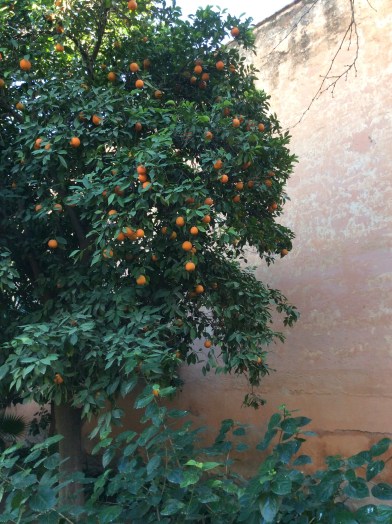
Writing poetry can be a kind of prayer. My father wrote stories and poetry, but my mother taught me to pay attention to the world around me. She constantly noticed the natural world, flowers on the bank or scent of orange blossoms from the orchard, bees at the birdbath, a fox that came through the front yard, or hawks that circled above the hill behind us. The wind as it blew through the pines where she grew up in the Black Hills of South Dakota, was an ancient choir, she said. As she described the experience to me, I could hear the wind as if it were real. She recalled wild gooseberries’ tart flavor, and told me the names and shapes of wildflowers that grew on the land of her childhood home. Her descriptions lived in my mind as if they were real. Even though where I grew up in eastern San Diego county’s dry desert–very different from the Black Hills, I felt preciousness my mother’s memories of her childhood’s natural environment. Her respect for those experiences nurtured in me a love of my own childhood’s natural environment.

I played outside every day as a child, climbed around on granite boulders, or sat inside the branches of an avocado, umbrella or pepper tree. Our front door often stood open to the outside air. I ran through the yard barefoot, watched clouds parade by, and sunsets spill across the horizon. Coyotes’ yips echoed through the valley in the evening. Crickets sang. Stars came out. These were all gifts, and I belonged to that earth. The experience of growing up in such a place with the opportunity to experience the natural world as part of the rhythms of every day life created in me a foundation for wanting to remain connected to the earth. To have our feet on the earth, to literally ground our selves there, is life engendering. If deprived of such experiences, I think our bodies and spirits still long for them without possibly even knowing it.
image

Poetry relies on imagery and figures of speech. It integrates the physical world with the world of language. It tells abstract ideas by recreating the physical world. It reconnects the writer and the reader back to place, and this is a central reason why I find it so powerful. In our world, the culture of the workplace pushes us to compete, to gain power and control. When writing poetry, however, I interactively participate in reconnecting to the physical world and the presence residing beneath and inside the movement of life. I trace my origin of wanting to write back to these childhood experiences of connection to the earth’s vibrant, sustaining presence. Willa Cather writes in My Antonia, “I was something that lay under the sun and felt it, like the pumpkins, and I did not want to be anything more. I was entirely happy. Perhaps we feel like that when we die and become a part of something entire, whether it is sun and air, or goodness and knowledge. At any rate, that is happiness; to be dissolved into something complete and great. When it comes to one, it comes as naturally as sleep.” To be able to wander in time, to play in a landscape or place is to be transformed and enlarged by it. Writing poetry focuses the writer on presence, and in doing so, helps move the writer toward wholeness. I recommend it.

image

pilgrimage, place, poetry, spirtuality, Uncategorized

To Bodhgaya and Beyond

The great story weaves closer and closer, millions of
touches, wide spaces lying out in the open,
huddles of brush and grass, all the little lives.

–William Stafford, from “Over in Montana”

IMG_9362
Buddha on the side of the temple at Bodhgaya

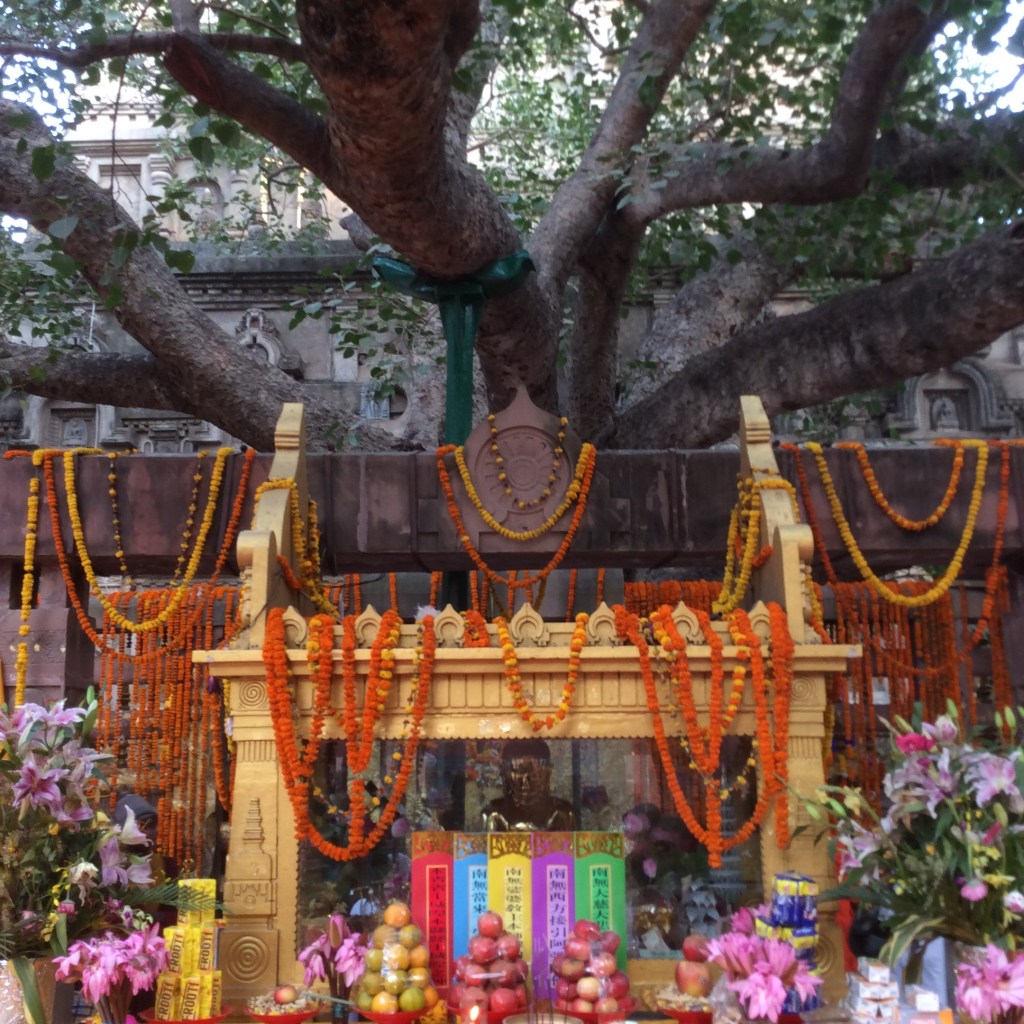
Bodhgaya, India, is the place where the Buddha attained enlightenment after forty-nine days of meditation under the ficus, otherwise known as the Bodhi tree, a tree related to the mulberry. Because Bodhgaya is a place of historical significance,  I wanted to visit it while living in India. Two weekends ago, I had that opportunity.

The Bodhi tree is a ficus religiosa . Its leaves, even without a breeze, are said to be continuously moving. “O Ashvatha, I honor you whose leaves are always moving…,” says a verse in the Bhagavad Gita about the tree. Gods are thought to live in the leaves causing them to move, and thus the official name, ficus religiosa–the religious fig. The name fits, in particular for the bodhi tree in Gaya. Though the tree standing in Bodhgaya now isn’t the actual tree the Buddha sat under, it’s a relative. Sanghamitta, the daughter of the 3rd century BC Indian emperor, Ashoka’s, brought a branch of the original tree the Buddha sat under to Sri Lanka and planted it in Anuradhapura. The original tree was destroyed, how is uncertain. There are various versions (see more here) of how this occurred, though most accounts state that the a shoot from the Sri Lanka tree was brought back to India and replanted at the original spot.

IMG_9405
Bodhi tree, Gaya, India, where the Buddha attained enlightenment

Bodhgaya is a holy site and a pilgrimage destination. One of the things that struck me the most while in Bodhgaya, was how many distinctive faces I saw as I sat near the tree, observing as people made their circumambulation around the shrine. Many visiting were monks and nuns performing ritual prayers, but others were like me, there to stand in a place considered holy, and to absorb what it had to share. For all the crowds, the place still manages to have a sense of calm, probably because so many there are intent on doing their prostrations and sending up prayers.

IMG_9367

It struck me how similar people are in the way they express devotion or carry out holy acts, though they are from different religions. Burning candles and incense, offering prayers, bowing down, ringing bells, bringing flowers,–these are commonly used in acts of worship in many religions. Bodhgaya attracts a wide spectrum of people from Buddhist countries, but people from many walks of life and countries in various parts of the world had come to stand in the spot where so many before have journeyed to send up their hearts’ longings–or possibly to set them down. Possibly, however, some pilgrims had come simply with an openness, willing to receive whatever understanding their minds brought to them while standing there, listening to their heart’s inner whisperings.

I’ve been learning about Buddhism, since arriving in India nine years ago, and somehow I expected to feel moved while standing in such a holy place. Instead, I found myself noticing people’s feet, and thought of the many journeys people had taken to arrive at this place where our lives briefly intersected with a smile or a short glimpse.

Once surrounded by forest, Bodhgaya it is now a city with apartments, shops, restaurants and hotels. To imagine the place as it was when the Buddha spent time there requires you to stretch your imagination. People continue to come to this place, because they wish to make a connection with the long chain of seekers, hoping to gain insight into how to live.

Pilgrimages are taken for many reasons, but one important reason is to the desire to expand beyond the boundaries one currently lives in– to break through the skin into something new, perhaps as the snake does when it sheds its old skin because it has grown bigger. Thoreau, purposefully set out to let his soul grow bigger when he spent a year living outside of Cambridge, Massachusetts on Walden Pond and wrote his famous meditations on living known as Walden. Thoreau speaks to the those of us who have felt the desire to step out of the hamster cage of events that keep us continuously rolling, and who long to live meaningfully. “Every man is tasked to make his life, even in its details, worthy of the contemplation of his most elevated and critical hour,” Thoreau asserts, and we are led to explore the idea that every life is worthy contemplation, of spending time reflecting on what our actions mean. This act isn’t meant to benefit just a few lucky ones who can take the time off to do so. We can do this daily as when we give our full attention to whatever it is we are doing, wherever we are walking or sitting. Listening deeply to those we are in relationship, listening to the world we walk through allows us to sense the holiness of life itself underneath the surface of all that is.

While wandering through the temple grounds at Bodhgaya, I read a quote on a plaque. The quote’s first portion eludes me, but the second portion read something like “Now I enter the forest of my old age,” and it struck me as a metaphor for transformation in general. We may have been walking through a plain before where things could be easily seen, but when we change, we enter a forest. Things aren’t necessarily easily found or understood. Perhaps we are even purposefully looking for a different path from the paths we once knew or walked. A whole new life can appear. As we age, though, I think of forests in the fall, flames arising from the myriad leaf faces, the sugar inside burning before the leaves let go to the earth.

Thoreau chose to go to the woods, and set aside a year to live in a small cabin on Walden Pond. Many of us can’t do that, or at least don’t feel it’s possible until reaching such an age where regular work ceases. Thoreau bravely took time out to consider to look for life before old age.  Thoreau chose to live simply during his year away, in order to find what it is that matters in life. He went to the woods, he said “because I wished to live deliberately, to front only the essential facts of life, and see if I could not learn what it had to teach, and not, when I came to die, discover that I had not lived. I did not wish to live what was not life, living is so dear; nor did I wish to practice resignation, unless it was quite necessary. I wanted to live deep and suck out all the marrow of life, to live so sturdily and Spartan- like as to put to rout all that was not life, to cut a broad swath and shave close, to drive life into a corner, and reduce it to its lowest terms, and, if it proved to be mean, why then to get the whole and genuine meanness of it, and publish its meanness to the world; or if it were sublime, to know it by experience, and be able to give a true account of it in my next excursion.” This is a brave statement. It requires an openness to life, to what you might understand if you listen to the world around you, including listen to the physical world.

The Buddha, as well, encouraged people to let go of their attachments in order to find life. We may be born in one place, have a particular history or speak a certain language, but we need each other’s differences. The interconnected nature of our physical environment itself demonstrates this reality. Other people in other places with perspectives different from our own have experiences worth listening to, insights worth understanding. I notice fear is such a strong motivating force in the media but it creates so much suffering. The Buddha’s path began with a question, “How do I relieve suffering?” What if we were to live differently? What if everyday in recognition of life’s dearness we deliberately asked “How do I live so I learn what life has to teach me today? How do I live today so that I don’t discover when I come to die that I’ve never lived?”

James Wright, in his poem “The Blessing,” shows the reader what it is like to live attentive to the details before us as he describes his encounter with ponies off the side of highway in Rochester, Minnesota who “have come gladly out of the willows/ To welcome my friend and me.” The ponies greet he and his friend with “shy bows,” then begin munching the grass again, as they have been all day. As the speaker of the poem carefully observes them, he becomes aware of the wonder breathing beneath the experience, “…Suddenly I realize/ That if I stepped out of my body I would break/ Into blossom.” We become more than we are when we let ourselves experience that we are connected to all that is.

May we all break into blossom.

IMG_9318


poetry, spirtuality

Awaiting a Renaissance of Wonder, Varanasi’s Portal

FullSizeRender (24)
Ganges River, Varanasi

I AM WAITING 

I am waiting for my case to come up
and I am waiting
for a rebirth of wonder
and I am waiting for someone
to really discover America
and wail
and I am waiting
for the discovery
of a new symbolic western frontier
and I am waiting
for the American Eagle
to really spread its wings
and straighten up and fly right
and I am waiting
for the Age of Anxiety
to drop dead
and I am waiting
for the war to be fought
which will make the world safe
for anarchy
and I am waiting
for the final withering away
of all governments
and I am perpetually awaiting

a rebirth of wonder

(See the full poem here)

Days before leaving for the Hindu holy city of Varanasi, I read Ferlinghetti’s poem from his book, Coney Island of the Mind. The poem ends, “and I am awaiting/ perpetually and forever/a renaissance of wonder.”  Ferlinghetti repeats a variation of these words at the end of each stanza, and since reading them, I can’t get the poem out of my mind, especially since visiting Varanasi where you don’t have to turn a corner to be surprised by wonder. Wonder walks down every street, floats down the river, and fills the sky with light and smoke. The Celts believed there are certain places on earth where the veil between heaven on earth is so thin that you can see through to the other side. Varanasi is such a place.

A city inhabited for 5,000 years, Varanasi is a stoop-backed, broken down, broken open ancient place where life, death, joy and suffering live openly side by side. Its narrow, (approximately) four foot wide streets spill over with foot traffic, broken brick, refuse, water, cows, cow pies, motorcycles, bicycles, and pilgrims, all hoping to move. Waiting in long lines winding through the humid streets in 40 Celsius (104 Fahrenheit) degree heat holding offerings of flowers, rice and red tika powder, pilgrims wait for hours to enter temples. Though it might not fit my ideal of how I want heaven’s portal to look or be, Varanasi embodies how things likely come to be at the end of one’s life: poor–left with nothing in the end but our failing bodies, bent down in humility, and waiting to be released into the elsewhere. Varansi is one of India’s most holy cities. Though there is suffering most everywhere you look in India, suffering, for Hindus, meets its end on the banks of the Ganges. To die in Varanasi and have your ashes cast into the river is to enter moksha–to never have to be reborn again into the cycle of birth and death. Death after death, millenia after millenia, this 2,525 km/ 1,569 mile river absorbs the ashes of a multitude of suffering and more.

For the Hindus, the Ganaga (Ganges) is sacred–a goddess. According to the World Wildlife Federation, “Approximately 1 in 12 people in the world (8%) live in its catchment area…Together the Brahmaputra and Ganges water sheds span 10 biomes and contain the widest diversity of all large river systems.”The river supports somewhere around 500 million people. Nevertheless, “Every day, over 3 billion litres of pollution, mostly toxic chemicals and untreated sewage, enters the Ganga, putting countless lives at stake,” Reports the Global Alliance for the Rights of Nature. Watch this 20 minute National Geographic Live, Chasing Rivers, Part 2, The Ganges, and you will see a fascinating and  fantastic insightful, and powerfully engaging look into the Ganges, its social and religious significance, as well as the environmental issues surrounding it.

The word sacred means to be set apart, while the English word, holy, or whole, uninjured “that must be preserved whole or intact, that cannot be transgressed or violated,” according to the Online Etymology Dictionary. Alongside this river of life flowing down from the high Himalaya and our desire to be released from suffering, flows the river of our industrialized and overpopulated world with its humming electric wires and ever charging lithium batteries in our iPads and cellphones. Sewage, chemicals from leather production–all go into the river, the goddess who can take it all, because she is, after all, a goddess, is the thought of some.

At some point while growing up, I remember hearing that in days gone by people didn’t place anything on top of their Bibles because they were thought to be sacred. Similar to this notion of treating the sacred differently, when visiting an ancient temple on the island of Samos in Greece, I recall being asked to remove my shoes because the area was still considered sacred, even though people no longer worshiped the gods that were once housed in that temple. What makes something sacred involves an awareness, a setting apart and a setting aside. We do this with portions of the earth that we decide are special in some way. The Monterrey Bay in California is one of these areas. After decades of abuse resulting from pollutants and over fishing was made into a marine sanctuary, the Monterrey Bay is now a place where sea life thrives, and where “Every summer, a vast array of animals travel thousands of miles to reach the waters of the Monterey Bay — home to one of the biggest wildlife gatherings on Earth,” according to the Mercury News article, ‘”Big Blue Live’: Monterrey Bay to star in its own ‘Reality Show.'” (You can see more about this documentary here.) In the Monterrey Bay, you can find “humpback whales, blue whales, sea lions, dolphins, elephant seals, sea otters, great white sharks, shearwaters, and brown pelicans,” says the PBS, who, together with BBC, is creating the Big Blue Live documentary on this wildlife gathering. The sacredness of something requires our recognizing its sacredness and treating it as such. This is what has happened in the Monterrey Bay, and it has made a difference. Treating something as sacred can include holy practices in offerings of flowers and light, but as understanding of our interaction with the world grows, it can also include doing other things such as protecting the life in a bay or river and that demonstrate our respect.

According to the The World Bank’s site on “The National Ganga River Basin Project,” domestic sewage accounts for 70-80 percent of the wastewater that flows into the Ganga, Industrial effluents add another 15 percent, with far-reaching impacts on human and aquatic health due to their toxic nature. And, in the absence of adequate solid waste management in most cities, mounds of uncollected garbage add to the pervasive pollution.” Along with prayers, ritual bathing and offerings, waste water management, controlling industrial pollution, and making and enforcing guidelines regarding development along the banks, are all things people can do to show their recognition of the river as sacred. To keep it whole and healthy, the Ganges, like the Monterrey Bay can be treated like a sanctuary.

“The world is charged with the grandeur of God,” wrote Hopkins, in his poem, “God’s Grandeur.

Generations have trod, have trod, have trod;
    And all is seared with trade; bleared, smeared with toil;
    And wears man’s smudge and shares man’s smell: the soil
Is bare now, nor can foot feel, being shod.

And for all this, nature is never spent;

Nowadays, National Geographic discusses the dead zones in our oceans. If you look at the facts regarding places like the Ganges, and other rivers around the world, you will notice everywhere the blight we’ve left upon God’s grandeur. When we no longer recognize a reality larger than ourselves, God’s grandeur gets harder and harder to see. We aren’t choosing to notice it. As a result, we lose an understanding of what is sacred. In this context, Nietzche’s idea that man’s self-centeredness had killed God makes sense. If you look at the worst polluted places in the world the pollution is created because of human action. In Varanasi, the amount of wood needed to cremate bodies in Varanasi causes deforestation, according to Living On Earth’s article “Ritual and Deforestation in India.” To burn a body takes about a 1,00o pounds of wood. It’s also true that soap used for washing in the Ganga’s water causes pollution. The bigger polluters, however, are industries. If industries do not recognize the sacred that is because those who own and control them are looking to see profits instead of God’s grandeur. Religion could provide a motivation, but regulations are needed.

In his poem, “Poet as Fisherman,” Ferlinghetti writes about the fisherman out on the sea, looking out and “listening for the sound of the universe,”

Whole poems whole dictionaries
rolled up in a thunderclap
And every sunset an action painting
and every cloud a book of shadows
through which wildly fly
the vowels of birds about to cry

The earth speaks to us when we are listening. When nearing death, Hindus want to go down to the water–the earthly element of transformation. Something in us intuitively understands our connection to the earth helps us understand the sacred. Entering the water, the body lets go and opens itself to the ultimate transformation–death. Birth in death, death in birth. This is always the way in India–opposites are bound together–so perhaps out of the death of rivers, an awareness can be born: the need everywhere for people to find the sacred again. We find that awareness, at least in part, through choosing to set aside our self-centeredness, and to recognize the intrinsic value of nature and our connection to it.

Through the centuries, poets have drawn nature as a central source of inspiration and metaphor. Poetry explores where the sacred touches the earth, touches the heart. Our current inability to recognize the sacredness of the earth seems connected in my mind to why poetry is so little read or valued today. Buddhist affirm the interdependence of all things, Hindus, that there is a bit of God in all things. The Psalms state, “The heavens declare the glory of God, and the firmament shows his handiwork.” When you love someone, you show him or her respect. You take care of the person. You listen, you look for a way to touch the person, to connect. We barely look at the night sky these days, however, or notice the moon, what the trees have to say in the afternoon, or notice the way “the sun streaming down/ in the meshes of morning,” as Ferlinghetti describes dawn in his poem, “Uses of Poetry.” Poetry, like dance or art, can help us connect again, help us find the sacred.

My last morning in Varanasi, I rose before dawn to travel down river to watch a ceremony honoring the sun. Men dressed in magenta silk stood on risers facing east. Lifting brass cobras with flames leaping from their bellies, the men swung them in slow, repeated circles while at the side of the audience women sang hypnotic mantras with humming vowel sounds, interrupted in intervals by the men on the risers ringing handbells for minutes at a time. Gradually, the night’s dark turned to dusky apricot, then blazing gold. The sun emerged above the horizon, and struck its rays across the water. There, amidst the funeral pyres and bathers, the worshipers raised their arms to hail surya, the sun, the life giver. I thought of the intensity of the previous day’s heat, the struggle and effort so many took to come to this city, the effort it takes so many in India just to live. As I watched a man slowly row his boat across the illuminated gold water, I breathed in the smoke of death from the funeral pyres, the loss, the heat, and breathed it out again with a new awareness and respect for the sun, for the earth. The ceremony had made the space between this world and the next a little thinner. In spite of the earth’s worn and weary state, in this city, its beauty is still visible.

If we want to rediscover the sacred, perhaps something in us, in our way of living must die in order for us to receive it. For a little while, I am here on this planet. With my words, with my whole self, I am trying to learn how to listen to the world, and as Ferlinghetti states, “I am perpetually awaiting/ a rebirth of wonder.”

Street side well
Streetside well, Varanisi
place, poetry, spirtuality

Going Wild–Walking Out Into Nature

“Odd as I am sure it will appear to some, I can think of no better form of personal involvement in the cure of the environment than that of gardening. A person who is growing a garden, if he is growing it organically, is improving a piece of the world. He is producing something to eat, which makes him somewhat independent of the grocery business, but he is also enlarging, for himself, the meaning of food and the pleasure of eating.”– Wendell Berry

In a few weeks I will be back home in California and able, once again, to walk out my door onto the earth and stand in the garden. I will pick berries and pull weeds, prune and plant. Growing a garden connects us directly to the earth. To garden is to learn something of what the earth needs and to care for it–to have a relationship with the earth and to love it. I miss that garden, that particular piece of earth. If earth is our mother, then I am its child, and sometimes I just want to go home–home to that particular landscape that looks and smells like home, where I have dug and weeded and planted, have walked many times–where I’ve given the trees names. When I go home, I will look out my window to see trees and mountains. I will be surrounded by nature. What a gift that is to the soul; what a pleasure to walk through greenery in forests and wild places.

But all this is still a few weeks away. For now, I am still in India. Last week was labor day holiday, and I took a short trip with friends to Musoorie, a city in the Himalaya foothills, a hill station resting at 6,500 feet, and place with roots from the time of the British Raj that is today popular with honeymooners. A walk along Camelback Road, brought views of iris growing wild on the forest covered hills, steep valleys, and the snowcapped Himalaya in the distance. We arrived during a rain storm, and the following morning, the sky was as blue as I’ve seen skies get in India. Tree leaves literally glowed in the light. This is the India I love to be in, the mountains, where the urban coat can be cast off, and the world’s natural form emerges. I felt myself alive again, filled with a sense of wholeness, looking out at the world in wonder.

Often after being out in nature, I feel more whole, as if I have returned to myself, as if in some odd way I’m being healed even though I may not have been particularly aware that I was “ill.”  Since returning to Delhi, I’ve come across an Atlantic Monthly article explaining new research showing how, as the article’s title says, “Nature Resets Our Minds and Bodies.” People who can view nature from their windows after operations generally recover more quickly, for example. “The business of everyday life — dodging traffic, making decisions and judgment calls, interacting with strangers — is depleting, and what man-made environments take away from us, nature gives back,” reports Adam Alter. The theory for how nature does this is called Attention Restoration Therapy, Alter explains. Human made environments ramp up our attention. Nature, on the other hand, asks little of us, and therefore calms our attention. The Japanese, the article goes on to say, have long advocated what they term forest bathing– long walks amongst trees, breathing in the wooded air, and the research on the effects of this activity “compared with people who walked through urban areas, shinrin-yoku patients had lower blood pressure, lower pulse rates, and lower cortisol levels, a marker of reduced stress.” That’s pretty nice! You don’t have to go to Japan to experience forest bathing, however. People in California, are promoting this idea as well, and you can head out into any forest. The idea, according to Brian Wu of the LA Times, is to go slowly, not walking more than three miles in four hours, take rests as you like, drink water or green tea, read.

Going to the mountains, or going to the garden. As it turns out, gardening, too, is good for the soul. Sue, Stuart-Smith, in her Telegraph article, “Horticultural therapy: ‘Gardening makes us feel renewed inside,” suggest that when we plant seeds we interact with the earth in a way that binds us to the mystery of how a seed produces life and our minds connect that with the mystery of our own lives. When gardening, one learns the importance of cutting away and pruning, of digging and weeding–all metaphors for what we must do in our own lives if we are to nurture what it is we have as seeds within us that want to grows.

American culture seems filled with the notion of getting somewhere, setting goals, becoming somebody. We get caught in the stimulus, the distraction of competition. After a while, however, this all grows tiring or we can lose track of who are, what we care most about. We lose our zest for life and get caught up in trying to make our mark or make a living, when we’re not actually living very much. Instead, we are walking through one procedure to the next, only partly alive. Feeling this sadness, this loss, however can be a very good thing as it can lead us back to ourselves. Wendell Berry writes,

It may be that when we no longer know what to do,

we have come to our real work
and when we no longer know which way to go,
we have begun our real journey.

The mind that is not baffled is not employed.
The impeded stream is the one that sings.

As Berry implies, obstacles and questions we don’t have answers for can help us find what makes us sing. When we open ourselves to the Mystery, or to mysteries bigger than our own life, we can experience how everything that is worth something in life isn’t necessarily connected to our effort or accomplishment. Our life stream wants to move from behind the dam that blocks it. It wants to flow, and confronting the question of why it isn’t can help us find they way to let our lives sing again.

The Karmapa, Ogyen Trinley Dorje, in his book The Heart is Noble, writes, “The particular profession or job you do is not the most important factor…Whatever work you do, you have to give yourself opportunities to just be. Even if it is only once a day, you should find a moment to just be  yourself in the course of each day. This could be through a short period of meditation or quiet reflection in the morning or the evening, or in whatever way best suits you. The point is to reconnect with yourself. Otherwise, the whole day you are running around and busy, and it is easy to lose yourself. To guard agains this, you should make efforts to return to yourself and recollect what is essential for you.”

Whether it be forest bathing, gardening, or painting on pottery–as I have done this afternoon–whatever it is, let us find those things that return us to ourselves, that allow our hearts to sing so that when we come to the end of our day or days, we will find that we have lived, we have truly lived.

gardening, poetry

Coming Back to the Garden

Gratitude Gardens
Gratitude Gardens

I sit looking out over my yard while I write, the sun neither too warm nor too weak– a perfect gentleness for a summer afternoon. I see the stone steps under the grape arbor, and the thyme that fits between the cracks, and think of how those cracks are like the summer holiday, the space in my life that I am hungry for. The quiet. I sit here satisfied simply to absorb the green and the random dove or falcon call. At unexpected moments the scent of redwood or pine wafts through. Restaurants and movies can be good. Shopping for supplies is necessary. But many of us also need to walk in the woods, go down to the river or ocean, sit by flowers or a slab of granite, or get our hands in the dirt to find ourselves again. I am one of those. This morning I decided to read Rilke again, and pulled from my shelf the volume of Selected Poems From Rainer Maria Rilke with translation from Robert Bly. In his A Book for the Hours of Prayer, Rilke writes,

1.
I live my life in growing orbits
which move out over the things of the world.
Perhaps I can never achieve the last,
but that will be my attempt.
I am circling around God, around the ancient tower,
and I have been circling for a thousand years,
and I still don’t know if I am a falcon, or a storm,
or a great song.

As a traveler, I’ve circled around the globe exploring and discovering, but there is another kind of travel, that of the inner pilgrim, traveling within trying to understand what it means to live and how to live meaningfully so that we can learn who we are and why we are here on earth–what it means when we meet and greet each other, what it means to be in relationship to others, to the earth, to this place in time. Like Rilke, I don’t know if I will ever achieve this, but this is my attempt.

Herb Bed at Gratitude Gardens

Here on my land while watering the garden, pulling weeds, or planting, I realize how deeply satisfied I am, how little it takes to make me feel content. I feel settled inside, whole. All the years of travel and exploration, these have been good. But the continuous striving that the workplace emphasizes seems irrelevant here in a garden that holds to an organic pace of being. Things grow according to the pace they were meant to grow at. The gardener nurtures them along by making sure there is adequate soil and light, plants the plants with others they are compatible with, tomatoes with basil for example, or strawberries with borage–but the true becoming is there in the mystery of biology and the seed. All the years of working and the practice of my work, reading, writing, and then I come home to the garden and sense I have found my true self, or it is at least a place I want to find myself in.

A metaphor for life, the garden has much it can help us understand about ourselves: that there are seasons and cycles for everything, the value of weeding to protect the life you are nurturing, that plants have personalities so to speak–some need more sun, others shade, which plants help them grow better, make them taste sweeter, and which protect. Gardens take work. If you want something to grow, you have to put in the effort by digging, planting, tending, and harvesting. Gardening can be a contemplative act. When you get your hands in the soil, you start to understand the connections to your own life. These are the connections I want to explore and know through our experiment in living here at Gratitude Gardens, a garden we are slowly building over the years here on our land.

At Gratitude Gardens we will raise our food and use the garden as a place to connect to the creative process in a variety of forms, for writing and art. We have planted herbs, flowers, grapes and fruit trees, and this summer are expanding the raised beds to make way for future food. Most anything we practice intentionally with our hearts can be a spiritual path that will teach us more of how to live if we are willing to view it in that way. For me, building a garden is an important part of that practice, and I want to believe there are others like me who feel hungry for the quiet, want to connect or reconnect to the earth and learn how to listen to what it has to tell us about life.

Gratitude Garden in its Beginning Stage

Adam and Eve left the garden. Everyone leaves. It’s the path of learning, knowing, of growing up. But we can come back too. We can make a garden. Yes, it’s made by the sweat of the brow, but that is an important part of learning what the gift of a garden is, and learning how to find yourself in one.

Maybe you, too, “have been circling for a thousand years,” or feel you have, and like Rilke, “still don’t know you “are a falcon, or a storm, or a great song.” Why not go on inner pilgrimage? Discover and claim your path so you can find through that work how it is you can come back to the garden.

place, poetry, writing

Of Time, Demons, and Living in a World Called Yes

Back from a recent trip to visit family half way across the world, my  feels foggy headed from jet lag, as if it has been stuffed with cotton. There were many things I hoped to do today, but my mind was half asleep, or wanted to be. It’s difficult to travel between worlds. During my recent trip, I traveled between many worlds as we visited different friend and family member’s homes, slipping into their lives, conversations and way of living for a few days or hours. Indeed, there are many worlds inside of this world.

Currently, I’m reading William Dalrymple’s From the Holy Mountain, where he travels through the Middle East, exploring and explaining the remnants of Byzantium. In one section, Dalrymple explains how Gregory the Great was known to recommend making the sign of the cross over lettuce leaves so you wouldn’t swallow a demon who happened to be perching there. (p. 55) In that comment, it struck me how different that world, with its belief in demons, is from my own. Dalrymple mentions how across the Mediterranean today, the role of the priest as a “prize-fighter against Devil minions” is still important. My husband’s father, whose parents came from Calabria in southern Italy had a belief in these minions. Once, for example, one of his grandsons fell from a table, and he explained there was a demon who made him do it. Salt should be scattered at the door to keep them way. A ceramic pot my husband made had a lid that  looked like a fox head, and my father-in-law turned it upside down because he thought it was a demon. This unseen world, was definitely alive for him.

This way of thinking is different than my own, and of a mind from a different world. The demon of my world is the lack of time to do the many things I want to do during any particular day. It’s a demon of my own mind, a demon that wants, nevertheless, to control my mind and make me think that life is a river of things that need to be accomplished, rather than an experience to be savored. While visiting friends in the LA area recently, we were walking around Puddingstone Lake, and I became aware that I was not at all thinking about the list of things that needed to be done, I was simply walking in the late afternoon light, enjoying the way it turned the trees half golden. I was looking at the lake, breathing, and feeling completely whole without having to do anything. I felt the way I did as a child when walking through the dry yellow grass on the hills behind my house, climbing on boulders to lie back and stare at the clouds and feel my body absorb the heat from the stone beneath me–where time was a lake to go swimming in, not a clock with seconds that ticked by, click, click, counting out every moment. It was a world of being rather than doing, and that world is difficult to get back to. The path gets grown over by the grass and shrubbery of obligations, but it is a world I want to visit more often.

As an expatriate, I’m used to moving back and forth between worlds, to belonging to several worlds, and feeling they are home. Actually, many places are simultaneously home and not home. I’m reminded of the words to the song, “This world is not my home, I’m just passing through. My treasures are laid up somewhere beyond the blue…” Home is a state of mind, as well as a place. I feel at home in myself, and therefore feel at home in many places. What I want is to visit more, though, the world where time flows, and to do that, I need to purposefully walk down the path, open the gate and enter that place. The gate could look like quietness, or a walk out of doors, like a book I want to read, like singing and music, or like the face of friends and voices of loved ones. “Love is a place,” as E. E. Cummings says, and if we want to experience the awareness of love we must put aside the press of obligations.

love is a place
& through this place of
love move
(with brightness of peace)
all places

yes is a world
& in this world of
yes live
(skilfully curled)
all worlds

——-

We see often, what we allow ourselves to see, what we set our gaze on. We grow toward and become what we spend time with. All day long I’ve heard the whine of train whistles in the distance, a reminder of the relentless motion of time moving down a fixed track in a busy city. If I want to live in a world where being is important, however, I must get off the train and go to that other world.

What do most of us want most in this world but to know we are loved? Love is a place we create as well as a place that is found, a place we come home to. There are many things I don’t understand about how to live fully, but if I want to learn, I must enter the gate that leads me there. That means time out from the schedule, some time each day to remember who I am, where I come home to myself, where I allow myself to enter the world of love.

As a writer, I know that giving myself a rule or a regular practice of writing can strengthen my work. This is the time of Lent. I didn’t grow up practicing Lent, but I’ve been thinking about what that might mean for me. Traditionally, it is a time of prayer, giving alms to others, fasting and/or giving something up–a practice of some kind of self-denial. Giving up a bit of the idea that I have control over everything, and that if I just keep working harder I will accomplish everything I think I should might be a good thing. If I accomplish everything on the list. But if I do, then what? Does that make me feel more whole? Will I simply add on to the to-do list? How long can a person keep doing that?

Perhaps there is a wisdom in the ancient traditions and practices that I can’t know because they aren’t part of my life. Maybe you have to give up some things, like always having too many things to do, to find other things– like a deeper, more meaningful and satisfying life.

poetry, Uncategorized, writing

Bread & Poetry: Writing Out Hunger

No, I don’t want this day to end. How I have loved the time to write and wander in words today.

I’ve begun a new manuscript on the theme of hunger. Over the years, I’ve written quite a few poems about food, but since living in India, I can’t come to terms with how to live while there are so many people going hungry all around me. “India is still world’s hunger capital,” says The Deccan Herald today. “With nearly a fourth of its 1.1 billion population hungry, India indeed is the world’s hunger capital.” This is not acceptable.

I realize the overall GDP of most the world’s nations has significantly improved over the last 200 years. Nevertheless, people are going to bed hungry every night. They are knocking on my window whenever I ride out into Delhi’s streets, and they are sleeping and dying on the streets during winter’s cold.

How do we go on living year after year this way? How is it that I myself do nothing? I think of Jesus’s words in Matthew 25, “For I was hungry and you gave me nothing to eat, I was thirsty and you gave me nothing to drink, I was a stranger and you did not invite me in, I needed clothes and you did not clothe me, I was sick and in prison and you did not look after me.’

“They also will answer, ‘Lord, when did we see you hungry or thirsty or a stranger or needing clothes or sick or in prison, and did not help you?’

“He will reply, ‘Truly I tell you, whatever you did not do for one of the least of these, you did not do for me.’

Whether we see the poor on the streets or not, they are there. “India has the highest number of undernourished people in the world — 230 million — added to which 1.5 million children are at risk of becoming malnourished because of rising global food prices,” says Prasenjit Chowdhury in the article stated above. The physical need for food is present everywhere here in India. Along with others, I am one of those who is doing nothing. How do I answer for that? Fredrick Buechner says “Vocation is the place where our deep gladness meets the world’s deep need.” My vocation isn’t that of a social worker, and even if it were, the need is far more than one person can ever hope to meet. It is overwhelming.

Chowdhury gives some practical suggestions to reducing hunger, “The National Food Security Act of the UPA government is a step in the right direction as it envisages food-security-for-all. But the task of expanding our public distribution system must also take into account weeding out bogus cardholders and hoarders, while a stricter vigil has to be kept on both the quantity and quality of the available foodstock under PDS. Incorrect information, inaccurate measurement of household characteristics, corruption and inefficiency must be plugged.” While these measures are, of course, out of my control, it is clear to pretty much anyone that sharing food is an essential expression of love. If we love the country where we live, we must love the people in it. Loving the people in it means helping them to be able to care for their basic needs. If we are global citizens, we are working to help the world function in such a way to live together peacefully. That means enabling people to feed themselves. A spokesman from the World Food Program is quoted in the article as saying, “A hungry world is a dangerous world, without food, people have only three options: They riot, they emigrate or they die.” Over 30 countries with hungry people rioted last year.

Love comes through the hands: we love those who feed us. My deep gladness is writing poems. Other people’s hunger may not be improved by my writing poems, but I know I can’t be the only person wondering how to respond to such deep need around me, and maybe in writing poetry about food and hunger, like a modern miracle, I will discover at least some small way to meet the world’s deep need. Maybe poetry can somehow become bread. As Roque Dalton says in his poem, “Like You”. The original is in Spanish,

También mi sangre bulle
y río por los ojos que han conocido el brote de las lágrimas.

Creo que el mundo es bello,
que la poesía es como el pan, de todos.

And my blood boils up
and I laugh through eyes that have known the buds of tears.

I believe the world is beautiful
and that poetry, like bread, is for everyone.

place, poetry, spirtuality, Uncategorized

Growing Older

A friend of ours will soon turn 50. We’ve known each other for years, and he will be having a party to celebrate. When my father turned 50, he let us all know he was half a century old. That seemed old at the time, but Dad didn’t really seem that much different than what he was when he wasn’t yet that age. When are people actually “old”? That probably differs from person to person, and from era to era, but something changes in the way you feel in the world when people perceive you as old.

In a capitalist culture where what’s new on the market drives people’s perception of what is “cool” and worth noting, old things are generally considered passé–out. People change their Facebook profile pictures sometimes daily. The new computer or phone model comes out and people discard the old one. The average American, for example, replaces his or her cell phone every 22 months, according to Scientific American. Following along with this mindset, Mother Nature Network reports that “[t]he U.S. produced 11 million tons of e-waste in 2012.” It’s expected to grow 33% by 2017.  Maybe the capitalist consumer perspective affects the way we look at old people and causes them to be seen similarly to old products. They aren’t “cool” anymore, and are put on the back burner or are tossed out, even though they still might have much to offer–and though throwing them out, so to speak, creates toxicity in the way we relate to each other.

Researcher on aging and consumption patterns, Michelle Barnhart from Oregon State University says on the University’s News and Research Communications site “Our society devalues old age in many ways, and this is particularly true in the United States, where individualism, self-reliance, and independence are highly valued.” This may account for why our thinking about older people is mostly negative, she suggests.

The general public’s thinking about old people is erroneous. Why should it be true that if you’re old, you’re obsolete as well–that your ideas and ways of thinking, perhaps even your being, doesn’t quite count for as much? As democratic societies, we say we value human rights, but how do we demonstrate the value of what older people give to society? The Guardian describes a study by the Royal Volunteer Society in the UK in 2011, and notes that older people are in fact an asset, not a drain to society. “Taking together the tax payments, spending power, caring responsibilities and volunteering effort of people aged 65-plus, it calculates that they contribute almost £40bn more to the UK economy than they receive in state pensions, welfare and health services.” In an effort to make visible the positive and tangible impact of the caring and volunteering that elderly people do, the study goes on to say that the “calculations on the net contribution of older people have been made by economic analysts SQW. It estimates that older people benefit the economy to a total of £175.9bn, including delivering social care worth £34bn and volunteering worth at least £10bn, compared to welfare costs of £136.3bn.” This is a considerable influence in monetary terms, even more so in human terms. Instead of fading away into irrelevance upon old age, the elderly make significant contributions to society–contributions that are not necessarily recognized.

Additionally, contrary to the cranky, negative stereotype many have of older people, elderly people are actually more adept than younger people in social emotional skills according to Helen Fields, in her article “What’s So Good About Growing Old” on the Smithsonian magazine’s site. Fields explains that, “Subjects in their 60s were better than younger ones at imagining different points of view, thinking of multiple resolutions and suggesting compromises.” It takes decades to learn how to manage social skills, Fields asserts, and older people are on the whole actually happier than younger people. Psychologist Laura Carstensen, at Stanford “led a study that followed people ages 18 to 94 for a decade and found that they got happier and their emotions bounced around less.” There is a stereotype that persists regarding older people, says Cornell sociologist Karl Pillemer, “and that stereotype is typically incorrect.”

Forgetfulness is something often associated with old age–forgetting the name of an author you read some time back, or the name of the book, the name of a co-worker, or a place visited. Billy Collins’ poem “Forgetfulness” describes a number of these incidents, and how little by little, the numbers, figures and names depart,

“as if, one by one, the memories you used to harbor
decided to retire to the southern hemisphere of the brain,
to a little fishing village where there are no phones.”

I love the way Collins’s poem brings us to a new view of forgetfulness–

“No wonder you rise in the middle of the night
to look up the date of a famous battle in a book on war.
No wonder the moon in the window seems to have drifted
out of a love poem that you used to know by heart.”

In fact, some new research emerging might change the way we understand aging and the mind as well. NY Times blogger Benedict Carey, in a recent post, “The Older Mind is a Fuller Mind”, quotes the lead author of recent research about memory and aging, Michael Ramscar from the University of Tübingen in Germany, that puts into question how steep the age-related decline for cognitive processing is, as well as bringing into question some of the research measures cognitive scientists have used. According to this study, “the larger the library you have in your head, the longer it usually takes to find a particular word (or pair).” The amount of information in long-term memory might be affecting the retrieval of short-term memory. “It’s not that you’re slow. It’s that you know so much,” suggests Carey.

Quite a few years back when my husband and I first began living overseas, we used to often spend the evening with an older couple we worked with at a school in Turkey. They were probably 25 or more years older than us, but we loved being with them. They would share the unique foods they scoured the markets to find. We’d share stories, and laugh with them for hours. We traveled with them as well, driving up the Turkish coast to visit Troy, and then on up to Alexandropolis in northern Greece—the area where the Cyclops from Homer’s Odyssey is traditionally believed to have lived. This older couple inspired us in our journey of reaching out to understand and explore other cultures, to step inside history, and to connect to it anew. They had a deep love for the culture we were living in, had returned to live in it a second time, and helped us to love it in all its variety and uniqueness. The role this older couple played in our lives was an important one, influencing the direction we moved into with our lives, and I am very glad for that friendship and its lasting effect on who we have become.

Old age might, for some, be seen like a foreign country, with different reference points and ways of living, thinking, and being. When we encounter older people, do we really see them? Do we notice them and allow ourselves to know them, and to learn from their perspectives? Age and death will surely come some day. How are we living now that will enable us to be the person we want to be when our own end comes? This is a question Joan Chittister explores in her book The Gift of Years. The pain of the wrongs that occurred when we were young is the thing older people must come to terms with, she says in the YouTubes, part 1 and part 2 about the ideas she presented in her book. We must go down into the innermost part of ourselves and learn how to find peace, she explains. Old age is the time to look at ourselves in the light, and come eye to eye with the mirror of who we are. “If we’ve been dishonest,” Chittister asks, “can we face the truth of ourselves? Can we see ourselves as the small part of the universe that we truly are, rather than the center? Can we speak our truths without having to be right?” Chittister says life isn’t about age. “It’s about aging well and living in to the gifts offered in every stage of life.” We all must come to terms with growing old. More than that, we can use our life to learn how to live well between whatever age we are, and whatever age it is when we realize, that “yes,” we are old now. Is it because it is hard to look closely at our interior selves that our culture has difficulty appreciating old age or valuing those who are older? The end time of life, Chittister says, is the time to “put down the remnants of the past and to learn from the present moment, and find it enough. It is the time to live with life as it is, and find it, too, is enough, to live with ourselves as we are and find it enough.” This is challenging, but something that seems worth doing at any age. Noticing, listening to, and cultivating friendships with older people seems a wise thing to do to set us on that path.