At seventy-three years old, Aretha Franklin sings Carole King’s song, “Natural Woman” at Lincoln Center with perfect timing, range of voice, power and outright presence. If you ever wondered what you might have to offer the world in your aging years, listen to her sing, and you will know what is possible—a person who knows who she is, who is in full possession of herself, and who gives her gifts—her talents and skill to the world as a blessing. This is beauty.
Daniel O’ Leary, a priest in Leeds and former teacher at St. Mary’s University College in London writes, “I like to think that each one of us, when we act out of our true essence rather than out of our false ego, when we refuse to betray our authentic self, when we are in close touch with our own sacred centre, in spite of persistent temptation, persuasion and compulsion to conform and to compromise – that when we act in this way we transform every room we enter, every conversation in which we take part, every relationship we engage in and every project we initiate or join.” Aretha Franklin was most certainly singing from with in the center of her true essence when performing at Lincoln Center, her presence transforming not only those in the room, as evidenced by Carole King’s overwhelmed and enthusiastic reaction to the performance, and by Obama who wiped tears from his eyes, but transforming also those who watch Aretha via the Internet. How do we live like that–from the center of ourselves, moving beyond the desire to demonstrate our skill, ability, talent, or worth—beyond the need to compete and claim a space, beyond nervousness and fear about perceived success—and instead, move into the depths of our own selves, to rest in the acceptance of who we are, including our imperfections and incompleteness? How do we live with open arms, surrendering into life in order to walk into a larger world, so we can let go into our own transformation?
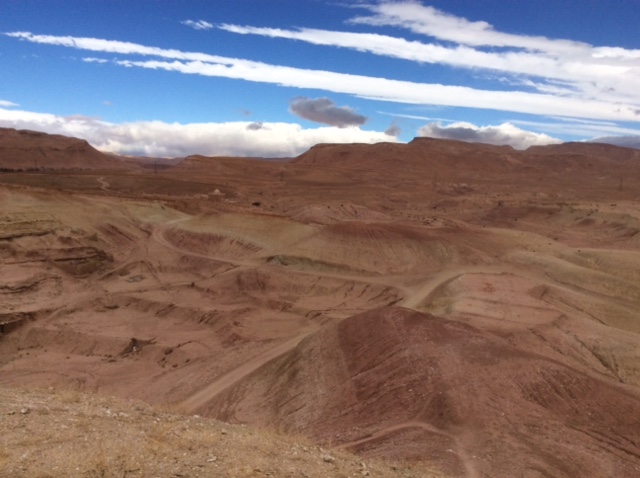
Recently, while traveling through Morocco’s enormous outback of the Atlas Mountains, I noticed how in the desert, the earth lays itself open for all to see. Nothing is hidden, the layers, folds, slumps, the red years of surface soil eroding away to the green rock beneath, solidity slowly wasting away–all is revealed. The Atlas Mountains, opens its chest to Allah, lays bare its red heart. Each ripple and rock stripe, distinctly visible and known. How vulnerable the earth is, face open to sun and wind. The sky kisses the earth. Goats, their shadows following them like dark drifting clouds, amble slowly across the red soil, grazing. Earth’s muscles loses hold. Rocks walls crumble—bones turning into gravel. Mountains slide into valleys in slow, smooth heaps. Complete with folds and flares, in her old age, the earth wears her skirt of splayed sand and rock, swirled out as in slow, ponderous steps–an ancient dance still in play. Continuously, the earth’s age reveals her beauty.
Erosion reveals the layers of earth’s substrata. As in our own lives, the surface wears away as time continues, revealing the bedrock of who we are, what we are built on—what our foundation consists of. When standing in Morocco’s 10 meters (thirty three foot) wide Todra Gorge, the color and stone rise 600 metres (1,969 ft) above in gold-red walls, surround you with their millennia of patiently layered rock, cut through by the Todgha River. The slow turning folds and twists that made the canyon’s strength, humble you, leave you without words. We take the wadi and the world in at a glance—the entire landscape gifted to us, a grace delivered as simply as the sky kissing the earth–a beauty, that like an abstract painting, strips away all to its bare forms and essence–joining us to the oneness lying beneath. To stand in the Todra Gorge is to connect to your foundation, to stand inside it. Experience it.
Todra Gorge
Todra Gorge
Todra Gorge
Todra Gorge cliff and sky
Later, a bit further down the road in the Dades Gorge, I woke the next morning to the view outside my window: the leaves of a tree trembling in the gold, early light of morning’s breeze. Everything around the trees delicate leaves was rock. Solid and still. The sun rose, turning the gorge’s walls to rust. Then, the tree, too, stood still as the stone surrounding it.
The next day, after traveling on to Ait Bin Haddou, I climbed the hill that overlooks the mud walled city. Walking along, Here you can find calcite formations strewn across the earth in palm-sized slabs, and can see the bubbling up in pillow-like form from beneath the soil’s shallow cover. The earth wears stripes here and spots of purple. Wind rushes across the earth, kicks up dust, and streaks the sky with long cloud flares. The sky is the very definition of blue—long vowels of ooooohhhh, moving with the wind’s rough breath, the scattered stones the earth’s consonants. The earth speaks.
Dust in the wind over river bed
Ait Bin Haddou sky
Calcite formations at Ait Bin Haddou
Embedded calcite
Red and purple earth
In mountains, in sky, in her erosion and old age the earth speaks. She has no pretensions. In full possession of herself, she gives her gifts to the world as blessing. She’s the natural woman. She knows who she is, and she is singing.
Looking out on the morning rain
I used to feel so uninspired
And when I knew I had to face another day
Lord it made me feel so tired
Before the day I met you, life was so unkind
But you’re the key to my peace of mind
‘Cause you make me feel
you make me feel
You make me feel like a natural woman.
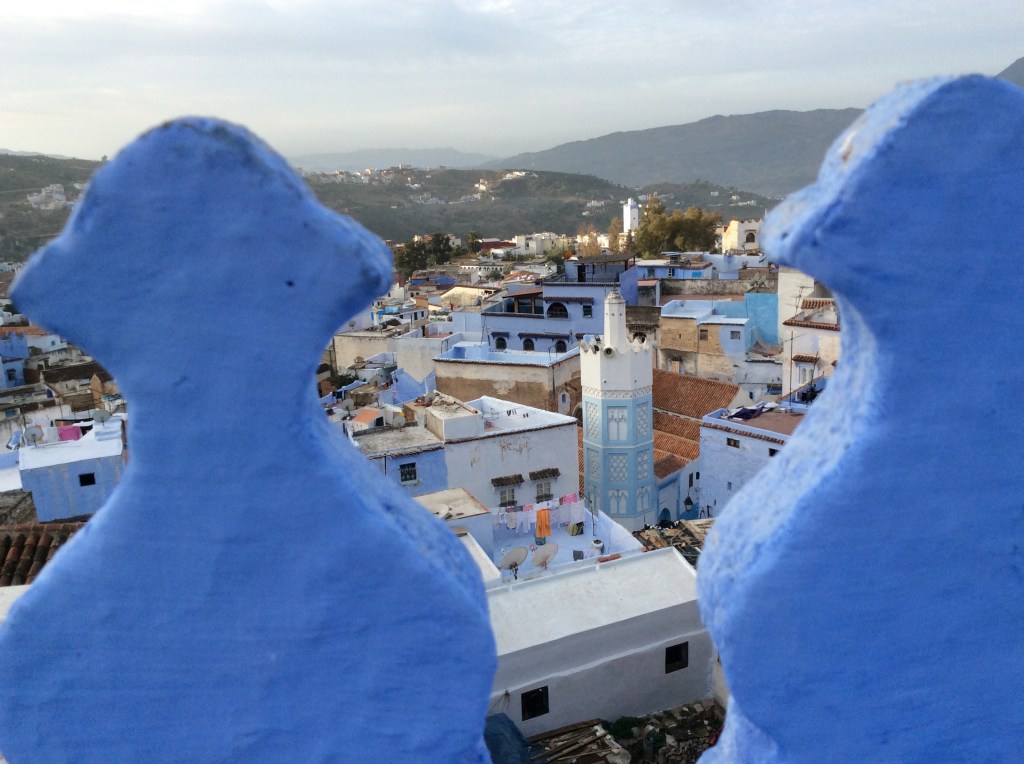
It’s a blue world in Chefchaouen, the small city of narrow, winding streets in the Riff mountains of northern Morocco. The blues here tell the story of the Jews who left Spain when in 1492 the monarchs, Isabel and Ferdinand, throwing off five hundred years of Muslim control, required Jews to leave or to convert to Christianity. Many Jews left behind their property at that time and migrated to Morocco, with many settling in Chefchaouen.
Though most of the Jews have left Chefchaouen now, immigrating to Israel and elsewhere after Morocco attained independence in 1956, the city is still blue. This is because the citizens have painted the walls various blue shades. Morocco can get very hot in the summer with temperatures reaching 40 degrees Celsius. The cool colors make the temperature feel cooler, and the blue color is thought by some to help keep mosquitos away. In Andalusia, in southern Spain, people painted their city walls, and the tradition was carried on when the Jews arrived in Morocco. Today, people come to visit Chefchaouen because its walls sing the blues in myriad tones. People come because Chefchaouen is beautiful.
What you want to do in Chefchaoen is wander the streets and discover its nooks where a fountain may flow out from a royal blue wall, or stand inside the blues that reflect off each other in narrow alleys, shining out from a street painted with moons and stars, blues that curl into quiet corners. The blues of Chefchaoen create a peaceful state. “Where are you from?” asks a man standing in the door where the community oven is located. We tell him, and he says, “Welcome to my country.” All over Morocco I’ve been asked this question, and always the reply is “Welcome to my country.”
It’s not just a saying. Morocco is a welcoming country. Just recently, Jews of New York City acknowledged Morocco’s extension of welcome and refuge to Jews during World War Two. Moroccan culture, like cultures in other Muslim countries I have visited, is generous spirited and open hearted. Always when visiting, and often when doing business, people offer you tea. I was taking a photo of my husband in a small street in Chefchaouen, and didn’t see a woman walking there, who stopped and waited while I took the photo. I was filled with delight at the beauty of the place. When I lifted my eye from the camera lens, I saw the woman and apologized. Her response was to smile. She reached out her hand, placed it on my heart, still smiling, and said a few words as she walked on, brushing gently by in her cream colored robe as she continued down the street. Though I hadn’t understood her words, I understood her intent, and felt I had been blessed.
Walking through the central plaza, I see a mother holding her baby close in her arms. Bent tenderly toward the child, over and over she speaks . An hour later, I stroll back through the same area, and she is still there, still cradling her small child in her arms. Wrapped snug in warm blankets and crooned to, this child is dearly loved, at peace. Islam means submission to God. The root of the word is the same as is used in the Arabic greeting, “Assalamualaikum,” meaning “Peace be with you.” Implied, is the idea that to submit to God is to submit to peace. There is lots of business in Chefchaouen, people selling their wares, vegetable markets, people hanging out their laundry. Old men in jellabiyas tap along the stony pavement with their canes, women hang out the laundry atop the roofs. Amidst the activity of daily life, prayer call drifts across the streets. The people of Chefchaoen, continue on in their beautiful town, practicing a way of peace.
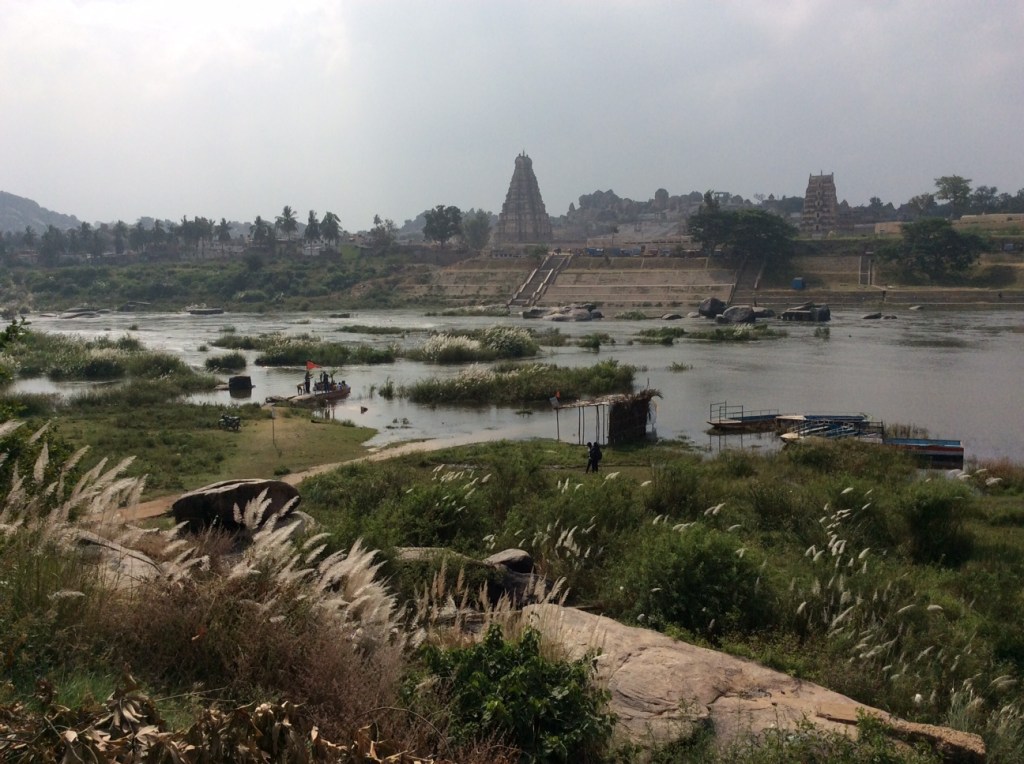
A plain dotted with trees and scattered with boulders, Hampi in the Indian state, Karnataka, is a beautiful landscape. My recent visit there during the Diwali holiday allowed me to wander into India’s rural outback, and to laze against sun heated granite by the Tungabhadra River. During the 1500s, the Vijayanagar had a population of 500,000. The empire covered the entire southern portion of India, but Deccan Plateau sultans joined together and defeated the Vijayanagar army. The temples’ treasures were carried off as loot, much of the population was killed, and of those who weren’t killed, many fled. One of the world’s mightiest kingdoms fell to ruin, and gradually into obscurity.
Four hundred years later, Robert Sewell, a British civil servant stationed in India, wrote about the empire in his book, A Forgotten Empire Vijayanagar: A Contribution to the History of India. Much later, in 1986, Hampi became a UNESCO World Heritage site.
In addition to being a World Heritage site, Hampi is also a place of important religious significance for Hindus. As the stories describe, Hampi is the hill where Shiva, the god of destruction, did penance before marrying Pampa. After Shiva married, the gods poured gold onto the Heamakuta hill. According to the Hampi India website, Heamakuta, means heap of gold.
Hampi’s temples and ruins are spread over more than 10 square miles, or 25 square kilometers. There is much to see, and the carvings are fantastic. Though a place of enormous significance for many people on the subcontinent in the 1400 and 1500s, Hampi and the Vijayanagar empire are mostly unknown to people outside of India. As I walked along near the queen’s palace, I ran my hand along one of the carved walls. “My hands are touching history,” I thought to myself. “My hands touch what the ancients have touched, yet I understand so little.” Whether at a ruins of an ancient empire, or walking down the street of our hometown, our lives are enveloped in mysteries. We just don’t often recognize it.
After our day of exploration at the ruins, we went on a walk on the grounds near our hotel. We stepped across bamboo bridges stretching over the river, looped up across massive granite faces. Turning a corner, we tucked ourselves through a wooden door between leaning rock slabs. As we stepped inside, it seemed we had entered into a rock cathedral with windows of sky beaming through the stacked boulders. We continued climbing a short distance to an opening where we stood, at last, to view the valley spread before us in a 360 degree view. It was as if we had entered a secret door that enabled us to see the whole world. What a wonder it was, too–a plain filled with trees, and a river meandering through it with granite boulders balancing in precarious positions and leaning agains each other in dramatic angles. Nature like this is not a site often seen when living in one of the world’s mega cites like Delhi. We scanned our eyes across the landscape, fishing for greenery, for sky, for what we didn’t even know how to name. Our hearts simply opened to the world, and when we left the hilltop, we knew something inside us had shifted. We were lighter, and ,paradoxically, somehow more solid. Nature writer Barry Lopez says, “real beauty is so deep you have to move into darkness to understand it.” This is because when beauty touches you, you slip into a place that is beyond rational thought and abstraction. The divisions between the physical and spiritual worlds collapse into one unified presence. That presence is far bigger than the mind can hold. You are humbled and made whole again.
The beauty of Hampi’s temples is definitely worth traveling a long distance to see. The setting of the ruins themselves, though, is what sets Hampi apart from other locations. In this landscape, you can learn that everywhere is a temple if we have eyes to see it. To be there is to walk around in a colossal expanse of found sculpture, an installation art piece of gargantuan proportions, the origins prehistorical. Everywhere I looked, I saw art emerging from the earth.
Hampi granite sheathes
Rice field, Hampi
Granite fissure
Granite sheathe 2
Granite sheathe 3
Rice field, Hampi
The earth is in an ongoing creative act. If you listen, you can hear it speak through its myriad forms. The wind in palm trees chatters with stiff, clattering branches. Wind through bamboo scratches and cracks like arthritic bones. Wind through neem trees speaks with a restless, dry and fragile sound like crinkled onion skins. The earth tells its stories.
In my continuing desire to learn Spanish, I’m reading Mary Pope Osborne’s Magic Treehouse book series in Spanish. Currently, I’m reading Una momia al amanecer, or in English, A Mummy at Daybreak. The children in the novel, Annie and Jack, learn how the Egyptians “tried to protect the body against death by preserving it for eternity.” (p. 45) Travel to the Vijayanagar empire’s ruins, however, assures the visitor that empires are temporary. All we have can be lost in a moment. Even stone wears away and topples. In Hindi, Vijay means victory. Victory, if found, is elsewhere, not in empires.
The final stanza of Louise Gluck’s poem “Summer Nights” reads,
Balm of summer night, balm of the ordinary,
imperial joy and sorrow of human existence,
the dreamed as well as the lived–
what could be dearer than this, given the closeness of death?
Life is so dear, and life is full of both imperial joy as well as sorrow. You don’t seem to get one without getting the other too, at least that is what I’ve observed from living in India. Everything is being destroyed and made at the same time. Maybe that is, in part, why art is necessary. It reminds us that we participate in the creative act of life. Perhaps this is why temples have so much art. Religion means to rebind, and the creative act helps us to re-member–to put our selves together again.
“Man is hungry for beauty. There is a void.”—Oscar Wilde
In the streets of my Delhi neighborhood, workers are building new apartments. Women carry sand on their heads. Bricks are stacked on the walkway. Yesterday the populous celebrated Republic Day, and I was reading Pamela Timms’ book, Korma Kheer & Kismet, the chapter titled “Independence Day in Sadar Bazar” where she describes the civic protests of 2011 where social activist, Kisan Baburao “Anna” Hazare, began a hunger strike in protest of government corruption. Concerned with the amount of interest Hazare stirred up in the populace, prime minister of the time, Manmohan Singh responded, ‘”Corruption manifests itself in many forms. Funds meant for schemes for the welfare of the common man end up in the pocket of government officials. In some other instances, government discretion is used to favor a selected few. There are also cases where government contracts are wrongfully awarded to the wrong people. We cannot let such activities continue unchecked.”’ Hazare’s hunger strike began the day after the prime minister made the statement, reports Timms, and goes on to describe some of the corruptions in the system—food vendors paying as much as a quarter of their salaries to the police to be able to stay open, and rickshaw drivers paying as much as 20% of their salaries to police to prevent their tires from being slashed, families having to pay bribe money to secure a place for their child at school. (p. 55) (You can read an overview of large-scale corruption in India here if you wish.)
New Delhi construction worker at work
Burning roadside trash can. Mussoorie, India
Bricks on New Delhi roadside ready for use.
It’s no surprise that corruption is present not only in India. It is a worldwide problem in both businesses, see a list here of top business corruption cases, and governments. Take a look at the thematic map from Transparency International here, to see a visual representation of corruption levels in countries across the world. Justice doesn’t prevail. In many cases, it’s simply the way the world functions where people live, and the everyday person, if he or she wants to function in society, doesn’t have a lot of choice about it.
With corruption and misuse of power so widespread, an enormous percentage of people in the world are pawns to those who hold the power. How do people manage? How do people—any of us and all of us—caught in such systems go on living with good conscience? I remember listening to Garth Lenz describing on his TED Talk about the effects of mining for oil in Canada’s tar sands had on the native people of the area. Parents in that area are caught in the dilemma of needing to feed their children, yet the toxins in the river are causing cancers at the rate of 10 times what it is in other parts of Canada. Because it’s very costly to fly in all the food a person needs in order eat, the aboriginal people are forced to eat the food “..as a parent, I just can’t imagine what that does to your soul. And that’s what we’re doing,” says Lenz. (transcript available here.) Certainly there were people during the time of Spain’s inquisition, in Nazi Germany and in Pol Pot’s Cambodia who didn’t agree with the government’s position but felt compelled to go along with the crowd mentality for fear of their own lives and those of their children’s. Certainly, there are people today in our own institutions who disagree with the use of power and yet are afraid of speaking out for fear of losing their jobs and the livelihood for their families. Not everyone can just move on or move out to a new situation, new job, new country, new life, and even if that were possible, where might one live or work where corruption was not part of the way of life? We have to learn to live in a fallen world.
I’m reminded of Maria Mazziotti Gillan’s poem, “I Open a Box,” in her book, Ancestor’s Song, where she describes her Italian immigrant mother’s doctor coming to her New Jersey tenement to assist her in the delivery of her baby. He arrives late, and Gillan’s mother has already given birth, cut the umbilical cord, and washed her child. When the doctor finally arrives, he doesn’t even enter the room. Instead, he distances himself from the situation.
“He washed his hands, wiped
them on one of the rough linen towels
I brought from Italy, stood in the doorway.
“You’ll be okay,” he said, and left.
“Oh, well,” my mother said, “I think
he was afraid of catching it.”
“Catching what?” I asked.
“Poverty,” she said.
New Delhi neighborhood street.
Poverty is often perceived by wealthier countries as something out there over there, not mine not related to one’s own life. Like the doctor at the door, people want to distance themselves from the poor, not realizing their lives are connected. We may want to stand at the door like the doctor of this poem observing a world we don’t want to be a part of. We may think we can wash our hands, bid others well and walk away, and disconnect ourselves from what we don’t want and live in a different neighborhood. But our lives are intertwined. One example: A few years back, students in my speech class debated whether the lithium beneath Bolivia’s salt flats should be mined. The area is of tremendous beauty yet the area holds more than half the world’s lithium. Lithium is a lightweight metal used in powering our high tech products—iPhones, iPods, and other handheld devices. Now, as the world searches for alternative energy and looks towards ways to store electricity in batteries in order to meet more of our needs, including the use of batteries for electric vehicles, the need for lithium grows in greater and greater demand.
Dan McDougal, in his article on Mail Online “In search of Lithium: The battle for the third element” quotes a lithium-ion battery producer, Mary Ann Wright of Johnson Controls-Saft, ‘Since a vehicle battery requires 100 times as much lithium carbonate as its laptop equivalent, the green-car revolution could make lithium one of the planet’s most strategic commodities.’“ There’s not enough lithium to power the world’s 900 million vehicles, however, McDougal observes. Bolivia has significantly large amounts of the needed lithium to produce the batteries for the growing electric car industry, an industry that most people perceive as a green technology. Mc Dougal reports that according to “William Tahil, research director with technology consultancy Meridian International Research, ‘to make just 60 million plug-in hybrid vehicles a year containing a small lithium-ion battery would require 420,000 tons of lithium carbonate – or six times the current global production annually.” To continue, McDougal goes on to report that “The US Geological Survey claims at least 5.4 million tons of lithium could be extracted in Salar De Uyuni, while another report puts it as high as nine million tons.”’ Bolivia is a very poor country. Child workers are exploited, but children work to help their families. While mining the mineral would bring needed jobs and money into the country, a problem is that mining the mineral requires an abundance of water, and water is a rare commodity in Bolivia’s high desert. Bolivia has experienced exploitation by outsiders before in the tin and silver mining industries. An overuse of water could significantly affect the country and its people in numerous ways—making it difficult to have enough water for daily use, as well as for farming. Additionally, mining pollutes water with toxins as well. McDougal asks his readers “Is the world’s need for a green solution to transport worth the destruction of this unique environment and way of life that it lives on?”
Transportation is necessary. Our society is structured in such a way that few of us can walk to work. We need some way of getting to work. We want to do that in the least harmful way to the environment and others. As a result, in the desire to move away from our dependence on oil, many people are looking toward buying an electric car. These same people may be unaware that in doing so they are connected to moral dilemmas of another sort. We are all part of the greater web of being.
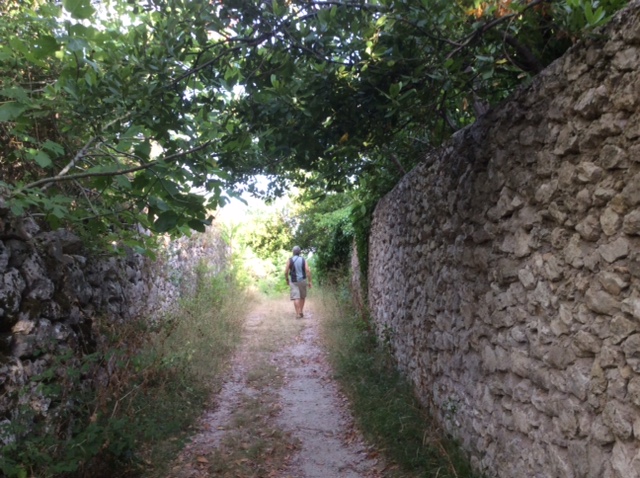
Walls and grass in Vicalvi, Italy sunset.
Parker Palmer, in his book, The Courage to Teach, which I’m currently reading, talks about the biologist Barbara McClintock, who was given the Nobel Prize in 1983 for her work that changed our understanding of genetics. Prior to her work, people thought of genes as separate things, not in connection to the environment they were a part of. Palmer explains that McClintock’s interviewer who wrote her biography, Fox Keller, “wanted to know, ‘What enabled McClintock to see further and deeper into the mysteries of genetics than her colleagues?’ McClintock’s answer, Keller tells us, is simple: “Over and over again she tells us one must have the time to look, the patience to ‘hear what the material has to say to you,’ the openness to ‘let it come to you.’ Above all, one must have ‘a feeling for the organism.’” We co-create our world. We can’t stand at the door. The burden of the cost of anything is born by all eventually. As Palmer goes on to say, “Modern knowledge has allowed us to manipulate the world but not to control its fate (to say nothing of our own), a fact that becomes more clear each day as the ecosystem dies and our human systems fail.” (p. 57) Perhaps, then one important way of living inside of corrupt systems and move ourselves and society toward greater wholeness is to do what we can with those around us to build and restore relationships constructively. Some things or many things may not be in our power. But some things will. We can learn to listen closely to the interrelationships of people and things so we gain a greater connection to life. With this understanding, we can better comprehend what actions will create harmony both with others and with nature.
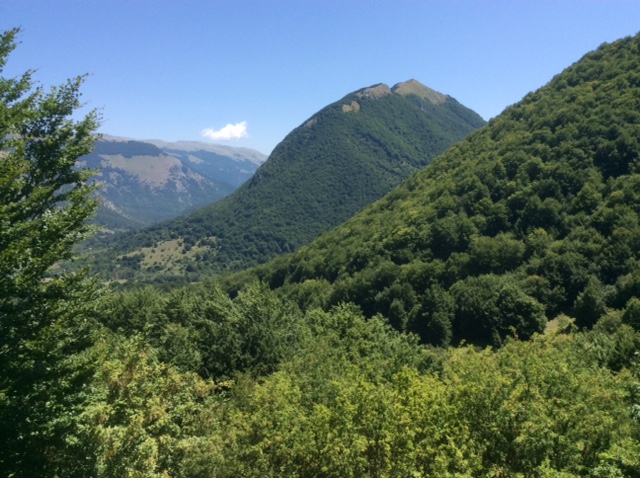
Abruzzo National Park, Italy.
Dostoyevsky said, “Beauty can save the world.” While it may not appear to be a solution to growing environmental and social concerns, the idea deserves a closer look. What connection does beauty have in showing us a way through our dilemmas of how to live in unjust social systems? The New York Times “Books” section, published in 1987 includes an excerpt from Richard Ellman’s essay “Oscar Wilde.” Ellman relates the story of Oscar Wilde coming to New York City in 1882. “Beauty is nearer to most of us than we are aware,” Wilde explained talking to reporters. One of the reporters wanted to know if a nearby grain elevator was beautiful. Earlier in the conversation, Wilde had said, ‘I am here to diffuse beauty, and I have no objection to saying that.” As reporters continued probing, Wilde explained further his ideas about beauty. ”’It’s a wide field which has no limit, and all definitions are unsatisfactory. Some people might search and not find anything. But the search, if carried on according to right laws, would constitute estheticism. They would find happiness in striving, even in despair of ever finding what they sought. The renaissance of beauty is not to be hoped for without strife internal and external.” ”Where then is this movement to end?” ”There is no end to it; it will go on forever, just as it had no beginning. I have used the word renaissance to show that it is no new thing with me. It has always existed. As time goes on the men and the forms of expression may change, but the principle will remain. Man is hungry for beauty. . . . There is a void; nature will fill it. The ridicule which esthetes have been subjected to is the only way of blind unhappy souls who cannot find the way to beauty.”’ Creating a world of beauty is creating the ideal world. Creating a heaven, so to speak. To do so will take great effort. But people are hungry for it, as Wilde says. We are hungry for beauty, and that hunger connects to the desire for a world without corruption. Without corruption, beauty has a better chance of thriving.
Elaine Scarry, author of On Beauty and Being Just, speaks on her Harvard Thinks Big, “Beauty as a Call to Justice” about how experiences of beauty help to move humans toward justice. When we experience the beautiful, we are pulled out of our everyday way of interacting with our surroundings. We stand still. We are transfixed, she explains. In those moments, beauty pours into us an awareness of the “surfeit of aliveness.” It takes us out of ourselves, and connects us with a larger reality. Scarry makes the case that this experience of beauty helps lead us to love what we see and to want to care for it and have a relationship with it.
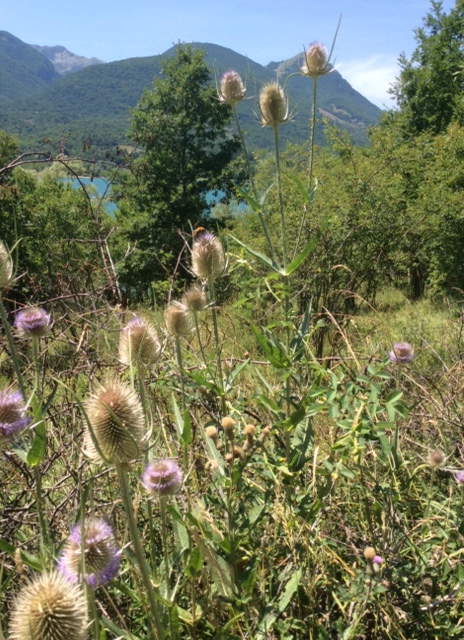
Wildflowers, Vicalvi, Italy.
I don’t know if its true as Keats said in his “Ode to a Grecian Urn” that “Beauty is truth, truth beauty,–that is all/Ye know on earth, and all ye need to know,” but I do believe we need to have a much deeper knowing of beauty than we currently hold. There is a relationship between our loss of beauty in many of our urban environments, a loss resulting from our pragmatic values that relegates beauty to the bottom realms, and efficiency to the higher realms of priority. When I speak of beauty, I’m not talking about beauty in the decorative or commercial sense. I’m speaking of the beauty such as nature gives us in a star strewn sky or a valley sweeping down in green fields from stoney mountain peaks. I’m speaking of the beauty Scarry described above—that stops us short, that overwhelms, and then lifts us out of ourselves. Is our culture’s pragmatic love of efficiency causing us to structure society in such a way that it’s actually challenging to make deep connections with others? We have connection to people on Facebook, but does the minimalistic communication that exists there nurture deep conversation and relationship? I doubt it. Could it also be true that our lack of seeing ourselves as connected to the beauty of the Bolivian salt flats and the lives of Bolivian miners as we pursue our technological development (and other similar realities) is part of the reason corruption continues to thrive? Do people act in ugly ways because they live in a world where connection to the natural world is broken? In glimpses of beauty, we can see the world we want to belong to, a world of balance and wholeness, and are drawn to it. If we gave beauty a place of respect and honor in our cultures, possibly we would treat the world with more respect. If we developed more of a relationship with those around us and with the natural world, wouldn’t we understand our connection to the world and realize more fully the effects of our choices? Is our collective loss of beauty causing us to lose our souls?
At the castle ruins, Vicalvi, Italy.
I never used to understand the Jesus prayer—the ancient prayer that says, “Have mercy on me.” I felt it seemed too focused on the negative and I already struggle to move beyond my failures. But as I see myself more and more intertwined with the existence of all that is, I see the value of this prayer. What the world is or isn’t, isn’t all up to me, but I’m also a part of all that is. How do we live in a corrupt world and yet continue to grow toward wholeness? The problems are all much bigger than me but mercy is extended. “For the Beauty of the Earth” is an old song that carries with it the idea of giving praise for the world around us and to the skies. Perhaps the ongoing practice of noticing and valuing beauty in the world, as the words of this song illustrate, acts to create a greater awareness of our interconnectivity. It’s worth trying.
One of the especially valuable aspects of creative work—of art and literature, of writing—is the way it nurtures the inner life. The artist must look very carefully at whatever she or he is drawing in order to see it and how it functions in relationship to itself and to the world it inhabits. In writing, an author must delve inside the subject with imagination in order to understand the subject and the interrelationship of the subject to oneself and the world. To write or to do art is to cultivate beauty. It is a way to reconnect to the world, is a way of making whole again as telling our story is a way of making us whole again. The flourishing of this kind of empathetic understanding that comes through our interaction with literature and the arts is important to not only the continuance of the world, but the continuance of a world that is good to live in.
Wherever we are, we can work with others to create greater wholeness. If we are going to change at all, it will be a step-by-step movement toward wholeness. In the mean time, we can pray as we walk, “have mercy,” and, by grace, we will continue on.
“Prayer begins at the edge of emptiness.”–Abraham Joshua Heschel
Heschel’s words strike me because there are a lot of things I don’t have answers for. Aware of my smallness in face of the suffering around me every day, I stand at the edge of emptiness and cry out.
When riding out into traffic, I’ve started a practice of looking into beggars’ faces who come to my window, or when someone speaks to me in the market asking for money, or when I see who is suffering, a family living on the street, for example, also animals who suffer, and in my mind I say, “I wish you well.” It’s a kind of prayer, and though it’s not directly answering the needs they have, it’s a way to keep my heart open–to keep noticing even though I might not be able to help the person in the way they ask of me. I want to see their humanness, and to be reminded of my own weakness and vulnerability.
Certainly, even in the lives of the desperately poor, there also must be times of joy. Even so, the human need in Delhi, is great. All the arms reaching out, the eyes–the world’s needs are immense. This week Nepal has its worst earthquake since 1934. The suffering is enormous. It will take decades, to recover, life times to become new, and we feel the grief hanging in the air as we go about our day.
The poverty in this world is not made up of physical poverty only, however. There is poverty of spirit, poverty of heart, and this is where I think that those of us in the developed world have a great lack. Everywhere around us today, from psychologists like Martin Seligman and his ideas about flourishing, to religious leaders like Matthieu Ricard, people are talking about how to be happy. Even Pope Francis has come up with his list of 10 tips for a happier life such as taking time off to be with your family, and spending time in nature. People who study what makes us happy tell us that focusing on what brings us a sense of well being actually helps us to become happier, and of course that is a good thing. But sadness and melancholy are also a part of life, and experiencing sadness and melancholy can help us become more compassionate, as Courtney Stephens explains on this animated TED Ed lesson. We learn from our sadness how to be more human.
I don’t know how best to respond to the sadness in the world, the grief so many feel, but want to give something of myself to meet that need. One must start somewhere, however small. It’s the start that counts. It makes room for greater opening, and I know I need to open.
For months now I have been working on poems on the subject of food. It has taken some time, longer than I expected because new ideas for poems keep surfacing. I am now nearing the end of the poems I want to write for this series. I hope I’ve written well enough that after putting the poems into a manuscript I’ll find a publisher so I can use the proceeds from its sale to give to an organization that helps prevent hunger here in India. I hope it will be of some good. In the process of writing these poems, I’ve also been rereading about creativity, and returned today to Rilke’s Letters To a Young Poet where I read,
“…Everything is gestation and then birthing. To let each impression and each embryo of a feeling come to completion, entirely in itself, in the dark, in the unsayable, the unconscious, beyond the reach of one’s own understanding, and with deep humility and patience to wait for the hour when a new clarity is born: this alone is what it means to live as an artist: in understanding as in creating.
In this there is no measuring with time, a year doesn’t matter, and ten years are nothing. Being an artist means: not numbering and counting, but ripening like a tree, which doesn’t force its sap, and stands confidently in the storms of spring, not afraid that afterward summer may not come. It does come. But it comes only to those who are patient, who are there as if eternity lay before them, so unconcernedly silent and vast. I learn it every day of my life, learn it with pain I am grateful for: patience is everything!”
The need in India has been here for decades. It’s not going to go away in the near future. The sidewalk on the street where I live is in a perpetual state of change. It’s put together one month only to be torn up the next, a metaphor for my own incompleteness–of starting over, trying to make things work, change, to get things “right.” Whatever it is that causes that sidewalk to have to be torn up so often is a mystery. It’s just the way things are here. Likewise, whatever it is we are making or doing with our lives, it isn’t necessarily what we see on the surface. What’s really happening comes from a place far deeper, beyond the reach of our own understanding. I look into the face of my partner who I’ve known for decades now, and find him still a mystery, and stand in wonder. Who am I, I don’t even really know. Definitions, lists and examples aren’t enough to explain. Similarly, how can I in any way touch or meet the vast needs of a world as immense as India? I can’t. As Shakespeare wrote in Sonnet 65,
Since brass, nor stone, nor earth, nor boundless sea, But sad mortality o’er sways their power, How with this rage shall beauty hold a plea, Whose action is no stronger than a flower? O! how shall summer’s honey breath hold out, Against the wrackful siege of battering days, When rocks impregnable are not so stout, Nor gates of steel so strong but Time decays? O fearful meditation! where, alack, Shall Time’s best jewel from Time’s chest lie hid? Or what strong hand can hold his swift foot back? Or who his spoil of beauty can forbid? O! none, unless this miracle have might, That in black ink my love may still shine bright.
We are all frail and mortal. Beauty’s action may be no stronger than a flower, but still we need that flower. We all need to be touched, to be met, to be needed. So, I write on, my words, tiny splotches on computer screens of light wavering inside the colossal of India’s immensity, prayers of pale petals– ink floating down the Yamuna hoping to touch other lives.
“…experiences of beauty remain among the principal reasons for being alive, for wanting to remain alive, for sharing the joys of living with others…once we go beyond sheer survival…the quality of one’s life proves of the essence. And a life bereft of beauty–or, if you prefer, without the potential for beautiful experiences–is empty.”–Howard Gardner, Truth, Beauty, and Goodness Reframed
Traditionally, the criteria for great art was beauty. While across cultures people still find natural scenery like lakes and mountains beautiful, beauty has pretty much lost its place as an important criteria of Great Art, says Gardner. But beauty isn’t necessarily a criteria for art any longer, Gardener explains. What matters more now is whether art is memorable, whether it stimulates our interest–if it makes us see anew. This may be true, but I think for many, standing in a cathedral like Barcelona’s Sagrada Familia, still is capable for carrying people into a place of wonder and awe at how much beauty light hold can as it shines down through the glory hole above the altar because of the angle and shape of the skylight there as the golden walls reach up to the heavens.
Gardner’s criteria of making something that will niggle at people’s minds, stimulating their interest in memorable ways is possible if you are Antonio Gaudi. Gaudi’s Sagrada does both of these things in addition to being truly beautiful. I, on the other hand, am still working on practicing the most basic of basics in art. Last weekend I spent the afternoon painting on a pottery bowl–dragonflies, lily pads and grassy reeds. I’m new to drawing and painting, so it takes be longer than it would a person who is trained as an artist, but I don’t mind because the process itself engages me. For me, painting on pottery is a grand experience of experimentation. How will the design fit dynamically within the space without looking too crowded or too empty? How will I draw a design that’s not too complicated for my skill level? How will the line transform with the application of a particular glaze’s viscosity on the brush? How will the glazes’ s color change after firing that will influence what colors I choose before firing? I am a beginner, and these are questions I ask while working. Benchmarks of beauty for the the beginner in a particular field or craft are different from those who have been doing their work for years. Though it won’t pass for a high standard of beauty in the world at large, for a beginner the work one does can still be interesting and memorable–the hours spent creating completely absorbing.
My current drawing is a realistic one, but to paint it, I have to break the forms in the composition into their structural parts–deconstructing and then reconstructing objects in order to be able to paint them. I’m barely beginning to understand how to do that at the simplest level. Painters like Picasso, and Cezanne, deconstructed forms–painting from the inside of structures, so to speak, or the idea of what the structures suggested. Their work delves much further into complex understandings of what a forms are. I play with forms in order to understand how they function. Art masters, on the other hand, have gone through that stage long ago and have come out the other side. They understand forms so well that they have gained a flexibility that allows them to return to play with them anew–experimenting with them and knowing them in more intimately as a result. John Berger, in his book, Ways of Seeing, says, “The relation between what we see and what we know is never settled. Each evening we see the sun set. We know that the earth is turning away from it. Yet the knowledge, the explanation, never quite fits the sight.” Maybe this is why artists are constantly making, and making again, trying to show what they see inside an object, the feeling suggested in the form that makes it come alive.
Poetry is sound and line, shape–the use of white space to create meaning. As with visual art, in poetry also there is a kind of meta meaning going on between physical form and feeling. Beneath a poem’s words is the sound of words and the poem’s design on the page that is an integral part of the poem’s meaning. The artist places a line on the page and it, too, takes shape and meaning. Jeanette Mullaney, who writes and edits e-mails for the Metropolitan Museum of Art, talks about visual art’s marriage to poetry. These two art forms can take you away from where you are or bring everything together, she says. In my view, they might also sometimes paradoxically function to do both at the same time.
The connection of sound to emotion is interesting, even if there are no words or the words are indistinct. If you listen to just the sounds in this short animated Pixar film, La Luna, or this Polish, British, Norwegian animated film, Peter and the Wolf, (see more about the film here)much can be understood without specific words. Just the music and general sounds give an idea of what is happening. Connecting art and poetry, allowing them to resonate off of each other. Last year, poet Kenneth Goldsmith performed poems at the Museum of Modern Art in New York City while standing in front of various art pieces. According to the MOMA site, nearly everyone at the readings felt they had an impact on their visit, some saying that the associative connection between the art and the words deepened their experience of each.
Beauty is all around us in the very structure of nature–the Fibonacci curves of roses, pinecones, and the nautilus shell, for example, a structure that is beautifully balanced. It takes time to learn how to see. I want to create something beautiful but doing that is no small task. Nature took millions of years to develop, so of course I should understand that it’s going to take me a while too. But the time element doesn’t matter, really. Just working with color and shape hour after hour is somehow very satisfying. Art and poetry connect in the journey toward finding a life of meaning. Creating art, whether the form is poetry, film, painting or dance, is a way to enter in to and connect with a state of being that engenders attentiveness to life. It’s calming, refreshing, and an antidote not just to the pace of modern life but to its process as well. As Gardner stated, without beauty, life feels empty.
A trip this week to Hikkaduwa beach in Sri Lanka got me wondering about how places we travel to change us. Some trips I’ve gone on I thought I would return from changed, that my eyes would be opened to some newer, deeper understanding of life, but that didn’t actually happen. Other travel, however, has left an indelible impression on me–such as the trip to southern Italy to visit the towns of San Lucido and Amantea and walk the streets where my husband’s grandparents came from, or the summer I spent in Guatemala helping with relief efforts after an earthquake, also my first trip to India when I saw the way people lived a life so different from my own, and how difficult life was for so many. After visiting Sri Lanka this week, I’m left feeling deeply grateful for the places on earth where greenery and beauty are still in tact, where people can breathe deeply and the air is pure, for places where people can restore themselves. Hikkaduwa beach is such a place.
Tsunami memorial, north of Hikkaduwa
Maybe we should be able to transform our minds and way of being without visiting other lands or worlds, but travel can boost our potential to do that as it places us in entirely different realities operating under different rules and understandings. Walking around in such a world for even a few days can help us to see things don’t necessarily have to be how they currently are. Old patterns can be broken. Something new can emerge. What we perceive as fixed boundaries defining the way the world is or functions, we discover when traveling, is actually a social construct that people collectively build and uphold, and that can change. Whatever the actual cause–whether it is simply time away, or new connections made as a result of being as totally new environment, what seemed impossible before travel to a different location often seems doable after travel.
Over the years of living and working abroad, I’ve been able to travel many places, and doing so has given me a clearer picture of the world. Unlike a few decades ago, nowadays, of course, a person with Internet access can simply look up an area of interest and view absolutely wonderful images. The mosaics in Ravenna, I learned after reading in William Dalrymple’s book, From the Holy Mountain, together with those in the cathedral in Trastevere in Rome, are Europe’s best examples of Byzantine mosaics outside of Istanbul. Traveling to Ravenna isn’t currently possible for me, however, but the online 360 degree view of some of these mosaics online at this site is truly stunning, and it’s fantastic to be able to see them. Then there are the videos of locations, like those on this site of Ravenna, that you can also explore.
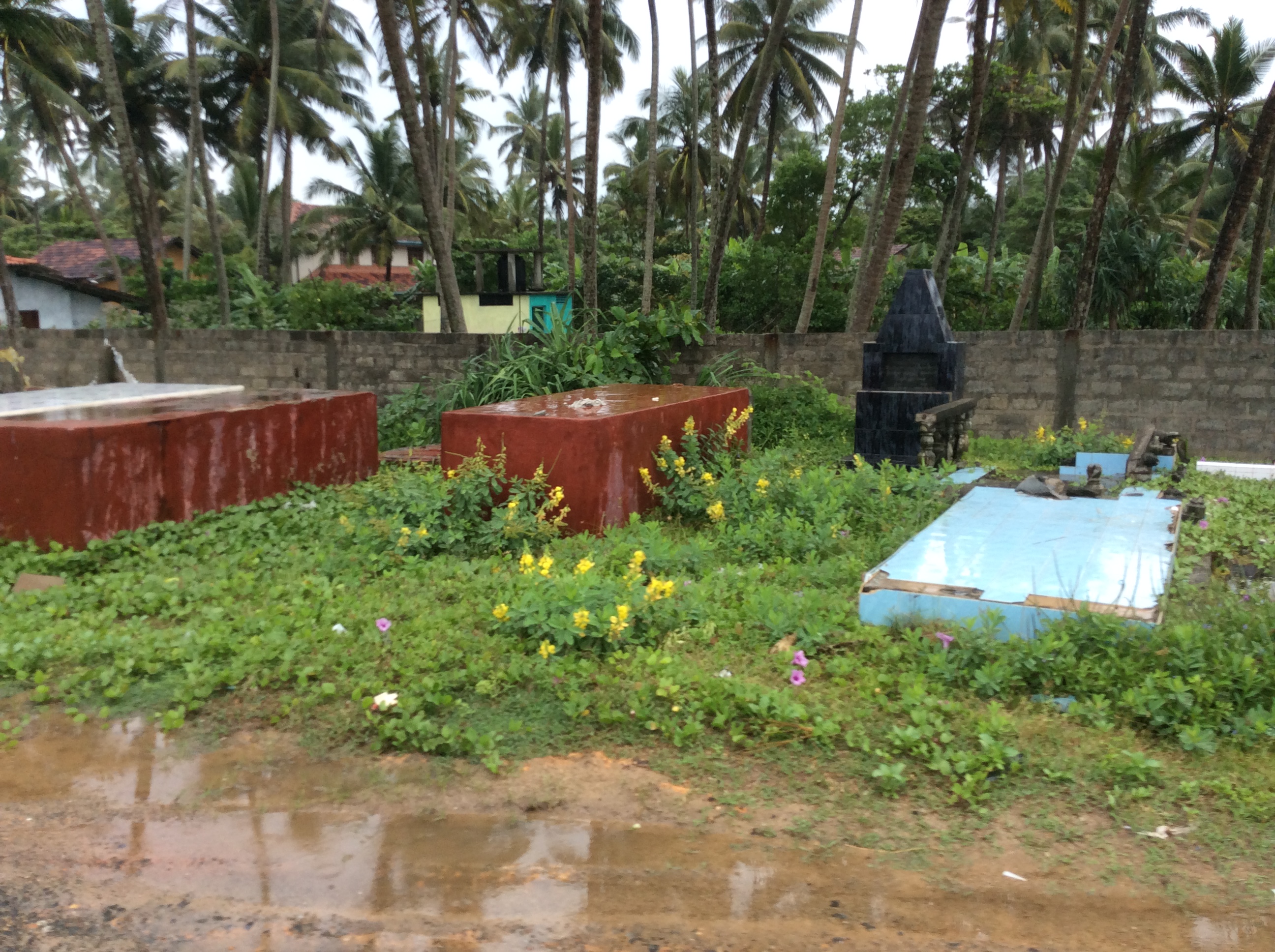
Roadside grave from 2004 tsunami victims, Sri Lanka
Mini mind breaks that take us vicariously to other locations are not an adequate comparison to the kind of transformation that can occur from visiting a place in person, however. Traveling in person allows you to meet people, make connections, learn about history in context, find yourself in new contexts and situations, and to experience first hand the subtleties of a world built on different foundations. In the world today when so many are afraid of differences, it seems much good could come if people were able to travel often so that they could experience the contexts and causes that create various world views and realities. Perhaps we would find ourselves better able to listen to and understand those different from ourselves, and empathy between people would grow.
Hikkaduwa home, Sri Lanka
On the other hand, the environmental state of the planet is a growing concern, and airline travel contributes to the unhealthy state of the environment, raising the question of when travel is justifiable. If we are traveling merely for pleasure, is the expenditure of fuel justifiable? When we arrive at the new location, does what we do there add to other’s lives in a positive, constructive way? It’s true that tourism is important to the economy of many places, but our current economic systems aren’t sustainable. If we care about the places we go to visit, and I do think that when we visit new places we generally have a greater affinity for them, how are we giving back something to these places as a result of our travel? How are we are connecting with a place in a way that sustains it, as opposed to using it as a consumer–taking away from it what we can, and moving on to the next location? These are questions I’ve thought about for some time now.
A few alternative travel options people can try are opportunities like snorkeling with whale sharks in the Seychelles where a portion of the money you spend helps contribute to research and tagging efforts. Having done this previously, I can say it’s a fabulous experience–you have a close encounter with one of the most amazing animals on the planet, and you contributing to efforts to understand them better. If you want to read someone else’s blog post about this activity, see here. If you’re interested in places you can connect with to snorkel or dive with whale sharks, see here. Additionally, travelers can visit places like Ravenna and take a workshop where you learn to make a mosaic. The Shaw guides to art, writing, and other cultural workshops as well, lists thousands of learning travel opportunities around the world. An alternative option is travel where you can contribute to social efforts like helping to build houses with Tabitha Cambodia, something I’ve also done on several occasions and found a moving and valuable experience. All these reasons for travel are ways a person can either learn or give something back while traveling.
Still, just being in a new environment can broaden us, a bike ride through the mountains, for example, can help us understand the world in new ways. Sometimes a person just wants to see the art in France because of a love for art. Maybe others want to visit Eastern Europe to get a better sense of history there. Some people may want to climb Mt. Olympus because they loved their high school world history class and it would be a dream to visit the location in person. There are many reasons for desiring to travel and there are no simple guidelines for what are the right reasons to do it, but maybe one consideration to nurture could be how we might use our travel experiences to in someway give back to the world or enhance our relationship with others.
Twilight, Hikkaduwa, Sri Lanka
This weekend when I put on my snorkel and stuck my head underwater and saw the thousands of fish swirling about in the shallow pool just off shore, the eels poking their heads out of the rock, the lion fish with their striped fins floating next to the coral wall, and the juvenile emperor angel fish dancing about their tiny holes wearing their fancy blue, white and black patterns, I was filled with joy. It was, after all, Thanksgiving weekend in America, and I felt fully alive and grateful for the earth’s abundance, for the life given me to experience such beauty. I don’t know if one person’s experience of beauty can ripple out to others in a way that helps to restore lives, but more and more, I’m convinced of beauty’s importance for our lives. From Ravenna to the fish floating in Hikkaduwa’s beaches, could it be possible that if more people experienced nature’s beauty, maybe more would want to cherish and protect it and fewer would be willing to trade it away for economic gain? I’m encouraged by Mary Oliver’s poem in Swan: Poems and Prose.
DON’T HESITATE
Mary Oliver
If you suddenly and unexpectedly feel joy,
don’t hesitate. Give in to it. There are plenty
of lives and whole towns destroyed or about
to be. We are not wise, and not very often
kind. And much can never be redeemed.
Still life has some possibility left. Perhaps this
While visiting southern California recently I got to wander out into the hills outside of Wildomar and experience again a landscape similar to the one I wandered in as a child. At first glance the landscape seems semi-barren. Though there are few, if any trees, low chaparral grows in abundance, especially the beautiful red California buckwheat. The ants especially loved this plant, and numerous flower petals spread in a mandala around the ant holes. The flowers have a sweet smell, and the seeds are edible. At sunset, the light made each thing on the earth’s floor stand out distinctly. So much texture in the bark of broken shrubs, scattered rock. The hillside were alive with their blossom’s red rust blush. Truth, beauty, and goodness abound when we set out to notice them. Standing in the presence of beauty is too much for one person to hold. Overwhelming beauty is humbling and helps us to see our place in the vastness of all that is. It enables us to understand that the world is not ours, it is shared.
Wildomar sunset
In the Harvard Gazette, Howard Gardner advocates revisiting the values of truth, beauty and goodness “suggests keeping lifelong portfolios of beauty, either in our brains or a physical catalog that chronicles the experiences, music, art, and more that we find beautiful over time.” I’m thinking of hummingbirds, how they feed frequently, coming back to the flower repeatedly in order to maintain substance. As we do this, what is beautiful, good and true expands in us.
With its wide valleys and minimal vegetation, southern California has a wonderful sense of openness, and the sunsets this summer carried me away into the ecstasy of their expansiveness, and the sense of freedom they invoke. The skies filled me with awe in the vastness they evoked. I wondered why everyone in the neighborhood had not thrown open the doors, and walked out into the arms of the world waiting for them to see the boundless beauty above and around them. The world is a wonder if we open our eyes to see it.
Wildomar countryside
So many people today are wondering how to live well, how to find their center. Returning to Gardner, he states that what we need to do now is to learn how to behave not just for “numero uno, or for your neighbors, but for a wider public.” One start, I think, would be to consciously look for beauty in the world. Notice it, delight in it and share it, and thereby help others to lift their hearts into a deeper understanding of their own connection to life and to each other.
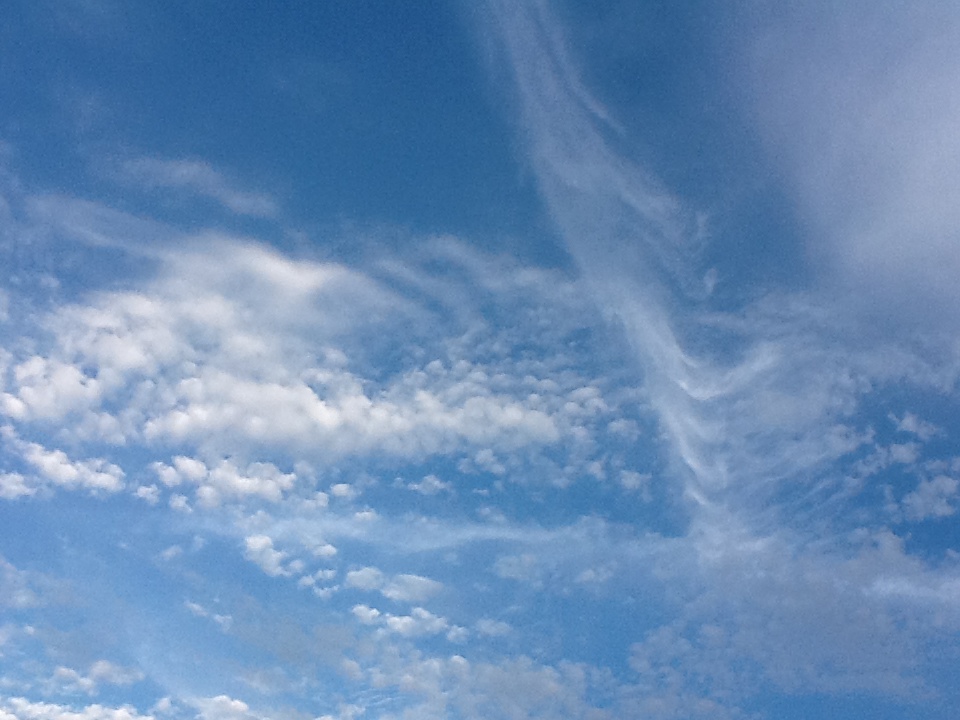
Frequently this summer I’ve been looking at clouds, the way they grow and contract before my eyes, sometimes so imperceptibly I wonder if it’s happening, other times so rapidly I wonder how they can do it. Gazing at the sky may seem like a mundane thing to do, but I recall many a time as a child lying back on the chairs outside my house and watching them glide by for hours, morphing forms as they paraded by as if on a slow moving carousel.
There was something soothing about those quiet afternoons. They carried me into a place, that looking back on it now, I can describe as a place of communion. Like staring at a campfire, the experience enabled me to enter a state where the world dropped away and I was absorbed into the moment, fully present in the simplicity of being. I call it a state of communion because even now, years later, while cloud gazing I find myself entering the same place in the mind and body, connecting with the environment where words aren’t needed, nevertheless communication is happening. I see the images, color, shapes–they are all showing themselves to me and something in myself is responding with more than a mere physical reaction. I hold and behold the forms, and in doing so, I am learning about the changing nature of the world and how I participate in beauty.
Though I gazed at clouds more often as a child, still today when I look up at the sky after waking up or as I walk home from work, something in me longs for the the open sky I experienced as a child, the vast, spacious world the mind can wander in. A hazy, flat sky flattens the mind. On days when the haze lifts, my heart feels freer, more content and at home. It’s refreshing to be reminded that shapes can also have forms with soft edges that float.
Our connections to the environment we grow up with influence who we become and leave an indelible mark. The house my father built and that I lived in as a child in San Diego county was perched high on a hill looking over a wide valley. We lived in a rural area with hills rimming the distant horizon, a geographical location that shaped my soul, so to speak: Living there nurtured a value of open space and encouraged in me the qualities of observation, reflection, and of taking the long view of things, values fundamental to my understanding of the world.
Earlier this summer I was recovering from a knee injury. Because moving around was slow and uncomfortable, all walking became a focused effort, each step a meditation. Immediately the world felt smaller and more challenging as a result. There seemed to be so much I couldn’t do, and I was surprised by how vulnerable and limited the injury made me feel. During that time, I was visiting my brother. I rested on his deck one morning, looking up into the enormous billowy clouds. Once again the world grew into itself, the largeness of it stretching out with the length of sky like an enormous blue sheet hung out across the universe, shifting in the solar breeze. Little had actually changed except my perception. I couldn’t move any faster than before, but staring at the passing clouds reminded me of the larger reality I was a part of, and brought me back to that place of wonder I participated in as a child. Just as clouds change forms, so does my life, and any suffering I might experience. Any suffering I might know, however small or big, is just a part of the larger suffering of the world. In the world there is pain, but there is also great beauty. Both coexist, and reality is a state of flow between them in different measures.
Not all of us live continuously in a world with natural beauty. I know I don’t. Countless others are like me–those who live in smog choked cities, those without access to green space and parks or who spend most their time in rooms without windows working under fluorescent light. Though we may not have access to it, the world’s immense beauty continues on. When I am in a place with natural beauty, I want to really notice it, pausing to take it in, to be thankful, and to consider all the processes of nature it took to create what I am experiencing. I want to remember often how open skies and time spent beholding them can restore.
When I am in a place that lacks beauty, when I find myself living there, I can also look up at the sky and know that beauty’s absence I that place will help me to recognize how precious beauty is when and wherever it is found. I can let this awareness fill me with gratitude that I have seen beauty, have beheld it, and hopefully do so again in the future.
I am reminded of Wendell Berry’s Sabbath’s 1999 poem, and how it values the small, quiet moments, emphasizing the importance of noticing and learning to rest in them, moments like looking at clouds.
VII
by Wendell Berry
Again I resume the long
lesson: how small a thing
can be pleasing, how little
in this hard world it takes
to satisfy the mind
and bring it to its rest.
Within the ongoing havoc
the woods this morning is
almost unnaturally still.
Through stalled air, unshadowed
light, a few leaves fall
of their own weight.
The sky
is gray. It begins in mist
almost at the ground
and rises forever. The trees
rise in silence almost
natural, but not quite,
almost eternal, but
not quite.
What more did I
think I wanted? Here is
what has always been.
Here is what will always
be. Even in me,
the Maker of all this
returns in rest, even
to the slightest of His works,
a yellow leaf slowly
falling, and is pleased.
Sonnet 73, That Time of Year When Thou Mayst in Me Behold
That time of year thou mayst in me behold
When yellow leaves, or none, or few, do hang
Upon those boughs which shake against the cold,
Bare ruin’d choirs, where late the sweet birds sang.
In me thou see’st the twilight of such day
As after sunset fadeth in the west,
Which by and by black night doth take away,
Death’s second self, that seals up all in rest.
In me thou see’st the glowing of such fire
That on the ashes of his youth doth lie,
As the death-bed whereon it must expire,
Consum’d with that which it was nourish’d by.
This thou perceiv’st, which makes thy love more strong,
To love that well which thou must leave ere long.
—–
It’s late spring in Delhi, which means the leaves are falling from the trees. Yellow leaves, and gold gather on the streets, pile on curbsides in drifts. The flowers that the city plants in the parks so that that were in full bloom in February and early March, are now growing spindly as stalks lean into each other, heads droop, and their bodies begin to turn to seed. The seeds are their gift for the future, the brown, withered looking things that hold the future generosities of spring. After the six or eight weeks of flowers, fall arrives. Then the months of monsoon–the floods of rain. That’s the season we’re in now, the season between seasons–between the dry and the wet.
When I was attending what was then called Bethel College in St. Paul, MN, my poetry teacher read Shakespeare’s 73 sonnet to us, and asked us to go out and look at the fall leaves–the fiery Dutch elms that grow in profusion throughout the city’s streets, and that crowd along the Mississippi’s river banks. Leave your books, she suggested, and go out and notice them before they are gone. They don’t last long.
A native of southern California, I knew what it felt like to live through the Twin Cities long months of winter’s color deprivation and cold that followed September’s autumn. For the most part, it seemed to me that Minnesotans loved their snowy winters. I had heard various people I met there describe how they looked forward to winters–the snowshoeing and cross country skiing, the briskness in the air. But coming from the land of sun, where winters didn’t usually require much more than a light jacket and shoes that covered the toes, that anticipatory attitude was difficult for me to understand. I hadn’t learned to ski or skate, and for me getting bound up in sweaters and mittens, hats, thick socks any time you went out wasn’t something I looked forward to. Change is interesting, but I truly missed the freedom of wandering outside for a stroll, run, or bike ride. So, I followed my teacher’s suggestion, and went out to walk through trees on campus, and visited other campuses along Snelling Ave. whose campuses were thick with trees. I went down by the Mississippi as she suggested. It was glorious–all that color shining in the myriad leaves. All that sugar burning inside them as temperatures turned. The whole world a flame. As my teacher said, the trees were all the more beautiful, for knowing what would come next.
And what came next was winter. Dark branches silhouetted against white for months. Beautiful things often have a way of piercing the heart, of opening us–the last yellow leaf falling from a tree, rainbow color glistening from a spider’s web, the way clouds roll in low over the ocean at sunset. As Dana Jennings says in her NY Times article “Scratching a Muse’s Ears”, about Mary Oliver’s poetry book, Dog Songs, says, there are tears inside of things. Because we know this, it can make our heart ache when we see something beautiful. We’ve all eaten from the tree that lets us know we are not living in the garden anymore–but we know what it looks like, that last leaf falling from the tree before winter, and how it feels to watch it fall, joining the fire floating down the river or resting on the forest floor before it turns to dust.
So, all of you who have sat at your desk all day, I encourage you. Get up, leave your books or your office, you papers and your e-mail, and go outside and notice this day. Find what there is to love in this day, before you have to leave it. Notice life. What is it you are living?
THE TABLES TURNED
William Wordsworth
Up! up! my Friend, and quit your books;
Or surely you’ll grow double:
Up! up! my Friend, and clear your looks;
Why all this toil and trouble?
The sun above the mountain’s head,
A freshening lustre mellow
Through all the long green fields has spread,
His first sweet evening yellow.
Books! ’tis a dull and endless strife:
Come, hear the woodland linnet,
How sweet his music! on my life,
There’s more of wisdom in it.
And hark! how blithe the throstle sings!
He, too, is no mean preacher:
Come forth into the light of things,
Let Nature be your teacher.
She has a world of ready wealth,
Our minds and hearts to bless—
Spontaneous wisdom breathed by health,
Truth breathed by cheerfulness.
One impulse from a vernal wood
May teach you more of man,
Of moral evil and of good,
Than all the sages can.
Sweet is the lore which Nature brings;
Our meddling intellect
Mis-shapes the beauteous forms of things:—
We murder to dissect.
Enough of Science and of Art;
Close up those barren leaves;
Come forth, and bring with you a heart
That watches and receives.
___
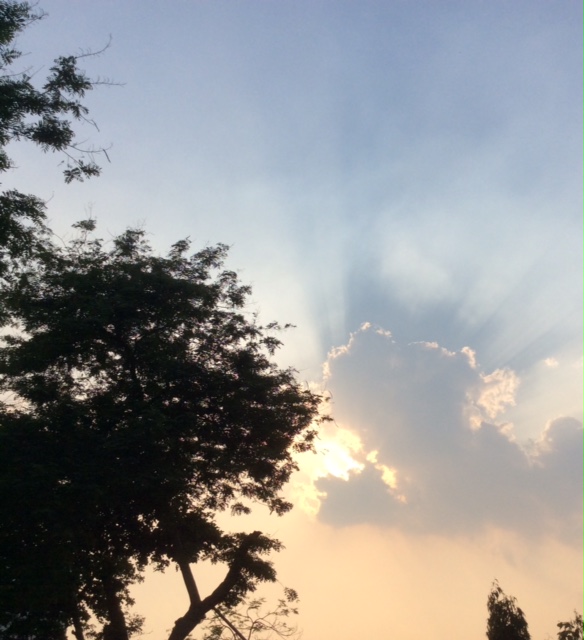
Okay, so I took my own advice and got up and went out for a walk. I didn’t have a wood to walk in, so I took a walk around the block where I live. The wisps of clouds turning from pink to salmon against a pale turquoise sky–the kind of sky that is rare in Delhi.
It was a short walk around a city block. The first quarter of the block I couldn’t stop staring up in amazement. The second quarter of the block, I grew aware of the traffic noise as it hustled by. As I turned the corner, I noticed a billboard that read “Platinum Living” with a sleek, blond-haired woman wearing an elegant low cut black gown and a long strand of pearls leaning back against a comfortable couch. I glanced down at the pair of abandoned black slippers at my feet on the sidewalk and wondered who this ad was aimed at speaking to in a city where a quarter of its population is below the poverty line, 30% live in slums, and in a country where the World Bank estimates that 21% of the deaths in India are related to unsafe water. As I continued to walk, the acrid smell of burning leaves permeated the air, scratched at my throat, and made me cough. (Sadly, too many things here seem to makes me cough.) By the time I turned the last corner and entered my apartment door again, the sky’s color had drained away.
Wordsworth’s poem admonishes us to go out into nature with a listening heart, one that watches and receives. That is definitely the heart I stepped out of the door with, and is the one I want to hold on to. I live in a city, though. It’s not the same as standing at the ocean’s edge or walking amidst the redwoods. What was I expecting, anyway? In truth, I was just expecting to enjoy the early evening coolness and to take in the color-brushed clouds. I just happened to get the other experiences in addition because they are a part of this environment. The walk makes me wonder, though, can experiencing beauty motivate us to protect it, nurture it? Or are we so used to the traffic, the billboards, the burning leaves and discarded shoes, to the poor living in substandard housing, that we give up on beauty, that we forget to notice those gestures of grace nature gives us even in the city from time to time–those rare moments of clear sky and color-streaked clouds that open our eyes, move us out of our routines, the moments that call us to step out of our brokenness into the possibility of another way of being?
On the other hand, maybe its that very poverty and brokenness around me that encourages me to notice the way the sky sometimes opens into a canvas of shinning color, as it did this evening. Either way, I need those moments of open sky and color. They carry me through winters. The winters I’m talking about don’t always necessarily always come with snow and cold. They can look like a multitude of cities flung across this world, or any place where we are too busy to notice or take care of what nurtures us.

 Daniel O’ Leary, a priest in Leeds and former teacher at St. Mary’s University College in London writes, “I like to think that each one of us, when we act out of our true essence rather than out of our false ego, when we refuse to betray our authentic self, when we are in close touch with our own sacred centre, in spite of persistent temptation, persuasion and compulsion to conform and to compromise – that when we act in this way we transform every room we enter, every conversation in which we take part, every relationship we engage in and every project we initiate or join.” Aretha Franklin was most certainly singing from with in the center of her true essence when performing at Lincoln Center, her presence transforming not only those in the room, as evidenced by Carole King’s overwhelmed and enthusiastic reaction to the performance, and by Obama who wiped tears from his eyes, but transforming also those who watch Aretha via the Internet. How do we live like that–from the center of ourselves, moving beyond the desire to demonstrate our skill, ability, talent, or worth—beyond the need to compete and claim a space, beyond nervousness and fear about perceived success—and instead, move into the depths of our own selves, to rest in the acceptance of who we are, including our imperfections and incompleteness? How do we live with open arms, surrendering into life in order to walk into a larger world, so we can let go into our own transformation?