Uncategorized

Slow Living

For some time now I’ve been thinking about how to live more slowly.  Three days ago we arrived in Cilento National Park, a few hours south of Naples, Italy, and we were eating dinner when Michael noticed how fast I was consuming my food. “Why are you eating so fast?” he asked. “We don’t have to be anywhere.” I realized he had a very good point. It wasn’t like I was on lunch break at school and had to rush off to class in a few minutes. So, I slowed down, deciding to savor the ability to eat slowly.

Now, however, a day later, I am going to learn the lesson of going slowly on a much deeper level as I have fractured my wrist while walking through a lengthy, dark tunnel in the Vallo di Diano. The tour advisor at the agritourismo where we stayed said there would be no water in the tunnel, and gave no indication that we would need a light. Our guide had one dim headlamp, and that made it difficult to see the holes. Though I was doing my best to be careful, my foot slipped on the narrow space between two larger holes filled with water. Down I went. Since I also got bronchitis upon my return from Ladakh and my arm is in a plaster cast, I am most definitely moving slowly.

Currently, we are in Matera, Italy. We did get out to walk around for an hour or so today, mostly, we are resting, though, and don’t have an agenda. I’m happy with that.

Some Examples of Slow Living:

Having no set itinerary for the day. Just step out of the door and follow your intuition.
Try something new on the menu that you’ve never eaten, and stay as long as you want to eat your food.
Take a nap in the afternoon, even a long and leisurely nap.
Walk, and follow the meandering route.
Look for something interesting and draw it, even if you think you don’t know how.
Stop to admire an overview.
Sit on a bench and watch the people walk by.
Typing with one finger as I am doing now.
Uncategorized

Impossible Situations

Domkhar Village, Ladakh
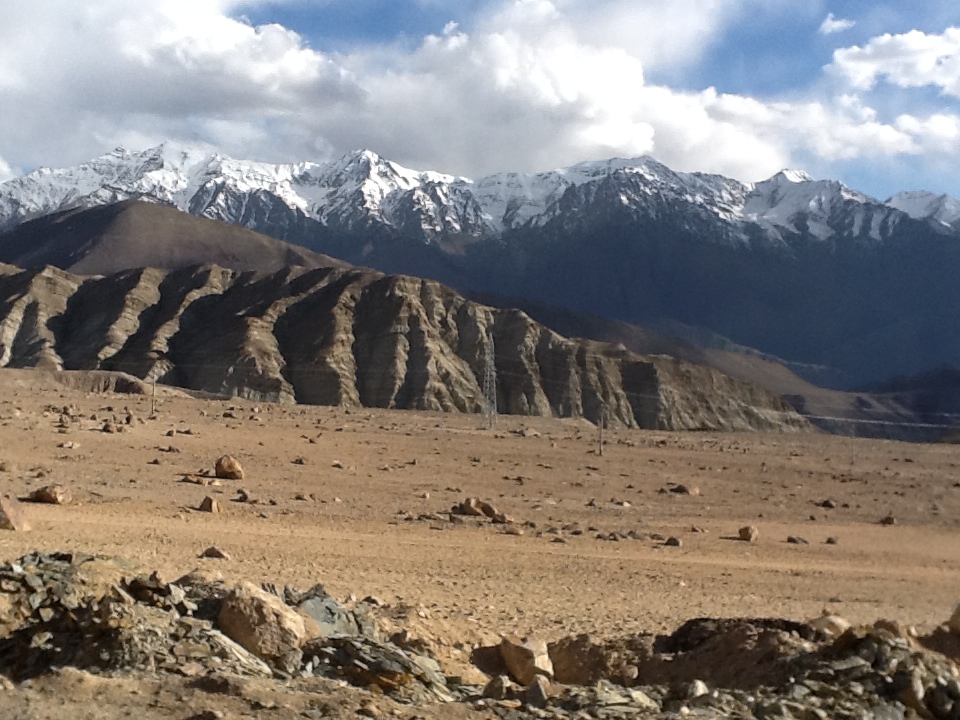
High desert, high mountains, thin air, ancient Buddhist monasteries, and intensely blue skies–this is Ladakh, or the Ladakh that most tourists know. But there are other Ladakhs to know, worlds inside of worlds that most visitors to Ladakh are not aware of.
On the Road to Domkhar from Leh
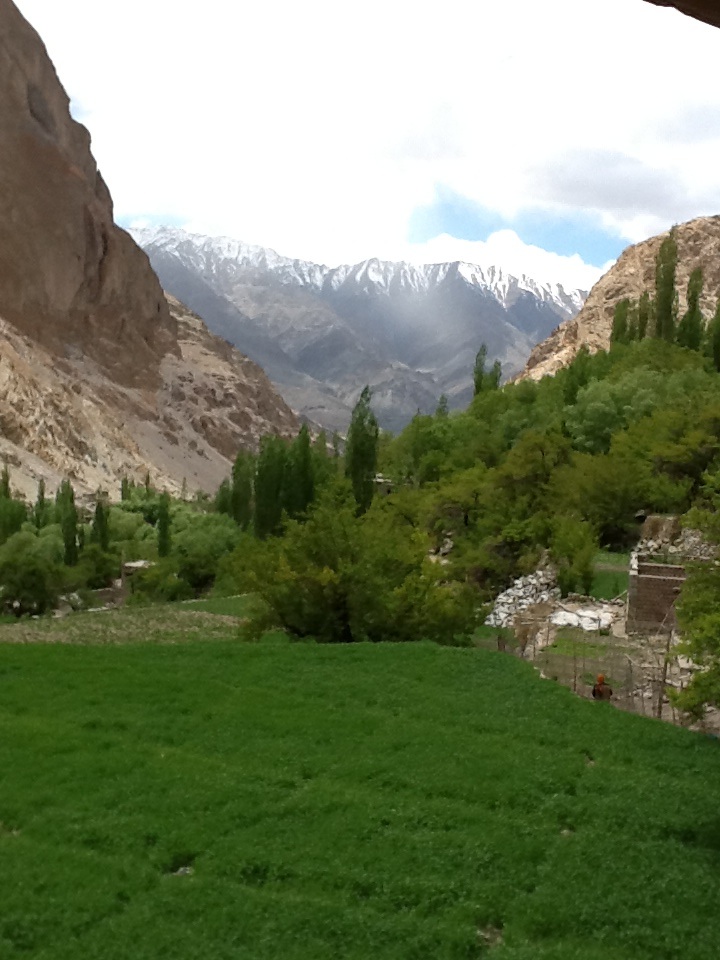
When we arrived in the village of Domkhar, 120 kilometers from Leh, I knew I had arrived in a different world. Village elders calmly rimmed the gathering area in front of the school, prayer wheels spinning in their hands, mothers sat with their children in their laps, and thermoses of tea from each family waited beneath the tent shade. The village’s community spirit was palpable as the entire village welcomed us in a ceremony that celebrated the community’s recent accomplishments. Located in a beautiful, narrow valley with sheer cliffs made of uplifted conglomerate earth on the side of the Indus River Valley, Domkhar is home to approximately 32 families who farm apricots, barley and a variety of vegetables on terraced plots. Intelligently, the villagers have channeled water to run by the houses and along the walkway that winds up through the village.  The night we spent in Domkhar, the moon’s light, one day short of full, shone so intensely that it lit up the whole valley–the immense, rust-red mountains, the fields of thick barley, the blue sky, all shyly emerging from beneath night’s cloak. Two years ago this past April, the area got in one day the amount of rain that they would normally receive  in 50 years, resulting in mudslides that carried away bridges, houses, people, and much of the valley’s good soil used for farming, replacing it with rock. The whole region is still recovering, as is Domkhar.
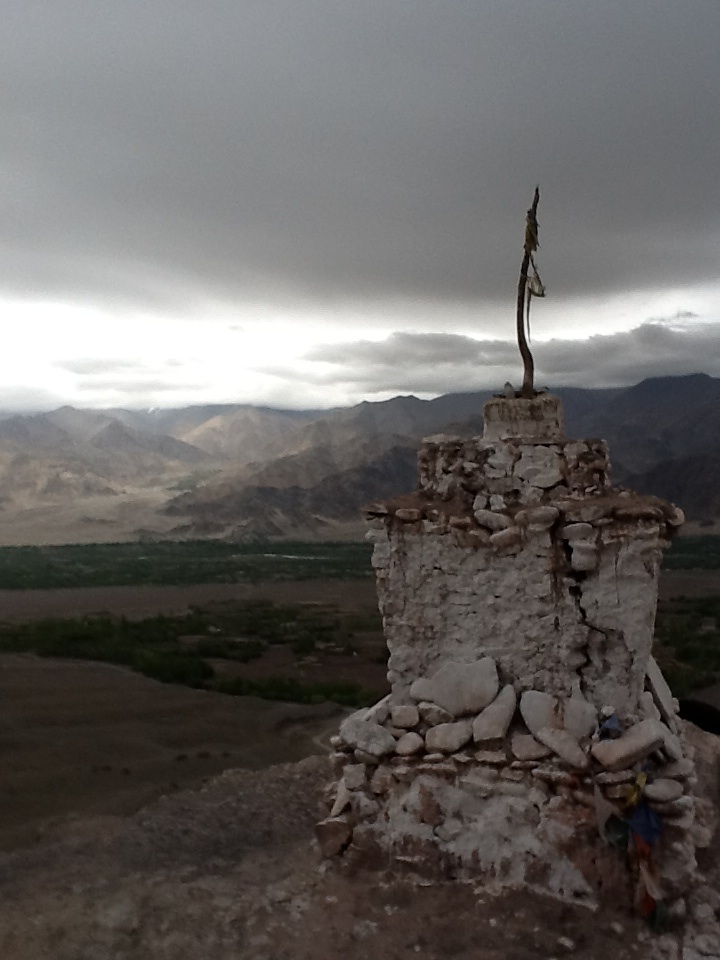
Ladakh Overview from Matho Monastery
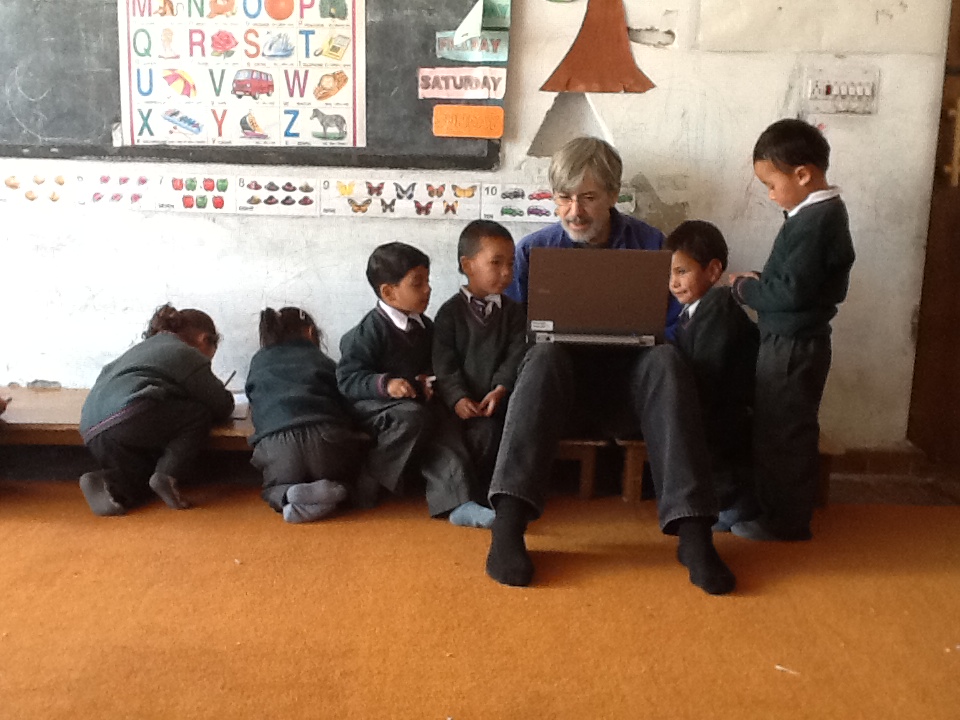
I went to Domkhar with my husband Michael as part of the Partners in Education teacher training work we do with teachers in Ladakh, and also with the Tibetan Children’s Village Schools here in India. This was our second visit to Ladakh, and our school principal from the American Embassy School and one of our technology teachers, Gagan Soni, accompanied us. The purpose for our visit was to observe teachers teaching in their classrooms in order to get a better understanding of their situation and needs, and to give them feedback on the ideas they have put into practice ideas from our previous teacher training workshops that they have attended over the past couple of years since we began our work with them.
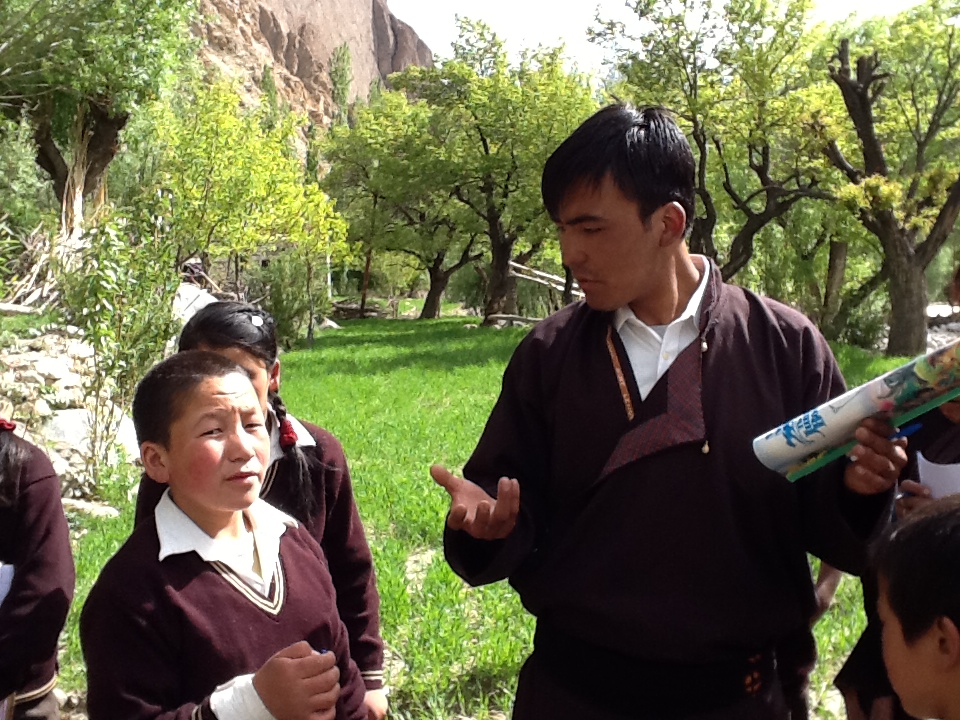
Rinchen teaching in Domkhar
Teaching in the Ladakh region is challenging for numerous reasons. The Indian government considers the Ladakh area a hardship posting, so the government moves teachers to different villages every three years, sometimes more often. One of the teachers in the village of Domkhar has been moved six times in one year. Her child is one year old and has rarely seen his father since birth. Children who have a parent who is a teacher often only have one parent present with them in the home. Another challenge for teachers in the region is that the tests and text books are in English, while the local language is Ladakhi, a language which is not taught in schools, and the official language of the country they live in is Hindi.  Neither teachers or students feel they are competent speakers, readers or writers in any of these languages. Also, schools often have very few books or resources to assist them, in addition to the fact that in India beginning teachers are required to have only one year of training beyond high school. These, and other other challenges make it difficult for teachers to be adequately prepared to teach, thus affecting the quality of the education they are able to give their students.
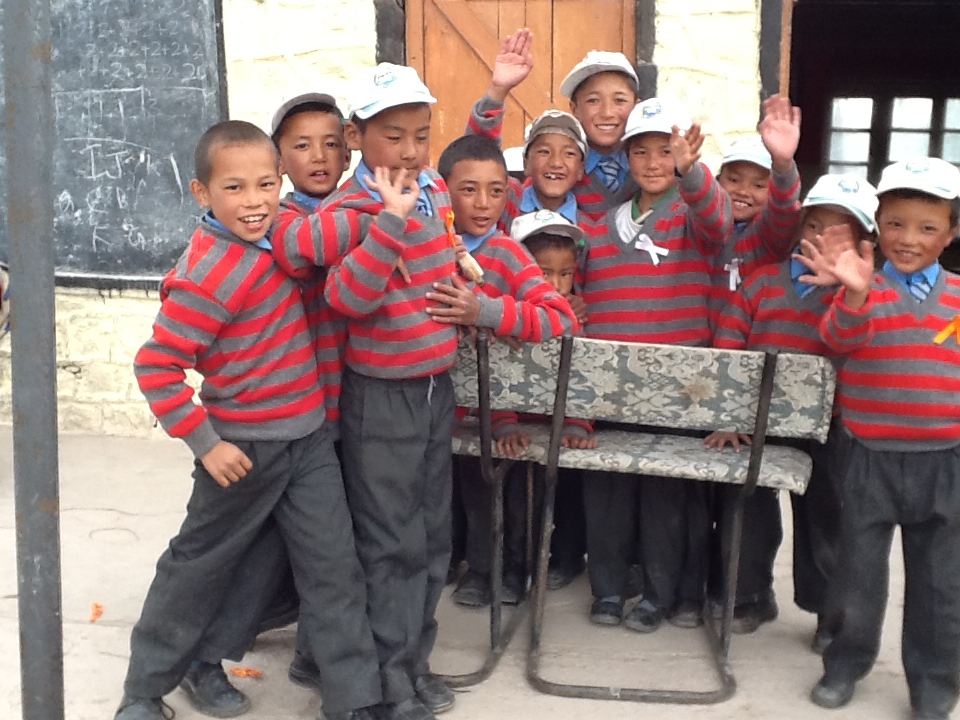
Students at Government School, Matho, Ladakh
While the situation is very challenging, teachers continue on with their work. Villages like Spituk, Matho and Dhomkhar believe in the value of education for their children. In Domkhar, for example, the village has raised the money for their own school building and for a satellite so they can communicate on the laptops that our school, AES, donated for their use. They have also raised money for a micro-hydro generator so that they can create electricity for their school and community. A new project for them now is that they are adding on a new section to their school using the plastic bottle construction method that a number of locations in Latin America have begun to use as a way of recycling plastics. Tashi Thokmat, the Domkhar village leader enthusiastically shared with us his news yesterday that as part of World Environmental Day, the villagers of Domkhar have made an appeal to tourists and citizens of Ladakh to place their used plastic bottles in collection containers. These containers as of yesterday are placed in various hotels in Leh. The villagers will then take the bottles back to their village and use them for their new building.  “We can’t stop the plastic bottles but we can reuse those empty plastic bottles in many other ways” the villagers explain in their appeal to hoteliers–an appeal which made it into last night’s TV news. The vision the villagers are creating together has built a strong sense of community and citizenship, so much so that the young people who have gone away to Delhi to university want to come back to the village to live because they feel committed to their community.
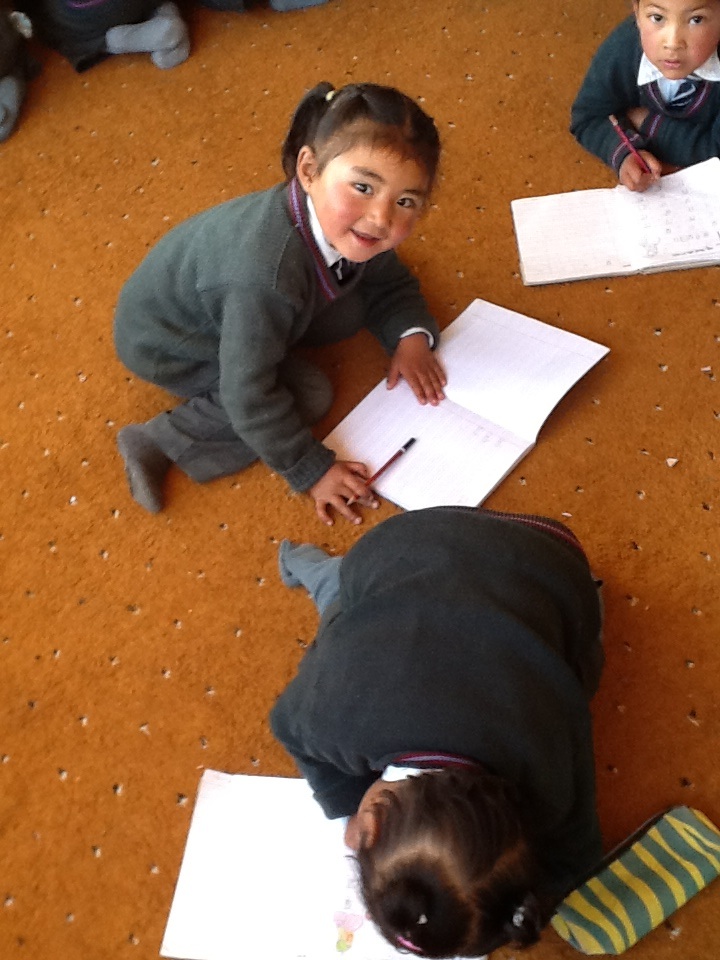
Children at Spituk Government School
People like Cynthia Hunt of HEALTH Inc., among other NGOs, are helping Ladakhis to improve their lives. Still, after their numerous accomplishments the Domkhar teachers ask “What can we do to improve?” This is the question we all have when we want to change our lives and make things better. In the midst of difficult situations, however, a number of Ladakhis are already doing a variety of things that create hope. While the main source of income for Ladakhis is tourism and more and more hotels are being built, the hotels use water from aquifers that is drawn up for use. This is an unsustainable process, however, as Ladakh is a desert. Water is scarce and the water withdrawn is not replaceable. One of the teachers who works at one  the local government schools, Chetan  Anchok, is writing scripts for production on local TV, and radio plays for a program called Family Serial, a popular program for Ladakhis. The purpose of the scripts he writes for these programs is to make Ladakhis more aware of social issues and of how to use environmental resources sustainably. The teachers in Domkhar are reaching out to attend teacher trainings and  they are working to understand and apply new skills and to improve their English, as are the other teachers we are working with in the schools around Leh and in the Tibetan Children’s Village Schools. It is a slow process and the need is great but small changes make bigger, systemic changes more possible, and they make difficult situations feel more bearable.
Michael with students from Spituk government school, Ladakh
Since moving to India five years ago, I have often struggled with how to respond compassionately to the enormous social problems present here. No matter what one might do to alleviate the poverty one sees, it seems it will be but a grain of sand in the vast desert of need. I have been reading the book 106 Impossible Things To Do Before Breakfast, by Robert Quine and John Nolan, a book of exercises to keep the mind creatively looking at solutions to problems that seem impossible such as doing laundry without soap, telling time with a broken clock, or taking a shower without water, etc.  The authors describe three key ideas for a person to keep in mind when dealing with impossible situations: “1. Consider all the possibilities, 2. Accomplishing the impossible takes a lot of work, 3. Everything is possible.” The authors describe that though problems may seem impossible, you have to open your mind to get rid of preconceptions to find ways around the obstacles. Once you do, you will start looking at the world in a different way. You’ll see it alive with possibilities, not barriers.”  Beneath Ladakh’s raw and elemental beauty is a world of work to do to create a better quality of life for its inhabitants. Working together, constructive change can be made. There is no way around the fact that the problems are large, that the work will be hard, and that it will take time,  lots of it, but the world remains alive with possibility.
Dechen Angmo, local Ladakhi teacher
Uncategorized

Beginnings and Endings

Beginnings are connected to endings, and endings to beginnings. Every time something is born, something else passes away. This past weekend, my husband Michael, and I spent our time moving to a new apartment. Our move was only one floor above, not a very big move, still it seems new and different. Since the move was so close-by, I hadn’t given a whole lot of thought about the move being much of a change other than wondering how we were going to manage to find the time to pack and then unpack with so little time left in India before we would be leaving for the summer. Nevertheless, as the opportunity to move opened and I carried box after box up the stairs, I found myself repeatedly thinking about how this phase of my life was ending–my time in the apartment with its idiosyncrasies of the toilet pipes that run and then stop running on their own, the particular scent of the rooms, the tree leaves grown thick over the window–all that was over!

One phase of my life was complete but another had begun. Sunday night we went to dinner with our friend Kamal, and her family, in celebration of her acceptance into the teaching program at a university in Calgary. To become a teacher is Kamal’s dream, and she is entering a new phase of her life as she sets off for college in a city and country unfamiliar to her now. It’s all so very exciting, but at the same time, a bit scary because of its unfamiliarity.

Since I’ve moved many times in my life, I’ve often wondered what it is like for people who stay in one location their whole lives, or for those who have rarely moved. What is it like to grow deep roots in one place? How might it change the way you see the world? Imagine having friends who have known you your whole life, who have seen you grow and change, who have watched as you developed new skills, and who were there to encourage you along the way! You would have friends you share a long history with, who know you well enough that you could sit with them in silent communion. That would be a rare gift. You would also know a landscape intimately–its myriad shades of sunlight and shadow. A good steward of the land, you would have taken care of it through all forms of weather and seasons. The land itself would your trusted friend.

That is one version of what it could be like to stay in one place your whole life. My life has not followed this path, though. Instead, I have repeatedly stepped into the unknown or semi-known. Doing this gets more challenging as you grow older and feel greater pressure to save up financial resources for the years when you will not work and yet need to go on paying for your living expenses. Adventures involve the unpredictable and the unexpected, and moving into unknown territory often is not easy, as you never feel fully settled in any one place. On the other hand, the advantage of moving frequently is that it has served as a bell that reminds me to repeatedly come back to the idea of how precious the time is in each place I live in or travel to. Often, I only have a brief time to be with old friends from my hometown each summer, or just a hand full of days with family members every few years, so those days and whatever they contain are dear.

Quite a number of years ago now I read Bruce Chatwin’s Songlines, a book that helped me see the value of life of a migratory life in a new way. Chatwin explains, “As a general rule of biology, migratory species are less ‘aggressive’ than sedentary ones.

There is one obvious reason why this should be so. The migration itself, like the pilgrimage, is the hard journey: a ‘leveller’ on which the ‘fit’ survive and stragglers fall by the wayside.”

Chatwin says our “real home is not a house, but the Road, and that life itself is a journey to be walked on foot.” This is a terrific promotion of the value of walking, and the view of life one gains through the pace a journey takes when on foot. I’m intrigued, though, by the notion of life itself being a pilgrimage, a hard journey.  If we can recognize that those walking beside us as fellow travelers, young, old, rich, poor, of different religions and different cultures, we can learn from each other and can better understand how to find our way.

Our “way” has something to do with understanding how these mundane things of our lives, like packing up our house and moving, or walking to work or standing in line at the cafeteria, are what life is. The every day events and conversations and how we carry them out, are what make the fabric of our lives. In the commonplace of our lives lies the journey itself. It is a pilgrimage where the inner journey meets the outer that occurs whether we leave home or stay in the same place our entire lives. One reason I continue to pick the transitory life is that it forces me to continue to think about the place where the inner and outer journeys meet and to make myself take note of how I am walking.

This time of year in the world of international schools, the environment I live and work in, many people are moving away, both students and teachers. Thirteen years spent in one place, perhaps, and then that someone is gone. Last weekend, as I sat in the room with a group of friends singing, I was looking at the faces of three people I will not see again here next year, Vicky and Ron and Deanna. They are such a natural part of my world here that it is very difficult to imagine them gone. Even though we speak of it, though we have going away parties, though we talk about their plans, and look forward to them enjoying their new experiments in living, my mind goes on affirming their presence. I suppose that is because they aren’t quite gone yet, and because I know we will still be in communication after they are gone. But as Vicky says, they are “history.” Their influence on my life will no longer be the way it was. Still, the influence of their presence on my life continues. I know I have quoted Buechner several times already on these postings, but Buechner says it well, “When you remember me, it means you have carried something of who I am with you, that I have left some mark of who I am on who you are. I means that you can summon me back to your mind even though countless years and miles may stand between us. It means that if we meet again, you will know me. It means that even after I die, you can still see my face and hear my voice and speak to me in your heart.”

Good-byes are a kind of death, it is true. There are always too many things going on when they occur, and we are never quite ready for them. But they are also a beginning. The Hindus demonstrate this understanding of the cycle of life and death in their god, Shiva, who is both the creator-destroyer. The Jewish scriptures of Ecclesiastes say, “There is a time and a place for everything under heaven, a time to be born and a time to die.” The Celts in ancient Ireland began their new year in winter. For Christians, Jesus’ death brings life. In the midst of death, life is being born. When you are carrying the weight of boxes up stairs for hours on end, it’s just plain hard. Your feet get tired and your back as well. But that’s the way new things get born– step by step you carry your load to the new location and set it down. Of course, it’s always very nice when someone can help you carry the weight. We are on this road together, we can do that no matter where we are. As fellow pilgrims say on the road to Santiago de Compostela, “Buen camino,” happy travels.

Uncategorized

Seeing Wonder

For those living in the US or other places in the world within the temperate zone, it is spring, a time of flowering and vibrant green leaves emerging from winter’s dormancy. For us living here in Delhi, spring happened back in February. The earth now is about as dry and dusty as it will be all  year. Temperatures rise to over 100’s F/4o C, the air fills with a powdery dust so light that it hangs in the air for days without settling. It is the kind of weather that scratches the eyes and lungs and makes you long for the monsoon rains to come.

But the dust and dry air are only one reality. There are other worlds to know, whole worlds inside of this world. We walk by them, unaware, every day. Some people like Louie Schwartzberg, make it their life’s work to help us notice, to really look at the world around us so we can see its wonder.View his TED Talk on the hidden beauty of pollination and you can discover for yourself. Even house flies are beautiful, I realized, as I watched them hovering over flowers here in his film where a hummingbirds pivot through the air chasing an insect, monarchs and bees fill the heavens as if moving inside a surrealist’s dream, and bats plunge their heads into the rich  liquid red center of a flower.

We need people with hearts to see the world with eyes like Mr. Schwartzberg’s to help remind us of what Fredrich Buechner speaks of in Now and Then: A Memoir of Vocation, “Listen to your life. See it for the fathomless mystery it is. In the boredom and pain of it, no less than in the excitement and gladness: touch, taste, smell your way to the holy and hidden heart of it, because in the last analysis all moments are key moments, and life itself is grace.”

The world is full of beauty, even if I feel I can’t see it from my window. Do you, like me,  long to touch wonder? How will I make space in my life to look for beauty, for wonder today? That is a question I am asking myself this morning.

Uncategorized

Remembering How to See

“But what the poets sees with his always new vision is not what is “imaginary”; he sees what others have forgotten how to see. The poet is always inadvertently stripping away the veils and showing us his reality. Many poets, as we know, go mad because they cannot bear the worlds of illusion and falsehood in which most human beings spend their lives.” – Karl Shapiro, “What is Not Poetry?”

Writing is a way of getting to the truth of what I see, a way to peal back the layers, to ask what is this I have experienced,  how do I name it, what is its essence? There are two kinds of knowing–the experience itself, and then the re-experiencing when in the act of writing. Writing  allows me to burrow in to the original experience and know it more completely. The experiences I have nurture ideas for writing, and the writing enriches and deepens the experience. The two things are intimately intertwined.

Writing poetry is a way to keep alive, to keep in touch with the mystery. Wanting to name the mystery doesn’t lessen it, instead it helps to increase its wonder. I want to always be filled with wonder like I was as a child looking out the window of the house my father built at the sea of fog as it filled the valley below leaving islands of hills. The hills and the fog were not just objects with names, they were part of a geography that absorbed me into itself and defined me.

“The poet,” Shapiro says,”sees what others have forgotten how to see. “How do people arrive at the place where they forget how to see? How do I live in such a way that I am not asleep, so that I nurture the eyes and ears of the heart?

When I write, I am try to see with eyes open, to understand, to touch the live nerve where life touches the bone so that I know what my experiences are trying to say to me about how to live. If I want to write well, I must listen intently to the life around me and live with an attitude of vulnerability and humility. I can’t allow myself to get wrapped up in the desire to have a name, status, power, or be concerned with the competition or what others say about my work. Focusing on how people might perceive me or my work, would drain the real strength of my work and effort. It would distract, from the goal of writing itself, and get in the way of seeing and understanding that makes for good writing. The important thing is the work of writing, and to find as I write how to draw closer to being able to say what can’t be said–to stand inside the holy space of life. I must live leaning in to my experiences, looking, listening–then write what I see and hear, including the questions.

Our culture is very interested in competition and position, making it difficult to keep focused on the work of living deeply and writing honestly. A poet must be fully immersed in the world, seeing it, knowing it, but at the same time outside of it. As Shapiro goes on to say in the same essay, “Whenever the poet is not “oned” with the experience we can always detect the forcing, the insincerity.” It is this oneness with our experiences and with the world that allows us to know we are alive, and opens the door for us to experience meaning.

Uncategorized

Trying Something New

I joined Michael Citrino’s art night at school this spring and made my very first bowls from clay. I loved being able to go on Thursday evenings and immerse myself in an activity that is so completely tangible and yet so fully engages the mind at the same time. There is something wholly wonderful and restorative about letting go into the experience.

Julia Cameron in Walking in This World: The Practical Art of Creativity, says, “The human being, by definition, is a creative being. We are to make things and, in the old phrase, to “make something of ourselves.” When we lose interest in ourselves and our lives, when we tell ourselves dreams don’t matter or that they are impossible, we are denying our spiritual heritage…We become depressed and drained, even physically ill. We become snappish, irritable, high-strung. We call ourselves neurotic – this is not the case. We are not neurotic, we are miserable – miserable because have stifled our creative selves. Those selves are well—and too large for the cage we have put them in, the cage we call “normal.” (57)

Making a clay bowl is a long process and there are many different skills involved, from how to roll out the clay and get the bubbles out of it, to shaping the clay, to painting the under glaze on in a pleasing way and shape that communicates what you intend, then there is all the knowledge needed for how to fire a kiln and how to let it cool. Each part of the process requires a separate bank of knowledge. Making a piece of pottery takes a lot of patience. If you rush the process, there’s a much higher chance that it won’t turn out. At the same time, there are many variables along the way which can make your piece not turn out so well that are not really under your control–such as what will happen in the kiln once you finish the smoothing. It’s wonderful having the final product of the finished bowl, but there is something equally valuable about being involved in the state of making.

I was inspired by the Italian Majolica pottery, and wanted to make a pomegranate and a lemon bowl because I love the rich colors in the Majolica designs. Since I never had an art class in school, it was challenging to draw the shape of the fruit, and painting with a glaze color is not like painting with the color the object will be after it is fired. You can’t be too tied up in the end product because there are so many variables that could go wrong along the way. Like many creative endeavors, what the end product would actually turn out like was a bit of a mystery, and I looked forward to discovering what that would be. Yesterday evening, the pomegranate bowls I made were “born.” Below is one of the results. I am happy.

Pomegranate Bowl

Uncategorized

Three New Poems

In January, I created writing goals for each month, spurred on by an online conversation with Lisa O’Hara, long time friend from graduate school at the Bread Loaf School of English in Vermont. One of those monthly goals was to send out some poems for publication. The first result of that effort is that three poems were accepted by phren-Z the on-line journal from my hometown, Santa Cruz, CA. I’m very happy to be published in a journal in a town that has  so many fine writers. In the same issue, my friend, mystery writer, Vinnie Hansen has an essay appearing in the issue exploring the lines between fiction and nonfiction. Check it out here!

The spring issue launches May 15, and I have three new poems appearing there. “She Sings” is for Skye Sanford, one of the singers in the Delhi band, the Paisleys, that my husband, Michael plays harmonica with. The other two poems are about working in the garden and on our property in the Soquel hills above Santa Cruz.

Uncategorized

Origin of the Chapbook

My friend, Carolyn Boyd, recently published, The DNA of Sand, a chapbook of poems set in a variety of locations from Turkey to Texas, with poems that will surprise, delight and help you to see the world from a variety of perspectives.

Did you ever wonder about the origin of that slim volume we call the chapbook? If so, check out its history on Sam Riedel’s blog post, “Chapbooks: A Short History of the Short Book”.

Uncategorized

Productivity vs. Presence

“Many of us have a mind that measures self-worth in terms of productivity. If I did not produce anything today, if I did not write a book, give a speech, bake bread, earn money, sell something, buy something, get a good grade on a test, or find my soul mate, then my day was wasted and I am a failure. We give ourselves no credit for taking “being” time, for just being present. “Waiting” is thus a source of frustration.


And yet, if you asked the people you care about what they would like most from you, their answer is likely to be some version of “your presence” or “your loving attention.” Presence has no measurable product except positive feelings, feelings of support, intimacy, and happiness. When we stop being busy and productive and switch to just being still and aware, we ourselves will also feel support, intimacy, and happiness, even if no one else is around. These positive feelings are a product that is much desired but that cannot be bought. They are the natural result of presence. They are a birthright that we have forgotten we have.”


― Jan Chozen Bays from How to Train a Wild Elephant

Uncategorized

Finding Courage

I receive weekly messages in my box from Joan Chittister, of Monasteries of the Heart, and this past week when I received her message, I couldn’t help but think she was speaking directly to me as I am seriously asking what am I meant to do with my life. Here are Chittister’s words:

“We are all on our way to somewhere, however undefined, however unconscious. Without really knowing it, perhaps, we spend our days looking for the way out of the maze of indecision, of discomfort, of unfinishedness that can so easily become the soul’s permanent residence. We struggle for the way to an egress that is not there. We live looking for something that beckons but is not clear. Why? Because we can feel it within us, that’s why. It never quiets; it never sleeps. It just keeps urging us on. But to where? Answer: to nowhere I know, to do nothing I can see right now. Sometimes closer than others, always tantalizing, always just out of reach; the feeling of being in the wrong place gets so strong it can be painful.

The problem is that without clear intention, without ever stopping long enough to determine where we will end up if we stay on the road we’re on now, the purpose of life can sink into the routine of routine and little more. We simply go along, turning with the turns in the road but never plotting a course of our own. Never facing the single greatest question of life: Why was I born? Meaning, what am I meant to be? What was I made to do?

If those questions are never dealt with, never answered, then we may be breathing but we are not fully alive.

We must come to understand that the residual dissatisfaction with life as we have shaped it for ourselves is the very essence of what we name “call.” Clearly, it is at the moments of dissatisfaction with life as we know it now that the door to the future swings open for us. There is something missing in the making of who we are meant to be that we are being goaded to pursue.”

I have chosen to be a teacher, and have truly loved what I do, but something is goading me these days from inside, making me wonder if I am really giving to my life the fullness of all I can be, all I am here on Earth for.  When I listen closely, I am hearing a still, small voice rising up saying there is something more to become and do, what you have been doing so far has just been the preparation. There is another life in the making, working its way slowly toward birth.

If you look at the flowers after they go to seed, like the lettuce that is currently turning to seed in our window box, you will see that before death, there is the seed. The seed can give birth to new life once planted. What especially intrigues me in Chittister’s words above is that the answer she gives for where to go when we are searching for our new direction in life. Of course most of us want that place we go to to be somewhere concrete and tangible, somewhere secure, but Chittister tells us the place we go to is “to nowhere I know, to do nothing I can see right now.”  This is the existential leap, isn’t it–the faith or courage to step out when you can’t see?

Anais Nin said, “Life shrinks or expands according to one’s courage.” Learning to live with courage is a bit like rock climbing. My husband Michael took me rock climbing in the early years of our relationship. When I did my first climbs, I wanted to cling to the rock and pull my body in close to it. The rock seemed so solid and safe, but in reality, to keep my balance when climbing it was better to stand up on my toes and give myself a bit of distance from the rock. That was non intuitive and a bit frightening, but when I did it, I could see how much easier it was to climb up the rock’s face.When we reach out for this new place we want to go with our lives, it seems intuitive to want to hold on to something secure and solid. Maybe this is the right thing to do if you want another version of what you already have, but what if you want a whole different way of living and being?

I don’t know. And I don’t know if I’m ready for the big leap into the dark at this point. Change that endures is, or needs to be a process of organic growth, a slow process of change over time. Can a person become more courageous through practice? I don’t know.  But I can practice going toward a place of change in small ways. I can use my mind and imagination to stretch out into the unknown. Arms open, I can sit quietly saying to the universe, “Here I am,”  practicing opening to a new way of living in my heart. I can lean in to life and listen for the way I should walk. As the Thai proverb says, “Life is so short, we must move very slowly.” Slowing down purposefully each day can help me to listen to what it is my life is telling me. I can pause purposefully each day and come home to myself in an attitude of openness to what it is I am being called toward in those areas I feel dissatisfied with, and simply listen for what is surfacing.

Since all of life is a journey and the process is just as important, if not more important than the end of the journey, while waiting to understand what the next direction of my life should be, it is important, in the mean time, that I go to work and let myself dwell with the questions and uncertainty as an important part of the process. There is deep value in living out the questions, as Rilke pointed out in his letters to a young poet, until you someday live into the answer. Living with the uncertainty in this way allows for the answer, when it eventually becomes clear, to be understood from the inside. The work I have now, and the way I give myself to that work is the seed of the work I will be able to do in the future, when I have transformed into a different way of working, living and being.

Though part of me wants to know what the next phase of my life is, I recognize that I don’t need to know the plan. I can just walk step by step toward knowing. I don’t have to become all at once. At our wedding ceremony, Michael and I had a friend read the passage from The Velveteen Rabbit where the rabbit is asking the skin horse about what it means to be real and the horse tells him, “Real isn’t how you are made…It’s a thing that happens to you. When a child loves you for a long, long, time, not just to play with, but REALLY loves you, then you become Real.” Maybe you need to love your questions, need to live with, walk with and love them, so that when you live into the answers, you can speak them from the heart.The journey is as important as the destination. We have the gift of time to learn. Each day is our gift. I want to see the questions as a gift.

Buddhist priest and author, Thich Nhat Hahn in a conference for educators here in India in September of 2008 spoke about how important it is that headmasters at schools take care of the teacher in order to take care of those they are educating. I am not a headmaster, but I want to discover more of what I can do as an educator in order to take care of myself so that I do not pass on to my students a sense of over-activeness. Deep understanding arises from a calm mind. Feeding the mind, body and spirit the nutrients and qualities it needs in order to nourish our own spirits and those of who we meet–that is the foundation I want to act from.

In his book, Conjectures of a Guilty Bystander, Thomas Merton, quoting Quaker professor and theologian, Douglas V. Steere said:

To allow oneself to be carried away by a multitude of conflicting concerns, to surrender to too many demands, to commit to too many projects, to want to help everyone in everything is itself to succumb to the violence of our times. Frenzy destroys our inner capacity for peace. It destroys the fruitfulness of our work, because it kills the root of inner wisdom which makes work fruitful.

I belong to a culture of activism where doing is important. But perhaps there is too much of life given over to doing. Without pause, without a balance of being, the doing looses impact and meaning, and I want to live a life of meaning–to live with more weight given to being. I can’t learn how to live this by myself. I am not strong enough to pull against the tides of culture. There are others who seek greater balance between doing and being. How can we together walk our way toward a different way of living?

Today it is hot, the air, still, as I look outside my living room. But the monsoon wind and rain is sure to arrive soon.