Why do we write and tell stories? Author Barry Lopez, in this excerpt from his thoughts on writing from his web site, tells readers his thoughts about the value of writing. He reminds us that in the act of writing we draw on the fabric of the community in which we live, and learn and the histories and stories that have gone before us. Also, he suggests that in our storytelling writers bring readers into a place of hope. Writing, in giving place to the imagination, holds up a light for people to see what is possible, and enabling us to understand more of what it means to be human. In Lopez’s own words:
It’s a cliché, certainly, to say an artist or a writer should lead a questing life. It’s less often acknowledged, however, that in pursuing such a quest, a person frequently leaves behind a trail of at least minor injustices. I believe an artist has to remind herself or himself, in other words, that when you write or paint or compose music, you draw in mysterious ways on the courtesy and genius of the community. It is this sensitivity to gifts welling up unbidden, this awareness of the fate of the community, no matter how ego-driven or self-absorbed a writer or artist might become, and no matter how singular the work, that divides art from commerce.
In traditional communities all over the world, this ethic of communal reciprocity, in my experience, is what separates acts of selfishness from the work of leadership. The role of the artist, in part, is to develop the conversations, the stories, the drawings, the films, the music—the expressions of awe and wonder and mystery—that remind us, especially in our worst times, of what is still possible, of what we haven’t yet imagined. And it is by looking to one another, by attending to the responsibilities of maintaining good relations in whatever we do, that communities turn a gathering darkness into light.
“The life thatI touch for good or ill will touch another life, and that in turn another, until who knows where the trembling stops or in what far place my touch will be felt.”–Fredrich Buechner, The Hungering Dark
With only a few hours of sleep the night before, my traveling companions and I arrived in colorful Panaji in India’s southern state of Goa where we spent the Indian Dusserah holiday. Dusserah is the celebration of good conquering evil–the celebration of when Ram killed the 10 headed demon king, Ravana, who had abducted Ram’s wife Sita. Ravana wanted Sita for his own, but she resisted him. In the end, the goddess Durga gave Ram the secret knowledge of how to kill Ravana and Ram and Sita were reunited, demonstrating, Hindus believe, that we can be saved from the difficulties and chaos that threaten to overcome us–God still remembers us. In Delhi, Dusserah is a holiday where throughout the city people burn effigies of Ram.
In Goa, people celebrate with flowers instead. From busses to tractors to motorcycles, everywhere vehicles are strung with marigold garlands. Flowers hang from door frames along the streets. It’s a pleasing sight.
The Malabar Coast has been an important center of trade for 3,000 years, trading with the Mediterranean region. The Portuguese came to India in 1498, with Vasco de Gama’s arrival in Koshikode in Kerala, south of Goa. The area was important for its spices. Afonso de Albuquerque soon after developed Goa into an important trade center.
Religious tolerance has vacillated in Goa. The original openness changed to intolerance during the period of the counter revolution in Europe. If this taxi stand in the photos below is an indication, it seems that once again, people are living in open acceptance of each other’s different ways of thought. It wasn’t until 1961 that the Portuguese surrendered their control of Goa, and this forcefully when Indian troops marched into Goa. Goa was an autonomous area until 1987, however, when it became an Indian state. Portuguese influence can still be felt in the architecture and food. Churches, roadside crosses, and statues of the holy family are scattered through the neighborhoods, along with Hindu temples and mosques. The layers of culture add interesting texture to the city.
This slideshow requires JavaScript.
Everywhere one looks in Panaji and Old Goa, it seems there is something to notice–so many things to behold all carrying their history. Four centuries after the Portuguese arrived, we still see their touch on India’s history in the region. Even older, is the celebration of Dusserah in India. In Panaji, just like the orange shrine at the taxi stand demonstrated and Buechner’s quote at the top of this post describe, for good and for ill, histories intersect. Down through the centuries, our lives touch each other, the tremblings are felt.
When I first started the exercise of purposeful noticing, a friend living in Singapore wrote me, wondering about the value of observing the same location repeatedly vs. seeking out new places and things. I have family members who return to Venice, Italy every year, never tiring of it, always seeing something new in the familiar. There’s something to be said for pushing your boundaries within confined parameters, and my friend’s comment reminded me of an exercise of Ann Berthoff’s, which had students observing an object for 10 days in a row and writing about it in their journals. Through this activity, the writers grew to know their chosen object in new ways while interacting with it–sometimes talking to it, sometimes analyzing it and breaking it down into its parts, other times imagining how the object might be used–each writer taking a different approach.
Light Play–Patterns of the Afternoon’s Dappled Light on Front Steps
Berthoff, who was interested in the interaction between reading and writing, suggested that people make meaning as they read, and that language’s power comes through writer’s attempts to construct meaning while looking for patterns and explore the tensions in a text, both while reading and while writing. I recall the photo of splotches on a page in one of her books, Forming, Thinking, Writing, that when viewed, the brain translates into a Dalmatian. You can see how your brain does this for yourself here on this link. The recognition of a dog occurs because our brains search for patterns and connections. This wrestling with our confusion and making patterns out of it is actually what enables us to come to know what we know. Not only that, this shaping is a recursive process of naming and renaming, not a linear one with the goal of getting to the end product and then moving on.
From this foundational view point, we can understand that confusion is actually valuable. Confusion actually leads us into an interactive, exploratory composing process. When actively working with our confusion, we come to see how meaning is fluid, not static. We are wise, then, not to rush to conclusions, or be too quick to line up our points in an argument. It is our play with ideas, our extended experimentation and exploration, that is essential to deep thinking and understanding. We explore as we write, we think as we write, and through that, understanding grows. I believe this process actually holds true in many areas–whether exploring a question or a train of thought in science, or experimenting with materials in art. It is the extended play and continued exploration that expands our understanding of anything’s complexity, and that, in the end, can bring us back to a relationship with wonder.
Berthoff’s ideas resurface for me now as I reflect on the past nine days of purposeful noticing, and observe what is happening as I continue this practice. I’ve not been able to get out and see new places much, and have, therefore, needed to observe more closely things that are familiar, that I see every day, and try and give them focus through directed attention. As a result, I’ve found myself asking questions I’ve not thought of much or even at all. I’ve also noticed how observations lead to further observations and additional questions that I wasn’t planning on. Additionally, I’m beginning to more frequently see how the things I’m noticing can serve as metaphors.
Here are my observations, and a brief synopsis of what they’ve led me to think and wonder. (The previous observations are in previous blog posts.)
Reflection–sky and trees
Day 5: Outside my apartment, birds caw in distinctive ways, as if in conversation. What does their conversation mean? I’m noticing the birds in the tree I see through the window. How the tree that has died and been cut off half way has caused birds to shift from one tree to another. When something is taken away, we find another place to rest.
Day 6: At the swimming pool: The thin line between the surface of the water and underneath the water–two worlds separated but containing each other. So beautiful, this fluid division of realities.
Day 7: At the pool: The wobbly hexagonal shapes the broken surface of water makes on the shallow floor of a pool. What causes this shape to occur?
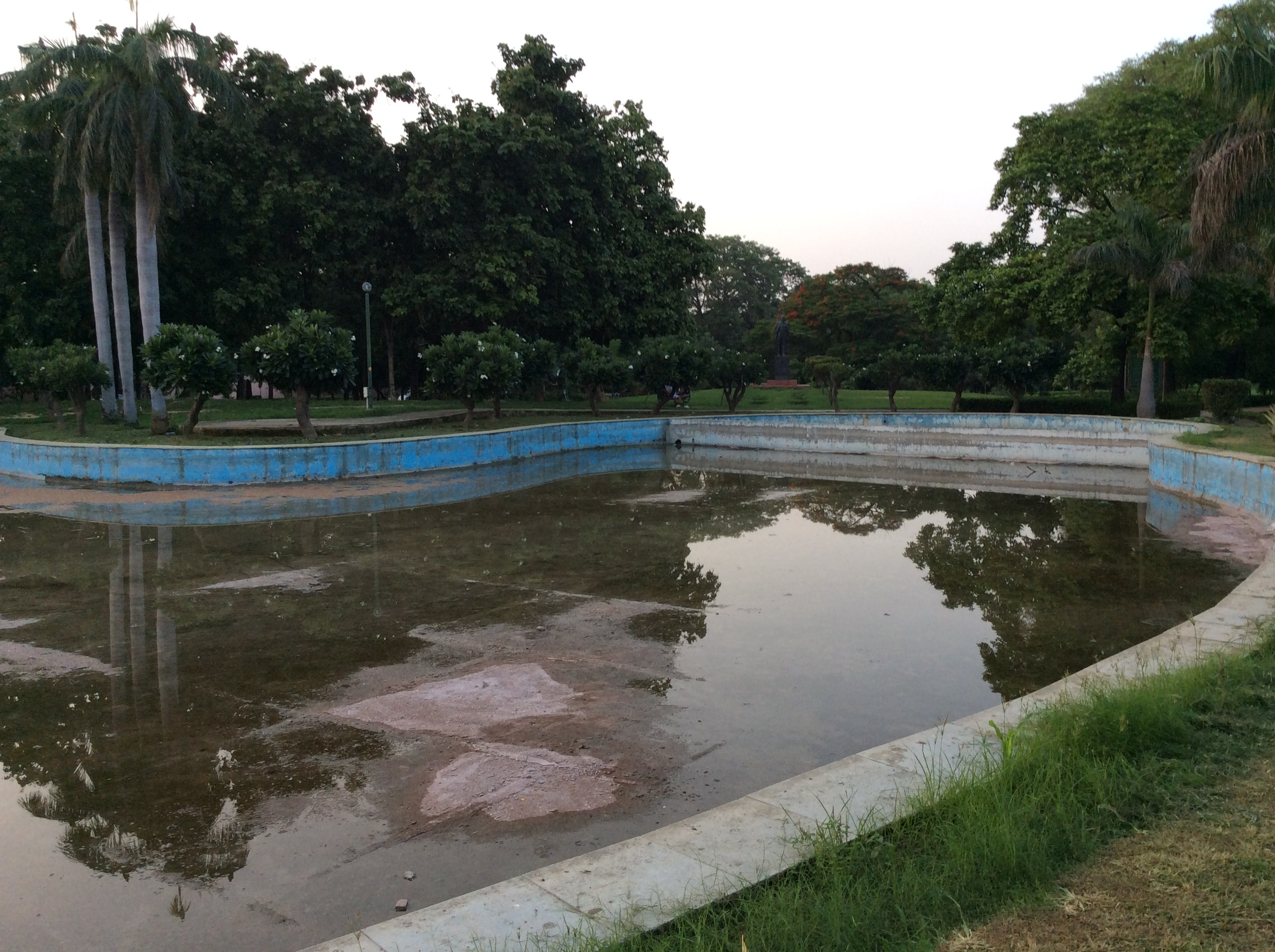
Reflections, Nehru Park, New Delhi
Day 8: Dragonflies. Yellow wings swarm and swirl by the hundreds above the trees outside my window. (Aren’t dragonflies viewed as good luck in Far East Asia?)
Day 9: Drooping collard greens in the window box. Leaves curling under, as if to hide from the afternoon’s oven heat. What appears to be fragile, isn’t necessarily. But even plants have their limits as to how much heat they can tolerate.
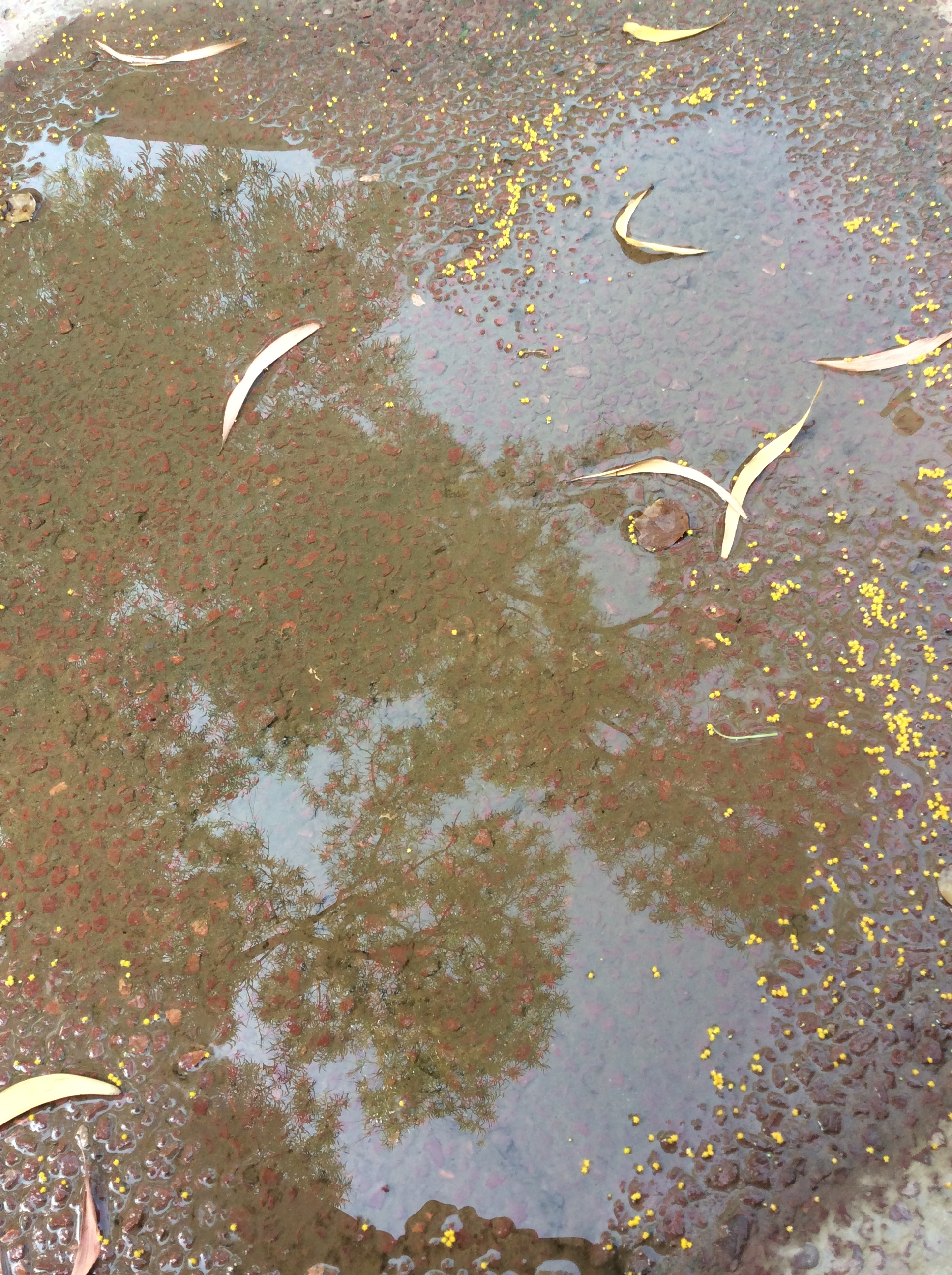
Reflection 3–sky, blossoms and trees
Day 10: The glistening leaves, toss white light as they blow outside the window. One brilliant pink flower, still and unmoved, beneath a harbor of vines.
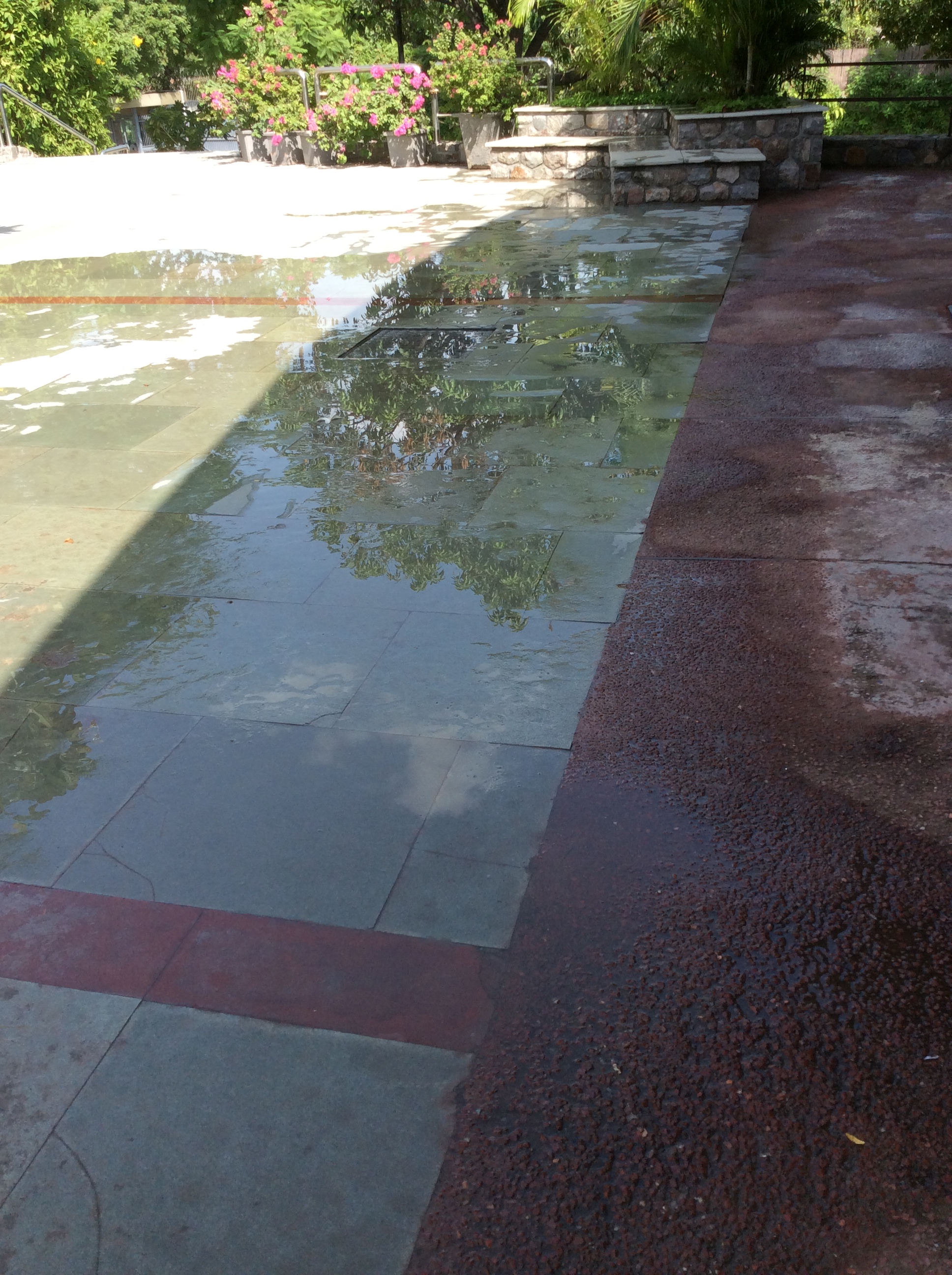
Day 11: A layer of water spreads in thin pools across the stony green path. I walk across the sky and trees reflected there. Water allows stone to become mirror.
What are these observations? I don’t yet know, but surely many of the things I’ve listed here are metaphors for other things we experience in life. What do any our live’s observations bring? Our brains like to create patterns, as I said earlier. They want to make meaning. I want the whole of my life to be meaningful. Writing and seeing are ways into making meaning. They are tools for anyone who chooses to use and cultivate them, enabling us to wrestle with existence, and to find our place in the midst of the current of days flowing through us.
This belief about writing’s value leads me to wonder more of how, through writing, I can better help others find wrestle with and affirm their own questions, explorations, and discovery of meaning. Martin Seligman, talks about what makes a meaningful life. He has done research on what things actually allow people to have a more content, satisfying, whole life. There are three aspects: 1. a pleasant life–defined as experiences of positive emotion, 2.a life of engagement where time stops and you’re in the flow of what you’re doing, and 3. a meaningful life. He explains that the pleasant life, or the presence of positive emotion, is a largely hereditary and that these experiences habituate: Pleasurable experiences are great when you first experience them, but the thrill wears off fairly rapidly. A life that is satisfying is more than merely experiencing positive emotions. This is where the idea of “flow”, to use Mihaly Csikszentmihalyi’s term, comes in. Flow, Seligman explains, is where you are totally connected to what you’re involved in and are experiencing. When you are in flow, time stops for you during that activity. The recipe for experiencing flow, Seligman says, is knowing what your highest character strengths are, and then reshaping your life so that you are connecting to and using these character strengths at work, at play, and in all you do.
Here is his site where you can take a character strengths quiz to help you identify these strengths. Alternatively, you could also take the character strengths survey on this site. Both sites have quizzes for young people as well. The VIA site, gives a variety of ideas for each character strength of what you might do to enhance that strength in your life. The experience of living meaningfully, Seligman says, can be expanded through knowing what your highest strengths are, and then using them to belong to or be in the service of something larger than yourself.
Here are some specific things Seligman suggests in his talk that his research shows people can do to enhance well-being in their lives: 1. Take the character strengths quiz and then once you know your strengths, design a beautiful day that uses and enhances these character strengths. Use savoring and mindfulness to deepen and enrich the day’s experience. 2.Gratitude visit: Write a 300 word testimonial directed to a person that you never properly thanked but that did something enormously important that changed your life’s direction. Make an appointment to meet with that person face to face and read them what you wrote. The positive effects of this experience last for several months, his research shows. 3.Strengths date: couples (and I suggest why not friends, or even enemies as a way of creating understanding) identify their character strengths through taking the strengths test (available on Seligman’s site and at the VIA character strengths site.) Then the couple designs a date or an evening where they both use their strengths. This activity serves to strengthen the bond between the couple. 4.Fun vs. philanthropy: Doing something philanthropic gives a sense of inner contentment or well-being that lasts longer than doing something fun. Do something that helps, enriches, or enhances other people’s lives, and your sense of well-being increases. Through research, Seligman discovered that the pursuit of meaning, in addition to doing things that people find engaging and where they are experiencing flow, contribute to people’s lives at the highest levels of well-being. If you’re interested in Seligman’s ideas, I encourage you to read his book Flourish, where he gives additional specific ideas and suggestions about what enables people’s lives to flourish, and how his research at the University of Pennsylvania is exploring what factors contribute to and nourish a meaningful life. (View Seligman’s TED talk hereabout these ideas.)
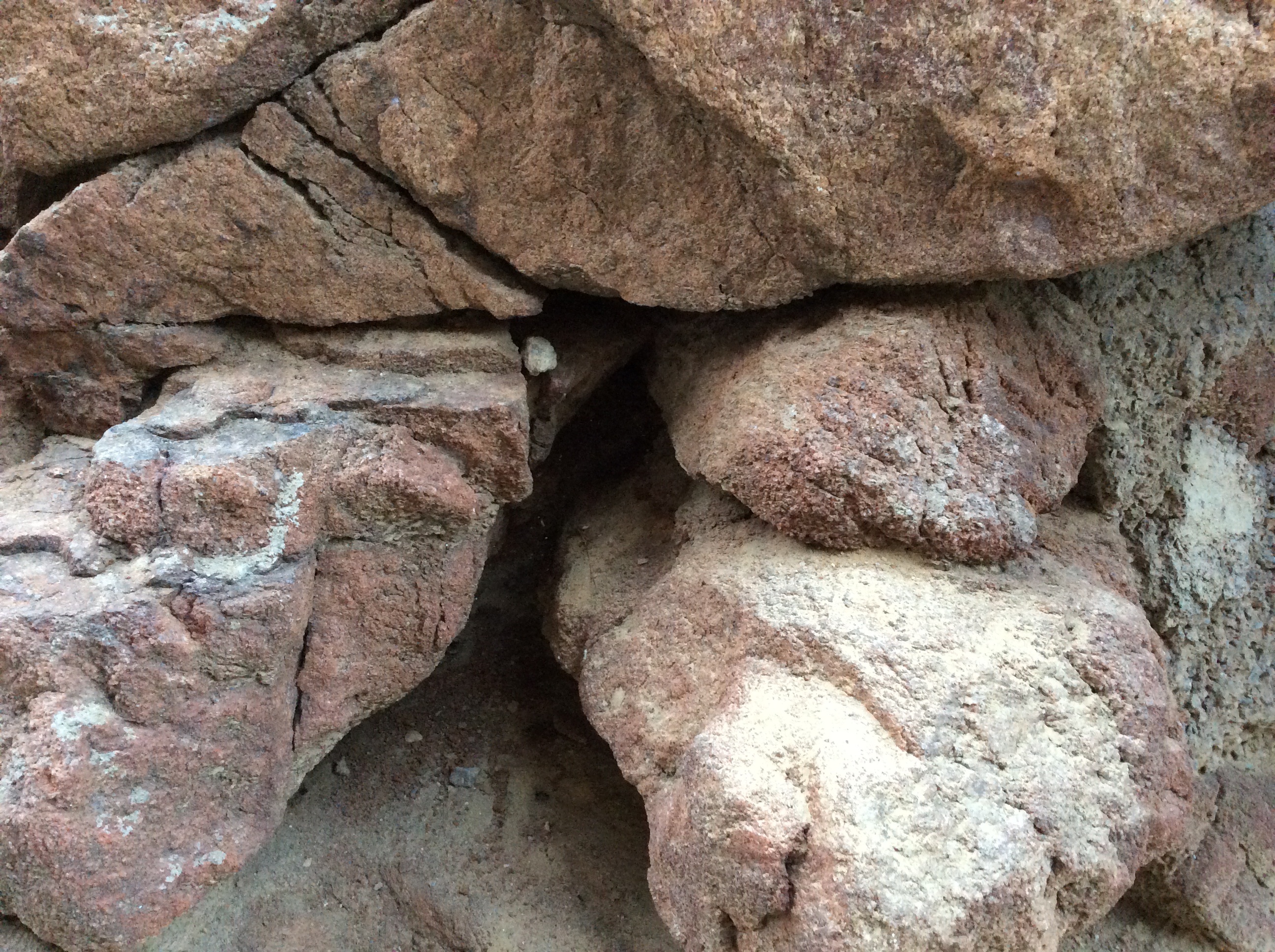
Rock Crevice in the Afternoon: A hollow place.Going Inside a Stone: Rock Crevice at Night, under florescent light.
I began my purposeful observation with the intention of making some cracks in my busyness so that I might find ways to live more purposefully, intentionally, meaningfully. I’m finding the close observations of tiny things are leading me towards some bigger observations and questions. How can I more purposefully keep my aspirations alive? In the work I do each day, how can I continue to renew those aspirations as I apply the skills I have to meet other people’s needs? What I’ve been given and what I’ve nurtured, strengthened and learned, is to be shared. How can I keep that focus before me so life’s meaning continues to deepen? We look and we look again. We explore and play. Step by step, we grow towards understanding of what it is to walk on this earth.
What insights do you have into what deepens your life’s meaning?
As I walked around this evening, out again with the intent to purposefully notice my surroundings, I became acutely aware of the noise that surrounds me. The neighborhood hums with machinery, electricity’s high pitched whine, and the roar of generators. Even inside the room where I now sit, a machine drones away on the other side of the wall. Even at rest, the world here whirs.
What if this sound took on life in a different form and became color? Imagine what that world would look like, or any world where sound became color, as if synesthesia were possible for a day. What would different things we see become if they were sound? Would we respond to noise differently than we do now?
The way we view a place is, in part, the associations we have with the sound. I will always remember my months at Lincoln College, Oxford for the bells that rang through the city in the evening. I will remember Izmir, Turkey for the peddlers walking down the street calling out “Aygaz,” followed by a dinging bell, and Izmir, again, for the mosque calls ringing through the cannoned walls of apartments in the morning’s early hours like a thousand voices calling out all at once.
When I return to my home in Santa Cruz, I am always stunned by the purity of the silence at night, in the morning, and how it seems to flood over me like a blessing, my whole body giving itself to a quietness so beautiful, so rare and set aside from other experiences of places I know that it feels I enter into a kind holy space–my whole body sighing in a kind of inner relief.
But of course sound can be more than noise. It can also be beautiful–the voice of the ones we love is always a sound that resonates in our hearts with happiness, and what could be a better antidote to noise than that sound which is like music?
A couple of weeks ago, I discovered Franco Corelli’s voice as I was looking up “Torna a Surriento.” What a magnificent presence his voice has–rich with the intensity and depth of life that wells up from the longing in the soul that opera evokes so well, bringing the listener totally inside the moment of the sound rising from the singer’s body. Here is Corelli singing “O Pase d’ ‘o Sole.”
The noise of the world only makes sound and silence all the more precious.
What do you hear today? What are the sounds around you telling you?
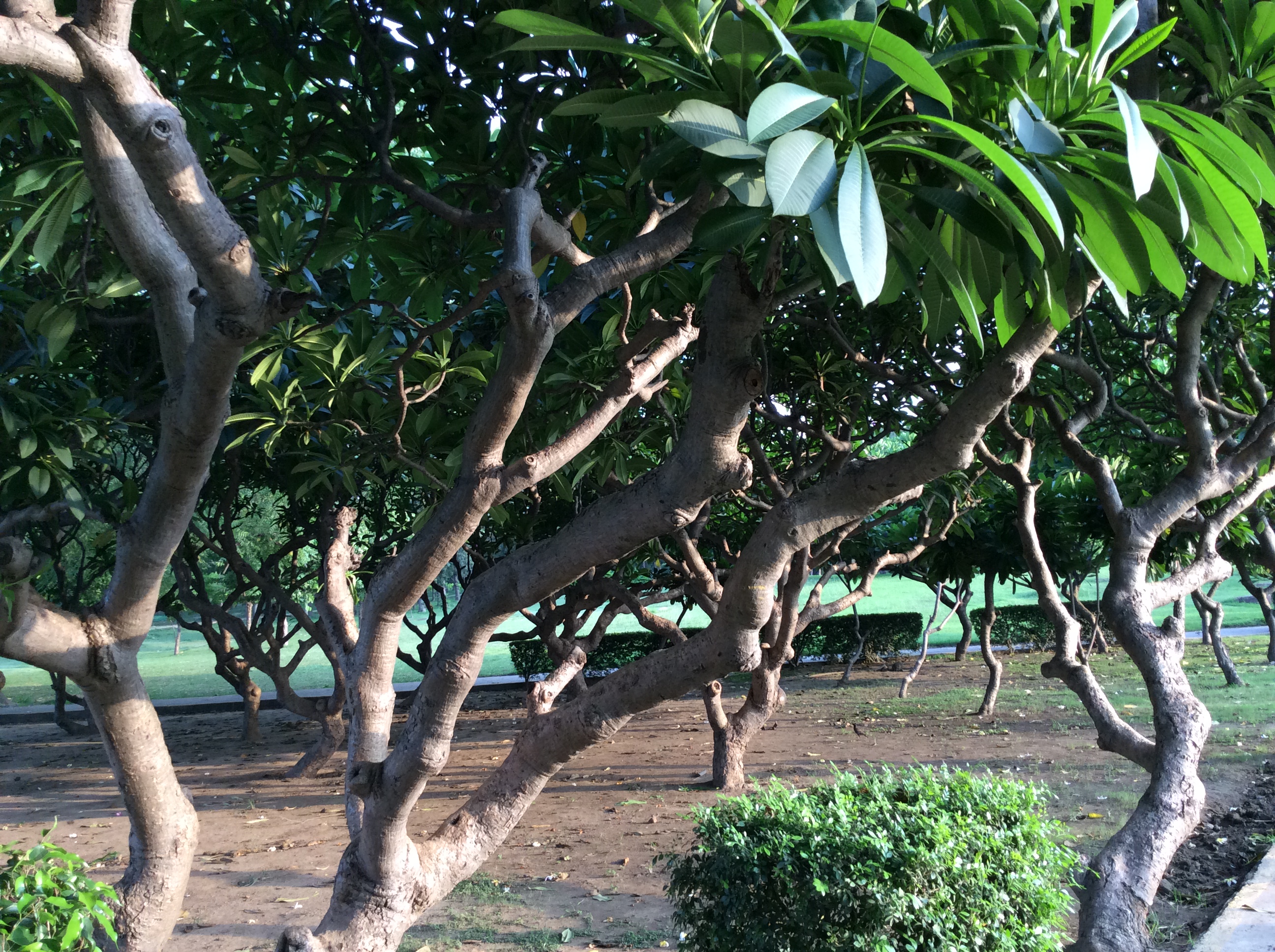
Today my walk involved walking through Nehru Park to a grocery store in Yashwant place. The late afternoon light cast lovely shadows on the tree trunks. I love the twisted turns and organic lines of the trunks and the character they hold. No straight lines here, and that is a refreshing thing to behold. I love the freedom in twisting, turning forms. It’s as if the trees are dancing while holding still, rooted to the ground.
This is so different than the palms I passed on the way home who were all about straight lines and angles–as you can see below. It makes me think of the variety of personalities we have in the world, some of us are curved and turning lines, others of us straight angles. The diversity makes us richer.
I am including these observations so that those of you trying to do this or not sure where to go with your observations can see a couple of examples. The items you notice don’t have to be significant, just something you looked for, then gave particular attention to for a time.
The idea is to notice just one thing, but if you want to notice more, that’s fine. I am including these as examples. I’ll include one last one here so you can see a different type of observation possibility, the interesting things in the world around you, such as might be found at a grocery store. What I love about the grocery stores here in Delhi, and throughout India is how much can be fit into a small space, and how much color there is on the shelves. I wonder what other people are noticing today where you live.
Over the past few weeks I’ve been doing further research about Italian immigrants in San Francisco, San Francisco in the early 1900’s, reading some of Billy Collins’ poetry, editing a couple of articles to send out for possible publication, barbecuing pizzas with my husband and friends, listening in Spanish to some cultural programs about food in various regions of Spain, along with various other things important for me to keep abreast of things at my work, which this year, again, includes totally new systems and ways of approaching things.
Just One Thing—Simplify.
About three times a week I get to the swimming pool, the gym about twice, and I aim to go on walks, though recently these have been fairly short. While I’ve done a number of things I want to do, drawing, as I was doing during the summer months, has now diminished to less than one page of drawings a week in my sketchbook. Books I want to read wait on a table. The clarinet I finally got out of the carry case last year with the intention learning to play currently sits on the shelf. I want to feed the things I’m passionate about. The reality is that each of these things takes time. To sum it up, there are many more things I want to do than I have time to do. Whatever it is we want to do or be takes practice, and this includes reshaping our life to live in a way that enhances our own well-being and sense of wholeness. For decades, I have pondered Thoreau’s quote from Walden, “Simplify. Simplify.” This still isn’t easy to do.
This past week I viewed the program, “Killer Stress–A National Geographic Special with Robert Sapolsky.” Sapolsky, a neuroendocrinologist, biologist, and researcher at Stanford University, explores the effects of stress–how it ages us more quickly, reduces our health, and cuts into our well-being–and yet how multi-tasking and stress is actually valued and promoted in our culture. Stress is difficult to escape. We all live in a social system. How can we live as free people, rather than slaves to a system that positions competition, power and financial success as centrally important? Sopolsky’s research lead him to observe how a troop of baboons, animals that are known to be aggressive, combative and nonsocial, became peacefully cooperative and nonaggressive after the dominant males suddenly died off as a result of contracting tuberculosis. The encouraging news in this study is that even though aggressive and destructive habits had been the way the baboons had functioned for decades, when they entered a new social construct where the aggressive males died, the whole community was able to become peaceable, even when new baboons entered the community. (See more at “Warrior Baboons Give Peace a Chance.”) Maybe there is hope for us too.
In his essay, “Slavery in Massachusetts,” Thoreau says, “It is not enough to be industrious; so are the ants. What are you industrious about?” In his essay, Thoreau admonishes readers to place their humanity before money, before laws– “policy is not morality,” suggesting that if we want to live humanely, we must place the way we relate to each other at the center. We must consider what it means to live wholly, what we mean when we say we want to live not as slaves to industry, but more fully.
What are we industrious about? What do we want to harvest?
So, how does this hopeful change where baboons learn how to live together peacefully apply to our own lives? Many of us continue to live in aggressive societies where community and connectedness are not held as central values, where diverse ways of seeing, being and unique contributions are not seen or held dear because the system is rolling down the track like a locomotive train, intent on getting on with whatever its own vision is. In her recent article on Brain Pickings,“The Shortness of life: Seneca on Busyness and The Art of Living Wide Rather Than Living Long,” writer Maria Popova quotes Roman philosopher, Seneca “It’s not that we have a short time to live, but that we waste a lot of it. Life is long enough, and a sufficiently generous amount has been given to us for the highest achievements if it were all well invested…Life is long if you know how to use it.” This is a stunning, paradoxical thought. We have time! As Thoreau suggested, it’s not that we’re busy doing something–what is it we are busy about that eats the time that would allows to understand we are living fully? Are we nurturing our passions–the things that makes us feel connected to our heart’s deep need and fully alive? If life is long enough if we use the time we have to fully live, how do we reshape our lives to do that. If, like many of us, we find we need to be on the institution train for a period of time, how can we still make use of the station stops? How do we open the window and feel the breeze and make sure to look up and notice the dragon flies swarming above the nearby trees?
In the hopes of recovering more life and a sense of space inside myself, I’m aiming to practice the act of purposeful noticing–looking for one small thing each day to connect myself more to the heart of the days I’m living–to the physical world, and to the life of those around me. I want to release myself from the world of walls, at least briefly every day, and every day remind myself that I am alive in a physical world full of wonder. I reside in a body that is allowed to wander and walk here on this earth. Walking, Ferris Jabr tells us in his recent article in the , “Why Walking Helps Us Think,” not only improves our memory, attention, and staves off degenerating brain cells, it also, through its rhythmic quality, creates a mental state that nurtures creativity and innovative ideas. Now that’s wonderful news!
I’ve decided to take a small, probably slow walk each day, and will couple it with a practice Naomi Shihab Nye suggests people consider–the practice of writing down just a few lines a day, maybe three, for example, of things I notice and observe. A short walk and three lines are manageable. I plan to try this for 40 days, a length of time long enough to notice change but short enough to feel doable. My desire is to observe how this small act might shift my thinking, perceptions of time, and way of being and living to allow me more of a sense of freedom and connectedness to the physical world around me.
I began my first observation yesterday, with noticing the tree in the school yard that was suddenly cut down. The tree has been a focal point of observation I’ve returned to many a morning over the last seven years as I’ve watched birds gather in that tree–crows and kites mostly. Last year, the tree was struck by lightning and was in distress. Its center branches had dead. Then, yesterday morning, I heard the sudden crack from my apartment as the tree’s center trunk broke apart–the result of the school’s gardeners pulling it down. Only this past Tuesday I had been standing next to it, noticing the sap dripping down its sides at various points on its trunk, as if it were grieving over the recent difficulties it had experienced. All day, the gardeners were cutting up the trunk and branches. Now the tree is half its original size. Everything changes. What was once present, is suddenly gone.
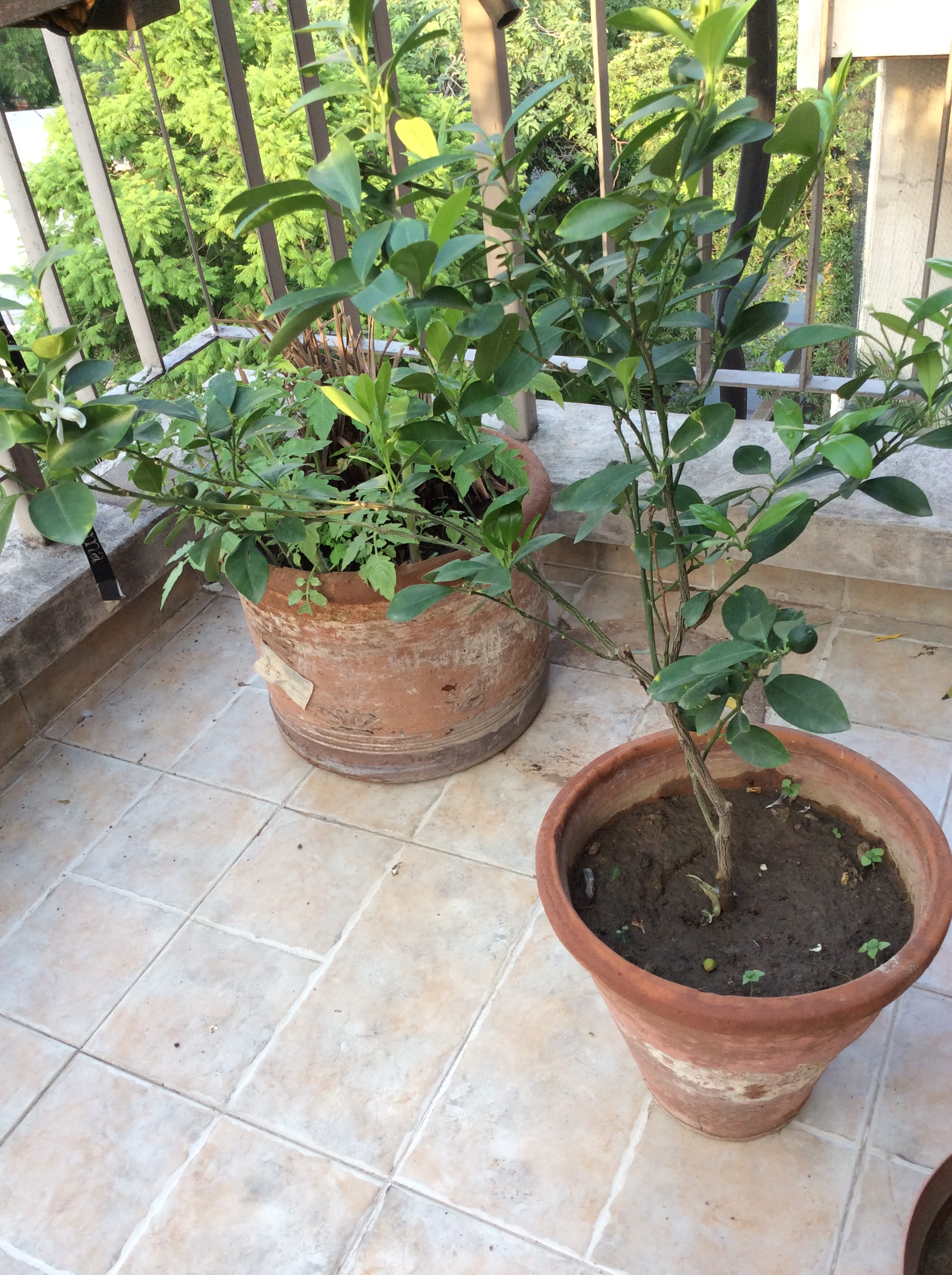
Observation: Lime tree with fruit and blossoms
The photo here shows today’s observation, our lime tree, one year old and putting out an abundance of leaves, blossoms and tiny fruit. It is a happy tree, ready for a larger pot. We hauled up several new plant containers four flights to place on our balcony with the hope of enhancing our garden there. The lime tree is thriving. We had orange groves the entire time I was growing up. When I smelled the one blossom that’s currently open, I was reminded of my mother who always sent me orange blossoms in the mail after leaving home. Citrus blossoms are always sweet.
I’ll post later the other things I observe in the coming week, and invite you to try this along with me and let me know what subtle things begin to shift in your own awareness over the course of time–what it is you discover through the practice? Do you feel an increased sense of health, awareness of nature, gratitude, wholeness, connectedness to life, your neighborhood, or the world? What is it that happens when we practice grounding ourselves in place, when we pay attention to the suchness of things? If forty days is too long for you, try 20 or four and see how that goes–whatever feels right for you in your desire to shift things in your life.
being to timelessness as it’s to time,
love did no more begin than love will end;
where nothing is to breathe to stroll to swim
love is the air the ocean and the land…
Love is the voice under all silences.
—
I want to listen inside that silence and notice the miracle of love that holds me up day by day.
I’m starting another year in India. Again, as I travel the streets I see the need everywhere around me. The need has been there even though I wasn’t here to see it. There is so much need in our world today. Often, it has seemed overwhelming, so enormous that it has made it difficult to start when I consider what it is I could do to respond to it. I am learning that the enormity of the problem is not what to focus on. Instead, it’s better to focus on the small thing that I know I can begin with, and to begin there. That small thing, like a seed can grow, and the small thing can be a help to those who receive it. In our world, often what is big is valued. What is abundant is sought after. But in the world of the heart, the small thing can be enough.
Several years back, while teaching a unit on the five major world religions, I noticed how in Judaism the 10 commandments say to rest on the sabbath right alongside the command to not kill and steal. I began to wonder why so much significance was given to resting. I usually felt I didn’t have enough time to complete the work I was given or felt I needed to do. As a result, I rarely took the time to do the things that fed my soul like writing or going out in nature. I felt I was only living half of a life.
Earlier, I had read portions of Wayne Mueller’s Sabbath, Restoring the Sacred Rhythm of Rest and Renewal. The book planted an important seed and was a voice that enabled me to see that the unrest I was feeling about the obligation to work almost without ceasing was actually something others were experiencing as well, and that such an approach to life actually causes a kind of violence–an inner disturbance which can then be transferred outwardly into our lives. In his book, Mueller quotes Thomas Merton who said, “The rush and pressure of modern life are a form, perhaps the most common form, of its innate violence. To allow oneself to be carried away by a multitude of conflicting concerns, to surrender to too many demands, to commit oneself to too many projects, to want to help everyone in everything is to succumb to violence. More than that, it is cooperation in violence. The frenzy of the activist…destroys his own inner capacity for peace. It destroys the fruitfulness of his own work, because it kills the root of inner wisdom which makes work fruitful.” Reading that for the first time stopped me short. There was a deep truth there that called out to me, and I know I needed to learn from it.
Most of us want to do something to help make the world a better place, and as Desmond Tutu, Jim Wallace, and others on this short video describe, it doesn’t have to be something big. Small things matter. We don’t have to feel guilty about what we’re not doing or if we are doing enough. What matters, I think is not how much we do, but what we do with an open heart. Relationship matters. I’m struck by what Wayne Mueller says in this short video about what is enough. We can only hold so many eggs he says, and at a certain point, we try and hold one more egg and something will get damaged. “We can only love well, kindly, thoroughly, a very few number of people in the course of a human life.” Mueller explains, and he goes on to suggest that what we do with our lives, instead, is to hold a crucible of something small and true, to offer not miracles, but ourselves. This a place we can give something that is real and valuable. In that giving, he implies, is something of meaning, something true.
I like the way Wendell Berry’s poem below, explores the idea of how we can be stirred, from time to time, to begin something new, to go elsewhere. How often has it seemed that doing something more or moving on could be an answer to the dilemmas of life we are facing. Sometimes that is the right thing to do. We see as the poem moves on, however, that the place the speaker of the poem ends up actually going to is in his mind–to a quiet place where he can think, or not have to think at all–and instead, he watches light filling the space between leaves. This is the sabbath time, space among leaves where wakefulness can occur.
The Thought of Something Else Wendell Berry
1.
A spring wind blowing
the smell of the ground
through the intersections of traffic,
the mind turns, seeks a new
nativity—another place,
simpler, less weighted
by what has already been.
Another place! it’s enough to grieve me— that old dream of going, of becoming a better man just by getting up and going to a better place.
2.
The mystery. The old
unaccountable unfolding.
The iron trees in the park
suddenly remember forests.
It becomes possible to think of going
3.
—a place where thought
can take its shape
as quietly in the mind
as water in a pitcher,
or a man can be
safely without thought
—see the day begin
and lean back,
a simple wakefulness filling
perfectly
the spaces among the leaves.
While visiting southern California recently I got to wander out into the hills outside of Wildomar and experience again a landscape similar to the one I wandered in as a child. At first glance the landscape seems semi-barren. Though there are few, if any trees, low chaparral grows in abundance, especially the beautiful red California buckwheat. The ants especially loved this plant, and numerous flower petals spread in a mandala around the ant holes. The flowers have a sweet smell, and the seeds are edible. At sunset, the light made each thing on the earth’s floor stand out distinctly. So much texture in the bark of broken shrubs, scattered rock. The hillside were alive with their blossom’s red rust blush. Truth, beauty, and goodness abound when we set out to notice them. Standing in the presence of beauty is too much for one person to hold. Overwhelming beauty is humbling and helps us to see our place in the vastness of all that is. It enables us to understand that the world is not ours, it is shared.
Wildomar sunset
In the Harvard Gazette, Howard Gardner advocates revisiting the values of truth, beauty and goodness “suggests keeping lifelong portfolios of beauty, either in our brains or a physical catalog that chronicles the experiences, music, art, and more that we find beautiful over time.” I’m thinking of hummingbirds, how they feed frequently, coming back to the flower repeatedly in order to maintain substance. As we do this, what is beautiful, good and true expands in us.
With its wide valleys and minimal vegetation, southern California has a wonderful sense of openness, and the sunsets this summer carried me away into the ecstasy of their expansiveness, and the sense of freedom they invoke. The skies filled me with awe in the vastness they evoked. I wondered why everyone in the neighborhood had not thrown open the doors, and walked out into the arms of the world waiting for them to see the boundless beauty above and around them. The world is a wonder if we open our eyes to see it.
Wildomar countryside
So many people today are wondering how to live well, how to find their center. Returning to Gardner, he states that what we need to do now is to learn how to behave not just for “numero uno, or for your neighbors, but for a wider public.” One start, I think, would be to consciously look for beauty in the world. Notice it, delight in it and share it, and thereby help others to lift their hearts into a deeper understanding of their own connection to life and to each other.
“Live as if you were to die tomorrow. Learn as if you were to live forever.” –Gandhi
“It is not that I’m so smart. But I stay with the questions much longer.”
–Albert Einstein
“The best thing for being sad,” replied Merlin, beginning to puff and blow, “is to learn something. That’s the only thing that never fails. You may grow old and trembling in your anatomies, you may lie awake at night listening to the disorder of your veins, you may miss your only love, you may see the world about you devastated by evil lunatics, or know your honour trampled in the sewers of baser minds. There is only one thing for it then — to learn. Learn why the world wags and what wags it. That is the only thing which the mind can never exhaust, never alienate, never be tortured by, never fear or distrust, and never dream of regretting. Learning is the only thing for you. Look what a lot of things there are to learn.” –T.H. White, Once and Future King
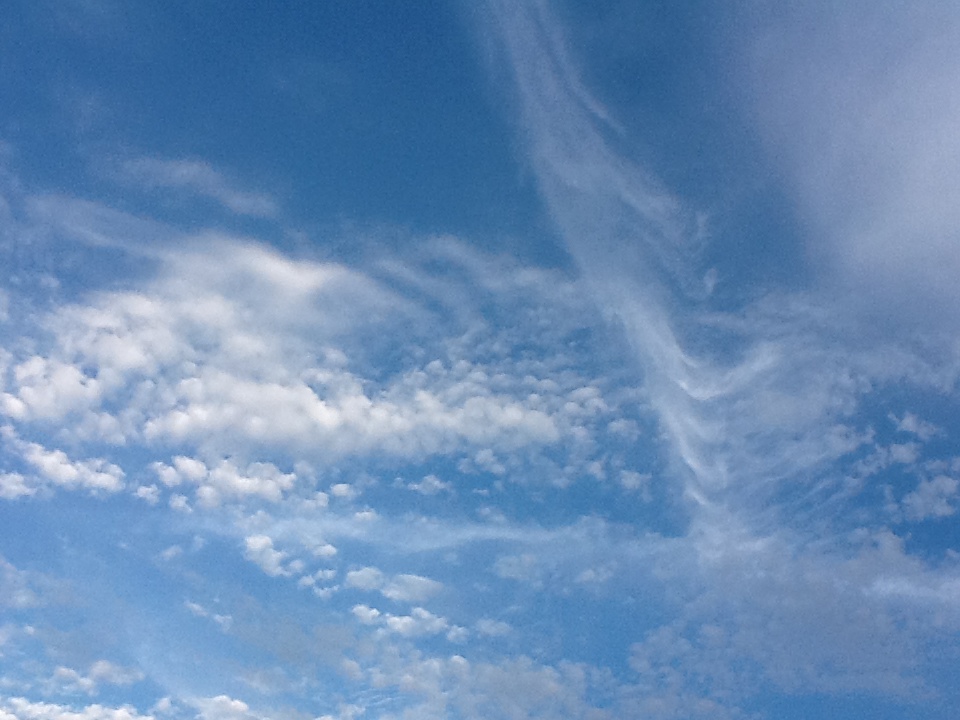
Frequently this summer I’ve been looking at clouds, the way they grow and contract before my eyes, sometimes so imperceptibly I wonder if it’s happening, other times so rapidly I wonder how they can do it. Gazing at the sky may seem like a mundane thing to do, but I recall many a time as a child lying back on the chairs outside my house and watching them glide by for hours, morphing forms as they paraded by as if on a slow moving carousel.
There was something soothing about those quiet afternoons. They carried me into a place, that looking back on it now, I can describe as a place of communion. Like staring at a campfire, the experience enabled me to enter a state where the world dropped away and I was absorbed into the moment, fully present in the simplicity of being. I call it a state of communion because even now, years later, while cloud gazing I find myself entering the same place in the mind and body, connecting with the environment where words aren’t needed, nevertheless communication is happening. I see the images, color, shapes–they are all showing themselves to me and something in myself is responding with more than a mere physical reaction. I hold and behold the forms, and in doing so, I am learning about the changing nature of the world and how I participate in beauty.
Though I gazed at clouds more often as a child, still today when I look up at the sky after waking up or as I walk home from work, something in me longs for the the open sky I experienced as a child, the vast, spacious world the mind can wander in. A hazy, flat sky flattens the mind. On days when the haze lifts, my heart feels freer, more content and at home. It’s refreshing to be reminded that shapes can also have forms with soft edges that float.
Our connections to the environment we grow up with influence who we become and leave an indelible mark. The house my father built and that I lived in as a child in San Diego county was perched high on a hill looking over a wide valley. We lived in a rural area with hills rimming the distant horizon, a geographical location that shaped my soul, so to speak: Living there nurtured a value of open space and encouraged in me the qualities of observation, reflection, and of taking the long view of things, values fundamental to my understanding of the world.
Earlier this summer I was recovering from a knee injury. Because moving around was slow and uncomfortable, all walking became a focused effort, each step a meditation. Immediately the world felt smaller and more challenging as a result. There seemed to be so much I couldn’t do, and I was surprised by how vulnerable and limited the injury made me feel. During that time, I was visiting my brother. I rested on his deck one morning, looking up into the enormous billowy clouds. Once again the world grew into itself, the largeness of it stretching out with the length of sky like an enormous blue sheet hung out across the universe, shifting in the solar breeze. Little had actually changed except my perception. I couldn’t move any faster than before, but staring at the passing clouds reminded me of the larger reality I was a part of, and brought me back to that place of wonder I participated in as a child. Just as clouds change forms, so does my life, and any suffering I might experience. Any suffering I might know, however small or big, is just a part of the larger suffering of the world. In the world there is pain, but there is also great beauty. Both coexist, and reality is a state of flow between them in different measures.
Not all of us live continuously in a world with natural beauty. I know I don’t. Countless others are like me–those who live in smog choked cities, those without access to green space and parks or who spend most their time in rooms without windows working under fluorescent light. Though we may not have access to it, the world’s immense beauty continues on. When I am in a place with natural beauty, I want to really notice it, pausing to take it in, to be thankful, and to consider all the processes of nature it took to create what I am experiencing. I want to remember often how open skies and time spent beholding them can restore.
When I am in a place that lacks beauty, when I find myself living there, I can also look up at the sky and know that beauty’s absence I that place will help me to recognize how precious beauty is when and wherever it is found. I can let this awareness fill me with gratitude that I have seen beauty, have beheld it, and hopefully do so again in the future.
I am reminded of Wendell Berry’s Sabbath’s 1999 poem, and how it values the small, quiet moments, emphasizing the importance of noticing and learning to rest in them, moments like looking at clouds.
VII
by Wendell Berry
Again I resume the long
lesson: how small a thing
can be pleasing, how little
in this hard world it takes
to satisfy the mind
and bring it to its rest.
Within the ongoing havoc
the woods this morning is
almost unnaturally still.
Through stalled air, unshadowed
light, a few leaves fall
of their own weight.
The sky
is gray. It begins in mist
almost at the ground
and rises forever. The trees
rise in silence almost
natural, but not quite,
almost eternal, but
not quite.
What more did I
think I wanted? Here is
what has always been.
Here is what will always
be. Even in me,
the Maker of all this
returns in rest, even
to the slightest of His works,
a yellow leaf slowly
falling, and is pleased.










 Anna Citrino---Poetry, Place, Pilgrimage