Uncategorized

Perseverance and Practice: Doing Art

“Art is a spiritual practice. We may not, and need not, do it perfectly. But we do need to do  it…Focused on our art, we connect to the artful heart of life. The creative pulse that moves through us moves through all of creation. It could be argued that creativity is a form of prayer, a form of thankfulness and recognition of all we have to be thankful for, walking in this world.” –Julia Cameron, Walking in this World

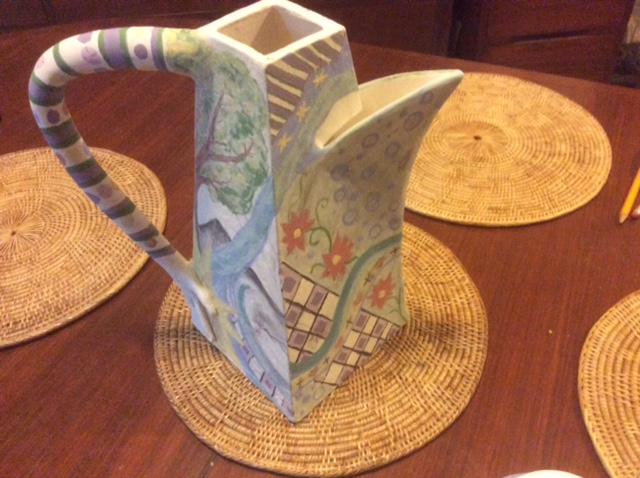
All morning I’ve been painting on a ceramic teapot that my husband made and called “The Mad Hatter’s Wife.” It’s a tall pot that narrows as it reaches the top. The lid is actually the head of the Mad Hatter’s wife. My husband gave her to me to paint, and in coming up with an idea of what she looked like, I figured that if she is married to the Mad Hatter, I had to make her be a woman who has a good deal of inner power. This would be necessary if living with a crazy man. Though hatters at the time Lewis Carroll was writing went mad as a result of repeated exposure to mercury vapors in the felting process, like also attracts like, and my hunch is that the Mad Hattter’s wife was probably a bit “mad” as well.

IMG_5333
Mad Hatter’s Wife tea pot lid (work in progress)

Married to a “mad” man, she’s likely a bit more individualistic and unique than others around her, and a bit more socially unacceptable as a result. She would’ve had to listen to her own inner voice and follow her own path. Thomas Moore said, “It is only through mystery and madness that the soul is revealed.” The underglaze painting for the Mad Hatter’s Wife needed to reveal the soul of woman connected to her inner power and creativity, I decided. Perhaps she’s named Breena or Brucie, Alva, Erline, Orla, or Tiana– a name having to do with elves or fairies. She’s got to be a bit sassy, too, I’m guessing, as her hand is placed on her hip, and her hip explodes in a sunflower. A woman who has never lost her inner child, I’ve made her body a bit ocean, tree, river, bee, bird, mountain and rainbow. Hers is the kind of madness that keeps one sane. She wears crystals on her arm, and my guess is that she probably can fly (at least in her dreams.)

Mad Hatter's Wife teapot in progress
Mad Hatter’s Wife teapot in progress
Mad Hatter's Wife teapot in progress view 2
Mad Hatter’s Wife teapot in progress view 2

My husband, Michael, gave me the teapot to work on last week, suggesting in a off hand comment to someone that I was going to make it my masterpiece. After hearing that, I realized I needed to paint her in the way that pushed the craftsmanship boundaries beyond what I’ve previously done. (You can see my previous work by going to the Art and Poetry Connections page here on my blog.) Though I want to make her wonderful, the work isn’t turning out as wonderful as I’d like. I want my craftsmanship to be better, but I’m still learning how to control my brush and the flow of the glaze. Different glazes have different textures, and they don’t all flow smoothly or the same. Drawing a perfectly straight line with the brush is difficult. I want the glaze to flow exactly where I want it, and that doesn’t always happen. The materials have their own way of being. I have to marry my effort to the nature of what I’m working with so that I communicate compatibly. Like any relationship, the understanding of how to make the connection look effortless and take on the magic expression of soul takes time.

The element of time and perseverance is something I’ve been thinking about repeatedly this past couple of weeks. It is nearing the end of the school year here, and as often happens when things come to an end, some things unravel while others fall apart so that something new can come into existence. Sometimes reality seems like a series of dreams. You live in one world for a time, and then that phase comes to an end. The location you’ve made your home is no longer yours, and you move somewhere else, take on a new job, or whatever: reality shifts. The whole world changes, almost as if you’re reincarnated. There are so many possible worlds! Even for those of who stay in the same place decade after decade, things still change. All around us the world is changing. What I’ve really been wondering about, though, are the people who have lived in countries where there has been a civil war, or an event like the earthquake in Nepal, where suddenly everything they thought they understood about their world and the foundations they stood on has changed. It takes decades to recover. How do they cope with it? How does anyone keep going in such situations?

Light is such a wonderful thing. I love a room full of light, sun streaming through the trees on a cloudless summer day. When I lived in Riyadh, though, I treasured clouds, and with it, the rain and the darkness–storms, because these were rare. I remember sitting on the edge of the escarpment outside the city and hearing the camels far below calling. If you have the opportunity to watch camels walk, you can notice how graceful they are. The heat can be relentless, the light unbearable, but camels somehow continue on. It made me think about the dark areas in our lives, the shadow places on earth that lie beneath the surface, or that track by in shifting movement–the things, people and places that do not or cannot speak directly. These things speak in language without words, giving voice to the things that can’t be said. Here is the poem I wrote about this when living there:

PERSEVERANCE
Anna Citrino

Black camels lift their calligraphic legs writing invisible letters
across the desert sand, as if drawing up the shadowed calm
hidden inside the light imprinted on the desert floor.

The camels raise their dark, slender limbs and casually wander
through the heated brightness, wooly heads held up
with muscled grace, an act of ease

with no thought of pain or fire. They know how to store water
to carry them through dry and cloudless seasons.
I have heard them groan, the guttural sound

reverberating from deep in the belly like the rumble
miles down inside the earth before the shudder
of tectonic plates. Their voices pull up

the yearnings of hidden worlds, let go the grief
from inside the nameless forms that cannot speak or see.
The camels are the shadows we seek.

Watch them from high up on a cliff, the trails they etch
into blind and heavy earth, letters of unsaid
stories the sun refuses to speak.

________

The writer, Edna Ferber said, “Perhaps too much of everything is as bad as too little.” Camels’ embody perseverance–this nameless longing we have, the suffering of waiting as we trek across deserts, but how do we keep going like they do through the times of heat and emptiness? Though camels can keep walking through the heat, before heading out into shade-barren land, they drink enough to help them hold out. This is something we, too, need to do. We need resources to keep us going. For me, one of the great resources to help me through times like these is art–art in the form of music, poetry, writing, painting, or dance.

IMG_5301
Flight of the Mind writing workshop. Lucille Clifton third from right. Anna next to Lucille Clifton on the right.

Back in the 1990’s I took a workshop with the poet, Lucille Clifton at the Flight of the Mind writer’s workshops (now no longer in existence) outside of Eugene, Oregon. At that workshop, I recall Clifton explaining how poetry humanizes us. “As long as one person is writing poetry,” she said, “the world will be a more human place.” Her words stuck with me, and have gained weight and significance over time. In the act of creating, we transform ourselves and our world. When creating, we are communing with our inner selves, but art, music, poetry, and dance are also communal acts in that they are meant to be shared with others, and in so doing, we reconnect ourselves to others and to our Source.

In Rattle’s interview with Maria Mazziotti Gillan, Gillan describes her journey as a writer to find her truth. “I think poems are in a very deep place inside yourself,” she explains. It took her time to realize who she was as a poet, and this is the risk she encourages others to take as well, to “move down into yourself, and tell the truth.” This confrontation with the truth of ourselves is what transforms us. When creating, we enter into a place of deep listening. We are making a poem, for example, but we are also listening for the words to rise up and connect us with our work. This is what prayer is too: listening. Communing. And art, whether it is writing, music, painting, photography, or dance is a vehicle for listening to our own truth. The deeper we can go into that place, the more we can be transformed. Fiction writer Frederich Busch explained “Good art is a form of prayer. It’s a way to say what is not sayable.” When I write, when I paint, I am connected body to soul, and it allows me to feel alive again, to feel whole. This is how we can all persevere: we go back to a place where we reconnect body and soul–to the creative act, the practice of art.

A couple of millennia ago, St. Paul wrote to the Romans, “For we know that the whole creation groans and suffers the pains of childbirth together until now. And not only this, but also we ourselves, having the first fruits of the Spirit, even we ourselves groan within ourselves, waiting eagerly for our adoption as sons, the redemption of our body.” Everyone suffers the pains of waiting, of trying to hold on and hold out–to persevere–even creation itself. It’s almost as if loss and suffering are necessary parts of beauty. We sense beauty more keenly when we are aware of loss. Yet, it’s out of this longing and suffering beauty arises.

In Arun Kolatkar’s poem, “An Old Woman” an old woman grabs hold of the speaker’s sleeve, an experience I’ve had myself here in Old Delhi. The woman follows the speaker, begging, and she won’t let go. The speaker wishes to be rid of her, but when the old woman says, “What else can an old woman do/ on hills as wretched as these?” something in the speaker shatters. Her question splits him open, and the world around him as well.

You look right at the sky.
Clear through the bullet holes
she has for her eyes.

And as you look on
the cracks that begin around her eyes
spread beyond her skin.

And the hills crack.
And the temples crack.
And the sky falls

with a plateglass clatter
around the shatterproof crone
who stands alone.

And you are reduced
to so much small change
in her hand.

Beneath our clumsy actions, our imperfect voices and art, somehow, sometimes, someone hears us. They see right into us, and inside that look we see the brokenness that interconnects us all. This is India’s gift to me–the myriad people on the streets like the beggar woman in this poem that mirror my own brokenness and need.

And so, we persevere. We live out Lorca’s “Theory and Play of the Duende,

“The roads where one searches for God are known, whether by the barbaric way of the hermit or the subtle one of the mystic: with a tower, like St. Teresa, or by the three paths of St. John of the Cross. And though we may have to cry out, in Isaiah’s voice: Truly you are a hidden God,’ finally, in the end, God sends his primal thorns of fire to those who seek Him.

Seeking the duende, there is neither map nor discipline. We only know it burns the blood like powdered glass, that it exhausts, rejects all the sweet geometry we understand.”

Art is not just for special people who call themselves artists. Though it is very personal, and an expression of the self, art is for everyone. It is meant to be given to the community. In the expression of our particular story, our dance, or song, we see that we have given expression to the larger community, and in that we find our place again in the human family. We are seen and heard, and through the container of that expression we find a way to endure the particular trials of our day or life–we find a way to continue on.

Art transforms us. So, though my lines on the Mad Hatter’s Wife teapot are crooked, my words not all I wish them to be, though my life continuously falls short, I keep practicing. In the end, the work is not only about the object created. The object is merely the container. The practice is the prayer. This is why we do as Kurt Vonnegut suggested, “To practice art, no matter how well or badly, is a way to make your soul grow. So do it.”

Beauty, creativity, spirtuality, Uncategorized

At The Edge of Emptiness

“Prayer begins at the edge of emptiness.”–Abraham Joshua Heschel

IMG_4144

Heschel’s words strike me because there are a lot of things I don’t have answers for. Aware of my smallness in face of the suffering around me every day, I stand at the edge of emptiness and cry out.

When riding out into traffic, I’ve started a practice of looking into beggars’ faces who come to my window, or when someone speaks to me in the market asking for money, or when I see who is suffering, a family living on the street, for example, also animals who suffer, and in my mind I say, “I wish you well.” It’s a kind of prayer, and though it’s not directly answering the needs they have, it’s a way to keep my heart open–to keep noticing even though I might not be able to help the person in the way they ask of me. I want to see their humanness, and to be reminded of my own weakness and vulnerability.

Certainly, even in the lives of the desperately poor, there also must be times of joy. Even so, the human need in Delhi, is great. All the arms reaching out, the eyes–the world’s needs are immense. This week Nepal has its worst earthquake since 1934. The suffering is enormous. It will take decades, to recover, life times to become new, and we feel the grief hanging in the air as we go about our day.

The poverty in this world is not made up of physical poverty only, however. There is poverty of spirit, poverty of heart, and this is where I think that those of us in the developed world have a great lack. Everywhere around us today, from psychologists like Martin Seligman and his ideas about flourishing, to religious leaders like Matthieu Ricard, people are talking about how to be happy. Even Pope Francis has come up with his list of 10 tips for a happier life such as taking time off to be with your family, and spending time in nature. People who study what makes us happy tell us that focusing on what brings us a sense of well being actually helps us to become happier, and of course that is a good thing. But sadness and melancholy are also a part of life, and experiencing sadness and melancholy can help us become more compassionate, as Courtney Stephens explains on this animated TED Ed lesson. We learn from our sadness how to be more human.

I don’t know how best to respond to the sadness in the world, the grief so many feel, but want to give something of myself to meet that need. One must start somewhere, however small. It’s the start that counts. It makes room for greater opening, and I know I need to open.

FullSizeRenderFor months now I have been working on poems on the subject of food. It has taken some time, longer than I expected because new ideas for poems keep surfacing. I am now nearing the end of the poems I want to write for this series. I hope I’ve written well enough that after putting the poems into a manuscript I’ll find a publisher so I can use the proceeds from its sale to give to an organization that helps prevent hunger here in India. I hope it will be of some good. In the process of writing these poems, I’ve also been rereading about creativity, and returned today to Rilke’s Letters To a Young Poet where I read,

“…Everything is gestation and then birthing. To let each impression and each embryo of a feeling come to completion, entirely in itself, in the dark, in the unsayable, the unconscious, beyond the reach of one’s own understanding, and with deep humility and patience to wait for the hour when a new clarity is born: this alone is what it means to live as an artist: in understanding as in creating.

In this there is no measuring with time, a year doesn’t matter, and ten years are nothing. Being an artist means: not numbering and counting, but ripening like a tree, which doesn’t force its sap, and stands confidently in the storms of spring, not afraid that afterward summer may not come. It does come. But it comes only to those who are patient, who are there as if eternity lay before them, so unconcernedly silent and vast. I learn it every day of my life, learn it with pain I am grateful for: patience is everything!”

The need in India has been here for decades. It’s not going to go away in the near future. The sidewalk on the street where I live is in a perpetual state of change. It’s put together one month only to be torn up the next, a metaphor for my own incompleteness–of starting over, trying to make things work, change, to get things “right.” Whatever it is that causes that sidewalk to have to be torn up so often is a mystery. It’s just the way things are here. Likewise, whatever it is we are making or doing with our lives, it isn’t necessarily what we see on the surface. What’s really happening comes from a place far deeper, beyond the reach of our own understanding. I look into the face of my partner who I’ve known for decades now, and find him still a mystery, and stand in wonder. Who am I, I don’t even really know. Definitions, lists and examples aren’t enough to explain. Similarly, how can I in any way touch or meet the vast needs of a world as immense as India? I can’t. As Shakespeare wrote in Sonnet 65,

Since brass, nor stone, nor earth, nor boundless sea,IMG_4080
But sad mortality o’er sways their power,
How with this rage shall beauty hold a plea,
Whose action is no stronger than a flower?
O! how shall summer’s honey breath hold out,
Against the wrackful siege of battering days,
When rocks impregnable are not so stout,
Nor gates of steel so strong but Time decays?
O fearful meditation! where, alack,
Shall Time’s best jewel from Time’s chest lie hid?
Or what strong hand can hold his swift foot back?
Or who his spoil of beauty can forbid?
O! none, unless this miracle have might,
That in black ink my love may still shine bright.

We are all frail and mortal. Beauty’s action may be no stronger than a flower, but still we need that flower. We all need to be touched, to be met, to be needed. So, I write on, my words, tiny splotches on computer screens of light wavering inside the colossal of India’s immensity, prayers of pale petals– ink floating down the Yamuna hoping to touch other lives.

Uncategorized

Solitude, Song & Poetry

When power leads man toward arrogance, poetry reminds him of his limitations. When power narrows the area of man’s concern, poetry reminds him of the richness and diversity of existence. When power corrupts, poetry cleanses.John F. Kennedy

I’ve begun reading Diana Senechal’s book, The Republic of Noise. In the first chapter she talks about the “virtual clutter” of our lives–it’s jittery jangle that has us jumping–and how the slow movement that has caught on because people are trying to fight back and regain something meaningful in their lives. The problem, Senchal suggests is connected to “our weakened capacity for being alone and our dwindling sense of any life beyond the immediate scramble.” (p. 5) Senechal works to define a way of living that is neither disconnected from contemporary society, nor sucked into its whirlpool, and writes to help readers define the “strength it takes to do what we find most rewarding. The strength it takes time to build.”

Artists need hours alone behind doors tuned in to their work, she explains. So do we all. In our scramble for quick answers, she suggests that we may be going against what we really want. We need, instead, to be able to stand alone and apart, to know our own thoughts–thoughts not based on what someone will “like” on a social network site. What we need most of all, Senechal states, is solitude.  “We cannot have meaningful relationships with others unless we know how to stand apart. We cannot learn unless we make room for learning in our minds. We cannot make sound decisions unless we are able to examine the options on our own, in quiet, along with any advice or information at hand. We cannot distinguish fads from sound ideas if we have never questioned social pressures and fashions. We cannot participate in democracy without the deep understanding of the issues at stake. We cannot accomplish anything of beauty unless we are willing to spend many hours working on it alone. We cannot endure disappointment, rejection, bereavement, or distress unless we have a place to join in ourselves. Without solitude, our very thoughts tend toward one-liners. Without solitude, we set ourselves up for halfhearted pursuits. The catch is that solitude, by its nature, cannot be a movement. Each person must find it alone.” (p. 9-10)

I’ve recognized for years that I need a lot of quiet time in order to restore myself and regain energy for the week ahead where I interact with people all day long. I need the time to write, do art, go out into nature for a bike ride or walk. I need the soundless open hours for inner thought in order to gain the strength to go on giving the rest of the week, and it’s affirming to read a book declaring the value of solitude. In solitude, Senechal explains, we get to know who it is we really are and how to hold on to that knowing. We live in a society where collectivism (her word) is promoted. But, without knowing how to separate ourselves from a group, she states, we also won’t really know how to create community because we won’t have an authentic self to bring to a group.  Solitude allows us to confront ourselves–our faults and strengths, and gives us the opportunity to practice becoming who we are. It’s not going to wipe away problems but it will give us a way to “collect ourselves,” she explains, and can help keep us from giving up. When we let go of solitude, we give in to the group because we don’t have the strength to “stand up for something or to stand apart…Without time to stand back or the strength to separate oneself, one has little opportunity to form one’s own thoughts, let alone defend them.” This is the root of loneliness, Senechal suggests.

But where are we encouraged to stand apart, I wonder? Certainly, the arts is a place where individual expression is still valued. This is, in part, why I’m attracted to them. Perhaps it is also a reason why the arts and artists have long lived on society’s fringes. Artists live inside their respective cultures, but also nurture a critique of it. I’m reminded of an interview with Ilya Kaminsky on the Poetry Society’s web site. “Writing about blackbirds, in our day and age, is political,” he explained to the interviewer. Everything is political, he suggests. It’s true. People don’t give that much attention to nature, to our connection to the natural world, so, yes, writing about blackbirds, for example, can be a political act.  “Our job is to discover something new and fresh and transformative in language; to tell something unexpected or deeply moving about human condition,” Kaminsky continues. “We don’t get there by avoiding certain subjects all together. To do so is shallow.

” In the interview, Kaminsky states that Wallace Steven’s poem, “Mozart, 1935”, “is one of the greatest poems ever written during a time of war.” The poem describes the artist at work at the piano playing while the “The snow is falling/And the streets are full of cries.” In the way the pianist plays his music, he describes the world’s wordless grief, anguish and fear at that moment in history. The artist gives the humanity a way to express the soul. (Read the full poem here.) This is why the artist shuts the door and does his work, why she goes on doing the slow work of developing her skill, so that she can give back beauty to the world, and the strength needed to keep on going in the dark hour.

Earlier, I’ve written about the value of singing as a way to keep your heart open and to give you strength of heart for each day. A favorite song of mine for this, as I’ve said in a previous post, is O Sole Mio. It lifts the heart even on dark and gloomy days because when you hit the high notes, it can’t but help but carry out into the world your pain and grief as if on the wings of a bird or in the crash of a wave, and you are somehow lifted out of yourself as a result.

This past week I’ve woken up with a different song that has me breaking out into song, “How Can I Keep From Singing,” a hymn widely used by Baptists and Quakers alike. Though I’ve no idea what brought it to mind as I’ve not heard it sung in ages, I love the encouragement in the words when thinking of them in relationship to the problems across the world I read about in the news, those learn about from different people’s struggles and disabilities, and as I face each day hoping to give to it whatever is needed. The lyrics remind me that whatever difficulty I or others face, the difficulties of the moment are not totality of life experience. By not taking things completely at face value and assuming a wider view, I can keep myself from being consumed by whatever the problem of the moment is. There is a new creation, I can make in myself while practicing day to day–one not based on fear.

To do this I must center myself elsewhere on a larger, wider, deeper foundation that is drawn up out of the well of hours in solitude. When focusing on this center, the tempest can roar, but inside, I can know the storm isn’t the world. As the lyrics state, tyrants can roar, but their time will come to an end and their power pass away. Love’s truth is bigger. We can cling to that knowing, and in that clinging we can find ourselves restored again.

Living in this mind frame when things are falling apart is difficult. Music is one of the things to help us remember ourselves, and to stay centered. You might like this version of the song, sung with lovely harmony by the group T Sisters.  I especially like Eva Cassidy’s version of the song. She sings it with a gospel flair, and her voice delivers the lines with a soulful power that can’t help but strengthen one’s own soul while listening. Whoever you are reading this, whatever you are facing in your life, I hope you find the way to keep on singing.

“How Can I Keep From Singing?”

My life goes on in endless song
above earth’s lamentations,
I hear the real, though far-off hymn
that hails a new creation.

Through all the tumult and the strife
I hear it’s music ringing,
It sounds an echo in my soul.
How can I keep from singing?

Oh though the tempest loudly roars,
I hear the truth, it liveth.
Oh though the darkness ’round me close,
Songs in the night it giveth.

No storm can shake my inmost calm,
While to that rock I’m clinging.
Since love is lord of heaven and earth
How can I keep from singing?

When tyrants tremble in their fear
And hear their death knell ringing,
When friends rejoice both far and near
How can I keep from singing?

No storm can shake my inmost calm,
While to that rock I’m clinging.
Since love is lord of heaven and earth
How can I keep from singing?

My life goes on in endless song
Above earth’s lamentations,
I hear the real, though far-off hymn
How can I keep from singing?

Lord, how can I keep from singing?
Oh, how can I keep from singing.

Uncategorized

What is Interesting, What is Memorable, What is Beautiful

“…experiences of beauty remain among the principal reasons for being alive, for wanting to remain alive, for sharing the joys of living with others…once we go beyond sheer survival…the quality of one’s life proves of the essence. And a life bereft of beauty–or, if you prefer, without the potential for beautiful experiences–is empty.”–Howard Gardner, Truth, Beauty, and Goodness Reframed

Traditionally, the criteria for great art was beauty. While across cultures people still find natural scenery like lakes and mountains beautiful, beauty has pretty much lost its place as an important criteria of Great Art, says Gardner. But beauty isn’t necessarily a criteria for art any longer, Gardener explains. What matters more now is whether art is memorable, whether it stimulates our interest–if it makes us see anew. This may be true,  but I think for many, standing in a cathedral like Barcelona’s Sagrada Familia, still is capable for carrying people into a place of wonder and awe at how much beauty light hold can as it shines down through the glory hole above the altar because of the angle and shape of the skylight there as the golden walls reach up to the heavens.

Gardner’s criteria of making something that will niggle at people’s minds, stimulating their interest in memorable ways is possible if you are Antonio Gaudi. Gaudi’s Sagrada does both of these things in addition to being truly beautiful. I, on the other hand, am still working on practicing the most basic of basics in art. Last weekend I spent the afternoon painting on a pottery bowl–dragonflies, lily pads and grassy reeds. I’m new to drawing and painting, so it takes be longer than it would a person who is trained as an artist, but I don’t mind because the process itself engages me. For me, painting on pottery is a grand experience of experimentation. How will the design fit dynamically within the space without looking too crowded or too empty? How will I draw a design that’s not too complicated for my skill level? How will the line transform with the application of a particular glaze’s viscosity on the brush? How will the glazes’ s color change after firing that will influence what colors I choose before firing? I am a beginner, and these are questions I ask while working. Benchmarks of beauty for the the beginner in a particular field or craft are different from those who have been doing their work for years. Though it won’t pass for a high standard of beauty in the world at large, for a beginner the work one does can still be interesting and memorable–the hours spent creating completely absorbing.

My current drawing is a realistic one, but to paint it, I have to break the forms in the composition into their structural parts–deconstructing and then reconstructing objects in order to be able to paint them. I’m barely beginning to understand how to do that at the simplest level. Painters like Picasso, and Cezanne, deconstructed forms–painting from the inside of structures, so to speak, or the idea of what the structures suggested. Their work delves much further into complex understandings of what a forms are. I play with forms in order to understand how they function. Art masters, on the other hand, have gone through that stage long ago and have come out the other side. They understand forms so well that they have gained a flexibility that allows them to return to play with them anew–experimenting with them and knowing them in more intimately as a result. John Berger, in his book, Ways of Seeing, says, “The relation between what we see and what we know is never settled. Each evening we see the sun set. We know that the earth is turning away from it. Yet the knowledge, the explanation, never quite fits the sight.” Maybe this is why artists are constantly making, and making again, trying to show what they see inside an object, the feeling suggested in the form that makes it come alive.

Poetry is sound and line, shape–the use of white space to create meaning. As with visual art, in poetry also there is a kind of meta meaning going on between physical form and feeling. Beneath a poem’s words is the sound of words and the poem’s design on the page that is an integral part of the poem’s meaning. The artist places a line on the page and it, too, takes shape and meaning. Jeanette Mullaney, who writes and edits e-mails for the Metropolitan Museum of Art, talks about visual art’s marriage to poetry. These two art forms can take you away from where you are or bring everything together, she says. In my view, they might also sometimes paradoxically function to do both at the same time.

The connection of sound to emotion is interesting, even if there are no words or the words are indistinct. If you listen to just the sounds in this short animated Pixar film, La Luna, or this Polish, British, Norwegian animated film, Peter and the Wolf(see more about the film here) much can be understood without specific words. Just the music and general sounds give an idea of what is happening. Connecting art and poetry, allowing them to resonate off of each other. Last year, poet Kenneth Goldsmith performed poems at the Museum of Modern Art in New York City while standing in front of various art pieces. According to the MOMA site, nearly everyone at the readings felt they had an impact on their visit, some saying that the associative connection between the art and the words deepened their experience of each.

Beauty is all around us in the very structure of nature–the Fibonacci curves of roses, pinecones, and the nautilus shell, for example, a structure that is beautifully balanced. It takes time to learn how to see. I want to create something beautiful but doing that is no small task. Nature took millions of years to develop, so of course I should understand that it’s going to take me a while too. But the time element doesn’t matter, really. Just working with color and shape hour after hour is somehow very satisfying.  Art and poetry connect in the journey toward finding a life of meaning. Creating art, whether the form is  poetry, film, painting or dance, is a way to enter in to and connect with a state of being that engenders attentiveness to life. It’s calming, refreshing, and an antidote not just to the pace of modern life but to its process as well. As Gardner stated, without beauty, life feels empty.

gardening, poetry

Coming Back to the Garden

Gratitude Gardens
Gratitude Gardens

I sit looking out over my yard while I write, the sun neither too warm nor too weak– a perfect gentleness for a summer afternoon. I see the stone steps under the grape arbor, and the thyme that fits between the cracks, and think of how those cracks are like the summer holiday, the space in my life that I am hungry for. The quiet. I sit here satisfied simply to absorb the green and the random dove or falcon call. At unexpected moments the scent of redwood or pine wafts through. Restaurants and movies can be good. Shopping for supplies is necessary. But many of us also need to walk in the woods, go down to the river or ocean, sit by flowers or a slab of granite, or get our hands in the dirt to find ourselves again. I am one of those. This morning I decided to read Rilke again, and pulled from my shelf the volume of Selected Poems From Rainer Maria Rilke with translation from Robert Bly. In his A Book for the Hours of Prayer, Rilke writes,

1.
I live my life in growing orbits
which move out over the things of the world.
Perhaps I can never achieve the last,
but that will be my attempt.
I am circling around God, around the ancient tower,
and I have been circling for a thousand years,
and I still don’t know if I am a falcon, or a storm,
or a great song.

As a traveler, I’ve circled around the globe exploring and discovering, but there is another kind of travel, that of the inner pilgrim, traveling within trying to understand what it means to live and how to live meaningfully so that we can learn who we are and why we are here on earth–what it means when we meet and greet each other, what it means to be in relationship to others, to the earth, to this place in time. Like Rilke, I don’t know if I will ever achieve this, but this is my attempt.

Herb Bed at Gratitude Gardens

Here on my land while watering the garden, pulling weeds, or planting, I realize how deeply satisfied I am, how little it takes to make me feel content. I feel settled inside, whole. All the years of travel and exploration, these have been good. But the continuous striving that the workplace emphasizes seems irrelevant here in a garden that holds to an organic pace of being. Things grow according to the pace they were meant to grow at. The gardener nurtures them along by making sure there is adequate soil and light, plants the plants with others they are compatible with, tomatoes with basil for example, or strawberries with borage–but the true becoming is there in the mystery of biology and the seed. All the years of working and the practice of my work, reading, writing, and then I come home to the garden and sense I have found my true self, or it is at least a place I want to find myself in.

A metaphor for life, the garden has much it can help us understand about ourselves: that there are seasons and cycles for everything, the value of weeding to protect the life you are nurturing, that plants have personalities so to speak–some need more sun, others shade, which plants help them grow better, make them taste sweeter, and which protect. Gardens take work. If you want something to grow, you have to put in the effort by digging, planting, tending, and harvesting. Gardening can be a contemplative act. When you get your hands in the soil, you start to understand the connections to your own life. These are the connections I want to explore and know through our experiment in living here at Gratitude Gardens, a garden we are slowly building over the years here on our land.

At Gratitude Gardens we will raise our food and use the garden as a place to connect to the creative process in a variety of forms, for writing and art. We have planted herbs, flowers, grapes and fruit trees, and this summer are expanding the raised beds to make way for future food. Most anything we practice intentionally with our hearts can be a spiritual path that will teach us more of how to live if we are willing to view it in that way. For me, building a garden is an important part of that practice, and I want to believe there are others like me who feel hungry for the quiet, want to connect or reconnect to the earth and learn how to listen to what it has to tell us about life.

Gratitude Garden in its Beginning Stage

Adam and Eve left the garden. Everyone leaves. It’s the path of learning, knowing, of growing up. But we can come back too. We can make a garden. Yes, it’s made by the sweat of the brow, but that is an important part of learning what the gift of a garden is, and learning how to find yourself in one.

Maybe you, too, “have been circling for a thousand years,” or feel you have, and like Rilke, “still don’t know you “are a falcon, or a storm, or a great song.” Why not go on inner pilgrimage? Discover and claim your path so you can find through that work how it is you can come back to the garden.

Uncategorized

A Closer Look–Three New Poems and Due Artisti

I am happy to share that three of my poems appear in the spring issue of the on-line literary journal, phren-z. Take a look, the journal is from my hometown, Santa Cruz, California, and has a pleasant diversity of art represented over its history of publication, and an excellent variety of poetry, fiction and non-fiction.

I also recommend you take a look at the artist web site, Due Artisti (Two Artists) of Arvid and Virginia Olson. The site displays the beautiful countryside of Italy, with many paintings of Venice. I especially love the realistic quality of the water in Virginia Olson’s Venetian paintings, the ripples and reflections, and the rich color Ms. Olson’s work contains. Arvid Olson’s watercolors have fantastic detail both in the architectural scenes and in those including nature. Enjoy!

Uncategorized

Poetry That Speaks to Our Times: Nicholas Samaras’ New Book, American Psalm, World Psalm

We move through our days, reaching toward whatever it is we have set our minds and hearts on, doing our work, making our plans, joining in with the life of family and friends. In between the routines and the larger movements in our life’s story, however, lie the quiet moments where the deep wonderings and emotions of being whisper to us. These are what Nicholas Samaras’s writing does in his new book of poems, American Psalm, World Psalm. They lay open the yearning we experience at the deepest level of our mind and being. When reading Samaras’s poems, the reader senses the open heart resting beneath them, the vulnerable place from which the words rise and speak. The poems in this volume reach into the fabric of who we are as modern people and wrestle with difficult questions, addressing them in a way that is both personal and powerful.

One of the things that especially spoke to me while reading American Psalm, World Psalm, is the space on the page and inside the poems. There is breath in the way Samaras uses the white space on the page. The “Psalm of the Quietest Wailing,” for example, is a sectioned poem where the first section contains only one line, “It is attention that makes worship.” The rest of the page is empty. I read the line, and I notice it on the page as if it were a stone lying in a Japanese garden surrounded by the wide space of raked sand. The next page reveals the poem’s second section where the poem’s speaker describes listening to “the rubble of history,” how he stands with it, his breath bearing witness to what its stones declare. Here, as throughout the volume, I sensed the humility, born from standing in this place of listening openness out of which the poet speaks. The poem’s third section contains two lines. Then, once again, the remainder of the page is open, leaving space for the reader to take in what is being said, space to reflect on the words. “What is virtue,” the poem’s fourth section asks, “but whispering, Who am I?” This is the very question the book’s poems bring me back to repeatedly. The poems call me out of a noisy world where a myriad of things crowd and clamber for attention, and they bring me into a garden where words are given back space to breathe in, where they regain a sense of themselves because of the honesty they are spoken in. Over and over while reading the poems I found myself leaning into the words on the page, listening deeply, drinking in the lines from a place of thirst hidden inside me the poems had found a way to name. “The writing from my hands is the quietist wailing,” writes Samaras, “the witness of breath against a listening wall.” With spare words and deep beauty, Samaras captures the essence of the hard places we live in.

The psalms that Samaras writes in American Psalm, World Psalm, like the Biblical psalms, are a deep cry of the heart trying to make sense of how to live in this world. From the topic of global warming, to a call for readers to consider what is actually enough, versus constantly concentrating on what our consumer driven world suggests we need, the poems in the book are not about religion in the cultural sense. These poems move into a deeper place. “Believing in God after the Holocaust is political,” writes Samaras in “The Political Psalm,” just as “Writing a sonnet after Dachau is political.” How do we find that place where we can move beyond words and into a relationship with the Divine that is beyond the stale words and religious routines that culture and time have deadened and beaten the spirit out of? Through a space of stillness, suggest the poems in American Psalm, World Psalm, where we open ourselves in waiting.

We live in a monetized world where transactions are shadowed by the awareness of how even every day actions, such as the subjects we speak of in an e-mail are pieces of data collected and used as reference points to sell us something. “I grieve to live in a country where a verdict/of “not guilty” doesn’t equal “innocent,” writes Samaras in “Psalm for Public Grieving.” The poems in American Psalm, World Psalm describe a variety of desert places we are living in, encouraging us to look at them closely. One of Samaras’ poems invites the reader to not take breath for granted. Another tells how it is in our emptiness and brokenness that we may find what it is to be blessed. Samaras describes in “Psalm for the Soul in Depression,”

…I don’t want
a preacher in expensive suits. There is
no salvation by slogans. There are no sound-bites
to bring us home. We don’t work
with the aim for conversion. We only
witness…

The weight of the light shining on the desert places in us grows through the book, bringing the reader into an awareness of her own unsaid longings. “Speak to me/ about the presence of absence” writes Samaras in “Sacred Air.” “Not everything created/ can be seen.” Samaras’s poems remind us that life is much more than this narrow space in our minds we’ve confined ourselves to. The poems in American Psalm, World Psalm speak to all who long to live in a world that still contains wonder. A universe filled with mystery surrounds us still, and we are invited to partake in it. As Samaras says in “The Psalm of Give and Let”

Let our mortal bodies be so crowded
by the unseen seen
that we go home changed forever,
finally attendant in prayer.

The poems in Samaras’ American Psalm, World Psalm demonstrate the power with which poetry can speak to us, and to our current lives and culture. Music moves us, and the music of Samaras’ psalms call us out of ourselves, out of our habits and routines into a different way of being in relationship to the world. “Only when you find yourself lost/will you confront what you value,” says Samaras in “God of the Desert.” Through finely etched words, like shadows drawn by bare branches across the sand, the words in these poems scratch on our souls. I feel deeply grateful for the gift of these poems to my life and to the world of poetry. These are poems to be lost and found in.

Nicholas Samaras’ book is available at Ashland Poetry Press, as well as on Amazon.

Uncategorized

This Day We Are Living–An Experiment in Noticing

Sonnet 73, That Time of Year When Thou Mayst in Me Behold

That time of year thou mayst in me behold
When yellow leaves, or none, or few, do hang
Upon those boughs which shake against the cold,
Bare ruin’d choirs, where late the sweet birds sang.
In me thou see’st the twilight of such day
As after sunset fadeth in the west,
Which by and by black night doth take away,
Death’s second self, that seals up all in rest.
In me thou see’st the glowing of such fire
That on the ashes of his youth doth lie,
As the death-bed whereon it must expire,
Consum’d with that which it was nourish’d by.
This thou perceiv’st, which makes thy love more strong,
To love that well which thou must leave ere long.

—–

It’s late spring in Delhi, which means the leaves are falling from the trees. Yellow leaves, and gold gather on the streets, pile on curbsides in drifts. The flowers that the city plants in the parks so that that were in full bloom in February and early March, are now growing spindly as stalks lean into each other, heads droop, and their bodies begin to turn to seed. The seeds are their gift for the future, the brown, withered looking things that hold the future generosities of spring. After the six or eight weeks of flowers, fall arrives. Then the months of monsoon–the floods of rain. That’s the season we’re in now, the season between seasons–between the dry and the wet.

When I was attending what was then called Bethel College in St. Paul, MN, my poetry teacher read Shakespeare’s 73 sonnet to us, and asked us to go out and look at the fall leaves–the fiery Dutch elms that grow in profusion throughout the city’s streets, and that crowd along the Mississippi’s river banks. Leave your books, she suggested, and go out and notice them before they are gone. They don’t last long.

A native of southern California, I knew what it felt like to live through the Twin Cities long months of winter’s color deprivation and cold that followed September’s autumn.  For the most part, it seemed to me that Minnesotans loved their snowy winters. I had  heard various people I met there describe how they looked forward to winters–the snowshoeing and cross country skiing, the briskness in the air. But coming from the land of sun, where winters didn’t usually require much more than a light jacket and shoes that covered the toes, that anticipatory attitude was difficult for me to understand. I hadn’t learned to ski or skate, and for me getting bound up in sweaters and mittens, hats, thick socks any time you went out wasn’t something I looked forward to. Change is interesting, but I truly missed the freedom of wandering outside for a stroll, run, or bike ride. So, I followed my teacher’s suggestion, and went out to walk through trees on campus, and visited other campuses along Snelling Ave. whose campuses were thick with trees. I went down by the Mississippi as she suggested. It was glorious–all that color shining in the myriad leaves. All that sugar burning inside them as temperatures turned. The whole world a flame. As my teacher said, the trees were all the more beautiful, for knowing what would come next.

And what came next was winter. Dark branches silhouetted against white for months. Beautiful things often have a way of piercing the heart, of opening us–the last yellow leaf falling from a tree, rainbow color glistening from a spider’s web, the way clouds roll in low over the ocean at sunset. As Dana Jennings says in her NY Times article “Scratching a Muse’s Ears”, about Mary Oliver’s poetry book, Dog Songs, says, there are tears inside of things. Because we know this, it can make our heart ache when we see something beautiful. We’ve all eaten from the tree that lets us know we are not living in the garden anymore–but we know what it looks like, that last leaf falling from the tree before winter, and how it feels to watch it fall, joining the fire floating down the river or resting on the forest floor before it turns to dust.

So, all of you who have sat at your desk all day, I encourage you. Get up, leave your books or your office, you papers and your e-mail, and go outside and notice this day. Find what there is to love in this day, before you have to leave it. Notice life. What is it you are living?

THE TABLES TURNED 
William Wordsworth

Up! up! my Friend, and quit your books;
Or surely you’ll grow double:
Up! up! my Friend, and clear your looks;
Why all this toil and trouble?

The sun above the mountain’s head,
A freshening lustre mellow
Through all the long green fields has spread,
His first sweet evening yellow.

Books! ’tis a dull and endless strife:
Come, hear the woodland linnet,
How sweet his music! on my life,
There’s more of wisdom in it.

And hark! how blithe the throstle sings!
He, too, is no mean preacher:
Come forth into the light of things,
Let Nature be your teacher.

She has a world of ready wealth,
Our minds and hearts to bless—
Spontaneous wisdom breathed by health,
Truth breathed by cheerfulness.

One impulse from a vernal wood
May teach you more of man,
Of moral evil and of good,
Than all the sages can.

Sweet is the lore which Nature brings;
Our meddling intellect
Mis-shapes the beauteous forms of things:—
We murder to dissect.

Enough of Science and of Art;
Close up those barren leaves;
Come forth, and bring with you a heart
That watches and receives.

___

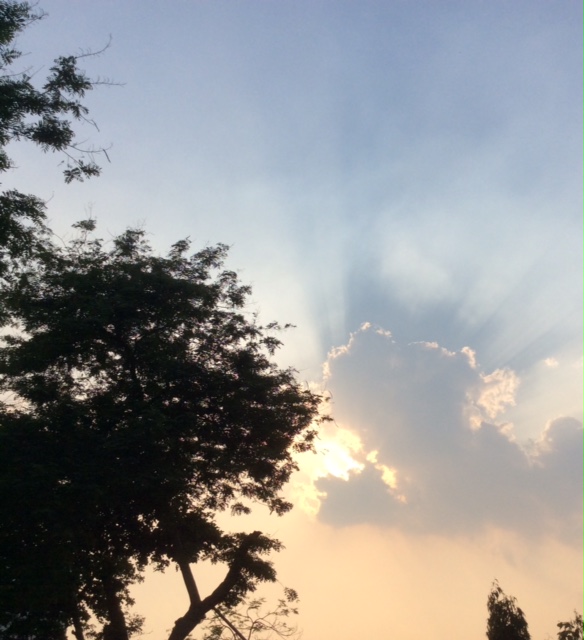
Okay, so I took my own advice and got up and went out for a walk. I didn’t have a wood to walk in, so I took a walk around the block where I live. The wisps of clouds turning from pink to salmon against a pale turquoise sky–the kind of sky that is rare in Delhi.

It was a short walk around a city block. The first quarter of the block I couldn’t stop staring up in amazement. The second quarter of the block, I grew aware of the traffic noise as it hustled by.  As I turned the corner, I noticed a billboard that read “Platinum Living” with a sleek, blond-haired woman wearing an elegant low cut black gown and a long strand of pearls leaning back against a comfortable couch. I glanced down at the pair of abandoned black slippers at my feet on the sidewalk and wondered who this ad was aimed at speaking to in a city where a quarter of its population is below the poverty line, 30% live in slums, and in a country where the World Bank estimates that 21% of the deaths in India are related to unsafe water.  As I continued to walk, the acrid smell of burning leaves permeated the air, scratched at my throat, and made me cough. (Sadly, too many things here seem to makes me cough.) By the time I turned the last corner and entered my apartment door again, the sky’s color had drained away.

Wordsworth’s poem admonishes us to go out into nature with a listening heart, one that watches and receives. That is definitely the heart I stepped out of the door with, and is the one I want to hold on to. I live in a city, though. It’s not the same as standing at the ocean’s edge or walking amidst the redwoods. What was I expecting, anyway? In truth, I was just expecting to enjoy the early evening coolness and to take in the color-brushed clouds. I just happened to get the other experiences in addition because they are a part of this environment. The walk makes me wonder, though, can experiencing beauty motivate us to protect it, nurture it? Or are we so used to the traffic, the billboards, the burning leaves and discarded shoes, to the poor living in substandard housing, that we give up on beauty, that we forget to notice those gestures of grace nature gives us even in the city from time to time–those rare moments of clear sky and color-streaked clouds that open our eyes, move us out of our routines, the moments that call us to step out of our brokenness into the possibility of another way of being?

On the other hand, maybe its that very poverty and brokenness around me that encourages me to notice the way the sky sometimes opens into a canvas of shinning color, as it did this evening. Either way, I need those moments of open sky and color. They carry me through winters. The winters I’m talking about don’t always necessarily always come with snow and cold. They can look like a multitude of cities flung across this world, or any place where we are too busy to notice or take care of what nurtures us.

Uncategorized

The Subtle Beauty of Creating A Good Line

When I lived in the desert several years back, I recall seeing the beautiful lines nature drew on the desert floor’s red sand crystals using slender grass strands, as the breeze bent them back and forth in the wind. Beneath the grass in wonderful dark silhouetted lines rested shadows. The desert contains a wide variety of fantastic textures and lines. National Geographic has captured some of these here, and Danielle Venton in her Wired article, “Photographers Capture Mysterious, Beautiful Patterns in the Sand” says that people don’t even understand the physics involved that creates such beautiful lines in the sand. 

Using my husband’s recent gift of a new set of drawing pens and lessons from Arthur L. Guptill’s book, Rendering in Pen and Ink, I’m learning a new appreciation for the beauty of lines. What the sand, wind and sun do effortlessly, is a challenge to create with pen and ink. Drawing a simple curve and then duplicating it so the line goes exactly in the direction you want it to, for example, is not easy. You need to take your time and go slowly, deliberately forming lines like warm-up scales for use later in drawing. Even then, creating a beautiful line takes practice, lots of it.

Malcom Gladwell says it takes 10,000 hours of practice to master something. If this is an accurate analysis of what it takes to get really good at a skill, then I’ve got about 9,995 hours to go.  BBC’s David Bradley says in his article, “Why Gladwell’s 10,000 Hour Rule is Wrong” that the research Gladwell based his research on actually suggests that the 10,00 hours are just a rule of thumb, though, not the “tipping point” at which you are a virtuoso. The amount of time depends on the particular skill you are practicing. “Learning and gaining experience are gradual processes; skills evolve slowly, with practice. And there is a vast range of time periods over which different individuals reach their own peak of proficiency – their concert level, you might say – in whatever field.” Ericson, the person’s study at Berlin’s Academy of Music on which Gladwell’s statement is based, suggests that what counts further is that “not just any old practice counts towards the 10,000-hour average. It has to be deliberate, dedicated time spent focusing on improvement.”

I don’t know how many hours French artist Simon Beck has put in to create his fantastic geometric figures in the snow, but the lines he draws using snow shoes are truly a thing of beauty and take hours at a time to create. The perseverance his work takes is inspiring.

Creating a good line is also important to poetry as well, and over the last few years, this is something that I’ve been trying to understand how to get better at. I examined lines from different poets, from William Stafford to Denise Levertov, John Ciardi, Louis Simpson, Mary Oliver, Naomi Shihab Nye, Lucile Clifton, Nick Samaras, Li Young Lee and a number of others, trying to define what gives a line its energy and strength. Sometimes I see it clearly, and sometimes it’s a mystery. It might take 10,000 hours to get it right. Seems like many things that hold great beauty take a lot of hours to learn. These kinds of skills are subtle. You can’t just create a rule to never break a line after using an article or after a conjunction, for example, because after making such a generalization, you’ll find a really good poem from an excellent writer that breaks the rule. That’s not to say that a good poet can’t or doesn’t sometimes make a weak line break choice, but I think that the writers I’ve mentioned are experienced, and their line break choices deliberate. People have different ideas of beauty, and different ideas about line breaks in poetry. The goal for me is to experiment and practice with increased deliberate focus while writing. What makes a line so powerful? What makes it feel right? Maybe it is an individual thing, but in any thing a person creates, practicing the skill over and over, and attuning oneself to observe closely what others are doing that stirs your own soul, and then to listening from the inside to what your own work suggests is a good start down a path that leads to better understanding. If I can learn to listen better to others’ work as well as to my own, if I can learn to listen more deeply to the world around me, I think I might gain greater insight into many things in life, not just how to draw or write a good line of poetry, but how to live. All these things are part of each other.

Uncategorized

My Next Big Thing

Recently, I was invited by Vinnie Hansen, author of the Carol Sabala mystery series, to participate with other writers in posting about their “next big thing” that they are working on as a writer. Vinnie is currently working on her seventh murder mystery in her series. The story takes place in Cuba where Carol Sabala is hired to locate a wealthy woman’s daughter. You can find out more about Ms. Hansen’s series and the upcoming mystery on Vinnie’s website by going to her page and then clicking on her Next Big Thing announcement link.

I have written earlier about Finishing Line Press accepting my chapbook manuscript, Saudade, for publication. The chapbook will be coming out in May, 2013, and pre-publication sales for the chapbook open in January. I will be sending more details about how to do this in January. For now, let me tell you a bit more about the book.

LG CoverEmail

What is the working title of your book?
Saudade. The word is Portuguese and means longing or sense of emptiness for something no longer present in your life but that you still love and feel the absence of.

Where did the idea come from for this book?
The idea came from living abroad, the travel while living in other countries, and the desire to explore and possibly answer the questions that living in foreign cultures inevitably makes a person wonder about regarding the meaning of the things we say and experience, and about what is that is ultimately important in life.

What genre does your book fall under?
Free-verse poetry.

How long did it take to write the first draft?
The poems in the chapbook are from a wide spectrum of time reaching from about 12 years ago until the present time.

What actors would you use for a movie rendition of your book?
Since Saudade is not a work of fiction, the actors would have to be those found naturally in the locations of the poems, which includes the orangutan of the Borneo rainforest, camels wandering the Saudi Arabian desert, Delhi’s citizens, the Alhambra’s architects and artists, the fado singer and musicians at the Santa Cruz Café, Coimbra, Portugal, and a cast of others.

What is a one sentence synopsis of your book?
If you look deeply enough even at those things that are difficult and painful, hope and beauty can be found.

Will it be self published or represented by an agency?
Finishing Line Press will be publishing the chapbook. Saudade will be available for pre-publication sale from January through April from Finishing Line Press, will come out in May, 2013, and will later also be available on Amazon.

Who or what inspired you to write this book?
The amazing perplexities and wonders of life, and the desire to understand how various cultures, worlds, experiences and places interconnect.

What other books would you compare this story to within your genre?
Saudade might compare with Carolyn Boyd’s DNA of Sand, or perhaps Michael L. Newell’s books, A Stranger to the Land, or Traveling Without Compass or Map, and possibly a few of Naomi Shihab Nye’s poems in that the settings of the poems are in a variety of world locations while appealing to themes that people everywhere experience of love, loss, hope, work, and longing to be whole.

What else about your book might pique the reader’s interest?
Music in a variety of forms—from jazz, to classical to Indian raga features in these poems.

Erica Lann-Clark is another author continuing this Next Big Thing thread where writers tell you about their upcoming work. Find out about Erica’s upcoming projects!  A professional storyteller, Erica’s lively piece, Shopping for God humorously explores the search for meaning in contemporary life. Learn more about Erica and her work, and check out Erica’s web page for her next big thing.