Uncategorized

The Subtle Beauty of Creating A Good Line

When I lived in the desert several years back, I recall seeing the beautiful lines nature drew on the desert floor’s red sand crystals using slender grass strands, as the breeze bent them back and forth in the wind. Beneath the grass in wonderful dark silhouetted lines rested shadows. The desert contains a wide variety of fantastic textures and lines. National Geographic has captured some of these here, and Danielle Venton in her Wired article, “Photographers Capture Mysterious, Beautiful Patterns in the Sand” says that people don’t even understand the physics involved that creates such beautiful lines in the sand. 

Using my husband’s recent gift of a new set of drawing pens and lessons from Arthur L. Guptill’s book, Rendering in Pen and Ink, I’m learning a new appreciation for the beauty of lines. What the sand, wind and sun do effortlessly, is a challenge to create with pen and ink. Drawing a simple curve and then duplicating it so the line goes exactly in the direction you want it to, for example, is not easy. You need to take your time and go slowly, deliberately forming lines like warm-up scales for use later in drawing. Even then, creating a beautiful line takes practice, lots of it.

Malcom Gladwell says it takes 10,000 hours of practice to master something. If this is an accurate analysis of what it takes to get really good at a skill, then I’ve got about 9,995 hours to go.  BBC’s David Bradley says in his article, “Why Gladwell’s 10,000 Hour Rule is Wrong” that the research Gladwell based his research on actually suggests that the 10,00 hours are just a rule of thumb, though, not the “tipping point” at which you are a virtuoso. The amount of time depends on the particular skill you are practicing. “Learning and gaining experience are gradual processes; skills evolve slowly, with practice. And there is a vast range of time periods over which different individuals reach their own peak of proficiency – their concert level, you might say – in whatever field.” Ericson, the person’s study at Berlin’s Academy of Music on which Gladwell’s statement is based, suggests that what counts further is that “not just any old practice counts towards the 10,000-hour average. It has to be deliberate, dedicated time spent focusing on improvement.”

I don’t know how many hours French artist Simon Beck has put in to create his fantastic geometric figures in the snow, but the lines he draws using snow shoes are truly a thing of beauty and take hours at a time to create. The perseverance his work takes is inspiring.

Creating a good line is also important to poetry as well, and over the last few years, this is something that I’ve been trying to understand how to get better at. I examined lines from different poets, from William Stafford to Denise Levertov, John Ciardi, Louis Simpson, Mary Oliver, Naomi Shihab Nye, Lucile Clifton, Nick Samaras, Li Young Lee and a number of others, trying to define what gives a line its energy and strength. Sometimes I see it clearly, and sometimes it’s a mystery. It might take 10,000 hours to get it right. Seems like many things that hold great beauty take a lot of hours to learn. These kinds of skills are subtle. You can’t just create a rule to never break a line after using an article or after a conjunction, for example, because after making such a generalization, you’ll find a really good poem from an excellent writer that breaks the rule. That’s not to say that a good poet can’t or doesn’t sometimes make a weak line break choice, but I think that the writers I’ve mentioned are experienced, and their line break choices deliberate. People have different ideas of beauty, and different ideas about line breaks in poetry. The goal for me is to experiment and practice with increased deliberate focus while writing. What makes a line so powerful? What makes it feel right? Maybe it is an individual thing, but in any thing a person creates, practicing the skill over and over, and attuning oneself to observe closely what others are doing that stirs your own soul, and then to listening from the inside to what your own work suggests is a good start down a path that leads to better understanding. If I can learn to listen better to others’ work as well as to my own, if I can learn to listen more deeply to the world around me, I think I might gain greater insight into many things in life, not just how to draw or write a good line of poetry, but how to live. All these things are part of each other.
Uncategorized

My Next Big Thing

Recently, I was invited by Vinnie Hansen, author of the Carol Sabala mystery series, to participate with other writers in posting about their “next big thing” that they are working on as a writer. Vinnie is currently working on her seventh murder mystery in her series. The story takes place in Cuba where Carol Sabala is hired to locate a wealthy woman’s daughter. You can find out more about Ms. Hansen’s series and the upcoming mystery on Vinnie’s website by going to her page and then clicking on her Next Big Thing announcement link.

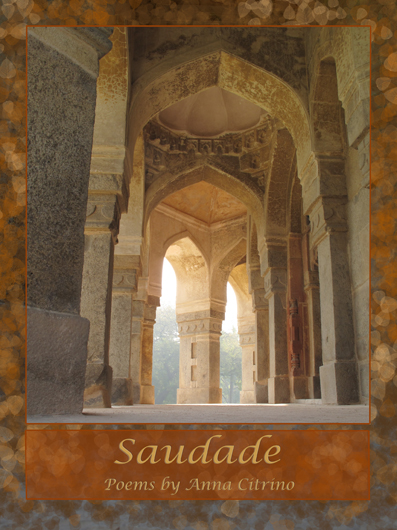
I have written earlier about Finishing Line Press accepting my chapbook manuscript, Saudade, for publication. The chapbook will be coming out in May, 2013, and pre-publication sales for the chapbook open in January. I will be sending more details about how to do this in January. For now, let me tell you a bit more about the book.

LG CoverEmail

What is the working title of your book?
Saudade. The word is Portuguese and means longing or sense of emptiness for something no longer present in your life but that you still love and feel the absence of.

Where did the idea come from for this book?
The idea came from living abroad, the travel while living in other countries, and the desire to explore and possibly answer the questions that living in foreign cultures inevitably makes a person wonder about regarding the meaning of the things we say and experience, and about what is that is ultimately important in life.

What genre does your book fall under?
Free-verse poetry.

How long did it take to write the first draft?
The poems in the chapbook are from a wide spectrum of time reaching from about 12 years ago until the present time.

What actors would you use for a movie rendition of your book?
Since Saudade is not a work of fiction, the actors would have to be those found naturally in the locations of the poems, which includes the orangutan of the Borneo rainforest, camels wandering the Saudi Arabian desert, Delhi’s citizens, the Alhambra’s architects and artists, the fado singer and musicians at the Santa Cruz Café, Coimbra, Portugal, and a cast of others.

What is a one sentence synopsis of your book?
If you look deeply enough even at those things that are difficult and painful, hope and beauty can be found.

Will it be self published or represented by an agency?
Finishing Line Press will be publishing the chapbook. Saudade will be available for pre-publication sale from January through April from Finishing Line Press, will come out in May, 2013, and will later also be available on Amazon.

Who or what inspired you to write this book?
The amazing perplexities and wonders of life, and the desire to understand how various cultures, worlds, experiences and places interconnect.

What other books would you compare this story to within your genre?
Saudade might compare with Carolyn Boyd’s DNA of Sand, or perhaps Michael L. Newell’s books, A Stranger to the Land, or Traveling Without Compass or Map, and possibly a few of Naomi Shihab Nye’s poems in that the settings of the poems are in a variety of world locations while appealing to themes that people everywhere experience of love, loss, hope, work, and longing to be whole.

What else about your book might pique the reader’s interest?
Music in a variety of forms—from jazz, to classical to Indian raga features in these poems.

Erica Lann-Clark is another author continuing this Next Big Thing thread where writers tell you about their upcoming work. Find out about Erica’s upcoming projects!  A professional storyteller, Erica’s lively piece, Shopping for God humorously explores the search for meaning in contemporary life. Learn more about Erica and her work, and check out Erica’s web page for her next big thing.

Uncategorized

Remembering How to See

“But what the poets sees with his always new vision is not what is “imaginary”; he sees what others have forgotten how to see. The poet is always inadvertently stripping away the veils and showing us his reality. Many poets, as we know, go mad because they cannot bear the worlds of illusion and falsehood in which most human beings spend their lives.” – Karl Shapiro, “What is Not Poetry?”

Writing is a way of getting to the truth of what I see, a way to peal back the layers, to ask what is this I have experienced,  how do I name it, what is its essence? There are two kinds of knowing–the experience itself, and then the re-experiencing when in the act of writing. Writing  allows me to burrow in to the original experience and know it more completely. The experiences I have nurture ideas for writing, and the writing enriches and deepens the experience. The two things are intimately intertwined.

Writing poetry is a way to keep alive, to keep in touch with the mystery. Wanting to name the mystery doesn’t lessen it, instead it helps to increase its wonder. I want to always be filled with wonder like I was as a child looking out the window of the house my father built at the sea of fog as it filled the valley below leaving islands of hills. The hills and the fog were not just objects with names, they were part of a geography that absorbed me into itself and defined me.

“The poet,” Shapiro says,”sees what others have forgotten how to see. “How do people arrive at the place where they forget how to see? How do I live in such a way that I am not asleep, so that I nurture the eyes and ears of the heart?

When I write, I am try to see with eyes open, to understand, to touch the live nerve where life touches the bone so that I know what my experiences are trying to say to me about how to live. If I want to write well, I must listen intently to the life around me and live with an attitude of vulnerability and humility. I can’t allow myself to get wrapped up in the desire to have a name, status, power, or be concerned with the competition or what others say about my work. Focusing on how people might perceive me or my work, would drain the real strength of my work and effort. It would distract, from the goal of writing itself, and get in the way of seeing and understanding that makes for good writing. The important thing is the work of writing, and to find as I write how to draw closer to being able to say what can’t be said–to stand inside the holy space of life. I must live leaning in to my experiences, looking, listening–then write what I see and hear, including the questions.

Our culture is very interested in competition and position, making it difficult to keep focused on the work of living deeply and writing honestly. A poet must be fully immersed in the world, seeing it, knowing it, but at the same time outside of it. As Shapiro goes on to say in the same essay, “Whenever the poet is not “oned” with the experience we can always detect the forcing, the insincerity.” It is this oneness with our experiences and with the world that allows us to know we are alive, and opens the door for us to experience meaning.

Uncategorized

Three New Poems

In January, I created writing goals for each month, spurred on by an online conversation with Lisa O’Hara, long time friend from graduate school at the Bread Loaf School of English in Vermont. One of those monthly goals was to send out some poems for publication. The first result of that effort is that three poems were accepted by phren-Z the on-line journal from my hometown, Santa Cruz, CA. I’m very happy to be published in a journal in a town that has  so many fine writers. In the same issue, my friend, mystery writer, Vinnie Hansen has an essay appearing in the issue exploring the lines between fiction and nonfiction. Check it out here!

The spring issue launches May 15, and I have three new poems appearing there. “She Sings” is for Skye Sanford, one of the singers in the Delhi band, the Paisleys, that my husband, Michael plays harmonica with. The other two poems are about working in the garden and on our property in the Soquel hills above Santa Cruz.

Uncategorized

The Mandorla

Recently I read renowned Jungian psychologist, Robert A. Johnson’s book, Owning Your Own Shadow, Understanding the Dark Side of the Psyche, where I learned about the mandorla. Most people know what a mandala is, but a mandorla, Johnson explains is “that almond-shaped segment that is made when two circles partly overlap…This symbol signifies nothing less than the overlap of the opposites…the overlap of heaven and earth.” Many of Europe’s cathedrals have mandorlas and often either Christ or the Virgin Mary is framed in the mandorla. Johnson says that the mandorla is the place of poetry. Johnson explains that the mandorla can help us when we no longer know how to live between the pull of opposites in our lives. It can help us rebind what is torn apart.

“It is the duty of a true poetry to take the fragmented world that we find ourselves in and to make unit of it…All poetry is based upon the assertion that this is that. When the images overlap, we have a mystical statement of unity. We feel there is safety and sureness in our fractured world, and the poet has given us the gift of synthesis.

Great poetry makes these leaps and unites the beauty and the terror of existence. It has the ability to surprise and shock–to remind us that there are links between the things we have always thought of as opposites.”

Johnson goes on to explain that if we make a practice of our effort to create poetry, we can find a way to see how the two worlds are really a part of each other, part of a larger whole. The space in the center where the circles overlap will grow larger and larger, until we see that everything is actually only part of a larger whole. Essentially, I see what he is talking about like this: We get born into a culture and we learn to place things in certain forms. We learn we are this, but not that. This is part of growing up and we function under the laws and ways of being of that culture. Our culture is just a form, a shape, and it is good to learn the rules for the ways of being that are given to us–it is part of being human. Then, at some point in our lives we go through a kind of crisis when things more or less fall apart or become very difficult, and we move out of that Garden and into the world. It is in this space where there are no clear cut laws that we learn how to have true relationship.

This struggle between opposites, the not heaven and not earth is where we learn authentic relationship and learn who we are–where we do the work of becoming. Maybe this is what St. Paul recognized when he encouraged the followers of Jesus to be in the world but not of the world. (Romans 12:2)  Johnson says that “to balance out our cultural indoctrination, we need to do our shadow work on a daily basis.” By this he means to consciously be aware of it and confront it ritually each day, and to spend time consciously letting it go of it. This has the benefit of not imposing our shadow side on others, which also enables us to do less harm in the world by not feeding the general unrest and conflict that is there. The other result, Johnson says, is “that we prepare the way for the mandorla–that high vision of beauty and wholeness that is the great prize of human consciousness.”  Ceremonies such as the mass of the Christian church, he says is one of the ways culture enables us to live out the unwanted elements symbolically so we do not live it out in real life.

Johnson’s discussion reminds me of Lorca’s essay on duende where Lorca describes how the Muse struggles with death, and in that tension is where great art is born.

As Lorca decribes it–

The true struggle is with the duende.

The roads where one searches for God are known, whether by the barbaric way of the hermit or the subtle one of the mystic: with a tower, like St. Teresa, or by the three paths of St. John of the Cross. And though we may have to cry out, in Isaiah’s voice: Truly you are a hidden God,’ finally, in the end, God sends his primal thorns of fire to those who seek Him.

Seeking the duende, there is neither map nor discipline.

We only know it burns the blood like powdered glass, that it exhausts, rejects all the sweet geometry we understand, that it shatters styles and makes Goya, master of the greys, silvers and pinks of the finest English art, paint with his knees and fists in terrible bitumen blacks, or strips Mossèn Cinto Verdaguer stark naked in the cold of the Pyrenees, or sends Jorge Manrique to wait for death in the wastes of Ocaña, or clothes Rimbaud’s delicate body in a saltimbanque’s costume, or gives the Comte de Lautréamont the eyes of a dead fish, at dawn, on the boulevard.” (Garcia Lorca, Theory and Play of the Duende)

What I especially love about Johnson’s book is in the way it clearly describes large and complex ideas in accessible language.  The work of our lives is to balance being with doing. Our culture strongly emphasizes doing–who we know, what we know, how accomplished we are, how we can market our skills, etc. Johnson is suggests that the more we can balance doing with being the more whole and healthy we will be. He quotes Jung as saying, “Find out what a person fears most, and that is where he will develop next.” Basically, living in the in between places is where we do our soul work, the work that will enable us to move to a greater place of wholeness. We are like Jacob, wrestling with our angel and the place where we can contact the duende is where the art of our life is born, it is where Spirit lives and where we work out our salvation.