art, Geography, poetry, Uncategorized, writing

Sicily, and Cathedrals of the Heart

20161219_100643-1

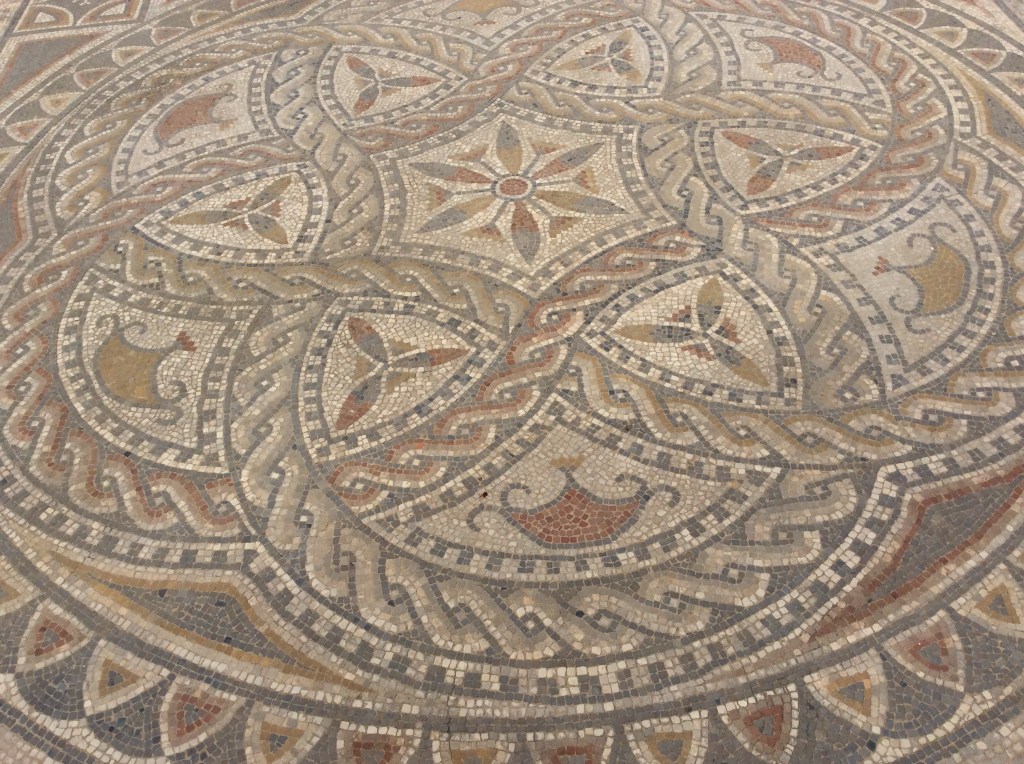
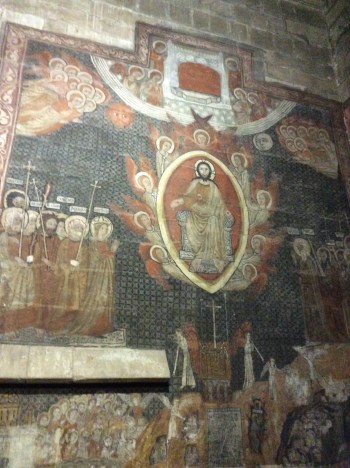
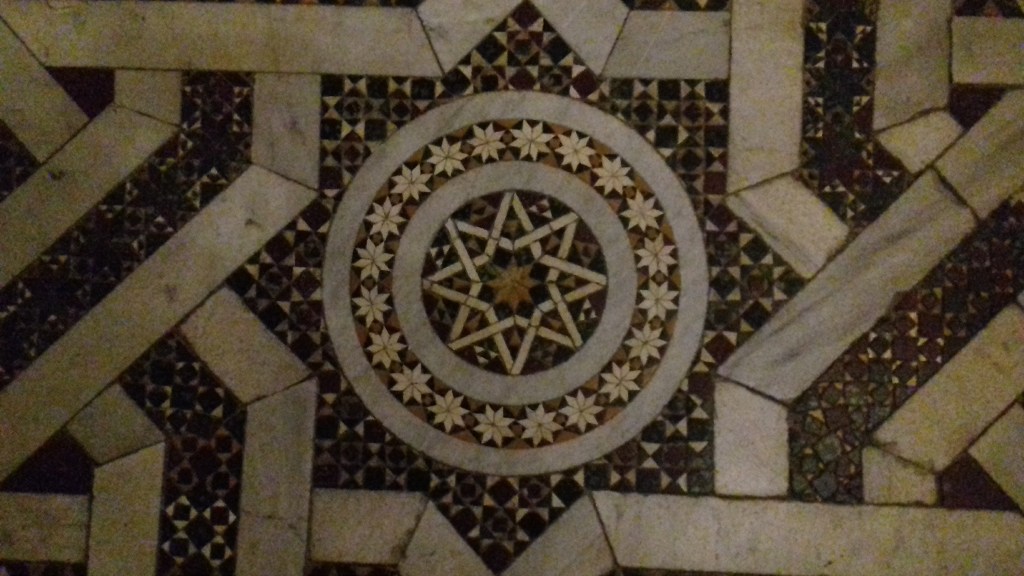
I’ve just returned from Sicily, a poor region of Italy, but a land rich in beauty–beauty enough to leave me speechless and in awe as I stepped inside Monreale’s cathedral and looked into the face of the pantocrator–Christ as the Lord of the Universe–depicted in the shining mosaics filling the central apse. The mosaic is so finely made it seems to be painted. A world heritage site, the cathedral holds the largest Byzantine mosaics outside of the Hagia Sophia in Istanbul. Mosaic art was practiced in the Byzantine empire since the fifth century (according to the Joy of Shards Site.) Thousands of skilled craftsmen had to have worked for centuries to be able to produce the level of skill to create the quality of workmanship presented in Monreale’s cathedral and cloister. (See more images here and here.) The walls depict various Biblical stories–God giving Adam the breath of life, Noah building the ark, Jesus holding out his hand to Peter who has jumped the fishing boat he was on with the other disciples in order to meet Jesus who he sees walking across the water–stories told through images of God interacting with the world and in humans’ lives.

20161218_164013Jungian psychologist Robert A. Johnson, in his book, Inner Work, writes of how the original meaning of fantasy comes from the Greek, phantasía, meaning “to make visible, to reveal.” Johnson explains how it’s our imagination that converts the invisible to the visible, enabling us to contemplate it. Interaction with world in the form of the arts and in writing enables us to understand spiritual truths. For the Greeks, Johnson goes on to say, phantasía was the way the divine spoke to the human mind. Until the Middle Ages, Johnson states, phantasía was thought of as the “organ that receives meanings from spiritual and aesthetic worlds and forms them into an inner image that can be held in memory and made the object of thought and reasoning” (p. 23). Phantasía was also the word Roman writers employed when wanting to “speak of the human faculty by which we express the contents of the soul by using poetic or spiritual energy.” In other words, practicing using our imagination, as artists and writers do, allows us to become conscious again of spirit. Johnson asserts also that when speaking of sensing the spirit, all ancient people understood, “Only our power to make images enables us to see it.”  In fact, Johnson explains, “When we experience the images, we also directly experience the inner parts of ourselves that are clothed in the images” (p. 25).  As Abigail Tucker reported in The Smithsonian’s article, “How Does the Brain Process Art?”, the brain signals the body to have physical responses to art, mirroring what is viewed.

The cathedral at Monreale, clearly demonstrates Johnson’s assertion of imagination’s power. Stepping from the everyday life of the street and entering the cathedral, I was carried out of myself into a place of wonder so astonishingly beautiful in its glowing color and intricately depicted images it could bring a person to tears—or at least it did me. A thousand years ago in Sicily, people worked the land, even as many do now—a challenging life, dependent on nature and the weather, as much of Sicily uses dry farming methods. Life could be difficult, but then there was the world inside the cathedral—a place of intense beauty, a heaven on earth, that could lift you from the mundane, and transport you into a place of wonder. In doing so, you understood your life was more than mere struggle. You were also part of a greater reality, you were also Spirit, and you participated in the life of that Spirit as revealed in the cathedral’s art.

Recognizing God speaks through nature, the Psalmist wrote, “The heavens declare the glory of God and the firmament shows his handiwork.” The Psalmist created music to express the presence of Spirit. Artist Georgia O’Keeffe painted flowers enormous on her canvases as a way to invite viewers to engage with the natural world. “Nobody sees a flower,” she wrote, “- really – it is so small it takes time – we haven’t time – and to see takes time, like to have a friend takes time.” Interacting with nature as an artist, as well as simply viewing paintings and pondering them are ways to touch Spirit. Similar to O’Keefe’s intention for viewers in the paintings she produced, though cathedrals’ construction were normally initiated by kings as expressions of their power, and often with political aims, cathedrals could also be viewed and embraced as embodiments of love—love expressed in and through the hands that made them. To produce works of such beauty, heart had to be invested, not merely the use of skill. A thousand years later, the mosaics in the Monreale’s cathedral beauty draws the world to stand before them in awe.

The Norman ruler, King William, ordered construction to begin on the Monreale’s Cathedral in 1172. The building was completed in 1176, and the mosaics by 1189. That is only 17 years for a work of monolithic and intricate beauty. I think of the difficult times we currently live in, and the tremendous effort needed to rise to the challenges–social, political, economic, and environmental–that we face, not unlike that of building a cathedral. Likely, all times could be identified as difficult depending on where you live and what you’re living through, but a particular area of current concern are the many in the world who have lost their homes. The Guardian’s December 31, 2016 article describes, “War, weather, climate change and terrorism have made millions homeless,” and then goes on to add starvation, and natural disaster to the list of causes. Sixty three million people today are fleeing disaster according to The Guardian. To address the needs of these displaced people so that their fundamental necessity for shelter is met will take the effort of millions. The forces at work to create such displacement are monumental. I’m wondering, though, how we might use our imaginations to create a cathedral of spirit amidst the poverty of our current situation in order to address the human needs of those around us.

20161218_150524

While reading Unsettling America, An Anthology of Contemporary Multicultural Poetry, I came across Maria Mazziotti Gillan’s poem “In Memory We Are Walking,” where Gillan describes how as a child, she once went on a picnic with her Italian immigrant family. The poem allows us to go inside the experience of what displaced people likely feel coming to a new land for reasons of necessity, and working to make it home. On a rare excursion, the poem’s speaker–a young girl–and her family left Patterson, New Jersey, walking out of their mill worker’s house “built cheaply and easily,” and past “squat middle-class bungalows” that, to her, appeared to be wealthy abodes. She describes how her father, hoping for a job, walked from Patterson to Passaic, nearly a two hour’s journey, to inquire about an opening. He didn’t have the money to take the train. When he arrived, a worker told him, ‘“You stupid Dago bastard,…/ Go back where you came from./ We don’t want your kind here.” The words from this poem resonate elsewhere in the world and across time. Reading current news stories, though the faces may be different now, one can still see how attitudes prevalent at the turn of last century regarding immigrants persist.

Before leaving to travel to Sicily this past December, I visited downtown London early one evening. When I emerged from the subway tunnel, I heard a loud voice calling out, “Help me. Somebody save me!” A man sat on the street outside the subway exit shouted to those walking by. I didn’t know what kind of help the man needed, or if he possibly might not be in his right mind. Like others, though, I crossed the street to wait for the bus—on my way to elsewhere. Ten minutes later, the man’s desperate voice could be heard shouting, his words echoing across the street. On and on he called, his plea reaching into my thoughts—fixing itself there, and becoming, somehow, the needy voice of us all.

20161215_174636

Further up the street, suspended in flight, angels hovered above the roadway in the form of electric lights. Christmas shoppers emerged from the brilliantly lit multilevel department storefronts, windows packed with a plethora of products–leather purses and shoes, sequined dresses, sportswear and down jackets, wool hats and scarves, specialty chocolates and teas. Streets drenched in abundance while at the same time, not far away, a man calls out for help, and none respond. Further down the street, I walked by a man in a grim looking Santa costume. He leaned against a wall above the sleeping bag where he slept, a cup held out for money. Entering another subway station, a second Santa stood by the escalators holding a cup for offerings, a thin woman with a drooping Santa hat, and wearing grubby Santa coat and a plaid skirt. Homeless Santas, and a man pleading to be saved–if not physical poverty, we live amidst a poverty of spirit. Those on the street have the humility to admit their need. The man on the street shouted out the words that we in our social silence, pride, and neglect fail to speak: that in many ways in the places we live, if not our lives and way of living, then in our hearts–connection to each other, is broken. If so many around us live in dire need while others of us live in physical abundance, then somebody help us.

From the crowded streets of our lives, the homeless part of ourselves calls out in our poverty. The somebody that must help us needs to arise from within. What kind of world do we want to live in? What does a beautiful world look like? How would people interact in order to create a world where we could live without fear, where all people’s needs are met? Just like those who built the cathedrals of Sicily, we each have skills we have built up over time. Humbly, and together, we can use these abilities to create the world we want to live in. We can do our art and look for ways to create neighborly acts of kindness and generosity wherever we are. Whatever the work we look for or do, we can make of our work a spiritual effort, a prayer. With our hands and mind, we can create sanctuaries of the spirit, cathedrals of the heart that transform ourselves and those around us. As poet Nancy Wood writes, “Patterns persist,/life goes on, whatever rises will converge./ Do what you will, but strengthen the things that remain.” We can use our imagination to discover ways to transform despair, and to practice the skills that will make a world where, like the cathedral of Monreale, a refuge of beauty and place of peace people a thousand years from now can inherit and inhabit.

Like the work to create the cathedral, creating such a world takes devotion, love, and hard work. Labor doesn’t have to be merely work, as it often becomes when the goal is merely for self interest and personal gain. Just as beauty can open our hearts, labor can also enlarge us as we work together. The two aren’t inseparable when we work with the intention that the labor we do is a way to give something needed for the betterment of the community–for the beauty of the earth and humanity.
20161218_163751

poetry

A Beautiful Perseverance

IMG_5349

THE AMEN STONE

Yehuda Amichai

On my desk there is a stone with the word “Amen” on it,
a triangular fragment of stone from a Jewish graveyard destroyed
many generations ago. The other fragments, hundreds upon hundreds,
were scattered helter-skelter, and a great yearning,
a longing without end, fills them all:
first name in search of family name, date of death seeks
dead man’s birthplace, son’s name wishes to locate
name of father, date of birth seeks reunion with soul
that wishes to rest in peace. And until they have found
one another, they will not find a perfect rest.

…read the rest of the poem here

We can plan many things, carefully drawing designs, listing steps, following through with what inspires or seems important in order to move us in a direction we want to go. Sometimes, however, a great wave rises up in our world, and we are caught in a current of events that sweeps away all, or nearly all. You have little choice but to let go into the current. During this time, it’s all you can do to focus on the necessities at hand, swimming along in the current stroke by stroke, aiming toward home. Though we may have experienced an undertow earlier, or previously been nearly carried away by a powerful wave, it doesn’t make it easier when the tsunami rolls in and we’re caught in its path. Making it through to the other side is more than a struggle, it’s a miracle of perseverance.

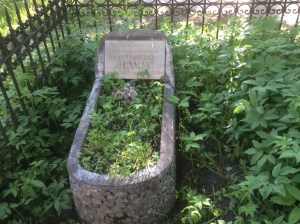
In Yehuda Amichai’s poem, “The Amen Stone,” Amichai describes a destroyed Jewish graveyard, and the painstaking effort of a man whose yearning for wholeness has made it his work to restore a fragmented and broken past. Though the tsunami of events that destroyed the graveyard happened ages ago, the effects of the fragmentation are still felt generations later. The broken stones with their names and dates are scattered “helter-skelter” over the earth. No act of God created this landscape. A tsunami of human choices made the situation, and we don’t have to know the specific event to understand that it’s more than just stones in the poem that are broken. Families have been split, histories scattered. Effort has been made to wipe from memory the story of the lives on the stone fragments. Longing speaks from the scattered stones to the man in the poem whose heart sees in the stone fragments a story yearning to be told.

IMG_5925

What is possible to know from the story of broken gravestones? When we walk past names on stones in ancient graveyards, do we know much of anything regarding the tales they tell? I think of Pip, in the opening scenes of Dicken’s Great Expectations, standing at his parents’ gravestones, trying to discern the quality of his parents’ character by the script style imprinted in the stones. We might not be able to tell much about the lives, but the gravestones’ existence speaks of those who lived and shaped their world, making together what has come to us through time. In a world of brokenness where people separate into camps of perceived right and wrong, left and right, allowing for no in between, brokenness prevails. Amichai’s poem begins with the word “Amen” in the first line, a word meaning “so be it,” a word often said at the end of a prayer. The world is broken, there it is. So be it. Look at it. See the world’s state for what it is. We are a scattered people, and not just those in this graveyard—economics, race, religion, politics, age, gender—there is so much we have let divide us from the common ground we could rest together in, and as Amichai states, “until they have found one another, they will not find a perfect rest.”

How do we live after a tsunami, real or political, has destroyed our land, our people, our hearts? Is it possible to become whole again? Can we heal the past? The root of the word religion is to rebind. Religions across the world hold as their foundations an understanding that humans are fragmented beings. Even if we can’t or don’t say it directly in words, when we acknowledge our brokenness, when we search for and tenderly lift the fragments of our world with the intention to restore, as did the “sad, good man” in the poem in his act of cleansing the gravestone shards, we enter into a sacred, and one might even say, religious act. Through the man’s creative effort of documenting what once was once whole, he unifies again what had been broken for generations. Healing begins.

IMG_5920

Interestingly, at the poem’s end Amichai uses the word child’s play to describe the man’s act. Some, perhaps, would consider the man’s effort a ridiculous waste of energy and time. His is an intuitive act of heart, rather than of logic. Children are the natural advocates for the value of play, and putting together the puzzle of broken stones must in the end be play because it is play that renews, and remakes us. Re-creation is what the man’s perseverant play has accomplished. By the poem’s end, we realize we are witnessing a paradox, a world that is broken and whole at the same time, as a mosaic is both broken and whole.

Does the man’s effort to restore the gravestones make a difference to those whose lives were blasted apart? If we understand our lives are connected into a webbed circle of being, as science leads us to understand, then what we do in one place and time affects the life of the whole. One act of kindness and healing changes the quality of all. The stone fragment the speaker in the poem saves is triangular, like the shape of the A in the word “Amen.” The poem relates a triad of actors, the destroyers who turned the gravestones to fragments, the man who “resurrects” the lives of the dead by reunifying the gravestones, and the preserver—the man who saves the stone with “Amen” written on it, putting to rest the prayer inside the stones’ longing: the story of the lives they stand for given back their substance. In the gravestones’ reconstructed puzzle and re-unified presence, the dead are re-given life. They are released—let go at last into a place of peace.

IMG_0442

A few months ago, I remember standing in a crowded New Delhi subway car at rush hour as the train door opened and passengers crammed and shoved their way through the door, hoping not to have to wait for the next car’s arrival. Pushed into the car’s back wall and pressed into a corner against the opposite wall, I watched as a woman hefted her large bag through the open door and pushed it across the floor between a profusion of bodies, then held on to the vertical steel bar in the middle of the floor, hoping to get her balance before the train took off. Behind her, though, passengers continued to shove themselves through the subway car’s open door—bodies piling into each other in a crush of sweating humanity. Hand still wrapped around her bag’s plastic rope handle, the woman attempted to stand. The bodies flooding through the doorway drove her toward the floor, however, catching her hand between the rope and the handrail. The woman cried out, straining to remove her strangled fingers from passengers’ weight pressing against her. She plead for people to stop. Deaf to her protests the deluge of bodies at the door, driven only by thought of getting on the train, continued to push forward.

Stunned, I watched in silence, as the tsunami of bodies rammed through the door. I expected people to calm down, notice what they were doing, that the woman would be okay, but the situation continued. My husband, standing closer to the scene, pushed the men away from the woman, and joining her in protest, called out “Stop!” Finally, the subway doors closed, the flood resided, people found space to put their feet, and the woman could release her hand from the plastic rope handle’s stranglehold on her. She stood up. She was a short woman, I noticed, ruffled, but still in possession of herself.

Why didn’t I act, I later wondered. What was it that made me simply stand there, saying nothing? As an outsider living in a foreign country, it’s not always clear when it’s okay to enter in to a scene, and when it’s not a good decision. Nevertheless, this woman was in need and yet I did nothing. Plenty enough times in my adult life I have felt powerless in situations, caught, and unable to discern the best course of action. These are fragmented parts of myself, and they don’t bring rest. If these moments were concrete objects, they could be dated and scattered about in the graveyard of past mistakes. What, though, if I took the journey of the man in Amichai’s poem? What if I bit by bit gathered the broken pieces, scrubbed them so I could name them clearly, and as if creating a work of art, gently set them together to let them tell their story and be released to a place of rest? Then, perhaps, I could live into a new story.

The Japanese have a practice called wabi sabi—of filling cracked pottery pieces with gold. The cracks aren’t removed, but when the pot is repaired, it is even more beautiful than before. Brokenness creates space for acts of compassion and gentleness. This is how we make beauty from brokenness.

IMG_0441

poetry, Uncategorized

Seen and Heard


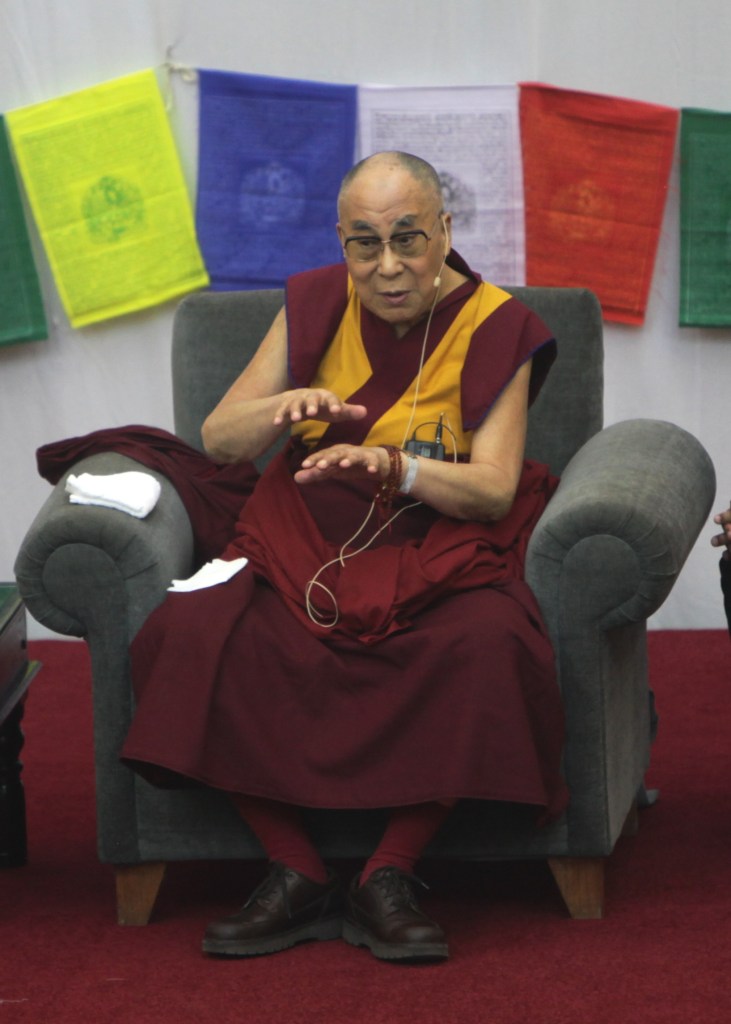
A great man was coming to visit, was going to step inside our walls, walk inside our rooms. We had prepared ourselves as best we could–put on clean clothes and shoes, combed our hair, opened our faces into smiles. Some us stood in a line at the door with palms held open, expectantly waiting. All eyes turned toward the light streaming into the narrow passageway from outside where the man would step into the room we prepared for him decorated with white satin and gold colored cloth draped from the walls. His foot paused in the doorway, and one thousand four hundred of us fell silent. We knew it was a rare moment.

_D4D8226
Dalai Lama, photo by Mark Cowlin

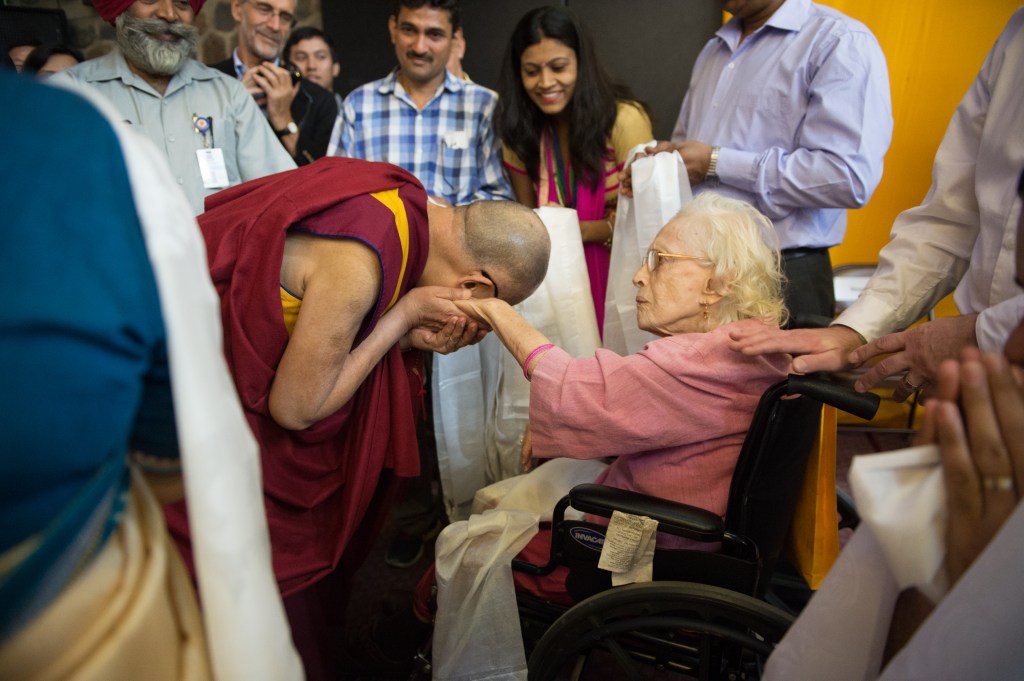
At last he walked in, wearing his red robe and glasses. All rose in unison, except those who could not. When the 98 year old woman sitting in her wheel chair saw him, she threw up her arm and called out “Where have you been?” into the expectant silence.

“Right here in the world, with you,” said the Dalai Lama, as he bent and bowed before her, holding her hand.

When he turned to the receiving line where I stood waiting, a voice inside called out silently (as I’m sure happen to all those near me) that he would look at me in the face, reach out his hand to mine, touch me, and in that touch somehow know me. Bless me. I didn’t want to press myself in front of others to be noticed. If he touched me, I reasoned, it would be his choice, and up to fate. Some people he did look at in the face and greet. Some, he touched their hand or head as he passed by. Others, faces glowing with the light of happiness, ended up in photographs.


_D4D8293
Dalai Lama, photo by HHDL office


Though he glanced at me briefly, he didn’t touch me or look straight into my eyes as I hoped for, however. Neither did I appear later in a photograph, though those on either side of me did. There is no photographic record of this encounter. No one will later know I was there unless someone later tells a story, as perhaps I’m telling you now, that includes my name. Though I was close to him, I was one the Dalai Lama passed by.

Why does that matter? Why did I want him to touch my hand? What did I, or any of us, hope to gain by his touch? What kind of connection or knowing might have occurred through that brief moment? I remember when president Obama visited Delhi several years back, how he and Michelle shook my hand. Though it was an encounter I never dreamed I would experience, I couldn’t exactly say after that that the experience had changed my life. Still, I felt somehow connected to my country in a more concrete way that I wasn’t previously aware of.

We all long to be known, to be visible, to matter. There is a kind of knowing when someone looks directly into our eyes and when we hold in ours the hand of a person we care about. Similarly, rather than merely gazing at photos of the home we love, we like to walk the land, hear the sounds, smell the earth. There is a felt presence and an exchange that occurs with physical reality, with touch. A thousand faces may stream by us in a subway tunnel, and we will not feel seen or known. A different kind of encounter occurs, when we gaze out at the world with an expectant heart, waiting to receive. We long for connection.


IMG_0589
Dalai Lama, photo by Eric Johnson

People recognize that the Dalai Lama is a man of integrity, someone who seeks to live in honesty and who has given himself over to be a living presence of peace. That is difficult, and we all know it. We want to listen to such a man. He might have something to say that will help us understand how to live. We want to look in his eyes, to touch us, because in some unspoken way, we recognize that our lives connect when we touch. Maybe something of that peace will enter into our own lives and change us.

We know when a loved one is present in a room when we first open a door, though we can’t see the person. When I was injured in college, my mother half way across the country woke in the night and knew something had happened to me. She also knew her brother had died before she was told. The body has a kind of knowing that moves through the heart.

We’re told of how when he was here on earth, people clambered around Jesus, hoping to touch him. Perhaps you recall the story of the woman who amidst the crowd reached to touch the hem of Jesus’s clothes, believing that if she did so, her life would be changed. I picture her threading her way through bodies, stretching her hand to reach the hem of his clothes from a stair below as he passed by. Though the crowd pressed in around him, Jesus noticed her, and turned around to see who it was. He must have looked into her eyes directly, recognized her in the vulnerability and longing revealed in her face. “Take heart,” he told her, her faith had made her whole. There is an interconnection, an exchange of energy, when hearts open. Some door opens that isn’t there otherwise, some liminal curtain is pulled back. An exchange happens. Lives connect. Perhaps this is how miracles are able to occur.

Where have we been all our lives? We are here in the world with each other. We have something to give one another, and the world around us in the open heart of our presence. The evening I first went out with the man who is now my husband, he told me at dinner as we watched rain dripping down the crystals at the now burned down Triton restaurant in San Diego, “The world is held together by strands of light.” We are more than the sum of our bones, body and breath, but through these, we touch life.

What we are living is mostly a mystery. We need containers to allow ways in to experience. But the real knowing spills over and out of these. That is why we need art, poetry, dance, literature. E.O. Wilson speaks of how in the future humans will be more and more integrated with machines, and that is why we will need literature and the humanities more than ever–to help us explore that territory of what it means to be human with all its difficult questions.

Words can be a way of finding how to be present in the world, a pathway into letting the invisible become visible to us. Words are strands of light we make to help us see the world and who we are, what it is we are living. Here is my poem I wrote several years back, “Seen and Heard,” that appeared in my chapbook, Saudade about this practice of presence. We don’t have to be the Dalai Lama. Everyone we know and encounter, wants to know that somehow inside the press of the crowd and busyness of the day and its multitude of priorities, that it is still their presence matters most. In our look, we can bless. In a pause, the tone of our voice, we can bring peace. With a simple gesture or touch, we can lets others know they are seen and heard. Perhaps that, too, is the light that holds the world together.

Seen and Heard

As a child, I stared long at the hidden pictures
in children’s magazines, looking for the lamb
inside the cloud, the face inside a pleat or tree,
the button or missing bow that made one figure
different from another. What satisfaction
when I found them. How affirming it was
to know that all those little details, the small
realities of the world that begged to be seen
could be found, recognized, known.

Today when I peer out at the world, the picture
I see is workers, day after day rising with the sun
to start their tasks. They feed the fire or prepare
the mortar for the brick. Some lift bundled
branches to their shoulders. Some hammer nails
or paint the walls. Others sort through files, prepare
documents, answer calls, gather round tables,
or read books deep into the night.

We do our tasks, we make the rounds.
Still, things hide there inside the walls
and trees, pressed inside the body’s quiet
folds of those we meet, waiting
to be found if we know how to see.

Cezanne looked for them, the hidden forms—
the cylinder inside a tree, the sphere inside
the head, the geometry of nature, and though
his eyesight was weak, or perhaps
because of this, he found the hidden shapes
and painted them in plains of color
so the rest of us could find them.

Goya, too, painted the secrets others meant
to cloak, the fear inside the peasant with arms
uplifted, his white shirt glowing against
night’s darkness, the hidden faces of the men
turned away from view, their guns that showed
the world in thickly painted strokes the torment
of a deaf world.

We turn through the pages of time
and off we go each day to make our story,
paint our picture, lift our bricks, do our work.

Our eyesight is weak, our hearing faulty,
but we stare at the pages anyway, trying
to make sense of the world, hoping to find
the forms inside of forms, to hear the unspoken
voices or even our own voice inside
the night sky darkness we might be standing in.

There we are with our boards to nail, bushes
to trim, our books piled beside us—
with whatever it is we discover and make
and love our world with, our arms
thrust up to the heavens, hoping someone
will see us. Hear us. Hoping someone has looked
long enough, hard enough to recognize us
hiding there inside the pleats and paint of life.


poetry, spirtuality, Uncategorized

A Visit from the Dalai Lama and 10,000 Shades of Blue

More important than what was recorded, these evenings
deepened my life: they framed every event

or thought and placed it with care by the others.
As time went on, that scribbled wall—even if
it stayed blank—became where everything
recognized itself and passed into meaning.

–William Stafford, “Keeping a Journal”

image

“The next hot job in Silicon Valley is for poets,” says the Washington Post today, describing how the tech industry is working to improve the interactive quality of the voice and personalities behind the artificial intelligences we interact with on the Internet, like Apple’s Siri, Amazon’s Alexa, and Microsoft’s Cortana. To do this, software engineers are turning more and more to poets, fiction writers and comedians in a new wave of jobs in artificial intelligence. Additionally, an article in Motherboard, Robots are coming for our poems,”now two years old, examples are given of robots co-authoring Shakespearian sonnets and haikus. An android learns the algorithms of language you give it, makes predictions about what words will be chosen over others, and uses these to write a poem. I don’t know the definition of “co-authored” as it is used in the context of the robot working together with a human, or how many trials it took to get a poem that feels cohesive and reads like a poem, but I enjoyed the sonnet, as well as a haiku a robot created that are included in the article.

Sasha Chapin’s article, “When robots write poetry,” written this past February, also describes how the algorithms are used that enable robots to write poetry. More interesting, however, is Chapin’s statement at the end of the article, “The coming artificial beings may love good poetry for the same reason we do: how it can seem to bridge the boundaries between consciousnesses. But they will possess a consciousness we couldn’t possibly understand. And when they write poetry, it will not be for us.”

While I question whether robots have consciousness, as Chapin implies, there is a difference between a living, human mind raising questions and pondering life and poetry artificial intelligence produces using algorithms, rather than conscious reflection. The Atlantic reports that number of non-book readers has tripled since 1978. Currently, I’m preparing to present a week long workshop on poetry and poetry writing with middle schoolers at ACS Hillingdon International School, a school just outside of London. As I consider what those students’ interests and concerns might be, I’m turning over the question in my mind, why is it we write for purposes other than to carry out necessary tasks, and in particular, what value does writing poetry hold?

Though  it may be helpful to learn that the job market is currently opening up for poets and fiction writers in the tech industry, there are deeper reasons to write and to read poetry, and these have to do with the poetry’s potential to connect us to the physical world, notice its mystery, and value its presence. If you’ve not seen this short TED talk about the worldwide telescope, it’s worth viewing. What Google earth has done to map the world is now being pieced together for the universe, enabling you to map your own virtual tour of the universe with images currently available. When I watched the talk and viewed the images, I felt humbled by the wonder of all that is—the immensity of creation and the miracle that I’m alive on this planet, existing amidst it all. Writing poetry is the opportunity to reflect on that wonder. Perhaps it’s interesting that a robot can write poetry, but how much more amazing it is to experience the poetry writing process yourself—to try and put words to what it means to be alive in this moment. As Salman Rushdie describes, “A poet’s work is to name the unnameable, to point at frauds, to take sides, start arguments, shape the world, and stop it going to sleep.” That’s a challenging task, but certainly a valuable one.

Recently, the Dalai Lama visited the school where I work. During his talk to the student body, he repeatedly emphasized humanity’s interconnectedness with each other and with the natural world. A compassionate heart and a calm mind go together, he explained, and a disturbed mind affects the body. There’s hope for a more compassionate world if we make an attempt, he said. With anger, there is no hope, and he admonished us to make an effort.
With effort, this century can be a happy, a peaceful century, he explained. When there is too much stress, violence comes. Human rights violations are first emotional problems, he stated. Violence comes as a consequence of emotional problems. “We have to make an effort to promote more warm heartedness so there will be no opportunity to kill or bully, because we take care. No one can survive without community,” he said. Selfishness destroys your own happiness. “Society is the basis of our happy life, so we have to take care of society. West needs East. Southern and Northern worlds need each other—not this notion or that,” he said. Around us we see so much fear and distrust, yet friendship is dependent on trust, and trust is dependent on compassion, he explained. Narrow mindedness and shortsightedness brings disaster.

In aiming to build a compassionate world, poetry is a valuable asset. Poetry nurtures our inner life and helps us to understand what it means to be human and to stand in relation to the world around us. Robots might be able to write, but we are human. We want to know what that means—what we can give to the world to meet its deep need, and thereby meet our own deep desire to feel we belong in this world by knowing what we can give to it. Writing poetry, in its aim to find the best words to describe experience, requires observation and awareness, as well as reflection. Because the problems we face both individually and collectively are complex, the practices of observation, awareness are especially needed. Deep reflection, allows us to work out our connections to each other and to the natural world, along with the disconnects we experience in trying to do so. Deep reflection is the territory poetry explores.

Before Old French gave the English language the word “orange,” English speakers referred to the color as yellow-red, ġeolurēad in Old English, according to, Matt Soniak, writer for Mental Floss. It’s not that orange didn’t exist before we had the word, but having the word created a clearer picture of the idea. Tech Insider the origins of another color, blue in this video, demonstrating that without a word for something we physically experience, such as the color blue, people have significant difficulty recognizing it. This phenomena emphasizes the benefit of both verbalizing what we are experiencing, as well as reflecting on those experiences in written words. Additionally, because languages have their own music and mirrors, reflecting the world in different ways, speaking and writing in more than one language expands the potential language has to enable us all to better understand ourselves and our interconnection to others and the world around us. If we are going to find how to live together peacefully, as the Dalai Lama suggested is both possible and important, we need tools to do so. Writing and poetry in specific, is a wonderful tool to use for this purpose. As T. S. Elliot said, “Poetry may make us from time to time a little more aware of the deeper, unnamed feelings which form the substratum of our being, to which we rarely penetrate; for our lives are mostly a constant evasion of ourselves.”

It’s possible that one could sit with pen in hand or type at the computer, and plod mindlessly through a series of steps or items and produce writing. I’ve read this kind of writing before. But if taken to heart, writing can be a tool that enables the mind to unwind its string of thoughts and make patterns that hold meaning and change our lives both individually and collectively. Poetry and literature is our attempt to explore the meaning of being human. As Barry Lopez, explains, “I believe in all human societies there is a desire to love and be loved, to experience the full fierceness of human emotion, and to make a measure of the sacred part of one’s life. Wherever I’ve traveled–Kenya, Chile, Australia, Japan–I’ve found the most dependable way to preserve these possibilities is to be reminded of them in stories. Stories do not give instruction, they do not explain how to love a companion or how to find God. They offer, instead, patterns of sound and association, of event and image. Suspended as listeners and readers in these patterns, we might reimagine our lives. It is through story that we embrace the great breadth of memory, that we can distinguish what is true, and that we may glimpse, at least occasionally, how to live without despair in the midst of the horror that dogs and unhinges us.” We need stories, and poetry. They are our thread through the labyrinth of existence.

While diving in the Maldives a few weeks back, the boat I was living on passed over and past 10,000 shades of blue—blues we have no word for. I found a wonderful color palate for different shades of blue, along with their names on Wikipedia, but though many colors are represented here, it falls far short of what the eye actual sees—the way the white-blue sky bends down into the sea and becomes the sea, for example, or the depth of blue reaching for infinity behind the shoals of yellow, white and black banner fish, along with all the subtle gradations between shades of turquoise as water shallows and then brushes against white sand shores. To try and name any of the experiences we have is to call them, again, into existence, and to share with others what moves us, and what is meaningful–this is what poets aim to do. It is the focus and goal of their efforts, even though what we hold most precious is often beyond naming. “The power of poetry,” says Michael Lewis, “is the ability to express the inexpressible, and to express it in terms of the unforgettable.”

If we are to build a compassionate world, we need to be able to recognize how to nurture our lives and wellbeing of the world around us. We need to be able to reflect on our lives. In his poem, “Keeping a Journal,” William Stafford, identifies the value of writing in his closing lines when he explains how through the process of writing he found his journal to be a place where “everything/recognized itself and passed into meaning.” To speak with an open heart in a journal or a poem takes courage, but in doing so, we can gain insight into ourselves and our relationship to the world, insight that can enable us to transform the way we live and interact. Writing poetry helps open our eyes and reach for meaning. As David Whyte says in his poem, “The Opening of Eyes”

That day I saw beneath dark clouds
the passing light over the water
and I heard the voice of the world speak out,
I knew then, as I had before
life is no passing memory of what has been
nor the remaining pages in a great book
waiting to be read.

It is the opening of eyes long closed.
It is the vision of far off things
seen for the silence they hold.
It is the heart after years
of secret conversing
speaking out loud in the clear air.

We write and our lives are deepened. This is what is important about poetry—it teaches us how we can live.

Uncategorized

Dancing Into Dimminishment

image

You may have seen 81 year old Sarah Paddy Jones dance the tango with Nico Espinosa and astonish crowds in Madrid, or on stage in Britain’s Got Talent for the fact that she is old and is yet able to do things that people even much younger than her can’t do. It’s amazing and inspiring to watch the grace and flexibility of these dancers. Ms. Jones has followed her passion, and worked very hard to be able to dance with such strength and beauty. Being tossed around over someone’s body and sliding across the floor with ease isn’t the norm, though probably, more elderly people might be able to move fluidly if they worked at building their strength and simply moved more often. Do we especially admire Ms. Jones, however, not because she dances well, but mostly because she is moving like a younger person would? Even with great determination, would such a dream of dancing like Ms. Jones be possible for many of those who might desire to dance like her at her age? When Ms. Jones comes on stage, the judges look highly doubtful of her ability. After they see what she can do, however, they praise her for her ability to move like a younger person. Ms. Jones is following her heart’s calling, and it’s wonderful to see her moving inside the flow of dance. Is emulating the ability of younger people, however, what older people should in general aspire to? Ms. Jones found in dance what feeds her heart and deepens her soul, and this is the reason to honor her efforts. This is what we, too, can follow into old age–the thread of who we are, so that we ripen further into what brings us wholeness. Nevertheless, while I marvel at Ms. Jones and admire her skill, I also wonder about our expectations of others and of ourselves as we age. We can’t always fix what wears out as we get older, and eventually, our bodies do wear out. It’s also important to recognize that aging and the narrowing of our powers is a normal part of everyone’s life. While we should still stretch to deepen our lives, it also might be important to understand who we are as we get older, and to move toward developing more of that, rather than emulating what younger people do, even if it’s what our culture applauds.

Diminishment comes in myriad forms. It’s not something we we want to think about or accept–losing our job, our health, a friend, a family member, our home, our country. Individually and collectively we define what quality of life means, and set our life compasses to move in that direction. What is the attitude and focus that engenders ongoing engagement and satisfaction in life, that creates wholeness all the way up to the end? We expand our understanding, develop new skills, polish others, yet for all this effort and growth, diminishment is still a destination we will all eventually arrive at before passing from this world, and we will need to understand how to stand in relationship it. How do we also learn to live into an era of loss, to accept weakness in ourselves, to invite and even welcome humility? What is the purpose of our life’s trajectory if in the end we lose everything? These are questions to live into.

Some time back, I saw this video shared on the Internet, of a man singing to his 92 year old wife on her death bed, and I thought, this couple has the something that keeps them whole, even through the stages of complete diminishment: They are fully alive to each other. I remember singing to my father as he lay dying, remember, too, reminding him of stories about things we did together, things he told me that he did when he was a child–climbing a windmill, running 16 miles through the forest at night because his feet were his only transport and he wanted to see my mother. As I watched my father during the evenings of his last days, the room seemed so utterly silent as he rested there, so still and unresponsive. As I now look back on this time, however, that experience of utter and complete silence has grown to seem significant. At the time, I so much wanted to feel the presence of something larger holding us during those final hours. What I felt most, however, was a profound silence weighted beneath everything–something like the weight of the ocean’s water at its great depths–the deepest blues fading into darkness. Nevertheless, underneath all the weight, there remained something light, something small like breath–and each breath seemed significant. We learn what love is through the love our parents bring us, and through our relationship with our partners and friends.  As James Agee wrote in A Death in the Family, “I hear my father and my mother and they are my giants, my king and my queen, beside whom there are not others so wise or worthy or honorable or brave or beautiful in this world. I need never fear: nor ever shall I lack for loving-kindness.” When my father lay dying, though the room felt so empty, I became aware that love was larger than any one particular love. During those last days my father’s life diminishing before my eyes, I realized that the love I felt for him wasn’t an isolated thing. It was connected to the love I felt for my sister who had watched over my parents for more than a decade through as their health diminished, and connected, also, to the love of all the others in my life who have lifted me up, supported and sustained me from day to day, year to year. Love lives beyond death.

image

Rowan Douglas Williams, Archbishop of Canterbury, in his interview with Image magazine about the poet James Harpur’s book, The Wound of Knowledge, says, “interesting thing about great poetry is the silence it generates. This is a complex area, but the great holy silence at the heart of things is not just an absence or a cessation. It’s what happens when you’ve been led to this point…The silence, when you get there, has become pregnant.” Poetry, aims to articulate and give in words the presence of such moments of deep loss. Great poetry not only generates silence, however, it also rises up out the silence of the losses that press down to crush us. Loss somehow is necessary in order for us to move beyond the borders of ourselves. Beyond the borders of ourselves a wider something awaits.

Perhaps it seems odd to be writing about loss on Easter Sunday. You’d think it might be better to turn my mind to thoughts of renewal and rebirth. Yesterday, I lost my journal in the airport on a flight back to India, however, and I’m still grieving that loss. In it were half a year’s writing, reflections, travel observations, seeds of thought about projects I’m currently working on or planned to work on. What I feel as a result of this loss is grief. I can’t think of a better word. I realize that there are much greater losses in life than this. In comparison to so many other people’s losses, this is utterly miniscule. I recognize other ideas will arrive and I will write them in future journals. But I can’t replace the pages of reflections, images, awarenesses, or ideas written in that lost journal. They are more than words. They are my exploration and expressions of what it means to be alive in the world. And that is gone.

imageAges ago now, I remember sitting in a parking lot in St.Paul, Minnesota during winter listening to Robert Bly reading a poem on the radio. I don’t recall the poem’s title or the specific lines, but Bly’s lines astonished me with the picture they created of words emerging from the mouth into the air in visible puffs. I pictured the words taking on physical shapes, having presences. Form. Being. Words have presence and meaning beyond their mere articulation, though often incomplete or imperfect, they are mirrors of our souls. For me, they are the ladder I make to climb into a place of being.

Words guide and change our lives, but they also point to larger realities that live beyond words. Recently, Ben Slavic, a colleague I work with described how he had previously worked with Sauk, Myskoke, and Chickasaw people whose languages are dying out. Only a few native speakers remain. What is it like to lose your language? We are, in fact, losing many languages world wide per year. Do those languages go on existing in some form, he wondered? “Maybe they want to hear them again, loudly and everywhere amidst the laughter and tears of life – fully alive again…Where do words go after they are spoken?” My colleague wondered, “Is there a kind of residue, an echo, of them left over somewhere? Do they get to be fainter and fainter echoes of themselves in some parallel universe of sound?” In the BBC article, “Languages: Why we must save dying tongues,” author Rachel Nuwer writes that “languages are conduits of human heritage…convey unique cultures,…contain an accumulated body of knowledge, including about geography, zoology, mathematics, navigation, astronomy, pharmacology, botany, meteorology and more.” Also, as Nuwer explains, “languages are ways of interpreting the world, and no two are the same. As such, they can provide insight into neurology, psychology and the linguistic capacities of our species.” These all seem very important, yet, as Nuwer describes, “Over the past century alone, around 400 languages – about one every three months – have gone extinct, and most linguists estimate that 50% of the world’s remaining 6,500 languages will be gone by the end of this century.”

If all we say disappears into air, if the dear companion of our own body in the end loses all its capacity, if thirty years from now all people remember of who we are or what we said or did are a few dates and our occupation, if everything shifts and changes, where do lost words, lost time, lost lives and worlds go? What is their value and meaning?

In her poem, “Happiness,” from her book, Broken Cup, Margaret Gibson writes about her husband’s Alzheimer’s. She quotes her husband reading what the Dalai Lama says, “An art, not a right, happiness,” then later closes the poem with a memory,

long ago, after
a night of reading each other’s
poems aloud, every
blessed one of them,
the road beneath us seen through the rotting-out
porous floor of the old jeep
as we traveled at the
speed of light, and nothing, nothing
could slow us down
or keep us
separate from each other
or the road, wherever it took us.

The commitment to love is what creates meaning, Gibson suggests, even in our loss. This is a hard lesson, and Gibson’s writing about loss is surpassingly powerful. In the closing poem of Broken Cup, “A Good Death,” Gibson tells about her husband who she recognizes will in the end lose all words.

…may you also, while now there’s time
practice dying

before you die. May you daily stand outside time’s rush
whose rivering is

our natural light, and there on the steep lip of what we call
darkness,

call me angel, if angel I am; draw sunbursts in the rain lit air;
sing your heart out.

Great being, radiantly still. And near.

In learning to be present and open to all that is, Gibson seems to say, we find how to bear diminishment.

This past week I was scuba diving in the Maldives. On one of the dives, I found myself kneeling on the sandy ocean floor 25 meters below the surface in front of table coral raised before me like an altar. I watched as manta rays six 10 to 15 foot wide circled and circled over my head like enormous communion wafters in a repeated mantra of movement. Rocked and bowed by the surge, I absorbed the vision of the mantas’ presence. They had come to the table coral simply because they wanted the wrasse who live there to clean them, but as I watched them swoop over me with their great wings as if they were the Passover angel, I grew humbly aware of the immensity, mystery and wonder of being completely immersed in the arms of nature. I knew I was very much alive, and part of something enormous and beyond explanation or comprehension. Animals can be identified, their behaviors and environment explained, but something much greater happens than the sum of individual parts when we enter their world, and encounter them, something there will never be enough right words to describe.

I have lost my journal, and though I’m still able to go diving, though I can go on to keep new journals and write new poems,  in the end, though I may cry for it all to come back to me, I will need to let it all go. Maybe this is when resurrection has the possibility to occur–after we go down into the depths of death or hell. We come to where we recognize we must or can let things be what they are, and trust that somehow in our diminishment we are still whole, that there is something significant moving in the depths of that diminishment beyond what the losses all add up to.

image

art, poetry, Uncategorized, writing

Looking Deeply: Art, Poetry, and Presence

Barry Lopez in his children’s book, Crow and Weasel, writes, “Remember on this one thing, said Badger. The stories people tell have a way of taking care of them. If stories come to you, care for them. And learn to give them away where they are needed. Sometimes a person needs a story more than food to stay alive. That is why we put these stories in each other’s memories. This is how people care for themselves.”

Stories connect us to the people who came before us, the narratives they live out and the tales they tell us about what the world is, and who we are in the world. We live by the stories that have shaped and taught us. They give meaning to our experience and direct us in our journey. Stories condense experience, give us the opportunity to examine our difficulties, and to reflect on how our struggles might enable us to grow.

The oldest form of story is poetry. Before poems were ever written, they were told. People’s histories were given in poetry–words constructed to call up experiences through sound and imagery that evoked emotion and helped people remember who they were, what they had done, and why it was important. In listening to poetry, we can step inside a reflection of life that holds up a mirror, and at the same time speaks to something beyond what is experienced. It is a way to reconnect to what it means to be human and to the mystery of existence. As Dana Gioia writes, “In a moment’s pause another world / reveals itself behind the ordinary.” By extension, because poetry was once connected to other art forms, stories, music, and dance, these are doors we can open to that allows us to walk into a larger reality, to see the world from a wider perspective.

image

The idea that the physical world intersects with the spiritual world is an ancient one, found in many traditions; the Celtic, Catholic, and Native American being a few examples of these. St. John Damascene, a Syrian monk who lived from c. 675 or 676 –to 749 CE, wrote a defense for the use of icons (see more here) that shaped the direction of the church. Though others at the time argued against the use of icons and representational art. God is bigger than any particular physical form, the thinking went, and therefore representation of God in icons should not be allowed. St. John of Damascene argued, however, that if God became human in the form of Christ, then two are intermingled. The sacred could be seen living and breathing through the human form, and therefore it was completely acceptable, he argued, to create icons, to worship through icons, and to paint the human form. In fact, art was a way for the illiterate to see God, Damascene explained, and to read the story of God’s compassion for and interest in humans through the paintings. Damascene demonstrated an acceptance of paradox, and the idea that one’s thinking doesn’t have to be contained in tight boxes of either or. William Dalrymple, in his book, From the Holy Mountain, quotes Damascene saying, “‘…the flower of painting makes me look, charms my eyes as does a flowering meadow and softly distils the glory of God in my soul.'” Through painting, as through nature, Damascene declares, God communicates his presence in the world, and art is a central way in which humans can experience and connect with the Divine.

imageThough Dalrymple describes the cave where St. John of Damascene wrote these thoughts in The Fount of Knowledge, as “crude and primitive,” he goes on to say that, “Without Damascene’s work, Byzantine ars sacra would never again have been permitted, Greek painters might never have been able to pass on their secrets to Giotto and the Siennese, and the course of the Renaissance, if it had happened at all, would have been very different.” I’m very grateful for Damascene’s words and thoughts regarding art. Without them, we’d likely be deprived of much beauty, and the spirit that speaks through that beauty.

In her poem, “Pray for Peace,” Ellen Bass speaks of this interconnection of the everyday world around us with the world of spirit.

Pull weeds for peace, turn over in your sleep for peace,
feed the birds, each shiny seed
that spills onto the earth, another second of peace.
Wash your dishes, call your mother, drink wine.

Shovel leaves or snow or trash from your sidewalk.
Make a path. Fold a photo of a dead child
around your VISA card. Scoop your holy water
from the gutter. Gnaw your crust.
Mumble along like a crazy person, stumbling
your prayer through the streets.

Though a way of communicating half forgotten these days, Bass helps the reader to see that prayer can be any act we do with full attention and heart. When we pay attention to our lives, doing what we love presence, that is prayer–a breathing, walking prayer that adds meaning to our lives, and enables us to grow toward wholeness. Making a routine out of things saves energy and time, but even routines can be done with attention and heart. How do we cultivate the kind of noticing awareness in our every day lives, the ways of being that enable the act of living to become prayer?

Involvement in a creative act is a central way to connect the physical world with the inner world. Though there are a variety of art forms that can enable a person to live in fuller awareness of a connection to life’s mystery, writing is an excellent path from which to begin this journey. Whenever I leave the house, I carry imagemy journal, a small book that easily fits inside a pocket. I carry it because at any time something might appear, or someone might say something that needs to be noticed, and I want to be ready. My journal is my fishing line, so to speak. Though I may miss many things swimming in the world around me, because I’m prepared with pen and paper to notice something, I am more likely to find and catch something than if I had no tool at all to help me. Whatever I’m working on as a writer, I look and listen for moments that speak to me while moving through the day—a random phrase, a gesture, a sudden familiar scent that might embody the idea I’m reaching for in a writing piece I’m working on. I remain attentive to sounds, textures, colors, actions—the world’s details that define a place or time. As a result of knowing the questions I’m living with and what I’m looking for, things tend to show up and announce their connection like a kind of internal spark. Suddenly, as if witnessing the embodiment of a metaphor, I see, for example, how something I’m looking at or hear is related to something seemingly completely different. The discovery has a wonderful quality to it, and to then write it out is to be able to embody that insight. Sharing it with others deepens a sense of connection to the world.

Writers aim to name the world, and doing so is to participate in a kind of co-creation of life, at least this is how I experience what happens while writing, and it is one of the motivating reasons to write. To write is to observe closely, and to observe closely moves me to an awareness that I am part of a greater something beyond myself–that I swim in the mystery of existence. Writing is a path that allows me to enter a space where I’m both fully present in my life, and somehow not present at the same time as I step inside the weave of words. This is because I’m living inside of the thing I’m writing about, and what I’m writing about is bigger than me. As poet Nicholas Samaras explained to me once, writers are always writing, even when not writing. I agree with Samaras when he says, on Poetry Net, “God is in the point of my pen.” In losing myself in the work I am doing, I’m made more alive, full, and solid. It’s a paradox.

image

Writing poetry can be a kind of prayer. My father wrote stories and poetry, but my mother taught me to pay attention to the world around me. She constantly noticed the natural world, flowers on the bank or scent of orange blossoms from the orchard, bees at the birdbath, a fox that came through the front yard, or hawks that circled above the hill behind us. The wind as it blew through the pines where she grew up in the Black Hills of South Dakota, was an ancient choir, she said. As she described the experience to me, I could hear the wind as if it were real. She recalled wild gooseberries’ tart flavor, and told me the names and shapes of wildflowers that grew on the land of her childhood home. Her descriptions lived in my mind as if they were real. Even though where I grew up in eastern San Diego county’s dry desert–very different from the Black Hills, I felt preciousness my mother’s memories of her childhood’s natural environment. Her respect for those experiences nurtured in me a love of my own childhood’s natural environment.

I played outside every day as a child, climbed around on granite boulders, or sat inside the branches of an avocado, umbrella or pepper tree. Our front door often stood open to the outside air. I ran through the yard barefoot, watched clouds parade by, and sunsets spill across the horizon. Coyotes’ yips echoed through the valley in the evening. Crickets sang. Stars came out. These were all gifts, and I belonged to that earth. The experience of growing up in such a place with the opportunity to experience the natural world as part of the rhythms of every day life created in me a foundation for wanting to remain connected to the earth. To have our feet on the earth, to literally ground our selves there, is life engendering. If deprived of such experiences, I think our bodies and spirits still long for them without possibly even knowing it.

image

Poetry relies on imagery and figures of speech. It integrates the physical world with the world of language. It tells abstract ideas by recreating the physical world. It reconnects the writer and the reader back to place, and this is a central reason why I find it so powerful. In our world, the culture of the workplace pushes us to compete, to gain power and control. When writing poetry, however, I interactively participate in reconnecting to the physical world and the presence residing beneath and inside the movement of life. I trace my origin of wanting to write back to these childhood experiences of connection to the earth’s vibrant, sustaining presence. Willa Cather writes in My Antonia, “I was something that lay under the sun and felt it, like the pumpkins, and I did not want to be anything more. I was entirely happy. Perhaps we feel like that when we die and become a part of something entire, whether it is sun and air, or goodness and knowledge. At any rate, that is happiness; to be dissolved into something complete and great. When it comes to one, it comes as naturally as sleep.” To be able to wander in time, to play in a landscape or place is to be transformed and enlarged by it. Writing poetry focuses the writer on presence, and in doing so, helps move the writer toward wholeness. I recommend it.

image

art, Looking For..., place

The Found Art of Hampi, India

IMG_8615
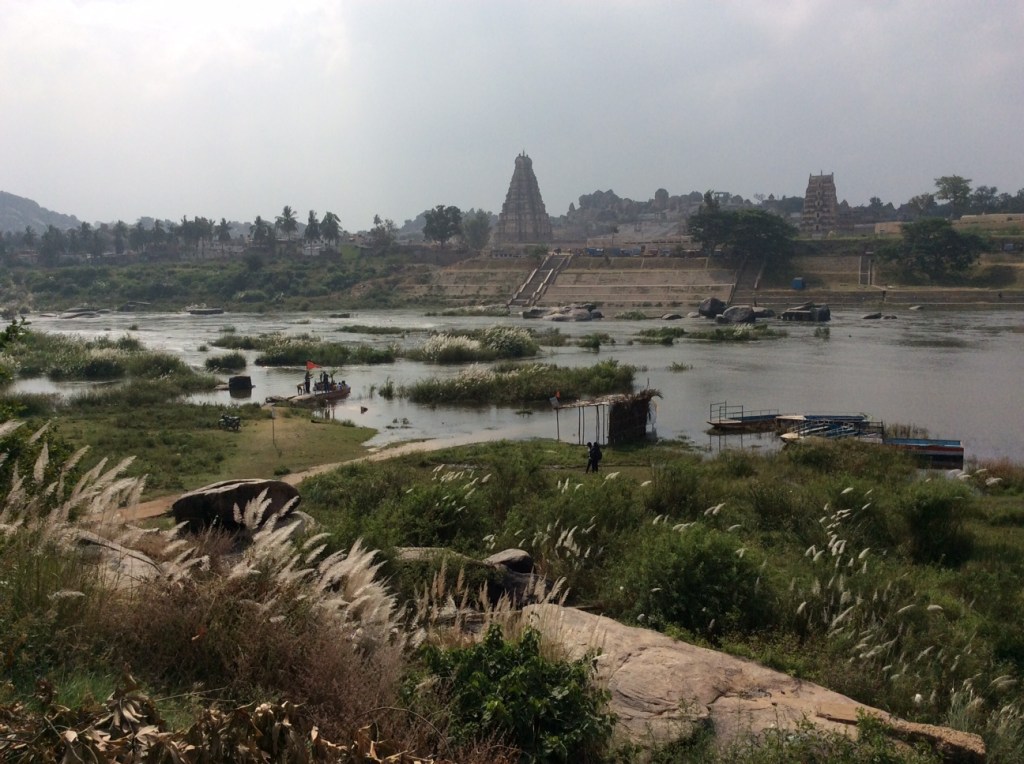
Hampi from the Tungabhadra River

A plain dotted with trees and scattered with boulders, Hampi in the Indian state, Karnataka, is a beautiful landscape. My recent visit there during the Diwali holiday allowed me to wander into India’s rural outback, and to laze against sun heated granite by the Tungabhadra River. During the 1500s, the Vijayanagar had a population of 500,000. The empire covered the entire southern portion of India, but Deccan Plateau sultans joined together and defeated the Vijayanagar army. The temples’ treasures were carried off as loot, much of the population was killed, and of those who weren’t killed, many fled. One of the world’s mightiest kingdoms fell to ruin, and gradually into obscurity.

Four hundred years later, Robert Sewell, a British civil servant stationed in India, wrote about the empire in his book, A Forgotten Empire Vijayanagar: A Contribution to the History of India. Much later, in 1986, Hampi became a UNESCO World Heritage site.

In addition to being a World Heritage site, Hampi is also a place of important religious significance for Hindus. As the stories describe, Hampi is the hill where Shiva, the god of destruction, did penance before marrying Pampa. After Shiva married, the gods poured gold onto the Heamakuta hill. According to the Hampi India website, Heamakuta, means heap of gold.

Hampi’s temples and ruins are spread over more than 10 square miles, or 25 square kilometers. There is much to see, and the carvings are fantastic. Though a place of enormous significance for many people on the subcontinent in the 1400 and 1500s, Hampi and the Vijayanagar empire are mostly unknown to people outside of India. As I walked along near the queen’s palace, I ran my hand along one of the carved walls. “My hands are touching history,” I thought to myself. “My hands touch what the ancients have touched, yet I understand so little.” Whether at a ruins of an ancient empire, or walking down the street of our hometown, our lives are enveloped in mysteries. We just don’t often recognize it.

After our day of exploration at the ruins, we went on a walk on the grounds near our hotel. We stepped across bamboo bridges stretching over the river, looped up across massive granite faces. Turning a corner, we tucked ourselves through a wooden door between leaning rock slabs. As we stepped inside, it seemed we had entered into a rock cathedral with windows of sky beaming through the stacked boulders. We continued climbing a short distance to an opening where we stood, at last, to view the valley spread before us in a 360 degree view. It was as if we had entered a secret door that enabled us to see the whole world. What a wonder it was, too–a plain filled with trees, and a river meandering through it with granite boulders balancing in precarious positions and leaning agains each other in dramatic angles. Nature like this is not a site often seen when living in one of the world’s mega cites like Delhi. We scanned our eyes across the landscape, fishing for greenery, for sky, for what we didn’t even know how to name. Our hearts simply opened to the world, and when we left the hilltop, we knew something inside us had shifted. We were lighter, and ,paradoxically, somehow more solid. Nature writer Barry Lopez says, “real beauty is so deep you have to move into darkness to understand it.” This is because when beauty touches you, you slip into a place that is beyond rational thought and abstraction. The divisions between the physical and spiritual worlds collapse into one unified presence. That presence is far bigger than the mind can hold. You are humbled and made whole again.

IMG_9022

The beauty of Hampi’s temples is definitely worth traveling a long distance to see. The setting of the ruins themselves, though, is what sets Hampi apart from other locations. In this landscape, you can learn that everywhere is a temple if we have eyes to see it. To be there is to walk around in a colossal expanse of found sculpture, an installation art piece of gargantuan proportions, the origins prehistorical. Everywhere I looked, I saw art emerging from the earth.

The earth is in an ongoing creative act. If you listen, you can hear it speak through its myriad forms. The wind in palm trees chatters with stiff, clattering branches. Wind through bamboo scratches and cracks like arthritic bones. Wind through neem trees speaks with a restless, dry and fragile sound like crinkled onion skins. The earth tells its stories.

In my continuing desire to learn Spanish, I’m reading Mary Pope Osborne’s Magic Treehouse book series in Spanish. Currently, I’m reading Una momia al amanecer, or in English, A Mummy at Daybreak. The children in the novel, Annie and Jack, learn how the Egyptians “tried to protect the body against death by preserving it for eternity.” (p. 45) Travel to the Vijayanagar empire’s ruins, however, assures the visitor that empires are temporary. All we have can be lost in a moment. Even stone wears away and topples. In Hindi, Vijay means victory. Victory, if found, is elsewhere, not in empires.

The final stanza of Louise Gluck’s poem “Summer Nights” reads,

Balm of summer night, balm of the ordinary,
imperial joy and sorrow of human existence,
the dreamed as well as the lived–
what could be dearer than this, given the closeness of death?

Life is so dear, and life is full of both imperial joy as well as sorrow. You don’t seem to get one without getting the other too, at least that is what I’ve observed from living in India. Everything is being destroyed and made at the same time. Maybe that is, in part, why art is necessary. It reminds us that we participate in the creative act of life. Perhaps this is why temples have so much art. Religion means to rebind, and the creative act helps us to re-member–to put our selves together again.

Uncategorized

Beauty and Justice

IMG_7053
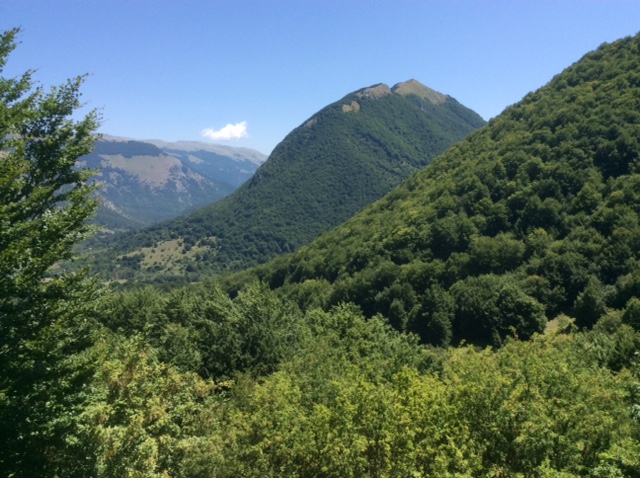
Mountains in Abruzzo National Park

 “Man is hungry for beauty. There is a void.”—Oscar Wilde

In the streets of my Delhi neighborhood, workers are building new apartments. Women carry sand on their heads. Bricks are stacked on the walkway. Yesterday the populous celebrated Republic Day, and I was reading Pamela Timms’ book, Korma Kheer & Kismet, the chapter titled “Independence Day in Sadar Bazar” where she describes the civic protests of 2011 where social activist, Kisan Baburao “Anna” Hazare, began a hunger strike in protest of government corruption. Concerned with the amount of interest Hazare stirred up in the populace, prime minister of the time, Manmohan Singh responded, ‘”Corruption manifests itself in many forms. Funds meant for schemes for the welfare of the common man end up in the pocket of government officials. In some other instances, government discretion is used to favor a selected few. There are also cases where government contracts are wrongfully awarded to the wrong people. We cannot let such activities continue unchecked.”’ Hazare’s hunger strike began the day after the prime minister made the statement, reports Timms, and goes on to describe some of the corruptions in the system—food vendors paying as much as a quarter of their salaries to the police to be able to stay open, and rickshaw drivers paying as much as 20% of their salaries to police to prevent their tires from being slashed, families having to pay bribe money to secure a place for their child at school. (p. 55) (You can read an overview of large-scale corruption in India here if you wish.)

It’s no surprise that corruption is present not only in India. It is a worldwide problem in both businesses, see a list here of top business corruption cases, and governments. Take a look at the thematic map from Transparency International here, to see a visual representation of corruption levels in countries across the world. Justice doesn’t prevail. In many cases, it’s simply the way the world functions where people live, and the everyday person, if he or she wants to function in society, doesn’t have a lot of choice about it.

With corruption and misuse of power so widespread, an enormous percentage of people in the world are pawns to those who hold the power. How do people manage? How do people—any of us and all of us—caught in such systems go on living with good conscience? I remember listening to Garth Lenz describing on his TED Talk about the effects of mining for oil in Canada’s tar sands had on the native people of the area. Parents in that area are caught in the dilemma of needing to feed their children, yet the toxins in the river are causing cancers at the rate of 10 times what it is in other parts of Canada. Because it’s very costly to fly in all the food a person needs in order eat, the aboriginal people are forced to eat the food “..as a parent, I just can’t imagine what that does to your soul. And that’s what we’re doing,” says Lenz. (transcript available here.) Certainly there were people during the time of Spain’s inquisition, in Nazi Germany and in Pol Pot’s Cambodia who didn’t agree with the government’s position but felt compelled to go along with the crowd mentality for fear of their own lives and those of their children’s. Certainly, there are people today in our own institutions who disagree with the use of power and yet are afraid of speaking out for fear of losing their jobs and the livelihood for their families. Not everyone can just move on or move out to a new situation, new job, new country, new life, and even if that were possible, where might one live or work where corruption was not part of the way of life? We have to learn to live in a fallen world.

I’m reminded of Maria Mazziotti Gillan’s poem, “I Open a Box,” in her book, Ancestor’s Song, where she describes her Italian immigrant mother’s doctor coming to her New Jersey tenement to assist her in the delivery of her baby. He arrives late, and Gillan’s mother has already given birth, cut the umbilical cord, and washed her child. When the doctor finally arrives, he doesn’t even enter the room. Instead, he distances himself from the situation.

“He washed his hands, wiped
them on one of the rough linen towels
I brought from Italy, stood in the doorway.
“You’ll be okay,” he said, and left.
“Oh, well,” my mother said, “I think
he was afraid of catching it.”
“Catching what?” I asked.
“Poverty,” she said.

IMG_7119
New Delhi neighborhood street.

Poverty is often perceived by wealthier countries as something out there over there, not mine not related to one’s own life. Like the doctor at the door, people want to distance themselves from the poor, not realizing their lives are connected. We may want to stand at the door like the doctor of this poem observing a world we don’t want to be a part of. We may think we can wash our hands, bid others well and walk away, and disconnect ourselves from what we don’t want and live in a different neighborhood. But our lives are intertwined. One example: A few years back, students in my speech class debated whether the lithium beneath Bolivia’s salt flats should be mined. The area is of tremendous beauty yet the area holds more than half the world’s lithium. Lithium is a lightweight metal used in powering our high tech products—iPhones, iPods, and other handheld devices. Now, as the world searches for alternative energy and looks towards ways to store electricity in batteries in order to meet more of our needs, including the use of batteries for electric vehicles, the need for lithium grows in greater and greater demand.

Dan McDougal, in his article on Mail Online “In search of Lithium: The battle for the third element” quotes a lithium-ion battery producer, Mary Ann Wright of Johnson Controls-Saft, ‘Since a vehicle battery requires 100 times as much lithium carbonate as its laptop equivalent, the green-car revolution could make lithium one of the planet’s most strategic commodities.’“ There’s not enough lithium to power the world’s 900 million vehicles, however, McDougal observes. Bolivia has significantly large amounts of the needed lithium to produce the batteries for the growing electric car industry, an industry that most people perceive as a green technology. Mc Dougal reports that according to “William Tahil, research director with technology consultancy Meridian International Research, ‘to make just 60 million plug-in hybrid vehicles a year containing a small lithium-ion battery would require 420,000 tons of lithium carbonate – or six times the current global production annually.” To continue, McDougal goes on to report that “The US Geological Survey claims at least 5.4 million tons of lithium could be extracted in Salar De Uyuni, while another report puts it as high as nine million tons.”’ Bolivia is a very poor country. Child workers are exploited, but children work to help their families. While mining the mineral would bring needed jobs and money into the country, a problem is that mining the mineral requires an abundance of water, and water is a rare commodity in Bolivia’s high desert. Bolivia has experienced exploitation by outsiders before in the tin and silver mining industries. An overuse of water could significantly affect the country and its people in numerous ways—making it difficult to have enough water for daily use, as well as for farming. Additionally, mining pollutes water with toxins as well. McDougal asks his readers “Is the world’s need for a green solution to transport worth the destruction of this unique environment and way of life that it lives on?”

Transportation is necessary. Our society is structured in such a way that few of us can walk to work. We need some way of getting to work. We want to do that in the least harmful way to the environment and others. As a result, in the desire to move away from our dependence on oil, many people are looking toward buying an electric car. These same people may be unaware that in doing so they are connected to moral dilemmas of another sort. We are all part of the greater web of being.

IMG_6990
Walls and grass in Vicalvi, Italy sunset.

Parker Palmer, in his book, The Courage to Teach, which I’m currently reading, talks about the biologist Barbara McClintock, who was given the Nobel Prize in 1983 for her work that changed our understanding of genetics. Prior to her work, people thought of genes as separate things, not in connection to the environment they were a part of. Palmer explains that McClintock’s interviewer who wrote her biography, Fox Keller, “wanted to know, ‘What enabled McClintock to see further and deeper into the mysteries of genetics than her colleagues?’ McClintock’s answer, Keller tells us, is simple: “Over and over again she tells us one must have the time to look, the patience to ‘hear what the material has to say to you,’ the openness to ‘let it come to you.’ Above all, one must have ‘a feeling for the organism.’” We co-create our world. We can’t stand at the door. The burden of the cost of anything is born by all eventually. As Palmer goes on to say, “Modern knowledge has allowed us to manipulate the world but not to control its fate (to say nothing of our own), a fact that becomes more clear each day as the ecosystem dies and our human systems fail.” (p. 57) Perhaps, then one important way of living inside of corrupt systems and move ourselves and society toward greater wholeness is to do what we can with those around us to build and restore relationships constructively. Some things or many things may not be in our power. But some things will. We can learn to listen closely to the interrelationships of people and things so we gain a greater connection to life. With this understanding, we can better comprehend what actions will create harmony both with others and with nature.

IMG_7054
Abruzzo National Park, Italy.

Dostoyevsky said, “Beauty can save the world.” While it may not appear to be a solution to growing environmental and social concerns, the idea deserves a closer look. What connection does beauty have in showing us a way through our dilemmas of how to live in unjust social systems? The New York Times “Books” section, published in 1987 includes an excerpt from Richard Ellman’s essay “Oscar Wilde.” Ellman relates the story of Oscar Wilde coming to New York City in 1882. “Beauty is nearer to most of us than we are aware,” Wilde explained talking to reporters. One of the reporters wanted to know if a nearby grain elevator was beautiful. Earlier in the conversation, Wilde had said, ‘I am here to diffuse beauty, and I have no objection to saying that.” As reporters continued probing, Wilde explained further his ideas about beauty. ”’It’s a wide field which has no limit, and all definitions are unsatisfactory. Some people might search and not find anything. But the search, if carried on according to right laws, would constitute estheticism. They would find happiness in striving, even in despair of ever finding what they sought. The renaissance of beauty is not to be hoped for without strife internal and external.” ”Where then is this movement to end?” ”There is no end to it; it will go on forever, just as it had no beginning. I have used the word renaissance to show that it is no new thing with me. It has always existed. As time goes on the men and the forms of expression may change, but the principle will remain. Man is hungry for beauty. . . . There is a void; nature will fill it. The ridicule which esthetes have been subjected to is the only way of blind unhappy souls who cannot find the way to beauty.”’ Creating a world of beauty is creating the ideal world. Creating a heaven, so to speak. To do so will take great effort. But people are hungry for it, as Wilde says. We are hungry for beauty, and that hunger connects to the desire for a world without corruption. Without corruption, beauty has a better chance of thriving.

Elaine Scarry, author of On Beauty and Being Just, speaks on her Harvard Thinks Big, “Beauty as a Call to Justice” about how experiences of beauty help to move humans toward justice. When we experience the beautiful, we are pulled out of our everyday way of interacting with our surroundings. We stand still. We are transfixed, she explains. In those moments, beauty pours into us an awareness of the “surfeit of aliveness.” It takes us out of ourselves, and connects us with a larger reality. Scarry makes the case that this experience of beauty helps lead us to love what we see and to want to care for it and have a relationship with it.

IMG_7048
Wildflowers, Vicalvi, Italy.

I don’t know if its true as Keats said in his “Ode to a Grecian Urn” that “Beauty is truth, truth beauty,–that is all/Ye know on earth, and all ye need to know,” but I do believe we need to have a much deeper knowing of beauty than we currently hold. There is a relationship between our loss of beauty in many of our urban environments, a loss resulting from our pragmatic values that relegates beauty to the bottom realms, and efficiency to the higher realms of priority. When I speak of beauty, I’m not talking about beauty in the decorative or commercial sense. I’m speaking of the beauty such as nature gives us in a star strewn sky or a valley sweeping down in green fields from stoney mountain peaks. I’m speaking of the beauty Scarry described above—that stops us short, that overwhelms, and then lifts us out of ourselves. Is our culture’s pragmatic love of efficiency causing us to structure society in such a way that it’s actually challenging to make deep connections with others? We have connection to people on Facebook, but does the minimalistic communication that exists there nurture deep conversation and relationship? I doubt it. Could it also be true that our lack of seeing ourselves as connected to the beauty of the Bolivian salt flats and the lives of Bolivian miners as we pursue our technological development (and other similar realities) is part of the reason corruption continues to thrive? Do people act in ugly ways because they live in a world where connection to the natural world is broken? In glimpses of beauty, we can see the world we want to belong to, a world of balance and wholeness, and are drawn to it. If we gave beauty a place of respect and honor in our cultures, possibly we would treat the world with more respect. If we developed more of a relationship with those around us and with the natural world, wouldn’t we understand our connection to the world and realize more fully the effects of our choices? Is our collective loss of beauty causing us to lose our souls?

IMG_6955
At the castle ruins, Vicalvi, Italy.

I never used to understand the Jesus prayer—the ancient prayer that says, “Have mercy on me.” I felt it seemed too focused on the negative and I already struggle to move beyond my failures. But as I see myself more and more intertwined with the existence of all that is, I see the value of this prayer. What the world is or isn’t, isn’t all up to me, but I’m also a part of all that is. How do we live in a corrupt world and yet continue to grow toward wholeness? The problems are all much bigger than me but mercy is extended. “For the Beauty of the Earth” is an old song that carries with it the idea of giving praise for the world around us and to the skies. Perhaps the ongoing practice of noticing and valuing beauty in the world, as the words of this song illustrate, acts to create a greater awareness of our interconnectivity. It’s worth trying.

One of the especially valuable aspects of creative work—of art and literature, of writing—is the way it nurtures the inner life. The artist must look very carefully at whatever she or he is drawing in order to see it and how it functions in relationship to itself and to the world it inhabits. In writing, an author must delve inside the subject with imagination in order to understand the subject and the interrelationship of the subject to oneself and the world. To write or to do art is to cultivate beauty. It is a way to reconnect to the world, is a way of making whole again as telling our story is a way of making us whole again. The flourishing of this kind of empathetic understanding that comes through our interaction with literature and the arts is important to not only the continuance of the world, but the continuance of a world that is good to live in.

Wherever we are, we can work with others to create greater wholeness. If we are going to change at all, it will be a step-by-step movement toward wholeness. In the mean time, we can pray as we walk, “have mercy,” and, by grace, we will continue on.

IMG_6975
At Vicalvi castle, above the Comino Valley, Italy
Uncategorized

Living In the Borderlands, Nicholas Samaras’s Poetry, Hands of the Saddlemaker

Most days we move through a world of familiar routines, often with unsurprising outcomes. The past few days I spent time with friends who own a house in Peschio, a tiny village situated above Alvito, Italy, a small community located on the edge of the Comino Valley a couple of hours below Rome in the state of Lazio. In Peschio, traditions still hold sway in people’s everyday lives. Bells ring on the hour, people have close connections with their neighbors and still live where they were born. Neighbors share gifts of food such as handmade pasta. In the evening, people gather for conversation at the local ice cream parlor or sit with friends on benches in the street. The town adorns the roads with ribbons for a celebration of the Madonna, carrying an icon of her through the streets. Here, communities aren’t driven by competition or pressed down with the weight of tasks to complete in a limited period of time. Life here is simple. Houses are not fancy, neither are their clothes. It’s true that the area struggles economically and that the population is aging, yet at the same time people have time to chat on the street or gather for an impromptu dinner on the neighborhood piazza. Human connection remains central to life.

I feel a connection to those living in a world where tradition is still a vital part of people’s understanding and way of being, but this way of being can’t be mine. I wasn’t raised with traditions that go back to the old world. I have lived in too many worlds with too many other lives, but there is a beauty there. Unlike the world in Alvito, the world most of us live in is filled not with space for human connection, but instead with human competition and the drive to get ahead, make a name, or gain power in some area, even if a narrow one. Minutes count, and finding time to sit outside and enjoy the evening air or to chat with a friend can be challenging. In such a world it is difficult to find satisfaction or wholeness. It’s challenging to find the time to reflect on life, hard to assume an attitude of receptivity instead of needing to act or be in charge, though receptivity is a central attitude that enables us to learn respect for our limitations and to value our interdependence with others, qualities that in turn engender connectivity with others and help us experience life as meaningful.

Occasionally, however, amidst the clatter and squeeze of everyday life that pushes us along from one event to the next, the extraordinary, like a giant fish rising from the sea’s depths or storm wind shaking a tree to its roots, occurs, and we are given a window into our lives that touches us at our roots and helps us see what we are. Having recently read Nicholas Samaras’s book, Hands of the Saddlemaker, I feel I have experienced the extraordinary. Echoes from the poems’ imagery and language move through my mind, rising at unexpected moments, floating up from the subconscious where the poems have been at work. The poems probe the  struggle to live purposefully with meaning when traditional values and ways of being no longer hold the world together.

Though we have access to unprecedented volumes of knowledge in our day, to live meaningfully and purposefully, all of us must negotiate between enormous areas of ongoing, continuous and rapid social, economic and technological fluctuation and change. It is no easy task to assimilate ourselves into these various worlds and learn how to integrate them into our lives in a way that allows us to develop wholeness. Each of us must explore how to direct ourselves through the current of these changes. Existentialist theologian Paul Tillich said, “Faith consists in being vitally concerned with that ultimate reality to which I give the symbolical name of God. Whoever reflects earnestly on the meaning of life is on the verge of an act of faith,” and Samaras’s poetry is an exploration of meaning making while swimming in the sea of the postmodern era. The intensely vivid quality of Samaras’s descriptions, language and poetic narratives in Hands of the Saddlemaker pulled me below the surface of words into an interior current flowing between places of exile and belonging, faith, and loss, love and death.

From the opening poem, “Lost,” describing the ease with which a person can lose his or her way, to the final piece, “Decade,” depicting the transformative moment where pain and brokenness from a relationship are let go, the poems in this volume traverse the territory between the traditions, beliefs and practices that both bind and open us. The book’s ending poem, “Decade” returns to a place of confrontation with grief and loss that allows one to come to finally release from its hold and come to a place of stasis where healing might begin. Philosopher Soren Kierkegaard said, “The greatest hazard of all, losing one’s self, can occur very quietly in the world, as if it were nothing at all. No other loss can occur so quietly; any other loss – an arm, a leg, five dollars, a wife, etc. – is sure to be noticed.” The ground we stand in our era is constantly shifting and most of us don’t have lives that thread us back to origins, place or carefully followed tradition. The poems explore the territory between and beyond borders, tradition and predefined boundaries, stretching into broader realms of experience and emotion where transformation is forged and meaning created amidst brokenness. This is a book of poems that speaks to our time and worthy of careful and repeated readings.

 One of the poems in the volume, “Easter in the Cancer Ward” describes the process of coloring and decorating eggs for Easter, while confronting the certainty of death and contemplating the significance of belief in life after death ends. One of the children in the ward with cancer directly states “I’m dying.” Another unexpectedly later asks the poem’s narrator if he believes in Christ and living forever, prompting him to search within in himself for an honest answer. Easter, as we know, is about life after death, but the poem places us in the moment where death lives inside of life and helps us see how the two are connected. The poem ends where the children put the narrator’s hands into the red dye, staining them red, the color of resurrection. The poem’s last line, “and we are laughing,” is especially poignant. Here is an image of life in death, death in life, and the hard territory one walks between the two. The child has led the speaker to touch that place, a world of pain and wonder inseparable from each other.

In his poem about crossing borders, “Passport,” Samaras writes, “In counties of the temporary, we are forever/ accumulating, possessing, leaving behind./ In the end, our hands will finally be empty.” This is an absolutely powerful piece about impermanence. In some sense, we are always standing at a border, the border between today and tomorrow, youth and age, innocence and experience. The border is a place of transformation–leaving a country, possessions, or a life. We exchange one way of being for another, one life for another. “I cannot help but be a citizen of transience,” writes Samaras, “always looking for the land beyond language.” Forever life is changing and we are leaving behind what we were, “our pale winter/ breaths losing the shape of our bodies.” There is death, but there is also the possibility of entering “the land beyond language,” a place where presence moves beyond the clothes we carry or the language our tongues wear, or any particular belonging, and we are “fresh and farthingless[ly]” ourselves.

Earlier this summer while walking in downtown Santa Cruz, California, I walked past a street preacher standing on his soap box calling out to passers by telling them they were sinners and to come to Jesus. While it’s true that we are all incomplete and need renewal daily, the word sin, is hardly in anyone’s vocabulary these days. I found the soapbox preacher’s tone disturbing. It didn’t compel me to examine my life. Instead, I wanted to push him away. I don’t like anyone yelling at me.

IMG_6829
WW2 monument in Alvito, Italy

Religion today is bound up in politics, is full of lines drawn on many sides defining right from wrong. What may have once been clear divisions of morality has been manipulated by motivations of profit, of revenge and the love of control, often confusing our understanding of what is really being said so that it’s difficult to know and act on the truth, even as we understand it. While some people are certain they know what is right (as I suspect the street preacher did because of his tone) in this world–the correct beliefs and actions, or at least want to convince us that they do, Samaras’a poetry presents a different vision of belief in the Divine. “In the Shell of a City Cathedral” two men enter an abandoned NY city cathedral that is condemned and scheduled to be torn down, paralleling what is in fact a reality in Christianity today, where the church is being blotted out in its geographical place of origin (see William Dalrymple’s From the Holy Mountain) and where the church has lost respect in the general population as a result of misconduct by priests, attitudes of bigotry, injustice, and through other acts contrary to the teaching of Christ who called people to love their neighbor. Even though the church in Samaras’s “In the Shell of a City Cathedral” is boarded up, abandoned, and set for destruction, though the homeless are lined up and sleeping outside it, the two men intuitively recognize there something inside the vestiges of its structure that nevertheless still offers refuge. “There is nothing worse than a safe life,” writes Samaras, and the faith demonstrated in this poem is not one of safety. The world inside the cathedral is broken. Wires and tubes twist across the floor, the staircase is dilapidated, and the roof opens to the sky and moon. What was once sacred is strewn together with the profane. The two men find it disturbing that “such a building, such a solidity can fall to man’s priorities.” The church’s broken state reflects our human inability to discern what is holy or pure. Svetozar, one of the two men, steps on a nail that pierces his foot. Similar to this unexpected wounding in a place once sacred but now desecrated, innocents across the world have been harmed in the darkness of wars that have changed lives forever, and in particular since the World Wars. Like the homeless sleeping outside the church walls, we are all in some sense homeless now, without belief and holding a general societal disregard or nonchalance regarding injustices. Ignore the nail that has pierced the foot, however, and we die.

Why enter the cathedral? Why call on faith in a time when to believe in God is to many an absurdity? “We climb to resist/ ourselves in a complacent country,” writes Samaras. “To enter this cathedral/ this edifice was necessary.” Faith isn’t arrogance or a person calling from a soapbox on a city street. It is the climb in a church of uncertain structure to

…a level footing, an icon

and a dusty mirror.
All through palpable darkness, the ginger

feeling for where the foot should go next,
the leaning the weight into it.

Here is humility. Here is a spirituality that connects to the suffering of humanity in the dark places of difficulty and pain. Here is where Samaras brings us to at the end of the poem, “wind filters throughout clothes. For a moment, I thought/ I heard the connected lives of others.” The speaker is holding the memory of one’s own hands wrapped around the broken bannister’s weight. The Christian ritual of communion and bread breaking represents Jesus’s self broken, like the bread, and the shared selfless giving with the community of humanity. Yes the church is broken, like all human institutions. But there is also the church that is still what a church is meant to be–God living through people on earth; Mother Theresa, Desmond Tutu, Dietrich Bonhoeffer, Teresa of Avila, Oscar Romero, Parker Palmer, and the myriad of every day people who do the work in the world and in themselves that creates wholeness. Faith is more than a set of beliefs. As Kierkegaard says, “It is so hard to believe because it is so hard to obey.”  The poem shows us those who take the risk and enter in can learn spiritual truths that remain beneath and inside the brokenness and with it, we can find strength to change our lives.
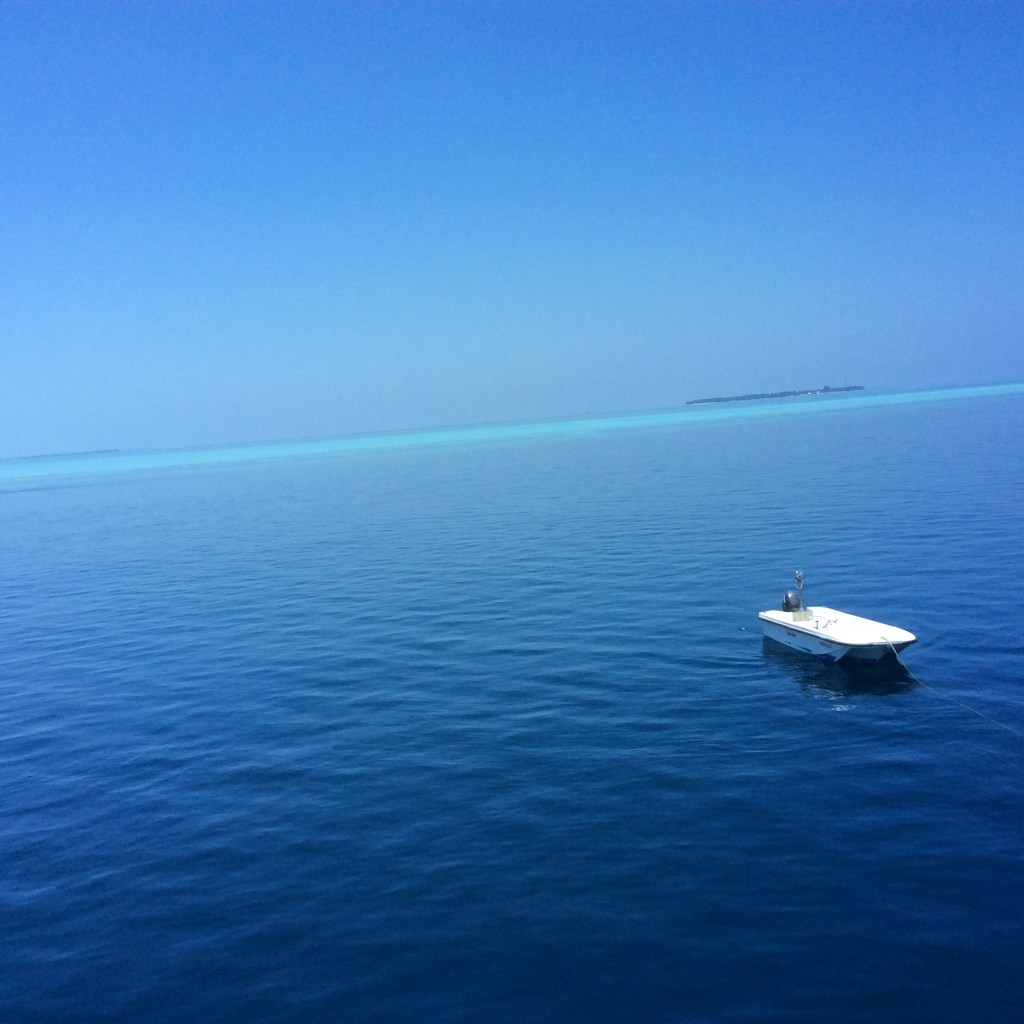
Perhaps I feel drawn to the poems in Hands of the Saddlemaker because inside the poems I hear a voice that tells me there are no easy answers. Several of the poems in the book deal with the hard work of reconciliation. We are all living in some form of exile and we must work out our own salvation. Having lived in other countries outside my own for 25 years, I feel an affinity for the voices of those living outside the boundaries of what might have once been home. I am from the borderlands. My parents moved to California from South Dakota and I was the first in my family to be born there. SanDiego County bordering Mexico was my childhood home. For me, everywhere and nowhere is home. I’m reminded of the old gospel song, “This World is Not My Home” (and here is a bluegrass version.) Though I live in one world, I am of another world too.

Woven through this volume of poems is the sense that the writing is born from a distinct, even painful awareness of the incompleteness of one’s own life, and the willingness to confront it honestly in order to cut through to the marrow of bone where the soul is laid bare and offered up on an altar like a prayer. I think of the Rembrandt painting I saw this summer in the Hermitage in St. Petersburg, Russia, of Abraham offering up Isaac and the angel holding back Abraham’s hand. The story and painting is a metaphor for what powerful art and writing is. It functions as a sacred offering. In the act of making and reading poetry and art we can be saved, so to speak, through the power of art and words to restore.

It was 3:00 am at the border as I reentered India last night, serendipitously, just like the line in Samaras’s poem, “Passport” where he says “It is always three am at the border.” I had my bag with my yearly supply of vitamins, my clothes, my journal. Men pushed a long line of luggage carts, some leaned against a wall, listless with the weight of waiting. My shoes are old and wearing through the bottoms, but again I begin. Beyond the airport doors waited the city’s broken walls, the millions who sleep on the street. Tired, without sleep, aware of the world I left behind, the world I was about to step into, I left the airport’s bright lights and glossy tiles and rode out into India. There are so many brave people living on India’s streets, each day not knowing where or how their food will come, how they will meet with illness or loss. Continuously, I am reminded here of the need to step beyond my own lack of faith, to be brave–to better understand the need around me and to listen for the voices that help me understand and how to serve out of my own depths the world around me.

The poems in the volume embody faith in periods of grief and loss, a willingness to bear that loss in order to find a way through it. I learn from the poetry in this book, and am changed. Samaras’s poems are more than descriptive words with an insightful message. They have soul. The poems in the book speak to each other in a way other poetry books I’ve read do not. The poems echo off and weave back into each other. They breathe together, become more than they were individually. These are poems whose words hold integrity, life and spirit. They help us find how to bear the hard things of this world. By example, they demonstrate poetry’s power to show us our humanity and bring us back to ourselves. Reading the poems in Nicholas Samaras’s Hands of the Saddlemaker calls me to live more deeply, to feel gratitude for the many small joys of our existence. There is a humility present in the spirit that comes through the writing at the same time that the writing demonstrates mastery and beauty. Such writing is rare, and to read it is a wonderful gift.

Uncategorized

Perseverance and Practice: Doing Art

“Art is a spiritual practice. We may not, and need not, do it perfectly. But we do need to do  it…Focused on our art, we connect to the artful heart of life. The creative pulse that moves through us moves through all of creation. It could be argued that creativity is a form of prayer, a form of thankfulness and recognition of all we have to be thankful for, walking in this world.” –Julia Cameron, Walking in this World

All morning I’ve been painting on a ceramic teapot that my husband made and called “The Mad Hatter’s Wife.” It’s a tall pot that narrows as it reaches the top. The lid is actually the head of the Mad Hatter’s wife. My husband gave her to me to paint, and in coming up with an idea of what she looked like, I figured that if she is married to the Mad Hatter, I had to make her be a woman who has a good deal of inner power. This would be necessary if living with a crazy man. Though hatters at the time Lewis Carroll was writing went mad as a result of repeated exposure to mercury vapors in the felting process, like also attracts like, and my hunch is that the Mad Hattter’s wife was probably a bit “mad” as well.

IMG_5333
Mad Hatter’s Wife tea pot lid (work in progress)

Married to a “mad” man, she’s likely a bit more individualistic and unique than others around her, and a bit more socially unacceptable as a result. She would’ve had to listen to her own inner voice and follow her own path. Thomas Moore said, “It is only through mystery and madness that the soul is revealed.” The underglaze painting for the Mad Hatter’s Wife needed to reveal the soul of woman connected to her inner power and creativity, I decided. Perhaps she’s named Breena or Brucie, Alva, Erline, Orla, or Tiana– a name having to do with elves or fairies. She’s got to be a bit sassy, too, I’m guessing, as her hand is placed on her hip, and her hip explodes in a sunflower. A woman who has never lost her inner child, I’ve made her body a bit ocean, tree, river, bee, bird, mountain and rainbow. Hers is the kind of madness that keeps one sane. She wears crystals on her arm, and my guess is that she probably can fly (at least in her dreams.)

Mad Hatter's Wife teapot in progress
Mad Hatter’s Wife teapot in progress
Mad Hatter's Wife teapot in progress view 2
Mad Hatter’s Wife teapot in progress view 2

My husband, Michael, gave me the teapot to work on last week, suggesting in a off hand comment to someone that I was going to make it my masterpiece. After hearing that, I realized I needed to paint her in the way that pushed the craftsmanship boundaries beyond what I’ve previously done. (You can see my previous work by going to the Art and Poetry Connections page here on my blog.) Though I want to make her wonderful, the work isn’t turning out as wonderful as I’d like. I want my craftsmanship to be better, but I’m still learning how to control my brush and the flow of the glaze. Different glazes have different textures, and they don’t all flow smoothly or the same. Drawing a perfectly straight line with the brush is difficult. I want the glaze to flow exactly where I want it, and that doesn’t always happen. The materials have their own way of being. I have to marry my effort to the nature of what I’m working with so that I communicate compatibly. Like any relationship, the understanding of how to make the connection look effortless and take on the magic expression of soul takes time.

The element of time and perseverance is something I’ve been thinking about repeatedly this past couple of weeks. It is nearing the end of the school year here, and as often happens when things come to an end, some things unravel while others fall apart so that something new can come into existence. Sometimes reality seems like a series of dreams. You live in one world for a time, and then that phase comes to an end. The location you’ve made your home is no longer yours, and you move somewhere else, take on a new job, or whatever: reality shifts. The whole world changes, almost as if you’re reincarnated. There are so many possible worlds! Even for those of who stay in the same place decade after decade, things still change. All around us the world is changing. What I’ve really been wondering about, though, are the people who have lived in countries where there has been a civil war, or an event like the earthquake in Nepal, where suddenly everything they thought they understood about their world and the foundations they stood on has changed. It takes decades to recover. How do they cope with it? How does anyone keep going in such situations?

Light is such a wonderful thing. I love a room full of light, sun streaming through the trees on a cloudless summer day. When I lived in Riyadh, though, I treasured clouds, and with it, the rain and the darkness–storms, because these were rare. I remember sitting on the edge of the escarpment outside the city and hearing the camels far below calling. If you have the opportunity to watch camels walk, you can notice how graceful they are. The heat can be relentless, the light unbearable, but camels somehow continue on. It made me think about the dark areas in our lives, the shadow places on earth that lie beneath the surface, or that track by in shifting movement–the things, people and places that do not or cannot speak directly. These things speak in language without words, giving voice to the things that can’t be said. Here is the poem I wrote about this when living there:

PERSEVERANCE
Anna Citrino

Black camels lift their calligraphic legs writing invisible letters
across the desert sand, as if drawing up the shadowed calm
hidden inside the light imprinted on the desert floor.

The camels raise their dark, slender limbs and casually wander
through the heated brightness, wooly heads held up
with muscled grace, an act of ease

with no thought of pain or fire. They know how to store water
to carry them through dry and cloudless seasons.
I have heard them groan, the guttural sound

reverberating from deep in the belly like the rumble
miles down inside the earth before the shudder
of tectonic plates. Their voices pull up

the yearnings of hidden worlds, let go the grief
from inside the nameless forms that cannot speak or see.
The camels are the shadows we seek.

Watch them from high up on a cliff, the trails they etch
into blind and heavy earth, letters of unsaid
stories the sun refuses to speak.

________

The writer, Edna Ferber said, “Perhaps too much of everything is as bad as too little.” Camels’ embody perseverance–this nameless longing we have, the suffering of waiting as we trek across deserts, but how do we keep going like they do through the times of heat and emptiness? Though camels can keep walking through the heat, before heading out into shade-barren land, they drink enough to help them hold out. This is something we, too, need to do. We need resources to keep us going. For me, one of the great resources to help me through times like these is art–art in the form of music, poetry, writing, painting, or dance.

IMG_5301
Flight of the Mind writing workshop. Lucille Clifton third from right. Anna next to Lucille Clifton on the right.

Back in the 1990’s I took a workshop with the poet, Lucille Clifton at the Flight of the Mind writer’s workshops (now no longer in existence) outside of Eugene, Oregon. At that workshop, I recall Clifton explaining how poetry humanizes us. “As long as one person is writing poetry,” she said, “the world will be a more human place.” Her words stuck with me, and have gained weight and significance over time. In the act of creating, we transform ourselves and our world. When creating, we are communing with our inner selves, but art, music, poetry, and dance are also communal acts in that they are meant to be shared with others, and in so doing, we reconnect ourselves to others and to our Source.

In Rattle’s interview with Maria Mazziotti Gillan, Gillan describes her journey as a writer to find her truth. “I think poems are in a very deep place inside yourself,” she explains. It took her time to realize who she was as a poet, and this is the risk she encourages others to take as well, to “move down into yourself, and tell the truth.” This confrontation with the truth of ourselves is what transforms us. When creating, we enter into a place of deep listening. We are making a poem, for example, but we are also listening for the words to rise up and connect us with our work. This is what prayer is too: listening. Communing. And art, whether it is writing, music, painting, photography, or dance is a vehicle for listening to our own truth. The deeper we can go into that place, the more we can be transformed. Fiction writer Frederich Busch explained “Good art is a form of prayer. It’s a way to say what is not sayable.” When I write, when I paint, I am connected body to soul, and it allows me to feel alive again, to feel whole. This is how we can all persevere: we go back to a place where we reconnect body and soul–to the creative act, the practice of art.

A couple of millennia ago, St. Paul wrote to the Romans, “For we know that the whole creation groans and suffers the pains of childbirth together until now. And not only this, but also we ourselves, having the first fruits of the Spirit, even we ourselves groan within ourselves, waiting eagerly for our adoption as sons, the redemption of our body.” Everyone suffers the pains of waiting, of trying to hold on and hold out–to persevere–even creation itself. It’s almost as if loss and suffering are necessary parts of beauty. We sense beauty more keenly when we are aware of loss. Yet, it’s out of this longing and suffering beauty arises.

In Arun Kolatkar’s poem, “An Old Woman” an old woman grabs hold of the speaker’s sleeve, an experience I’ve had myself here in Old Delhi. The woman follows the speaker, begging, and she won’t let go. The speaker wishes to be rid of her, but when the old woman says, “What else can an old woman do/ on hills as wretched as these?” something in the speaker shatters. Her question splits him open, and the world around him as well.

You look right at the sky.
Clear through the bullet holes
she has for her eyes.

And as you look on
the cracks that begin around her eyes
spread beyond her skin.

And the hills crack.
And the temples crack.
And the sky falls

with a plateglass clatter
around the shatterproof crone
who stands alone.

And you are reduced
to so much small change
in her hand.

Beneath our clumsy actions, our imperfect voices and art, somehow, sometimes, someone hears us. They see right into us, and inside that look we see the brokenness that interconnects us all. This is India’s gift to me–the myriad people on the streets like the beggar woman in this poem that mirror my own brokenness and need.

And so, we persevere. We live out Lorca’s “Theory and Play of the Duende,

“The roads where one searches for God are known, whether by the barbaric way of the hermit or the subtle one of the mystic: with a tower, like St. Teresa, or by the three paths of St. John of the Cross. And though we may have to cry out, in Isaiah’s voice: Truly you are a hidden God,’ finally, in the end, God sends his primal thorns of fire to those who seek Him.

Seeking the duende, there is neither map nor discipline. We only know it burns the blood like powdered glass, that it exhausts, rejects all the sweet geometry we understand.”

Art is not just for special people who call themselves artists. Though it is very personal, and an expression of the self, art is for everyone. It is meant to be given to the community. In the expression of our particular story, our dance, or song, we see that we have given expression to the larger community, and in that we find our place again in the human family. We are seen and heard, and through the container of that expression we find a way to endure the particular trials of our day or life–we find a way to continue on.
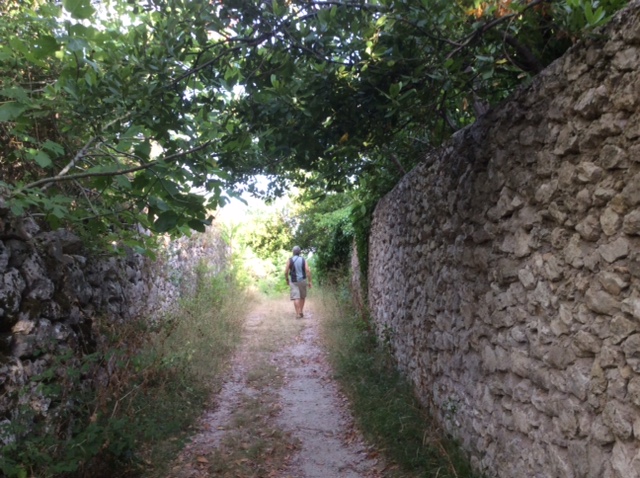
Art transforms us. So, though my lines on the Mad Hatter’s Wife teapot are crooked, my words not all I wish them to be, though my life continuously falls short, I keep practicing. In the end, the work is not only about the object created. The object is merely the container. The practice is the prayer. This is why we do as Kurt Vonnegut suggested, “To practice art, no matter how well or badly, is a way to make your soul grow. So do it.”