Uncategorized

Lifting the Voices of Women

Anna in the Red Sea

In Praise of Women Divers

This is for the woman who took her children 
to the Red Sea to paddle through water their father
had never touched, though he grew up beside it
every day looking into its face.

This is for the woman who became a divemaster
though told it was dangerous and she’d be seen
in a wetsuit, how she led other women underwater
though it was illegal, teaching them the ways of fish,
discovering together another world, finding 
every day is a good day to dive.

This is for the women who wore abayas
atop their wetsuits as if they were merely
onlookers while meeting the Coast Guard,
and the men on the boat the only divers.

This is for the friend who stood on the boat deck
wearing her snorkel and mask, black robe
flapping with wind, smilingly determined to explore
what lay beneath the sea’s sun-smoothed surface— 
all of us others planning to join her. 

This is for the women who broke the law 
by choosing to dive, who probed shipwrecks 
and gazed at their gaps, who entered through holes
blasted into steel holds—how vessels once so strong
no water could enter, are now broken open, sunken,
propellers forever halted, going nowhere.

This is in celebration of the women who saw wrecks
in water clear as windows, the happiness engendered when
something so big, so seemingly sturdy, in its destruction
became a place of beauty decorated with soft corals, animated
with angel and broom-tailed filefish sweeping through.

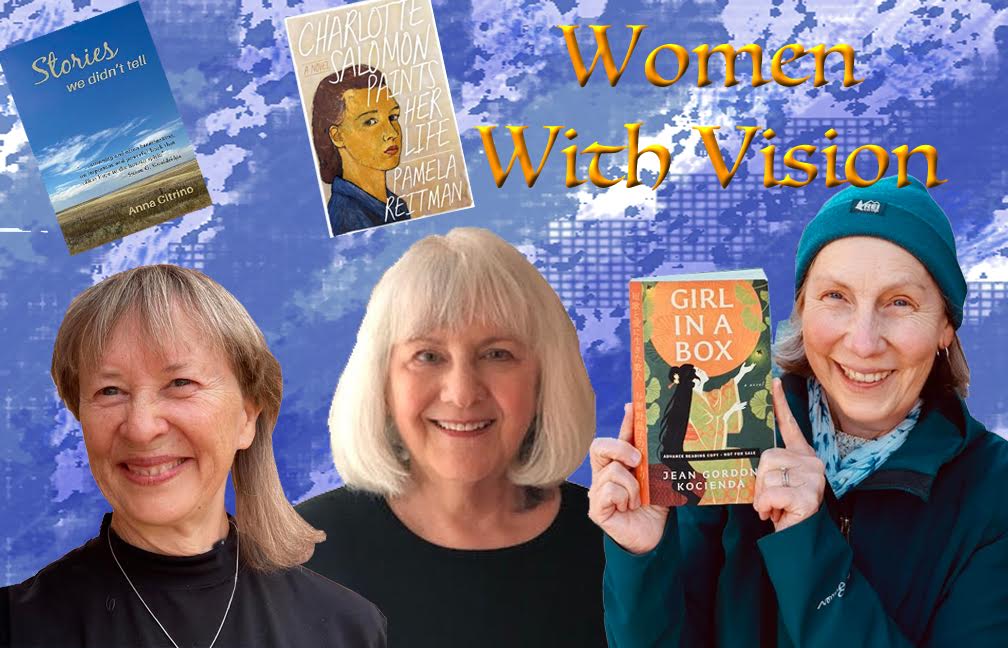
It’s Women’s History Month. I will be reading with authors, Jean Gordon Kocienda, and Pamela Reitman and Elaine Rock, lifting the voices of women from cultures across the world, celebrating them with readings of poetry, nonfiction, and story.

Come share a meal March 26 at 5:00 pm at the Aqus Cafe in Petaluma, Sonoma County, CA and listen to a few stories of some amazing women.

Seating is limited. RSVP is required: see: https://aqus.com/communitydinnerRSVP/

Hope to see you you there!

Uncategorized

Celebrating Women’s Voices

I hope you can join me to hear women’s stories through the voices of these writers in March. If you have a problem with the above link, try using this

And a poem from Stories We Didn’t Tell

MY MOTHER’S HANDS

Chugwater, Wyoming, 1923
Adella, age 66

Fingers curled, knuckles swollen with arthritis,
her head encircled by lamplight, I see my mother
bent over her hands, embroidering flowers
on tablecloths, then rubbing at the pain,
though there was little she had to relieve
the aching tenderness that came
from work she did all day
for years
as she milked and mended,
hauled water, and lugged hay.

Despite the hurt, she kept her hands moving,
shaping and reshaping her world, not deterred
by the pain, handing on what she could to me.

When young, I didn’t comprehend her aches—
how age alters a woman. Old now, I notice joints
that ache when moved, the hidden places
worn enough for tenderness to emerge.

When Jasper died, the life I lived died too.
Married now to Joel, a blacksmith, I’ve entered
a different world. Things break, and Joel
remakes and fixes them. Taking damaged saws
and wagon wheels, worn out horseshoes,
ruined tools, he heats the metal from dark carnelian
to opal white, and then strikes the steel over
and over, sparks flying as he reshapes
with his hammer. Form renewed,
he quenches it with water.
Restoration can be brutal.

I’m not a blacksmith but know something
about hammers. I’ve given birth nine times,
had two children and a husband die, known drought,
hunger and ongoing uncertainty—so many
unanticipated ways things wear down
before they fall apart.

It’s true, Joel drinks. Some may say that’s a fault,
but I’ve given him my hand in marriage, worn as it is.
He knows about broken things and tenderness.

Hearts and habits stiff as iron can be melted, renewed
when there’s someone who knows how to mend them.

Uncategorized

Stepping Into the Warmth of the Day’s Full Sun

“History is not to shame you. It’s not to guilt you. It’s a part of what makes us who we are. The good, the bad, the ugly. Our nation is like a family—we have stuff that nobody wants to talk about, nobody wants to deal with. But the problem is as long as we keep burying it or try to take it out of the public conversation and take it out of the public square, then we can never heal.”
—Dr. Wylin D. Wilson.

When I read Wilson’s above statement I couldn’t help but think about its connection to the stories my ancestors held but didn’t want to talk about either because it was too painful, they didn’t have the words to describe their experience, because there was no available container to safely hold such experiences, or a variety of other possible reasons. While I imagine what my ancestors may have wanted to say about their experiences in Stories We Didn’t Tell, I didn’t write the book without concern for how readers might receive the words. As Ursula K. LaGuin has stated, “Writers know words are their way towards truth and freedom, and so they use them with care, with thought, with fear, with delight. By using words well they strengthen their souls… And their words make the souls of their readers stronger, brighter, deeper.” Many of the stories in my new book are difficult ones. My hope is that through imagining ancestors’ voices, buried stories can be heard and a healing occur.

There are truths about life we wouldn’t know without the imagination ignited through books and through writing. Reading and writing are portals where we can enter into other worlds to commune with people and places we might not know otherwise, ways of thinking, being and living we’d find difficult to understand if we’d not taken that journey as a reader or writer.  Imaginatively stepping into the circumstances of my characters’ lives in my book and the historical circumstances they lived in allowed me to understand with greater depth the kinds of challenges my ancestors faced and especially how certain social structures functioned in oppressive ways for women in the past century. Walter Brueggemann writes, “You can’t make nice with injustice. This requires fierce, brave confrontation–which is difficult for those taught to be nice.” I was taught to be nice. But I want to live in ways that enable both myself and those I interact with to live into greater wholeness. I’m realizing that sometimes growing into greater wholeness means recognizing when it’s the right time to be brave, and when the situation requires me, to be fierce.

One of the reviewers for my book wrote that Stories We Didn’t Tell “is full of characters who are brave, resilient, and flawed.” I appreciate that comment because aren’t we all flawed? I hope for the book to honor both people’s struggles as well as strengthen readers who might identify with the challenges characters in the book face. In exploring the book’s themes, I’ve sensed my own need to be brave in facing up to some of the things I became aware of in my country’s history and in the past of those who came before me.

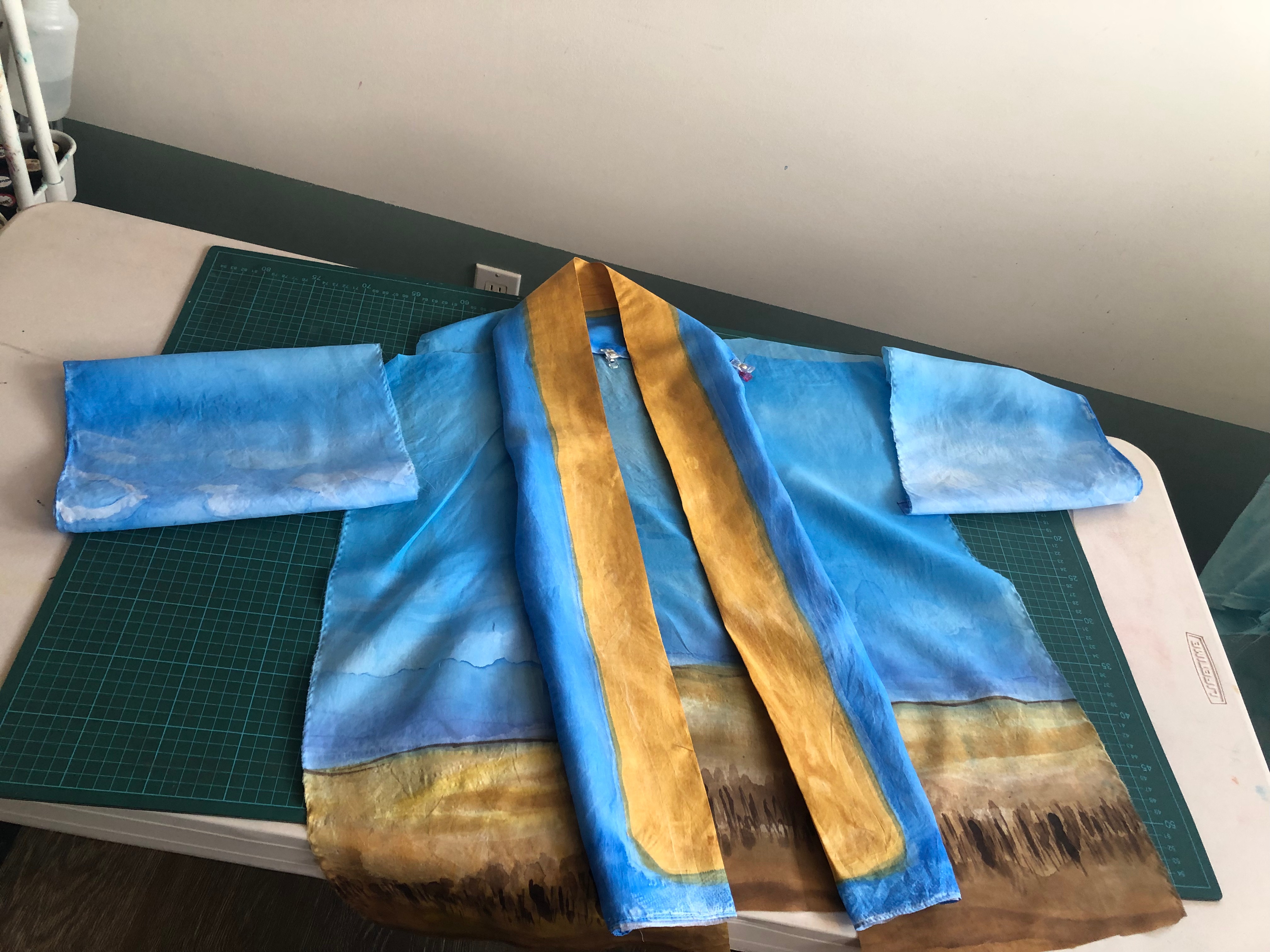
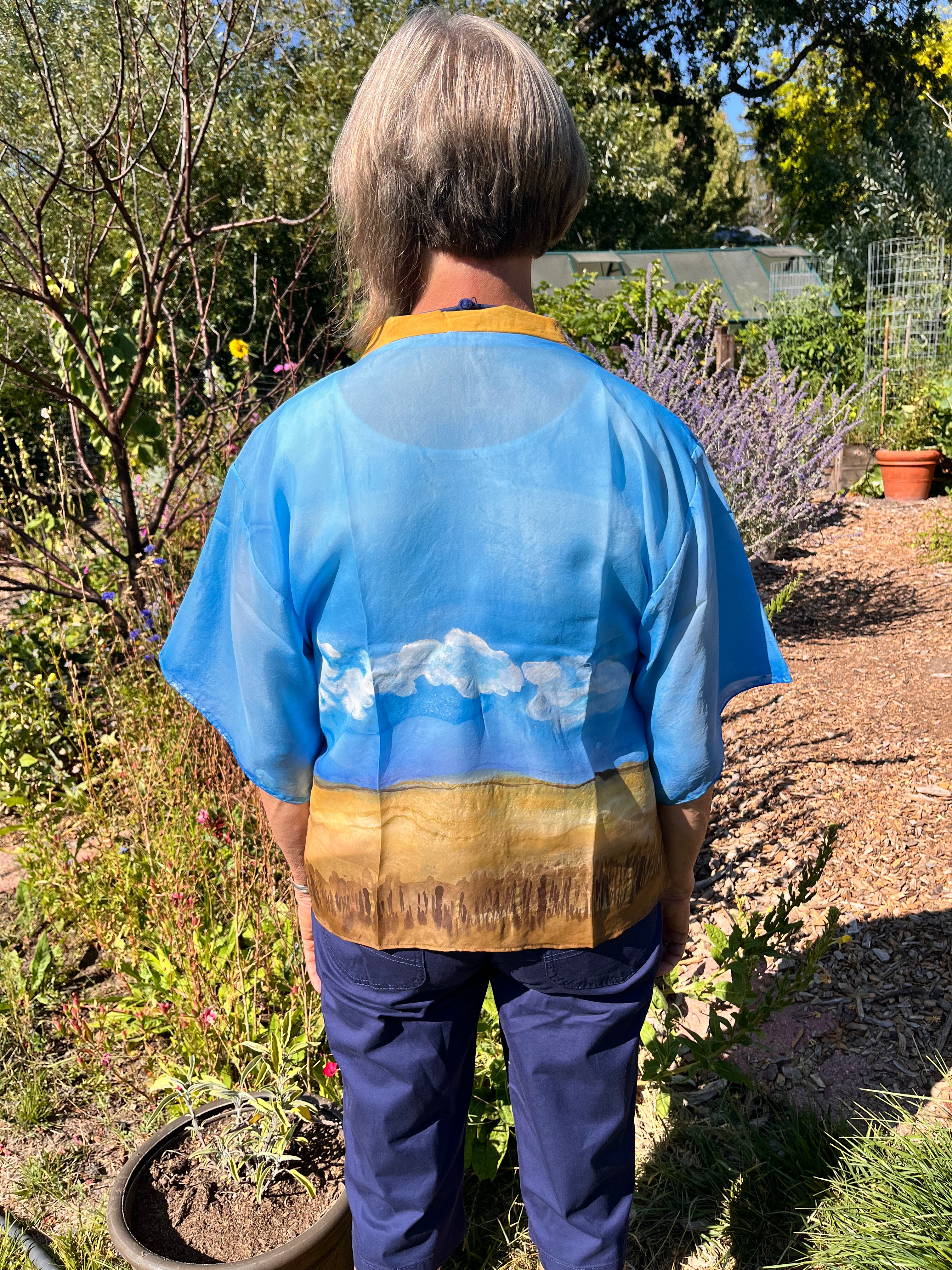
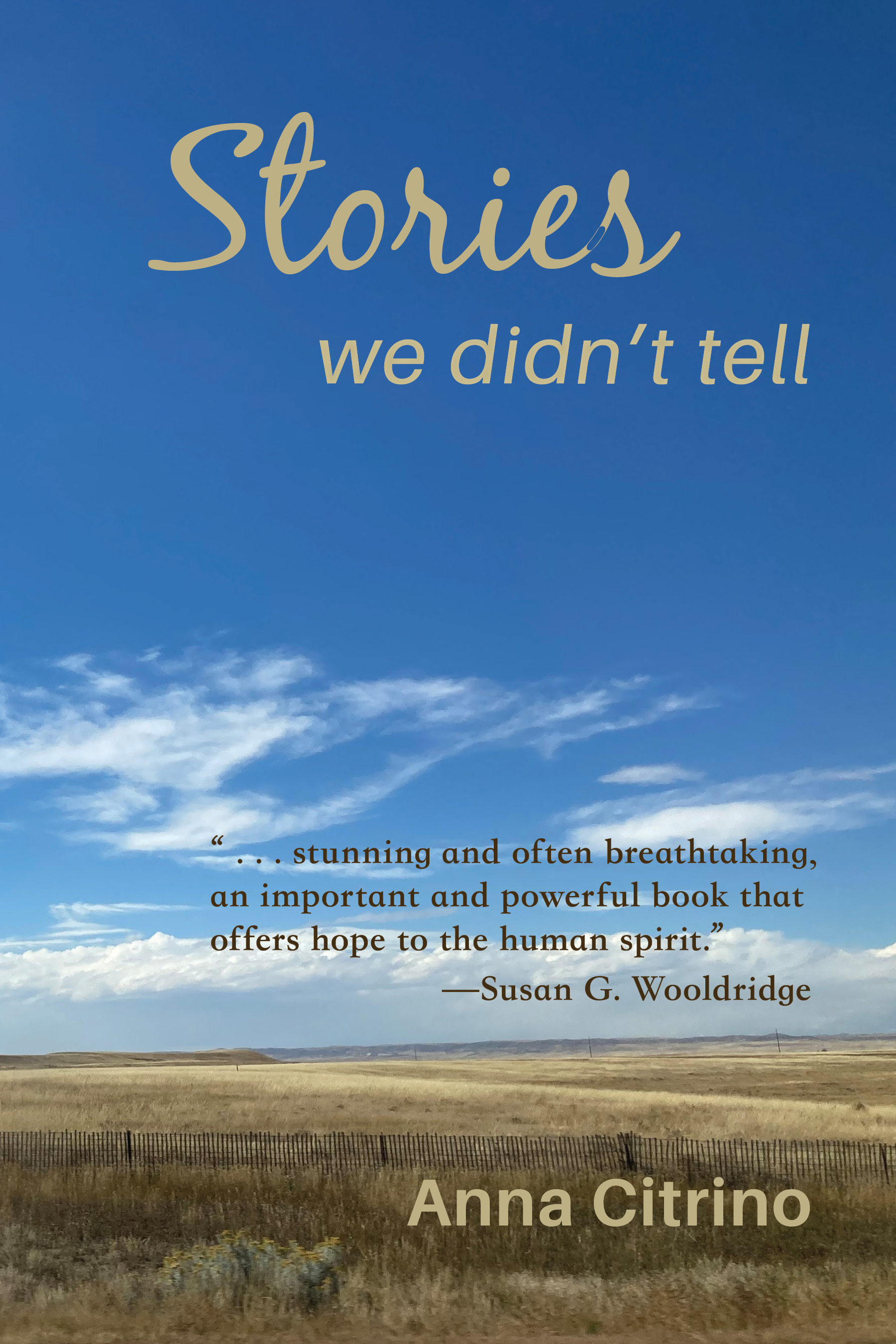
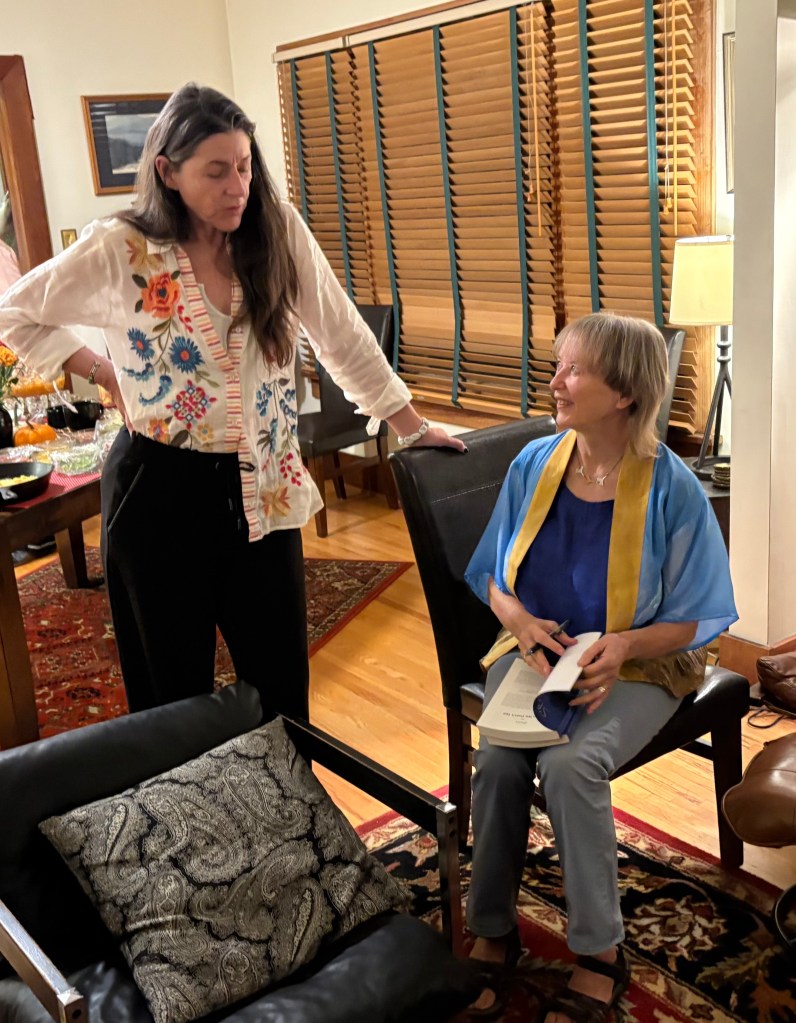
Writing a book requires serious and sustained effort. Birthing it into the world asks for an entirely different set of skills. Like my book’s character, Adah, who asked her sister to sew her a dress that ended up changing her life, I asked my friend Ann Pervinkler, of AnnsSilksofHawaii, if she would sew a kimono-type top for me and paint my book cover on it. Enfolded in an image of the book’s landscape, and enveloped in the silk of her friendship and care, I believed I could summon what I needed to introduce the book to audiences and give it the opportunity to speak.

“My art is a combo of skill, silk painting fun, and letting go. I’ve been sewing since childhood. Fiber arts since 1970,” Ann tells me. Below is her process for the kimono she made for me.

I’ve wanted to write the story contained in Stories We Didn’t Tell for decades. What an enormous gift of generosity it is to have a friend’s help in the effort to step more fully into my own becoming. Opening the package Ann sent the kimono in, I pulled away layer by layer the delicate tissue she’d wrapped it in, saw her husband’s colorful photo of a spring tree she’d enclosed with it, and lifted it’s cloud-like essence. What beauty her hands had made!

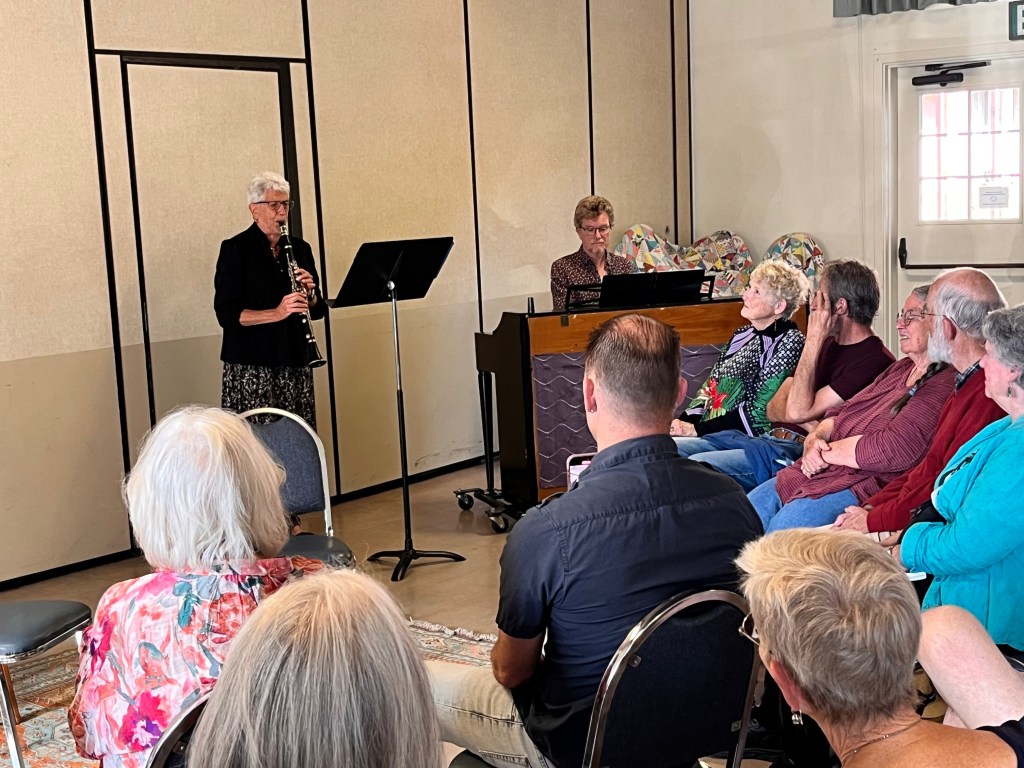
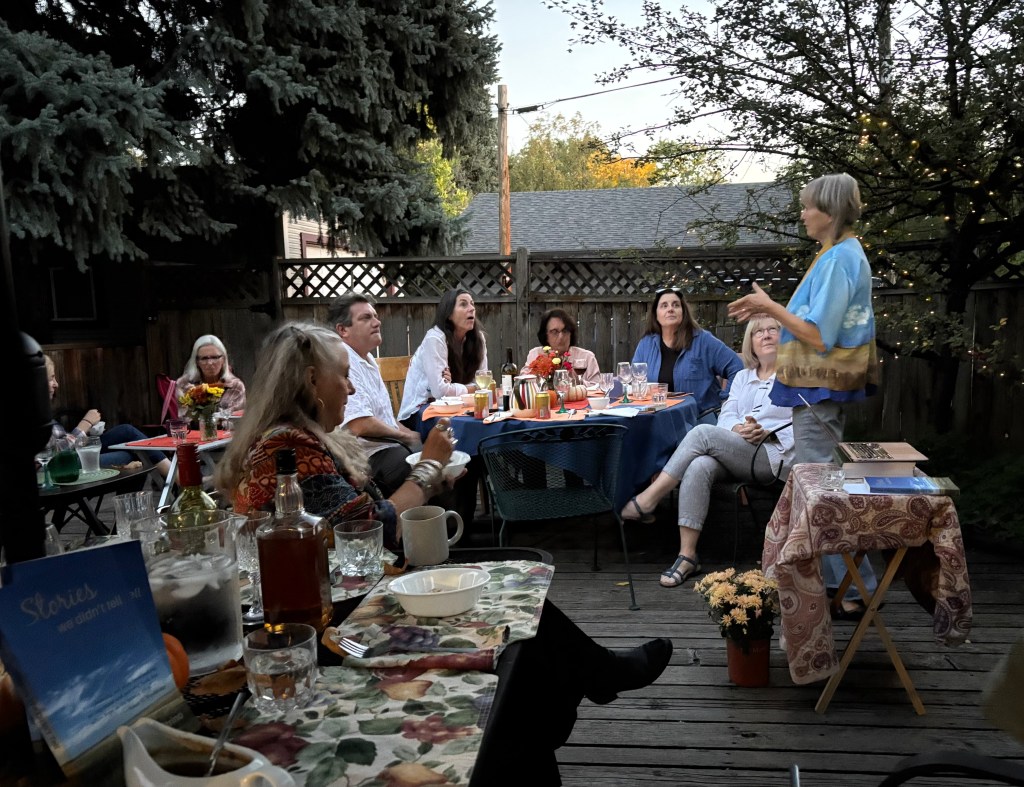
I wore the kimono for my book launch in Sebastopol, California, as well as to the reading I had a few days later in Fort Collins, Colorado, and felt wrapped in the support of not only of my friend Ann, but so many others on my writing journey. From my husband Michael’s many hours of listening to my poems in their draft form, to those who read portions of the manuscript, friends playing music at the book’s launch, and my friends the Fraziers generously opening their home and inviting friends over for a reading, my publisher’s belief in the manuscript at Shanti Arts Publishing in Brunswick, Maine, as well as my many teachers, publishers, fellow writers and readers over the years, and countless other people’s supportive efforts on my behalf, it’s very clear to me that though I might have my name on the cover, the book is but a thread in a long fabric of people’s nurturing effort and attention to my life that has allowed this book to become a reality. Ann’s generous gift to me of the kimono is a symbol of all those who have stood by me and affirmed me through the years in my effort to find a few well-considered words to say something that might add to the good of people’s lives. Thank you to all of you who take the time to read what I write.

We are meant to transform. Our flawed and incomplete selves can learn from those who bravely stepped toward creating a different future. Because we’ve lived through experiences of hurt, have known harm, been pushed aside, or discredited, because we know grief and loss, we can recognize in someone else the bravery it takes to step beyond boundaries we’ve been given or assigned ourselves to. This is what happens when my character Adah learns about the news in the town she came from in the following poem from Stories We Didn’t Tell.

LISTENING LONG AND FAR
Mesa, Arizona, 1957
Adah, age 68

I was doing laundry, scrubbing stains from
last night’s napkins when Litton came in with news
from Arkansas, “Governor Orval Faubus surrounded
Little Rock’s Central High School with the National Guard.”
Litton opened the paper and read, “Soldiers, armed
with rifles and carbines, turned back nine Negro students.”

I put down the napkins and took up the paper showing
Elizabeth Eckford in her crisp, clean clothes walking
away from the crowd that pushed her along, and the girl
behind her with the scrunched-up vinegar face,
bared teeth, and lips curled into a snarl.
That girl’s warped face pierced me.

I looked up from the paper to gaze through
the window remembering cactus’ sharp spines,
how I once accidentally backed into one
and it took a pair of pliers to remove its barb.

The steadfast set of Elizabeth’s face
is what sticks with me most, the small furrow
in her brow above her dark glasses, her head
tilted slightly down, watching where she’s going.

I don’t know Elizabeth’s story,
but recognize the look of a woman
silently holding herself together
beneath what can’t be said.

It’s not just today’s angry crowd that girl
suffers from. She’s moving into history’s
windstorm when trying to enter that school—
a cyclone, a hurricane, a blowing over
of the million little rocks men mortared together
and are used to standing on.

People can demand control, bring out their
armed guards, their tractors and chemicals,
make the world we live in a giant factory, can
process people through a convoluted system.
They can storm and shout, show up as vigilante
crowds with their curses, guns and rope.

But people like Elizabeth don’t do things solely
to keep their days happy. They do things
because beneath a desert’s angry heat
and the rigid rock weight of hard-hearted rules, life
begs to break through and rise from dry soil
with the surprise of color from land
believed to be barren.

How she’s able to walk through the crowd’s mass
of churning ire, I don’t know, except that her vision
must be as expansive as the sky, clear
as the water that streamed from the rock
Moses struck to slake the thirst
of multitudes.

I’ve traveled into the desert here
outside Mesa where I now live, sat
on a slab of sandstone and listened
long and far to the land’s
deep silence.

The sky’s expansive blue settles over me.
A wordless voice
drifts down
gentle 
as a feather—
says Earth
is borderless
belongs to itself.
Holds everyone.

I’m old, worn as a sandstone slab.
Don’t have Elizabeth’s courage
to walk through doors I’ve never entered,
but ache for the strength of a spring desert flower
to stand like Elizabeth, the open petals of her humanity
set on absorbing the warmth of the day’s full sun.

I hope you’ll read Stories We Didn’t Tell and that in its pages you’ll discover more of how you want to step into the day’s full sun of your own story.

Uncategorized

Among The Trees

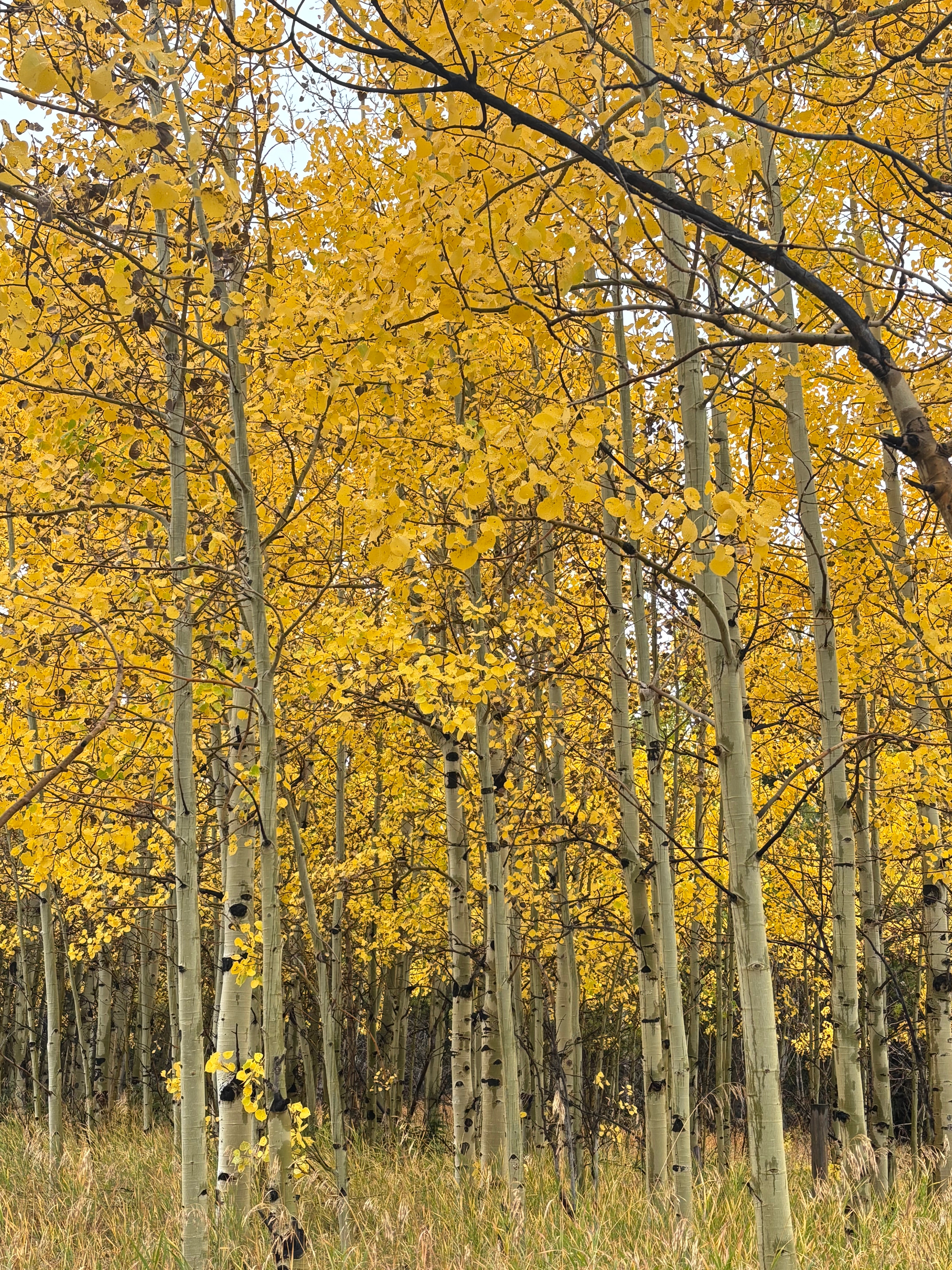
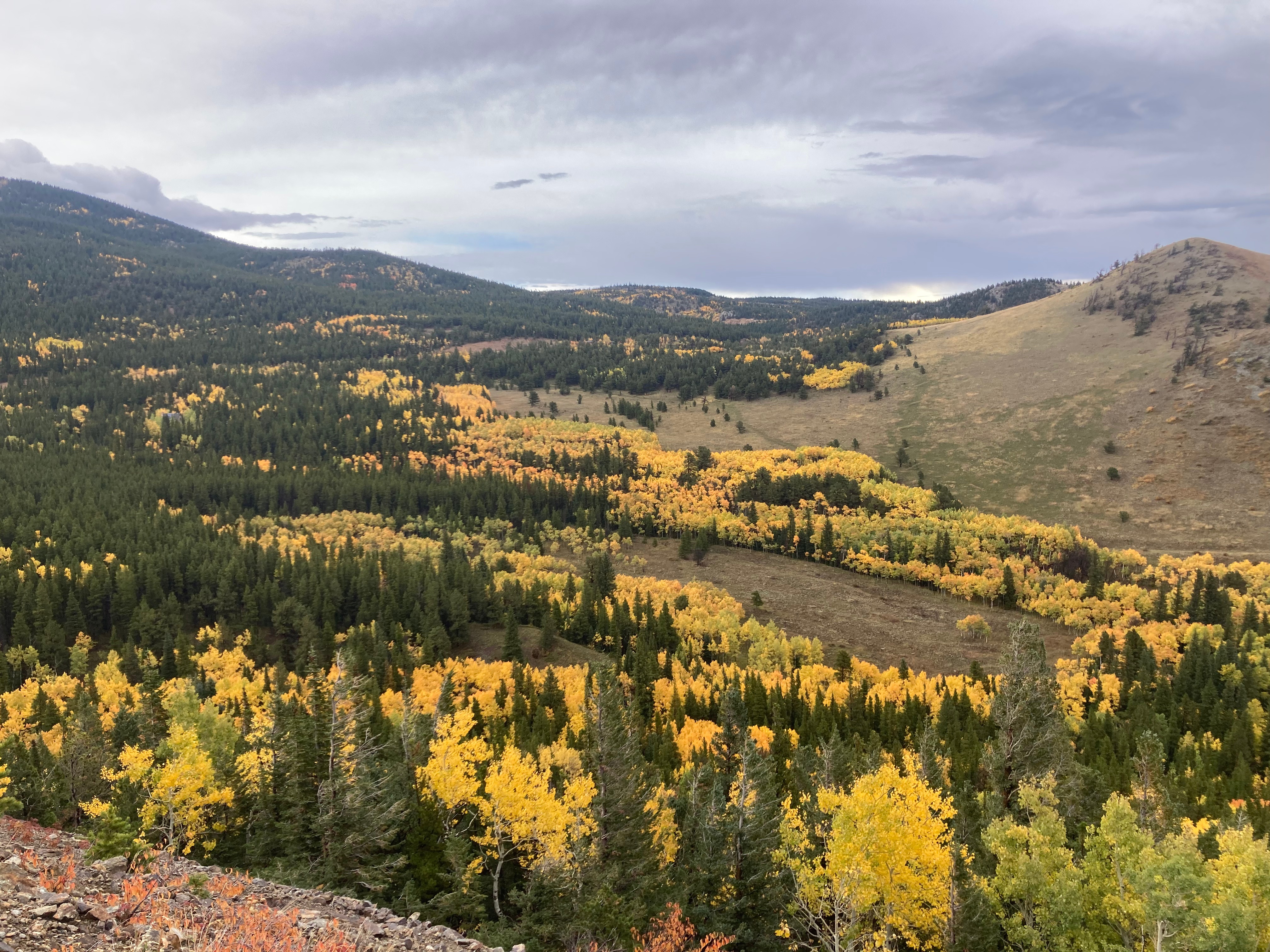
Recently, I visited Colorado where I gave a reading in friends’ backyard from my recently published book, Stories We Didn’t Tell. Leaving Denver’s airport, my friend drove me through the mountains where we viewed the aspen quilting the hillsides in gold between patches of green. Walking amongst the aspen, I felt I was wandering inside the glittering gold of a Klimt painting. Such astonishment of color! What life autumn brings. Clouds filled the sky as we drove and lighting let loose its ecstatic bolts of electricity, but the hills overflowed with vibrant yellow, leaves fluttering and swiveling in the brisk air. What a gift to be alive.

I’m grateful to live near trees. As I write, I look across an empty field. At the far end rests a line of redwoods. My great aunt, the central character in my new book, was raised on the prairies with its ocean of grass. Like her, I didn’t grow up with trees, but am grateful for their presence. Daily, they add beauty to my life. Landscapes shape our way of seeing the world. A walk in the woods can literally affect our sense of happiness, health, and wellbeing.

September 29 would have been my great aunt’s 135 birthday. Here’s a piece from Stories We Didn’t Tell in honor of her.

THE TREES
North Little Rock, Arkansas,
1946 Adah, age 57

A short time ago this town held four thousand
German prisoners of war. Things are calmer now,
thankfully, so this morning Litton and I
drove around Little Rock to explore Autumn.

Sweet gums at the capitol dressed themselves
in topaz and copper. Maples on riverbanks
huddled together beneath red and amber blankets.
Up north, oaks wore suits of rust.

The cold that brings these gifts of color is a sign
the trees soon will lose all they hold.
Seems I should feel sorrow standing beneath
their branches, knowing their loss grows daily,
but the War is over, and it’s my birthday.
Mostly, I feel embraced.

I’m a woman of the prairies and open skies.
When I speak, my accent tells the story:
I’m an outsider here.
Sugar maples, hickory, dogwood, and gum—
trees in general are foreign to me.
My history is from a different world, one made of grass.

Life here has comforts I enjoy.
Same as for others who live nearby,
Litton and I have electricity, indoor toilets,
heat, a toaster, refrigerator, and a radio.
Now and then, though, I take off my shoes,
walk barefoot to remember what it feels like.

Every place has something important it wants to tell us.
In spring, Little Rock’s magnolias lift
their flowers like cups to gather the afternoon’s
blue, and redbuds grow blossoms on their trunks.
In fall we ride roads curling through trees aflame
with brilliant color. Still, sometimes I wish
to hear the fields of prairie grass sigh
when the wind moves through.
I long for its voice
whispering in my ear.

Arkansas isn’t my forever home, but likely
I’ll miss people’s accents, sweet tea,
and the city’s abundant trees when I leave.

All of us in the family, including Mama, Father,
their parents and great grandparents too—everyone
left the land they were born on, and I have too.
Don’t know if I’ll ever return to Nebraska
or will want to.
For now, I carry my home with me,
choose the parts to keep.

Today I stood beside the river
in the afternoon’s gold light, opened
my arms to a maple’s leafy blaze,
and made my birthday wish:
to be like these trees—
the way they allow their beauty to burn
and burn and yet don’t die, even after
losing all that allowed them
to live into their fullness,
even as every colorful leaf
drifts down to earth.

May this autumn season bring you beauty, a deep sense of wellbeing, and an awareness life’s fullness meeting you as you savor color wherever you meet it.

Uncategorized

The Extraordinary Lives of Ordinary People

Stories shape our lives, yet sometimes people hold their stories inside and never tell them, perhaps because they are too painful, they fear might bring shame, or words simply can’t be found to tell them. Sometimes the dominant culture we live in doesn’t allow certain stories to be told or heard. When we hear them at last, those stories can be transformative.

Born in California, I had little contact with relatives living where my parents were born and raised on the Great Plains and in South Dakota. Curious about my origins, I wrote to relatives and traveled to interview them. Those interviews, together with further research of US history deepened my understanding of what it means to be a descendant of settlers, as well as the difficult social expectations and restrictions women of my ancestor’s era confronted as they worked to create lives they wanted to live. My new book, Stories We Didn’t Tell, released in September is the result of this research. Told in the voices of a family living on the Great Plains, Stories We Didn’t Tell begins when the US wars with Wyoming and Nebraska’s Native people have ended and concludes in the mid 1980s. 

Spanning an era of extraordinary change, people on the Great Plains played a significant role in creating the America we live in today. Told in interconnected narrative poems, Stories We Didn’t Tell explores stories that reside inside and beneath the surface of our country’s history. The book opens during a time when women were expected to be wives and mothers and where the working world held few options for women. Farm women were to be mothers and housewives, President Theodore Roosevelt told the public in 1907, “whose prime function it is to bear and rear a sufficient number of healthy children.” While not suffragettes or feminists, the book’s female characters are perseverant and resilient as they seek to create the lives they want within the constraints of the time they live in.

“A masterful book with sweeping scope and depth, Stories expresses the courage, daring and despair of Americans settling the west. The themes in this book are as relevant today as ever. I can’t imagine a more wide-ranging history of western expansion with its undercurrents and repercussions… Stories is an important and powerful book that offers hope to the human spirit.” —Susan G. Wooldridge, author of poemcrazy: freeing your life with words.

Join me to celebrate the publication of my new book, Stories We Didn’t Tell, Saturday 27 September, at 1000 Gravenstein Hwy N, Sebastopol, CA 95472 Fellowship Hall 3:30 to 5:30 for readings from the book, music, food, and book signing.

Living on what was previously called the Great American Desert, Adah’s family of homesteaders and ranchers seek to eke out a life on the Great Plains amidst the effects droughts, economic depression, two World Wars the mechanization of farming, and the forging of modern America. Confronting the many challenges, Adah, seeks to define a life for herself larger than the confining one she was born into.

Books will be available beginning September 2 on the Shanti Arts website as well as other common locations for finding books.

art, poetry, spirtuality, Uncategorized

Letting Go

Standing before the glass at the Monterey Bay Aquarium, I watched as sardines swirled in graceful, ribboned unison, turning then splitting into two shifting forms, as over and again a hammerhead shark pierced through their fluid movement. To observe life under the sea’s surface is to enter another world that is our own but utterly different, and is perhaps the most otherworldly experience one might have. While staring at the fish, on one hand, a person could say that nothing much is happening: over and over one large fish chases other smaller ones. But from another view, the most essential thing is happening: you are observing life in all its mystery and it leaves you standing in awe. For a few moments you’re unaware of anything but the fishes’ movement as they glide as if in dance through the liquid blue, and you step into some larger universe where time dissolves.

Inside the ocean, life teems in myriad forms, yet we’re barely conscious of its presence, as most of us rarely encounter what is happening beneath the ocean’s surface in our day to day lives.  I would never know about the hammerhead chasing the sardines unless I were to dive into their world or view them in an aquarium. Would we miss their dance if they were no longer with us? Recently, I received a letter from a friend who mentioned that if he never published another poem, the world wouldn’t miss his voice. Most of us at one point or another have probably felt similarly. We work hard at what we do, we aim to accomplish something significant, but still we wonder if our lives have meaning to others. Does a tree, a forest, painting, piece of music, national park or act of simple kindness matter? Why should we learn to cook, build a house, grow a garden, write a story or read one? The universe is enormous and full of fecundity. What does it matter that we create or that we protect the natural world, make space for beauty or nurture others’ creative effort? Would the world miss Dostoevsky, Edna St. Vincent Millay, Martha Graham or Aretha Franklin if they had never produced their work?

Maybe we can’t miss what we’ve never known or experienced. We tend to take in the world we’re given, absorbing it like food, and whatever we’re given becomes part of our being. We can go through our days somewhat routinely, not necessarily sensing a need for reflection. At the same time, however, something in us hungers to be in relationship to something larger than ourselves. We wouldn’t know what we had missed if the artists who produced their creative work never did so, but our world is certainly fuller, our inner lives richer because of them. To reduce or obliterate voices both nonhuman and human— the forests, animals, music, art, stories or other creative work is to diminish existence, reduce wonder, and to take away our souls.

Though the hammerhead chasing the sardines in the aquarium was beautiful to watch, what I was watching may have also been one animal seeking to make dinner out of another. Death and life are interconnected. To be born is to also to learn you will die. Simply to eat, whether animal or vegetable, something else gives its life in order to sustain our own. All of life is transition. Day follows night follows day. Always, we’re leaving behind one state to enter another. To love someone is to know you will also someday lose the one you love. We leave our parents’ home to enter a larger world. We enter a relationship of love, letting go of something of ourselves in order to expand our lives. Perhaps we move to a new location or a new country. In doing so, we gain a new understanding of the complex diversity and multiple realities coexisting in the world. As we age we lose things—our hair, our vision, our strength. With each transition we make in life we lose something. In turn, what we lose asks us to enlarge our internal selves. To love means to be in relationship, and relationship gives life meaning. The world we breathe and move in is alive and also fragile. Writers, and artists in general, invite us to take off our protective armor and become vulnerable again—to look deeply at our lives, to notice our relationship to the world around us, and to become more conscious of the reality that we stand in liminal space: aware both that we are alive, and understanding we will die. We’re living into as well as dying to each ongoing moment. To enter the world is to experience suffering as well as joy. The more we, like the ancient Biblical Job, can allow ourselves to stand in this awareness, the more we can move out of fear into a place of acceptance of all life brings us, even our own deaths–the biggest transition and opportunity of all to enlarge ourselves.

When we gaze at a school of fish whirling by or view minuscule jellyfish slowly drifting past an aquarium window, their transparent bodies radiating with moving iridescent light or when we lean our heads back to cast our vision into the midnight Milky Way, at stars so thick they have become mis, we catch our breath. Time stops and we stand in naked amazed awareness of creation. These moments may seem small, even insignificant within the press of responsibilities we often take on, but they are important. The accomplishments and creative energy of our lives, the things we hold dear—these reflect the impulse to live and thrive. They are the voice beneath our actions and inside our silences that say, “You are alive, and to be alive is a wonder.” Creative work, our own or appreciation of others’, allows us to touch life, feel its pulse. Our creative efforts may seem small even insignificant, but they are vital. They are efforts that whisper to us why we live. Life dwells in these moments and in the details that bring us into a world larger than our selves—into the mystery of our own being.

How beautifully Mary Oliver speaks of this in her poem, “In Blackwater Woods,”

Look, the trees
are turning
their own bodies
into pillars

of light,
are giving off the rich
fragrance of cinnamon
and fulfillment,

the long tapers
of cattails
are bursting and floating away over
the blue shoulders

of the ponds,
and every pond,
no matter what its
name is, is

nameless now.
Every year
everything
I have ever learned

in my lifetime
leads back to this: the fires
and the black river of loss
whose other side

is salvation,
whose meaning
none of us will ever know.
To live in this world

you must be able
to do three things:
to love what is mortal;
to hold it

against your bones knowing
your own life depends on it;
and, when the time comes to let it go,
to let it go.

“In Blackwater Woods” by Mary Oliver, from American Primitive. © Back Bay Books, 1983.

Deciduous trees burn with luminescent light during autumn as they move toward winter’s dormant stage. Here in Oliver’s poem, the trees in the woods are more than trees; they are lit candles. Similarly, Oliver implies, if we open the eyes of our souls, we can experience the world move from a space where we know the names of things and can categorize them back into a space of the nameless, allowing us to once more delight in their mystery. There are things worth understanding about life’s connection to loss, explains Oliver. Loss teaches us to hold ourselves open to our mortality. Hold the world dear, “against your bones knowing/ your own life depends on it;” Oliver writes, but at the same time our task is to learn to also let go of what we most love. This can be painful and very difficult, but in it, Oliver states, is fulfillment. In losing our life, we find it–ancient wisdom we learn and relearn. In letting go, we can become like autumn trees–lit candles, our lives rich incense others inhale.

Italian-American, poetry, Uncategorized, writing

Worlds Inside of Words

“Quite a few years of life have strengthened my conviction that each and everyone’s existence is deeply tied to that of others: life is not time merely passing by, life is about interactions.” ~Pope Francis

20161224_092752
Market in Catania, Sicily

I’ve been working on writing and revising a manuscript I’ve titled A Space Between, a series of linked narrative poems about southern Italians immigrating to San Francisco at the turn of the previous century. I started this series of poems about four years ago, set them aside for a few years, and have recently returned to them. The writing began as a result of listening to Gabriel Faure’s Apres un Reve (“After a Dream”), sent to me by a colleague I worked with in New Delhi, India who played the cello beautifully. Because I like to write poems in response to music, I suggested he play a piece of music on the cello and I would write a poem to go with it. As I listened to Faure’s piece, I pictured Naples’ wide harbor as I had seen it at sunset on a trip to southern Italy–the sky a brilliant, burning orange with a single boat sailing off into the far horizon. The music embodied feelings of deep tenderness and loss—how I imagine it  felt when my husband’s grandparents left Calabria to sail for America at the turn of the previous century. To lose the ones you love is to lose a world. How enormous the feeling must have been for immigrants as the boat they sailed on pulled away from shore and they realized they might never again walk on the land that shaped them or see once more those they hold dear. This experience of departure is where my manuscript began.

The process of writing A Space Between has been simultaneously like looking through a telescope into a deep space of ever expanding worlds, as well as peering down into a microscope at the fascinating details inside one life, event or moment. After I’d written the first poem, I discovered I had many questions about the Italian immigrant experience, leading me to research for answers. A wide range of writers have helped me developed a sense of life in both Calabria, Italy, and San Francisco, California in the early decades of the last century. Bit by bit, the research expanded both my understanding and my questions, motivating me to write more poems. As I continued to research, read and write, I eventually realized that along with the immigrants who left their country and struggled toward making a life in a new place, I too was on a journey. Now, approximately ninety pages later, I’ve got a completed draft, though I realize there’s much more to understand. My questions and interest in immigrant stories continues.

A Space Between unfolds through a series of narrative poems told from different characters’ perspectives. In creating a world through story or poetry, as in a mosaic, writers, and readers, see how worlds are interconnected— the interior life of characters with the physical world and with the social setting. In creating a narrative, you create a world. Language is a central mode of finding and making meaning. I feel deeply grateful for how writing the story in poems has changed me, not only because of what I learned through what I read, but also for the way the act of writing brings me deeper into the heart of humanity and the worlds we share.

Stories occur in a setting that shapes the narrative. In addition to the physical geography of a location, place is also created by how we name the world we are a part of, and how we use language to talk and write about it. Place is an integration of experience, imagination, thinking, emotion, and the words we give our experience about a place. Employing your imagination to write a story or a narrative poem moves a writer beyond the facts into a felt experience. Through the process of writing, I see ever more clearly how intricately interrelated events and lives are–how worlds live inside of worlds, touching each other in deep and powerful ways, affecting all that comes after. That changes how you think, feel, and respond to the world around you.

We don’t have to be a writer, however, to sense the power of our words. We might begin simply by telling our memories to a friend or child. It’s good to tell our stories as well as to say yes to listening to others’ stories in order to enter into their worlds. I knew little about the Italian American experience of those who came to San Francisco before I began the journey of trying to their stories in poems. Their history wasn’t taught at schools I attended as a child or found in textbooks; neither was it a shared family story. By trying to learn the stories of that era and finding the words that might bring them alive, whole new worlds have opened to me–including having a better understanding of what it might be like for those in our own era whose worlds have fallen apart causing them to leave their homes and all they’ve known to enter strange worlds with hopes for a better life.

In his poem, “Love is a Place,” E. E. Cummings explains this interconnectivity.

Love is a Place

love is a place
& through this place of
love move(with brightness of peace)
all places

yes is a world
& in this world of
yes live
(skillfully curled)
all worlds

Love is the ground we walk on, the atmosphere we breathe, the space we move in. Love is the place we all want to live in. We might read a lot about a subject, travel the world looking at facts and scenes from the windows of our own experience, curious about ways of being that puzzle us. When we enter the arms of one we know loves us, though, we intuitively feel we belong. To say yes to love is to say yes to a deeper place of knowing and belonging. As Pope Francis says, “life is about interactions.” To say yes to love is to recognize relationship is a life source. We sense we’re home. Humans are meant for relationship. Relationships with others, with ourselves, and with the natural world help us find our purpose and express what we find meaningful.

We have the ability to create worlds and places of love with our words. Words are a kind of magic, and are powerful in their ability to heal or to harm. Writers think carefully about what words make the world they want their readers to experience. Similarly, in making a place of love in our lives, we want to be aware of choosing words that evoke the world we want to live in with those around us. The recently reported news story of how two Lebanese twin brothers, Mohamed and Omar Kabbani, created a project called “Operation Salam” is an illustration of this idea of the power of words. Selecting a neighborhood in Tripoli, Lebanon, a previous war zone during Lebanon’s civil war between 1975 and 1990, the brothers painted rooftops a bright lime green so that from above, the word salam, or peace, could be read. The project brought the neighborhood together, as approximately 50 people worked to find places in the neighborhood where the brothers could carry out their painting project. “…The people from both sides want to live peacefully,” explained Mohamed. This single word, salam, literally proclaims from the rooftops this Lebanese neighborhood’s desire for peace. Interestingly, by saying “yes” to their roofs being painted, a larger world of “yes” took place—a kind of healing and making of a world they want to live in. Through the physical embodiment of the word as well as neighbors cooperating with each other where previously sectarian violence had occurred, the artists, with this single word, moved people once enemies further toward living peacefully.

To write about something is to enter a door inviting us into a deeper relationship with our subject and the possibility of falling in love with it. When we are in relationship with someone or something, we are listening for what the other is communicating so we can respond. Several times now, I’ve thought I was finished the manuscript of poems about Calabrian immigrants to San Francisco, but then I learn something more about the immigrant experience or Italians in America, and I want to reconsider what I previously said or thought. Keep listening, the story seems to tell me; there’s more to understand. Around us everywhere are worlds that beckon for us to listen. Inside of words, entire worlds exist. Stories, even a single word we share with another, can open a space for understanding and connection, and writing is a way to enter into a place of love.


art, poetry, Uncategorized, writing

Practicing Presence

“Listen to your life. See it for the fathomless mystery it is. In the boredom and pain of it, no less than in the excitement and gladness: touch, taste, smell your way to the holy and hidden heart of it, because in the last analysis all moments are key moments, and life itself is grace.”Frederick Buechner 

In the work I did for three decades, I lived with strict schedules. Nearly every minute counted, and clear goals for each hour, even portions of the hour, seemed necessary. This year I’m choosing to live differently. Thoreau went to the woods to live simply and deliberately. I’m beginning a new life in California as of this summer, and in my experiment in living, I want to focus on living with presence. I have goals–to learn to draw, play the clarinet, learn Spanish, to write poetry, among other goals. More than achieving all my goals, though, I want to open to a place of being. I want to listen to the land I live on, inhabit it physically and mentally–to take in the subtle changes as the seasons shift–the light, the color, the sounds, nurturing the awareness of its presence. I want to every day consciously notice life for the miracle it is.

As I walk across the land where I live, I notice many things that need tending to–the poison oak that’s growing up on the path, the oak trees that need trimming, how last year’s rainstorms have washed away soil on the bank. After being gone for some time, as I have been, there are numerous things I need and want to do. Perhaps these things don’t matter much in the big picture of the universe. Keeping the poison oak at bay, for example, isn’t going to influence what happens in India, though it will make it easier for me to walk around. The bigger lesson in caring for the trees, pulling out weeds, watering, and the various other things people do to their living space when living in a rural area, is understanding how living on the land involves an interconnection and a relationship. As I give to the land and care for it, it cares for me. If I avoid behaviors that cause erosion, for example, it benefits me and benefits the earth I live on as well. Tree roots don’t get undermined causing the tree to fall over. I used to not want to cut the herbs growing in front of my house, better to let them continue on their natural life, I thought. Over time, though, I’ve learned, that most herbs actually like to be cut back. They grow better as a result. The plants have taught me things about themselves.

Learning what the land you live on wants, what it needs, and how to give it that care takes time. Currently, I’m reading about what grows best in specific areas, what gophers and deer don’t like to eat. I’m also learning by getting out and walking around each day to see how things are doing. Doing the walk is a kind of observation ritual so I can better understand the organic processes of the land and my life in connection to it. Though it may be someone’s job to care for the community’s garden or shared landscape, living in an urban landscape requires similar attention. As in human relationships, the land we live on and use needs us to understand the effect our behavior has on it, if we are to live in good relationship with it, if we want a meaningful relationship.

Similar to learning how to have a relationship with the land I live on, learning to draw or to write require an attending to an inner awareness of what is trying to come forth. When drawing, as well as when writing, you heighten your attention to details, as the details develop the picture of what you’re focusing on. They enable you to see more fully–not just the object, but its presence and the meaning of its presence. This requires time to not be measured in minutes or in reaching a predetermined goal. Instead, we allow ourselves depth. We explore our connection to time–allow ourselves to move without measurement. Instead of skimming across the surface, we fully inhabit our actions, our thinking, our being. The German poet, Rilke, wrote about the artist’s connection to the creative act in Letters to a Young Poet  “In this there is no measuring with time, a year doesn’t matter, and ten years are nothing. Being an artist means: not numbering and counting, but ripening like a tree, which doesn’t force its sap, and stands confidently in the storms of spring, not afraid that afterward summer may not come. It does come. But it comes only to those who are patient, who are there as if eternity lay before them, so unconcernedly silent and vast. I learn it every day of my life, learn it with pain I am grateful for: patience is everything!” It takes time to know who you are as an artist. You have to listen to your life, to what it’s trying to tell you. The message is usually subtle and complex, and takes practice. You don’t have to be a visual artist or writer to be creative. Living is itself a creative act. We have visions of what we want to create in ourselves, and we can be patient with ourselves in the act of making our life something meaningful and with beautiful character.

Observing the world enhances our ability to listen to life and to experience it more fully. This past May, while hiking around in the UK’s Lake District, I looked up from the river’s edge where I was standing to see a leaf backlit by the sun. Its vibrant color and intricate texture stunned me. All the leaf’s veins stood out as if I was looking under a microscope. If color could shout, this leaf would certainly have been deafening. The more I keep my eyes open, the more I notice the infinite variety of colors, textures and shapes. The world comes alive, and I feel more alive as a result.

Often, I photograph textural details in the world around me. I carry my camera and my journal with me most places. I never know what amazing thing I might see. Holding a camera or a pen are but ways of paying attention, of nurturing a relationship to yourself and to the world. I don’t know what the various images of texture I’m collecting will add up to, the thoughts that will surface as a result. They may be nothing significant in themselves. The photo itself is not the goal. They are but a way of seeing, a pathway. As Shelley Berc, co-director of the Creativity Workshop in her article “How Fear Chokes Creativity and What to Do About It” writes, “We find wonder and beauty, new ideas and images everywhere when we allow our senses to experience each moment fully. When we shut down our perceptiveness and our sensitivity and only look to the finish line, our creativity has no access to the very elements that make it enriching and deep.” When I open the door to my house in the evening to sit on the steps, crickets croon and wind rustles the trees. Leaves fall like rain. There is an energy astir. The earth is full of wonder and alive with a kind of music in the interplay of all that is. We are more than our occupations, lists of accomplishments and goals, more than the muscle and bone of our bodies. Taking the photos or writing in a journal are mainly ways to enter a door into another way of being–one that is more awake, aware.

In his Book of Hours, Love Poems to God, Rilke, writes, “If we surrendered/ to earth’s intelligence/ we could rise up rooted, like trees.” There is a wisdom in the earth that can only be understood as we allow ourselves to absorb its sounds, its rhythms and textures, colors, as we develop an intimacy with it, enter into companionship with it. Trees have roots but they also bend and move, provide a place for birds to roost, food, shade for other plants to grow and for humans to enjoy. They offer beauty. There is more to trees, and the natural world they are a part of than merely the things they provide, however. The earth isn’t just a backdrop to human existence. It is our foundation. Perhaps recording what I see is a way to develop a different kind intelligence–one of deeper roots to all that sustains not just myself, but all of us.

The wind has blown in gusts all day. The light is soft gold. When I stood beside the redwoods this afternoon, I heard them groan. Every world region has different textures that are its own. The natural world is alive with presence. Walking in a forest, desert, beach, grassland, mountain, city park, or simply looking up into the sky and noticing it, listening to it, and then drawing or writing, photographing, or simply talking about what you are aware of draws us into the mystery of existence. Certainly, that’s worth experiencing deeply.

poetry, spirtuality, Uncategorized

A Visit from the Dalai Lama and 10,000 Shades of Blue

More important than what was recorded, these evenings
deepened my life: they framed every event

or thought and placed it with care by the others.
As time went on, that scribbled wall—even if
it stayed blank—became where everything
recognized itself and passed into meaning.

–William Stafford, “Keeping a Journal”
image

“The next hot job in Silicon Valley is for poets,” says the Washington Post today, describing how the tech industry is working to improve the interactive quality of the voice and personalities behind the artificial intelligences we interact with on the Internet, like Apple’s Siri, Amazon’s Alexa, and Microsoft’s Cortana. To do this, software engineers are turning more and more to poets, fiction writers and comedians in a new wave of jobs in artificial intelligence. Additionally, an article in Motherboard, Robots are coming for our poems,”now two years old, examples are given of robots co-authoring Shakespearian sonnets and haikus. An android learns the algorithms of language you give it, makes predictions about what words will be chosen over others, and uses these to write a poem. I don’t know the definition of “co-authored” as it is used in the context of the robot working together with a human, or how many trials it took to get a poem that feels cohesive and reads like a poem, but I enjoyed the sonnet, as well as a haiku a robot created that are included in the article.

Sasha Chapin’s article, “When robots write poetry,” written this past February, also describes how the algorithms are used that enable robots to write poetry. More interesting, however, is Chapin’s statement at the end of the article, “The coming artificial beings may love good poetry for the same reason we do: how it can seem to bridge the boundaries between consciousnesses. But they will possess a consciousness we couldn’t possibly understand. And when they write poetry, it will not be for us.”

While I question whether robots have consciousness, as Chapin implies, there is a difference between a living, human mind raising questions and pondering life and poetry artificial intelligence produces using algorithms, rather than conscious reflection. The Atlantic reports that number of non-book readers has tripled since 1978. Currently, I’m preparing to present a week long workshop on poetry and poetry writing with middle schoolers at ACS Hillingdon International School, a school just outside of London. As I consider what those students’ interests and concerns might be, I’m turning over the question in my mind, why is it we write for purposes other than to carry out necessary tasks, and in particular, what value does writing poetry hold?

Though  it may be helpful to learn that the job market is currently opening up for poets and fiction writers in the tech industry, there are deeper reasons to write and to read poetry, and these have to do with the poetry’s potential to connect us to the physical world, notice its mystery, and value its presence. If you’ve not seen this short TED talk about the worldwide telescope, it’s worth viewing. What Google earth has done to map the world is now being pieced together for the universe, enabling you to map your own virtual tour of the universe with images currently available. When I watched the talk and viewed the images, I felt humbled by the wonder of all that is—the immensity of creation and the miracle that I’m alive on this planet, existing amidst it all. Writing poetry is the opportunity to reflect on that wonder. Perhaps it’s interesting that a robot can write poetry, but how much more amazing it is to experience the poetry writing process yourself—to try and put words to what it means to be alive in this moment. As Salman Rushdie describes, “A poet’s work is to name the unnameable, to point at frauds, to take sides, start arguments, shape the world, and stop it going to sleep.” That’s a challenging task, but certainly a valuable one.

Recently, the Dalai Lama visited the school where I work. During his talk to the student body, he repeatedly emphasized humanity’s interconnectedness with each other and with the natural world. A compassionate heart and a calm mind go together, he explained, and a disturbed mind affects the body. There’s hope for a more compassionate world if we make an attempt, he said. With anger, there is no hope, and he admonished us to make an effort.
With effort, this century can be a happy, a peaceful century, he explained. When there is too much stress, violence comes. Human rights violations are first emotional problems, he stated. Violence comes as a consequence of emotional problems. “We have to make an effort to promote more warm heartedness so there will be no opportunity to kill or bully, because we take care. No one can survive without community,” he said. Selfishness destroys your own happiness. “Society is the basis of our happy life, so we have to take care of society. West needs East. Southern and Northern worlds need each other—not this notion or that,” he said. Around us we see so much fear and distrust, yet friendship is dependent on trust, and trust is dependent on compassion, he explained. Narrow mindedness and shortsightedness brings disaster.

In aiming to build a compassionate world, poetry is a valuable asset. Poetry nurtures our inner life and helps us to understand what it means to be human and to stand in relation to the world around us. Robots might be able to write, but we are human. We want to know what that means—what we can give to the world to meet its deep need, and thereby meet our own deep desire to feel we belong in this world by knowing what we can give to it. Writing poetry, in its aim to find the best words to describe experience, requires observation and awareness, as well as reflection. Because the problems we face both individually and collectively are complex, the practices of observation, awareness are especially needed. Deep reflection, allows us to work out our connections to each other and to the natural world, along with the disconnects we experience in trying to do so. Deep reflection is the territory poetry explores.

Before Old French gave the English language the word “orange,” English speakers referred to the color as yellow-red, ġeolurēad in Old English, according to, Matt Soniak, writer for Mental Floss. It’s not that orange didn’t exist before we had the word, but having the word created a clearer picture of the idea. Tech Insider the origins of another color, blue in this video, demonstrating that without a word for something we physically experience, such as the color blue, people have significant difficulty recognizing it. This phenomena emphasizes the benefit of both verbalizing what we are experiencing, as well as reflecting on those experiences in written words. Additionally, because languages have their own music and mirrors, reflecting the world in different ways, speaking and writing in more than one language expands the potential language has to enable us all to better understand ourselves and our interconnection to others and the world around us. If we are going to find how to live together peacefully, as the Dalai Lama suggested is both possible and important, we need tools to do so. Writing and poetry in specific, is a wonderful tool to use for this purpose. As T. S. Elliot said, “Poetry may make us from time to time a little more aware of the deeper, unnamed feelings which form the substratum of our being, to which we rarely penetrate; for our lives are mostly a constant evasion of ourselves.”

It’s possible that one could sit with pen in hand or type at the computer, and plod mindlessly through a series of steps or items and produce writing. I’ve read this kind of writing before. But if taken to heart, writing can be a tool that enables the mind to unwind its string of thoughts and make patterns that hold meaning and change our lives both individually and collectively. Poetry and literature is our attempt to explore the meaning of being human. As Barry Lopez, explains, “I believe in all human societies there is a desire to love and be loved, to experience the full fierceness of human emotion, and to make a measure of the sacred part of one’s life. Wherever I’ve traveled–Kenya, Chile, Australia, Japan–I’ve found the most dependable way to preserve these possibilities is to be reminded of them in stories. Stories do not give instruction, they do not explain how to love a companion or how to find God. They offer, instead, patterns of sound and association, of event and image. Suspended as listeners and readers in these patterns, we might reimagine our lives. It is through story that we embrace the great breadth of memory, that we can distinguish what is true, and that we may glimpse, at least occasionally, how to live without despair in the midst of the horror that dogs and unhinges us.” We need stories, and poetry. They are our thread through the labyrinth of existence.

While diving in the Maldives a few weeks back, the boat I was living on passed over and past 10,000 shades of blue—blues we have no word for. I found a wonderful color palate for different shades of blue, along with their names on Wikipedia, but though many colors are represented here, it falls far short of what the eye actual sees—the way the white-blue sky bends down into the sea and becomes the sea, for example, or the depth of blue reaching for infinity behind the shoals of yellow, white and black banner fish, along with all the subtle gradations between shades of turquoise as water shallows and then brushes against white sand shores. To try and name any of the experiences we have is to call them, again, into existence, and to share with others what moves us, and what is meaningful–this is what poets aim to do. It is the focus and goal of their efforts, even though what we hold most precious is often beyond naming. “The power of poetry,” says Michael Lewis, “is the ability to express the inexpressible, and to express it in terms of the unforgettable.”

If we are to build a compassionate world, we need to be able to recognize how to nurture our lives and wellbeing of the world around us. We need to be able to reflect on our lives. In his poem, “Keeping a Journal,” William Stafford, identifies the value of writing in his closing lines when he explains how through the process of writing he found his journal to be a place where “everything/recognized itself and passed into meaning.” To speak with an open heart in a journal or a poem takes courage, but in doing so, we can gain insight into ourselves and our relationship to the world, insight that can enable us to transform the way we live and interact. Writing poetry helps open our eyes and reach for meaning. As David Whyte says in his poem, “The Opening of Eyes”

That day I saw beneath dark clouds
the passing light over the water
and I heard the voice of the world speak out,
I knew then, as I had before
life is no passing memory of what has been
nor the remaining pages in a great book
waiting to be read.

It is the opening of eyes long closed.
It is the vision of far off things
seen for the silence they hold.
It is the heart after years
of secret conversing
speaking out loud in the clear air.

We write and our lives are deepened. This is what is important about poetry—it teaches us how we can live.

art, poetry, Uncategorized, writing

Looking Deeply: Art, Poetry, and Presence

Barry Lopez in his children’s book, Crow and Weasel, writes, “Remember on this one thing, said Badger. The stories people tell have a way of taking care of them. If stories come to you, care for them. And learn to give them away where they are needed. Sometimes a person needs a story more than food to stay alive. That is why we put these stories in each other’s memories. This is how people care for themselves.”

Stories connect us to the people who came before us, the narratives they live out and the tales they tell us about what the world is, and who we are in the world. We live by the stories that have shaped and taught us. They give meaning to our experience and direct us in our journey. Stories condense experience, give us the opportunity to examine our difficulties, and to reflect on how our struggles might enable us to grow.

The oldest form of story is poetry. Before poems were ever written, they were told. People’s histories were given in poetry–words constructed to call up experiences through sound and imagery that evoked emotion and helped people remember who they were, what they had done, and why it was important. In listening to poetry, we can step inside a reflection of life that holds up a mirror, and at the same time speaks to something beyond what is experienced. It is a way to reconnect to what it means to be human and to the mystery of existence. As Dana Gioia writes, “In a moment’s pause another world / reveals itself behind the ordinary.” By extension, because poetry was once connected to other art forms, stories, music, and dance, these are doors we can open to that allows us to walk into a larger reality, to see the world from a wider perspective.

image

The idea that the physical world intersects with the spiritual world is an ancient one, found in many traditions; the Celtic, Catholic, and Native American being a few examples of these. St. John Damascene, a Syrian monk who lived from c. 675 or 676 –to 749 CE, wrote a defense for the use of icons (see more here) that shaped the direction of the church. Though others at the time argued against the use of icons and representational art. God is bigger than any particular physical form, the thinking went, and therefore representation of God in icons should not be allowed. St. John of Damascene argued, however, that if God became human in the form of Christ, then two are intermingled. The sacred could be seen living and breathing through the human form, and therefore it was completely acceptable, he argued, to create icons, to worship through icons, and to paint the human form. In fact, art was a way for the illiterate to see God, Damascene explained, and to read the story of God’s compassion for and interest in humans through the paintings. Damascene demonstrated an acceptance of paradox, and the idea that one’s thinking doesn’t have to be contained in tight boxes of either or. William Dalrymple, in his book, From the Holy Mountain, quotes Damascene saying, “‘…the flower of painting makes me look, charms my eyes as does a flowering meadow and softly distils the glory of God in my soul.'” Through painting, as through nature, Damascene declares, God communicates his presence in the world, and art is a central way in which humans can experience and connect with the Divine.

imageThough Dalrymple describes the cave where St. John of Damascene wrote these thoughts in The Fount of Knowledge, as “crude and primitive,” he goes on to say that, “Without Damascene’s work, Byzantine ars sacra would never again have been permitted, Greek painters might never have been able to pass on their secrets to Giotto and the Siennese, and the course of the Renaissance, if it had happened at all, would have been very different.” I’m very grateful for Damascene’s words and thoughts regarding art. Without them, we’d likely be deprived of much beauty, and the spirit that speaks through that beauty.
In her poem, “Pray for Peace,” Ellen Bass speaks of this interconnection of the everyday world around us with the world of spirit.

Pull weeds for peace, turn over in your sleep for peace,
feed the birds, each shiny seed
that spills onto the earth, another second of peace.
Wash your dishes, call your mother, drink wine.

Shovel leaves or snow or trash from your sidewalk.
Make a path. Fold a photo of a dead child
around your VISA card. Scoop your holy water
from the gutter. Gnaw your crust.
Mumble along like a crazy person, stumbling
your prayer through the streets.

Though a way of communicating half forgotten these days, Bass helps the reader to see that prayer can be any act we do with full attention and heart. When we pay attention to our lives, doing what we love presence, that is prayer–a breathing, walking prayer that adds meaning to our lives, and enables us to grow toward wholeness. Making a routine out of things saves energy and time, but even routines can be done with attention and heart. How do we cultivate the kind of noticing awareness in our every day lives, the ways of being that enable the act of living to become prayer?

Involvement in a creative act is a central way to connect the physical world with the inner world. Though there are a variety of art forms that can enable a person to live in fuller awareness of a connection to life’s mystery, writing is an excellent path from which to begin this journey. Whenever I leave the house, I carry imagemy journal, a small book that easily fits inside a pocket. I carry it because at any time something might appear, or someone might say something that needs to be noticed, and I want to be ready. My journal is my fishing line, so to speak. Though I may miss many things swimming in the world around me, because I’m prepared with pen and paper to notice something, I am more likely to find and catch something than if I had no tool at all to help me. Whatever I’m working on as a writer, I look and listen for moments that speak to me while moving through the day—a random phrase, a gesture, a sudden familiar scent that might embody the idea I’m reaching for in a writing piece I’m working on. I remain attentive to sounds, textures, colors, actions—the world’s details that define a place or time. As a result of knowing the questions I’m living with and what I’m looking for, things tend to show up and announce their connection like a kind of internal spark. Suddenly, as if witnessing the embodiment of a metaphor, I see, for example, how something I’m looking at or hear is related to something seemingly completely different. The discovery has a wonderful quality to it, and to then write it out is to be able to embody that insight. Sharing it with others deepens a sense of connection to the world.

Writers aim to name the world, and doing so is to participate in a kind of co-creation of life, at least this is how I experience what happens while writing, and it is one of the motivating reasons to write. To write is to observe closely, and to observe closely moves me to an awareness that I am part of a greater something beyond myself–that I swim in the mystery of existence. Writing is a path that allows me to enter a space where I’m both fully present in my life, and somehow not present at the same time as I step inside the weave of words. This is because I’m living inside of the thing I’m writing about, and what I’m writing about is bigger than me. As poet Nicholas Samaras explained to me once, writers are always writing, even when not writing. I agree with Samaras when he says, on Poetry Net, “God is in the point of my pen.” In losing myself in the work I am doing, I’m made more alive, full, and solid. It’s a paradox.

image

Writing poetry can be a kind of prayer. My father wrote stories and poetry, but my mother taught me to pay attention to the world around me. She constantly noticed the natural world, flowers on the bank or scent of orange blossoms from the orchard, bees at the birdbath, a fox that came through the front yard, or hawks that circled above the hill behind us. The wind as it blew through the pines where she grew up in the Black Hills of South Dakota, was an ancient choir, she said. As she described the experience to me, I could hear the wind as if it were real. She recalled wild gooseberries’ tart flavor, and told me the names and shapes of wildflowers that grew on the land of her childhood home. Her descriptions lived in my mind as if they were real. Even though where I grew up in eastern San Diego county’s dry desert–very different from the Black Hills, I felt preciousness my mother’s memories of her childhood’s natural environment. Her respect for those experiences nurtured in me a love of my own childhood’s natural environment.

I played outside every day as a child, climbed around on granite boulders, or sat inside the branches of an avocado, umbrella or pepper tree. Our front door often stood open to the outside air. I ran through the yard barefoot, watched clouds parade by, and sunsets spill across the horizon. Coyotes’ yips echoed through the valley in the evening. Crickets sang. Stars came out. These were all gifts, and I belonged to that earth. The experience of growing up in such a place with the opportunity to experience the natural world as part of the rhythms of every day life created in me a foundation for wanting to remain connected to the earth. To have our feet on the earth, to literally ground our selves there, is life engendering. If deprived of such experiences, I think our bodies and spirits still long for them without possibly even knowing it.

image

Poetry relies on imagery and figures of speech. It integrates the physical world with the world of language. It tells abstract ideas by recreating the physical world. It reconnects the writer and the reader back to place, and this is a central reason why I find it so powerful. In our world, the culture of the workplace pushes us to compete, to gain power and control. When writing poetry, however, I interactively participate in reconnecting to the physical world and the presence residing beneath and inside the movement of life. I trace my origin of wanting to write back to these childhood experiences of connection to the earth’s vibrant, sustaining presence. Willa Cather writes in My Antonia, “I was something that lay under the sun and felt it, like the pumpkins, and I did not want to be anything more. I was entirely happy. Perhaps we feel like that when we die and become a part of something entire, whether it is sun and air, or goodness and knowledge. At any rate, that is happiness; to be dissolved into something complete and great. When it comes to one, it comes as naturally as sleep.” To be able to wander in time, to play in a landscape or place is to be transformed and enlarged by it. Writing poetry focuses the writer on presence, and in doing so, helps move the writer toward wholeness. I recommend it.

image